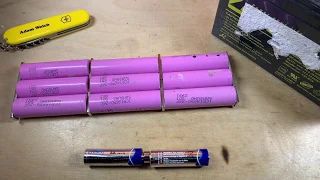
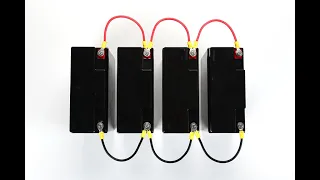
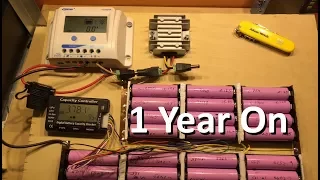
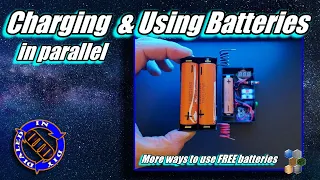
[Music] g'day youtube and welcome back to step by step back to basics today we're going to be building one of these battery packs or sell depending on how you look at it we're going to be building one of these 105 amp hour cells to place into a new 24 volt 100 amp hour battery that we'll build i need four of these for an upcoming project so before we actually go ahead and build that from all these cells we just finished harvesting and uh testing to get all the milliamp hours for each cell let's go ahead and sit down and talk a little bit more about the actual cell voltages and in series and battery packs and how to set these up so we can make an efficient battery so let's have a look at series and paralleling our batteries just so we have a basic understanding so we can build a better battery or power supply so basically in series you increase the voltage but the capacity stays the same in parallel the voltage stays the same and you can increase the capacity so i have um two small examples here um here we have in series so when we would to connect these we would go from our positive to our negative at the top and it would come down connect our positive to a negative positive to our negative this is like a flow of water through the battery so it's flowing in the in a wave through the battery so when we do this our voltage increases in this specific example we have seven uh 4. 2 volt lithium ion 18650 cells which are 3 volt to 4. 2 volts and when we put them in series they go to 21 volts to 29.
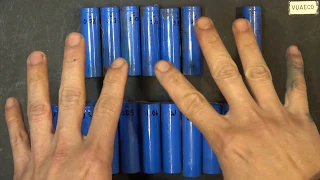
4 volts but since these are all 2800 milliamp hour batteries the amperage stays the same so our capacity is still 2 800 milliamp hours but our voltage has um increased to 21 through 29. 4 volts from the original three to 4. 2 volts and that is series we increase the voltage and the capacity stays the same in parallel what we have here we have seven batteries again but in these ones we'd go connect these all across the top and all across the bottom and this is paralleling our batteries so these are still a 4.
2 volt battery so the battery voltage is 3 volts to 4. 2 volts but in this case your capacity has changed the capacity of one of these batteries is 2 800 milliamp hours and since we put it in parallel the capacity of this battery now is 1900 600 19 600 milliamp hours okay so that is the difference basic difference between um series and parallel add one more example here of another battery pack which is in series and in parallel so we have two batteries which are running in series and seven batteries sorry two batteries which are running in parallel and seven batteries which are running in series so we're increasing the capacity from 2 800 milliamp hours to 5 um 600 milliamp hours but we're also increasing the voltage from 4. 2 volts to 29.
4 volts so um so this is what you do you cross all of these across and then you'd also go through the wave as well so you'd cross them this way and this way so these are all across this way and then we draw small bits of nickel strip across this way so in this particular case this is series and parallel but since this is only a small example and we want to build a big battery pack which is useful for for running large appliances refrigerators acs anything compressors i have a portable power supply i purposely built just to run a compressor because they have a real lot of draw on them when they first start up so this is one of the batteries or cells we're going to be building for one of our 24 volt 100 amp hour batteries so we took 38 of these which are averaging 2800 milliamp hours some are a little bit over some a little bit on it but it averages out to 2800 milliamps which turns this capacity once we add all these milliamps up it changes this to a 105 amp hour battery which means it's a hundred thousand five that 105 000 milliamp hours which you divided by a thousand and you get 105 amp hour battery because in theory this is just a 2.