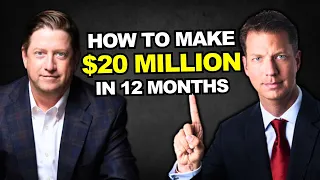
you can become an eight figure entrepreneur with no money doing one of these mini rollups buy a bunch companies put them together that creating of scale now gets me bigger I'm going to trade for a higher multiple because larger companies are rare and they trade for higher multiples than smaller companies now I'm going to sell the combined entity for eight times my net proceeds are 27 million I can build this model with no money down Welcome to the another episode of can you make nine figures doing this me and my partner Adam coffee The Man Who Sold 2. 46 billion in exit another $3 billion doll coming out 58 company Acquisitions and here's the most important question can you make nine figures or eight figures buying and selling and putting business together without any money the answer is Adam hell yes you can JT matter of fact I'm here to tell you that these next two episodes that you and I do will be the most valuable podcast video podcast whatever you want to call it episodes that we've ever done for the public well let's take this back right so we see a lot of things online where people saying you can buy businesses you know with no money and make millions of dollars so let's just maybe put this to rest is it possible and maybe what are the the myths of having so yes it may be possible but here's what the public the so-called wannabe gurus or maybe they did one or two deals but sustain can it be done and maybe put your take on that yeah sure JT right now I I just counted this morning I am working on 18 different buy and builds 18 of them where we're doing exactly what the hell we're talking about you and I are working on some of these and and uh so you know can it be done yes so so let me frame it up there are certain industries and there are certain kinds of companies that make it easier to do this and to win so we should probably cover that for just a a couple of minutes we've talked about it before but you know pretty soon I'm going to actually get on some of my tools and I'm going to demonstrate what the heck I'm talking about but but you know let's just talk about the what could we do to stack the deck in our favor you know and and you know right now let's say let's say we're an entrepreneur who's out there listening to us we don't own a business today maybe we're working in the Fortune 500 world you know and we're earning a good living we're making some money we've been doing some passive real estate investing but not setting the world on fire lately I want to do something new I've been hearing about this you know buying companies rolling them up putting them together you know and I want to get into doing that so I haven't bought anything yet so with all the industries in the world that are out there how do I pick one you know to start and so I've frame this up before we've talked about it on podcast I I put it in Empire Builder in the book it's like we need to focus on on needs not wants the economy moves in Cycles if I'm a business that's based on wants my wife wants a new dress you know because we're going out on Friday night my you know I got a truck I want new monster tires for my big ass 700 horsepower truck but I have needs you know I own a business I need help bookkeeping accounting payroll you know because I'm an entrepreneur and I'm an operator I'm not a finance guy and so I need help and I I need need I need that I must have that because I've got to be able to report my Revenue pay my taxes you know do whatever I I have to do you know if I'm sitting here in my office and it's raining outside and it's raining on my head and I'm indoors in my office I need my roof fixed doesn't matter whether I'm laid off doesn't matter whether I I I'm I'm I'm not having I don't have a bunch of money it's like there are certain things in life we need we must have them and so if we focus on needs when the economy Cycles down and we get into a recession or even worse if my business is focused on needs I will be more resilient to a down economy because at some level consumers still need the product or service that I've got so we want to be needs based next thing is we want to be recurrent Revenue based so think about I live in Texas you know there's big ass bugs out here I need Pest Control cuz Mama doesn't like bugs walking around in the house so so I have a pest control company I sign a contract I give them my credit card and every month they hit up my credit card every month and once a quarter they come spray my house and then they tell me hey Adam we got big ass mosquitoes out here you know I can add mosquito service okay yeah great go ahead do it okay yeah okay should I hit hit up the credit card we have in file yeah sure go ahead you know and and then they come back to me and say hey Adam we got termites here would you like to add termite service oh sure yeah go ahead hit up my credit card and hey we have army worms and they eat your lawn it's like I should be spraying your lawn and I should be doing you know these other treatments it's like would you like me to do that yeah sure go ahead should I hit up your credit card yes please before you know it it's like they're hitting me up for like $300 a month $400 a month and I just ignore it I don't care that's recurrent Revenue the hardest thing for for companies to do is find a customer once they find a customer you know then then we want that Revenue that we just found first of all we want to have a bunch of stuff to sell them you know bunch of different products or services but then we want that to be additive to the customers we already have here's the problem with a Project based business I made a lot of money in HVAC you know as an example and you can too you can make money in any industry as you know but some are better than others so like HVAC you know if I'm going to sell you an HVAC system you know you're going to buy one about every 12 to 15 years you know it's a oneandone event my Revenue this month is totally gone next month I have to start from zero and find enough customers to replace the revenue that I had last month that's a project-based business and then a down economy if it's discretionary you know then that's even worse you know so we need to find companies that focus on needs not wants contracted Revenue better than Project based Revenue finally the last point I'll make is that low capital expenditure is better than high capital expenditure so let me give you an example um that payroll bookkeeping accounting company that we're going to talk about in just a minute here um my product is in my head you know it's I don't have to have a plant I don't need a bunch of construction equipment I don't need a bunch of bunch of things I need some computer sitting on a desk that's very low capital expenditure to build that business which means it's very high free cash flow conversion and if we don't have money and we want to do a rollup and we want to buy a bunch of companies and put them together we're going to need to use the cash flow inside the business in order to service the debt that's required to buy the business and so if I have a company that looks great on paper it has really high EA High earnings but it has massive Capital expenditures I don't have any free cash flow so we want low Capital so I got needs not wants I've got contracted Revenue versus Project based and now I've got low capital expenditure free cash flow tons tons of Industries out there that meet that criteria a lot of services type businesses would meet that criteria professional even better than blueco collar Home Services but both do just just nicely and you know this is the profile so if I focus on a profile and I get the right kind of company yes I can absolutely buy companies for a low price and then put them together build a bigger company um get some synergies out of them make it more profitable and then can sell it for a higher multiple because of this thing called Arbitrage so that kind of sets the stage for the types of industries that we need to focus on in order to be able to do this with very little to no money and make a ton of money in a relatively short period of time well give us let's maybe hone in here the I start off saying can you do with no money right so someone's watching this let's say and say I'm going to do this with no money how would they go about doing it with no money um obviously there's the art of creative like I can buy real estate with no money and I and have done many of those but you know yeah obviously it's a lot I'm not always gonna get the best Properties or in this case the best companies creatively and then on previous episodes which I recommend everybody go listen to episode one to one to five and you know you you can go back and then you say okay well you should not buy a messed up company to try and turn it around because because then you're going to spend all your time you know taking this turd and trying to polish it up and it's you know so it takes a all time so where's the no money uh the no money come in uh low forget the zero little money but the no money how would that be done okay so in order so we need to keep the price of the acquisition of the small companies that we're buying down and the way we do that is by picking an industry that's highly fragmented so if you don't mind mind I am going to share my screen here and I'm going to get us to a window I've got open here are two tools that I literally use every day one of them is called dun and Brad street Hoovers so I'm going to give you an example we're going to build a company list so I'm going to hit get started we're going to take a look at bookkeeping and accounting Payroll Services you know the the these kinds of companies and so I'm going to come down here and I'm going to change we're going to look up based on NAIC or nacis code and I'm going to put in 5412 this is accounting tax preparation bookkeeping payroll service companies and so I want to just point this number out up here JT so I put in this knis code and in the United States there are 1. 8 million bookkeeping Accounting in payroll service companies in the US that's a massive number and when there's this many companies then there just aren't enough buyers to make the prices go up and so I happen to live you know in uh in Texas so I'm going to put in a local zip code and I'm going to say within 200 miles of where I'm at which does it matter in a in a rollup let's say in bookkeeping can you make it all across the United States or they prefer to have it targeted within one area um I if you're starting small with the first company think about building a region before you worry about you know so we don't want to buy one in Texas one in Florida and one in in California it's like that would be a disaster if you're going to buy and collect little companies you want to build scale you want to build density so I I I would prefer to build a region first and then become a multi-regional company and then become a national company and so I'm going to look just in in within 200 miles of where I'm at up here in the Dallas Fort Worth area which would open up the Texas triangle so this would be Dallas Houston San Antonio and so if I add this now you know there are 15,1 159 bookkeeping and accounting firms within 200 miles of my house that's a lot so this fragmentation sets us up and I I could look at the results and I can look at them by name and here's all the different companies you know that exist and some of these will be giant you know like deid or KPMG here's a deoe you know but a lot of these will also be small because there's more smaller companies than there are big now how do they know what the sales are how do they know what the sales are because I see these you know some of these are private companies so how how do they you know so so on this tool I'm not looking at the sales numbers because I think they're they're they're wholly inaccurate all I'm looking for with this tool is to identify the number of them that are out there and and so they they're going to represent a lot of different you know and if I click on one you know I can go in I get their website you know I can go to their website I get information about who owns it so I ignore revenue and employees on this particular tool so what I want to know from this tool is how many are there and where are they at now there are other tools that are a lot more expensive than this this one costs about $600 a year I could buy a tool that cost $188,000 a year called grata and it would give me a ton of accurate information I'm just using this to show if I've got no money and I got to keep it cheap so if I have time and no money I could use a cheap tool like this identify the total population and now I got a bunch of leg work to do so I just got the phone book now I got to go through and figure out how big they are if they're attractive you know Etc because I've got time no money if I've got some more money I could buy a more expensive tool but now let's turn to valuation so so we got to know what these companies are worth and so when I look at at the same knis code for for accounting tax prep bookkeeping payroll you know here I find that in the United States 276 you know of these companies have been sold in recent history and if I throw out the bottom 25% throw out the top 25% I'm kind of looking at the Arbitrage that's available to me I'm looking at 2.
6 to 7. 2 is kind of a typical spread and a median price being paid is 4. 3 well as I told you I'm doing three U rollups in bookkeeping accounting and payroll services and I've been loving what I've been seeing you know I've been seeing companies that you know on average may have le let's just say I find a company that's got three million in in revenue and it's got a million dollars in ebitda and the free cash flow conversion because there's no capital expenditure is like 95 98% so essentially I got three million revenue and a million bucks in free cash that company is selling for about three to 3.
5 times because there's just too damn many of them and not enough buyers to possibly buy them all at that size and so I have been actively working in this space and so let's use one of these as an example so I've got 3 million you know is the purchase price and I'm buying a million dollars of free cash flow so there's multiple ways that I could I could purchase this I could use some seller financing now if I'm not a bookkeeper counter you know accountant if I'm not going to step into this business and run it then I'm going to need somebody to run it so I'm looking for my first anchor business and my profile or the Avatar I create for the first one is I want 3 million in Revenue million dollars in earnings I want someone who's probably between 35 and 50 years old who's going to stay with the business they're an expert in payroll bookkeeping accounting services but they don't know anything about buy and build they're going to partner with me maybe I'm going to have them roll over 30% of their proceeds and they're going to become uh a co-invest or a co-owner with me and so they're going to get a bite of the apple right now when I buy the business and then they're going to stay invested run the business I'm going to buy a bunch more companies put them together that that creating of scale now gets me bigger I'm getting above the 1. 8 million small ones and I'm now becoming rare I'm going to trade for a higher multiple because larger companies are rare and they trade for higher multiples than smaller companies smaller companies trade for low multiples because there's not enough buyers bigger companies you know are rare and so so the numbers we've talked about before 34 million small companies in the US only 3,000 in the planet that have a billion in Revenue so as we get bigger and we're climbing up the pyramid all the sudden we're rare we're above the 1. 8 million small ones and we're in a new territory and people pay up for that new territory so let's go back to our numbers so I buy that first one they roll over 30% so I'm pay paying 3 million they're going to roll over 900,000 let's just make it round numbers for easy math because I'm a I'm I'm not a I'm not a math guy so let's say they're going to roll over a million so I need to pay them $2 million for this business and they're going to become my partner in a new holding company that I just formed and I'm going to buy a bunch of companies and put all the assets up into my holding company so this first person is coming along for the ride they're going to do what they do best I'm going to buy companies close to them they going to they're going to run my business and I'm going to get them a a a another payday because they've rolled over alongside me so I need two million bucks but I have a million dollar in free cash flow so if I look at the debt now and I say okay how much cash do I have and how much does it cost to service the debt let's assume I use 100% debt for that 2 million so if I borrow $2 million at 10% interest and I do it fully advertized for a 10-year note I'm probably going to need about $350,000 in cash to service a $2 million note but I'm buying a million dollars in cash so if I take my million dollars divide it by the 350 I've got roughly a three times debt coverage ratio three times debt service coverage ratio so if an economy you know turns South goes down and this company loses 10 20% of its Revenue I'm still going to have plenty of cash flow coming out of the business to service the debt so all that's left to do now is I need to get financed and so if I have this kind of a scenario I have 30% Equity even though it's not my Equity it's the equity of the seller and he's my partner or she's my partner in the new business we building and so their 30% rollover becomes my 30% equity as well because it's the holding company buying this this little operating company now I'll get back to financing in a second so once I buy the first company I call it an avatar so the avatar for my first business is I'm not going to step into it and run it I'm going to do the buy and build I'm going to work on buying other businesses putting them together I'm going to be the higher level business guy I'm not the accountant this person's going to run operations that's all they have to do and so now you know I've got them running the business but when I now buy the second third and fourth business maybe I change my avatar maybe I'm no longer looking for someone who's 30 to 50 years old who's going to stick around for the ride now I'm looking for the guy who's or the lady who's 60 to 70 years old who would like to retire and so that person's going to sell me their business I'm going to focus heavily on seller financing so they're not only going to get a bite of the Apple when they sell me the business but they're going to get an income stream coming from the debt that they're using to supply me the capital i work on these all the time I see Founders willing to do anywhere from 10 to 50% of the purchase price you know as a note because as they're 70 years old and walking out the door what they want is yeah I'll take a million of that purchase price now and then I get an income stream for 10 years and if you default I take back my business and I sell it again you know what a great deal you know so so I I would focus on older for the second third and fourth companies and I'd have you know a a a higher component of seller financing going back to that first one I might have them roll over 30% but then have them also Supply 20% seller financing so I now have 30% equity in the business and I only need 50% of the purchase price for debt now I I'll be honest you know in a perfect world somebody needs to have some freaking money you know a lot of banks and lenders would like you to you know even if it's a token you know the numbers you can raise the capital you can raise the capital you go to they say Hey listen I'll give you a piece so the idea of no money down is you have to be able you may not put any of your own money down but you have to convince others to give you money and just like I did I did my first 500 real estate deals um without spending a cent of my own money but somebody had to put money in there and this case was I raised the capital and so you have to be very good at convincing other people to bring him in either by giving a percentage or a preferred return and a piece of The Upside or just a a straightup loan which is going to depend uh you know on the on the type of deal and everything so when we talk about this um no money does doesn't NE have to be some of your own money and obviously dilutes maybe your percentage of the profit um and so but Adam there's the idea of like saying I'm gonna spend none of my own money I'm not going to raise any money from anyone right and Essence gonna buy this company no money down which in essence would be a 100% set of financing you're probably not getting a great company right because someone who's making three four 500,000 in profit in their company the likelihood of them just handing over the company to you with without you putting zero money is probably very unlikely not impossible but very unlikely correct um correct but I I will say this you know if you think about the SBA the small business administration there are loans that are geared towards people with not a lot of money and there's many many lenders who lend under SBA guidelines and they don't all have the same type of underwriting criteria if I walk into you know a a big big bank institution and say you know do you uh you know do you do SBA Loans you know and and they say oh sure we do but we require a 20% down payment okay so if I if I need 3 million or 2 million I'm going to have to come up with 4, 600,000 that's a lot of money but just like when you buy a house there are some lenders who say I want 20% down and there are some lenders who say I'll go I'll let you get by with 5% you know and and there are some lenders out there who say hey the the the property you're buying below market value a praise is really high you have a ton of equity in it you know that business looks good throws off a lot of cash I just need to see I just just need to see something I need to see you come out of pocket with 50 Grand 100 Grand something and so there's a lot of people in the world JT who who would love to say I don't want to sign any personal guarantee I don't want to I don't have any money you know and I want to become a you know a 9figure entrepreneur in five years well go buy a freaking lottery ticket because that's you know in life we're going to have to take some risk in life if we don't have any Capital at all we probably shouldn't be buying a company but if we if we did find one that met all of my criteria there still are people and ways out there to get these things financed I know I I have a I'm working with a guy in the collision repair industry who is buying and rolling up collision repair centers and these are great businesses um and uh meet a lot of my criteria not all my criteria but you know I'm helping him buy them and at the prices we're paying he's getting a ton of seller financing this guy is 26 years old JT you know he already owns two you know I'll have help him buy his third his fourth his fifth and then when we get a little bigger we're going to sell it to private Equity he'll keep building it because he's a young guy but he's going to get his first bite of the apple and then also at the same time keep keep going looking for a second bite of the Apple we've talked about that in other episodes um and so in his case a lot of seller financing and he is using SBA Loans but the hardest company to buy is my first once I buy my first I now have Equity I'm in a like business buying another like business now the bank not only looks at the cash flow of what I'm buying they look at the cash flow that we have they look at the companies on a combined basis and very quickly the numbers start getting getting ve very attractive you know I I have a model on my screen I mean I I I could show you an example of what this could look like um for for for somebody and you know so let's do that I'm GNA share my screen and I'm gonna and well Adam is sharing the screen especially if you want to listen to part to or any future uh episode make sure you subscribe and make sure you like and you comment and if you want to do this with us the link is in the comment Adam coffee.
com within with your company or just as a dealmaker we are open to make this happen so this is not a perfect model but I'll say it's a very directionally accurate model so I buy this first company I pay three million in Revenue it's got 3 million in Revenue it's got 900,000 Nea I'm paying 3. 5 times for it Enterprise Value paid is 3 15 you know million I set the seller rollover amount to 19% because the SBA will allow a seller to roll over 19% without guaranteeing a new loan um if it's above 19% then the seller also has to guarantee the loan that's being used to buy out their business and a lot of guys you know that would be uh that would be a bridge too far so the rollover amount in this case is 598 th000 and the seller financing is 20% Which is 630 that leaves a cash balance due at close of of 1. 9 million and so in my little model here I'm going to put equity in on the first three Deals 50% on the first 30% on the second 30% on the third now this model is to buy about seven companies um what I'm really doing is I'm trying to buy about four million in ebitda and so at the right I'm going to buy however many companies it takes if I could get away with buying three that' be great but I'm going to buy about 13.
5 million based on the demographics for this industry you know I should expect to have about 4 million in eitaa you know I'm going to pay 13. 8 million for the companies I'm going to have about 1. 6 million rolled over by the sellers my seller financing is 20% across the board so they're going to provide me with that um I'm going to need 9376 million cash at close to buy all of these you know in this case I'm putting equity in the first three it's 1.
8 million now JT I could re-engineer this to where it was very little or no money down but this is one that that I'm going to do and so I don't mind putting in a little bit of equity but I could also go out and raise this Equity uh and so at any rate I put in that as cash Equity I stop putting in equity after the first three because there's diminishing returns on Equity if I want to juice up my returns the highest the highest value is created by putting some equity in upfront that's why I do it high in the first and quickly taper off and then end and so by putting all this in you know my cumulative Revenue now because I expect as I'm collecting these companies I'm going to get some synergies I'm going to focus on helping them grow because we do need to be a growth company and so over the time period I put this together you know I'm going to grow in total you know maybe over a three-year period I'm going to grow about 25% you know and I'm going to grow earnings from 4 million to 5 million now I'm going to sell the combined entity for eight times Enterprise Value 4,500,000 I got some transaction fees if I hired a bank you know I've got to hire lawyers Etc U of course if I'm doing it I know who I'm selling it to I don't need all those fees um and then I got to pay off the debt so the cumulative debt which is the bank debt plus the founder debt I pay all that off my net proceeds are 27 million and if I go back to the first owner who put in that little bit of equity right here their Payday on this $20 million the first seller who rolled over 19% of their business you know they they get 4. 7 million and so if I if I if I look at and I and I go over to the right here there we go so for the people who put up the 1. 8 million right here they get an 11 times multiple of invested capital and the person that rolled over the 19% which if we go back up here all the way up so the rollover amount somebody rolled over 600,000 remember that they got 3.
15 million Enterprise Val value and they rolled over 600,000 of that you come down here they get 4. 7 million which is bigger than the first sale of the company and they're getting eight times their money on the money that they rolled over so my sales pitch to the sellers are you keep doing what you do which is running a great accounting business I'm going to keep doing what I do which is go buy a bunch of other companies and put them together you're going to run them for me and then when we get enough scale we're going to sell it you know and we're going to exit it and I only show them this you're going to make 4. 7 million I don't show them my 20 million you know but I I show them the 4.
7 million and then you know for them it's like hey I rolled over 600 Grand I get back five million I sold my company the first time for three you know three million 3. 15 I'm getting 4. 7 the second you know hey that's a good day you know and so I I would tell you JT it's like I can build this model with no money down but what happens is that 20 million is going to go away it's going to become 12 you know and I'm going to give 8 million to somebody cuz somebody's got to put up the money either there either I've gotten Equity from someone or I've got a lot more debt that needs to be paid off and debt that needs to be serviced but absolutely you can become an eight figure entrepreneur with no money and doing one of these manyi rollups and and having no cash you know as long as I buy the right kind of company and in the right kind of industry and I'm very disciplined only buying good companies run by good people I do good diligence I pay fair market value I don't overpay for companies and as long as I do that I could change this model around to where no equity came in and it became debt and then all of that equity which was 1.
8 million is now serviced as debt you know Andor I sell equity and I bring in some friends and other people and now I got to service their you know their their Equity um but what winds up happening is if I don't put any equity in at all I just moderate my returns and so all I'm really doing is hey there's there's a ton of lenders out there you know I have to start calling some of these lenders and saying look I'm going to buy a business this is what the headline price is going to be here's what the debt structure is going to look like and I want to understand your underwriting criteria you know I'm going to have a 3 to1 debt coverage ratio cash flow to the debt to service the loan what kind of a down payment are you going to require on me you know maybe I'm a veteran maybe I'm a female owned business maybe I'm a minority owned business there's a lot of programs out there that will help you know so I have to see if I qualify for any of that kind of stuff and you know under SBA guidelines I might be able to find you know A lender who says look I'll I'll underwrite this you know but I just need you to come out of pocket with something give me 50 Grand give me 100 Grand you know and and so I could go max out a bunch of credit cards if I wanted to you know not telling people to do that please don't go run out and do that but you know it's like I could take a home equity line I could get friends and family to say let's put together a little you know a little a little pile of money that we can put in and I'll give you a return I'll give you a piece of the equity action you know there's a lot of things that we can do creative you know for a for a guy like me if I put in 1. 8 million and I'm going to get a 20 million plus return an 11 times multiple of invested Capital that's a good deal now now imagine I do this JT not once but I do this four times so I get one going I pick another industry I get another one going I pick a third industry get another one going pick a fourth industry get another one going and then three four years down the road exit exit exit exit 20 million times four or five of these you're a nine figure entrepreneur so on the next episode and that's why you have to subscribe and comment and like we're going to talk about you may not need any money to do this because you can be creative use the company's money use another Investor's money but what skill does it take and this show is not just for people who want to put it together but how does your company fit because if you're at $1 million in EBA and you want to get to four million so you can exit to 28 to 32 or $35 million um you're G have to spend a lot of money on marketing and the best way to do that is to merge or acquire which we're going to talk about what are the skills required to do this on next one if you want to do this with me and Adam or learn how we do what we do uh ideally we'd like to do it with you or your company or show you how you do it so so we can do deals this is why we do this podcast make sure you like subscribe comment make sure you have the link at the bottom Adam coffee.