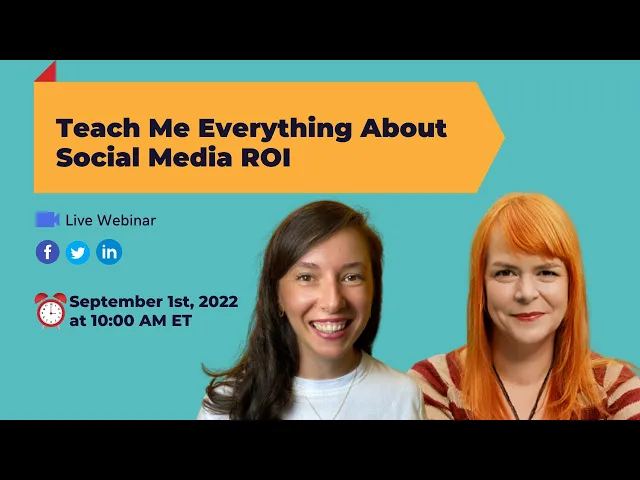
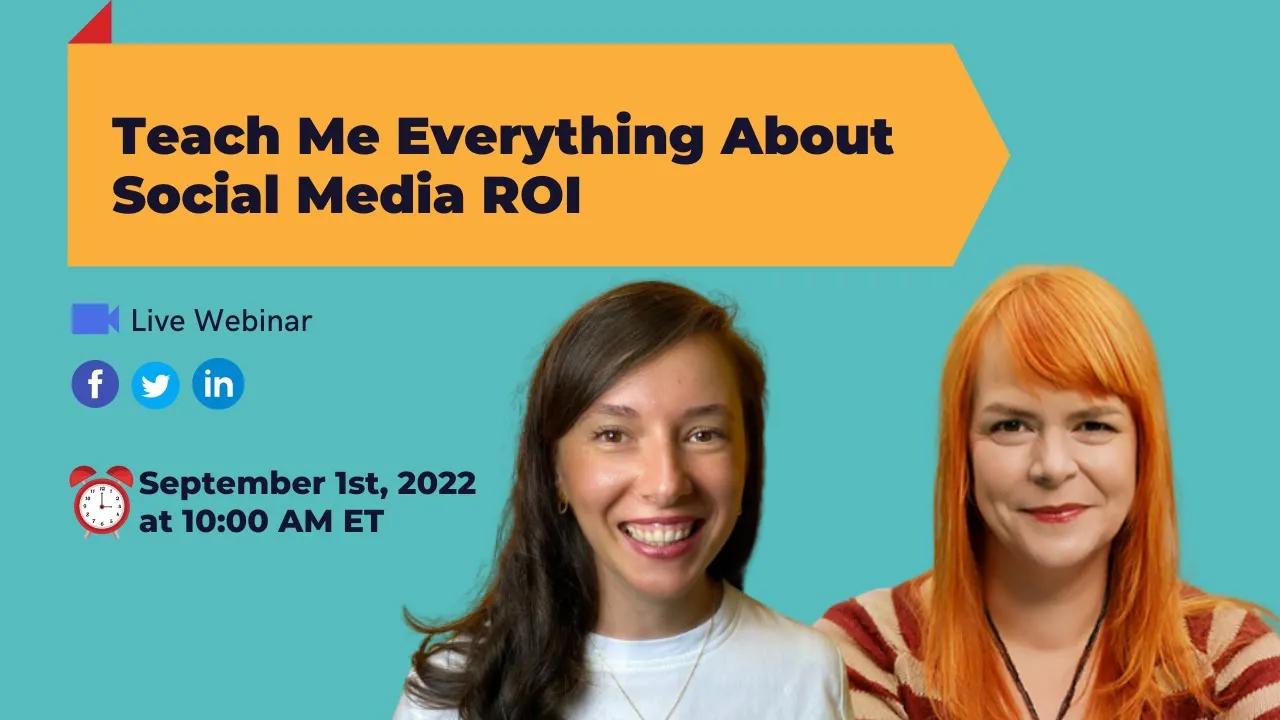
so yeah we are live uh hi everyone welcome to another um teach me session i'm madina founder of social insider and my guest for today is amanda webb uh hi amanda welcome hi hello uh amanda amanda webb is a digital marketing roi mentor trainer and consultant she's working with service-based businesses and organizations to develop roi driven digital marketing strategy which is a perfect match for the subject that we have for today uh because we are going to teach everything you need to know about social media and why and how to calculate it uh the definition
of social media and why the mistakes that sometimes you are doing when calculating this um this metric and other stuff about this uh so um yeah how are you amanda ready to share everything i'm i'm always love talking this is obviously the thing that i talk about the most as your introduction suggested so i'm always excited to share knowledge about that yeah yeah so uh i think i saw a webinar that you did with agorapulse uh this summer about something about the social media why and tracking and how to how create content yeah based on
data so that's why i actually it was an interesting uh webinar that you did for for them and that's why i invited here today uh good so amanda what is social media why it's that kind of it's that is the big question isn't it and i think you know when you're talking about social media very often people don't think about roi as much as they do for like kind of their website which they think about but it is really important so basically it is what it says on the tin roi stands for return on investment
so from your social media are you getting any return and that does mean money by the way it doesn't mean oh well i got this many subscribers to my email list you know it is you can calculate roi based on that like what what your social media contributed to the people on your email list that then converted into sales but you need to do it that granularly and then yeah compared to the amount of money that and time and energy that you spend on your social media and i think the benefit of this benefit of
knowing this is that you know that you're not wasting your time and for those of you that are working for companies it's a way for you to prove that the money that they're paying you to manage their social accounts is actually worthwhile yeah we did a study uh at the beginning of this year the life of a social media manager and uh 41 are struggling with measuring the social media roi so i think it's a a challenge for everyone uh both for people who are working at the in the in a specific agency or on
a brand so most of the time maybe they don't know how to evaluate the effort they don't know um how to evaluate the time if we are speaking about consultants or freelancers they know they don't know how to price their time when they should calculate this the the return of the return of investment um how they can start uh to measure the social media why what what where they should begin i suppose actually from what you just said the first thing they need to do is talk to the people that they're working for and make
sure they have access to everything so we're going to later on i think we're going to talk about analytics a bit but you can't just kind of like magic this stuff off from the social accounts themselves you have to like be able to follow the whole trail and know what their conversion rate is on their website and there's all sorts of pieces you need to set up with your client if you are working with a client if it's your own business like me you have to work that out for yourself you have to work out
you know how many website visits how many peop maybe they don't even visit your website so we'll talk about that the next stage then is knowing what you're spending so are you using a social media um scheduling tool are you using a social media evaluation tool something like social insider are you um what other tools are you using canva everyone uses canva i'm pretty sure i'm pretty sure everyone uses canvas stock images are you outsourcing any of your work so maybe you're a social media manager but you're outsourcing your graphics or maybe you're out on
video are you doing any training i think particularly your social media manager that that fits into that as well and you need to think about all those costs as part of your social media cost so how much that or how much is it cost in the company if they're providing some of those tools as well that's the first thing to look at the second thing to look at is actually the overall business expenses as well because for a small business like mine i will calculate that by how much time i spend on something so for
example as you know i do a live show every friday called the digital coffee that takes me six hours a week out of my week that is 15 of my week so i need to charge 15 of my business overheads that aren't involved that aren't accounted for in other activities you know things like heating yeah yeah or the cost of my computer i need to add that into my expenses and then the third bit that nobody ever thinks of which is time so the um amount of amount of time that you're spending is important you
we've all done it we've told a client that you're going to work on their account for one hour and you end up working three or four hours now you're still charging your client one hour yeah so you need to account for your own time and think about how much you're charging for that as a small business like me i have to set you know it's very easy for me to go well it's my time and it's my business so it's not worth anything but it still is because that's time i could be spending doing something
else that's maybe delivering more roi so you have to set yourself for your own business an hourly rate as well that can be lower than what you charge your clients but you still need to track that then you bring that all together and it will probably work out to be way more expensive than you thought in the first place that's your starting point the what you're making the revenue the return is a little bit easier because you're able hopefully if you get all the right access you're able to track how much of an effect that
your social media is having on the overall sales from the business so that one's a little bit easier particularly if you're running ads as well because you know it's it's measured the direct results from that a little bit harder for service businesses very easy for b2c yeah yeah yeah yeah and especially if you are an organic specially specialist it's even more difficult to know how much time do you need to get content ideas for example how much time do you need for research before creating a content plan so it's not easy to define how much
you have to spend when you you calculate this so you said that if you have to let's say uh split it into some steps when we calculate the social media roi so it's important to know how much uh what are the spends um the time the resources uh the the technology because yeah sometimes you need you need canva you need tools uh you need a new computer maybe and all of this should be on your um excel or whatever you uh gather this information uh what we should go first um what should go next for
calculating the social media roi so once you've gathered that information together and make sure you have everything it's quite comprehensive there is a formula for roi so sorry if i'm going to milk people with formulas like i try when i try reading this out it doesn't look half as good as it does on the page but let's try okay so you take the smaller number which is the amount of money that you make it should be smaller no that's yes no i've got that you take the amount of money that you're going to make you
divide it you minus the investment the amount of money so that gives you a nice small number that's the small number so your return your profits your turnover minus your investment and then divide that by a hundred that gives you a percentage then of your i miss the phase see i told you i was really bad at reading this out like let's start again everyone right you take your return which is the amount of money that you've taken you minus your investment which is the amount of money that you spent i missed the important bit
you divide it by your investment that's important you're just stuck with one tiny figure and then you multiply it 100 which gives you a a percentage i i'm really bad at doing that when i'm in front of people don't worry you're not the only one who uh you might you could be quite shocked or you could be really happy but either way that gives you a percentage and the reason it's a percentage is because you know your investment could go up with the anticipation that that means your revenue is going to go up but that
doesn't happen so it's the percentage that actually changes so it makes it a lot easier for you to track over time true true um so we have this formula uh let's say how can we calculate the engagement rate for the social media roi for engagement for example because most of the time people have to track based on their objectives uh and when we are speaking about the objective on social media uh we have engagement we have traffic we have sales uh i don't know leads generated generated sign ups conversion or maybe revenue generating in general
uh but let's have let's take a concrete use case for people who have to uh measure who have to have to have engagement as an objective how can they calculate the engagement the social media roi for this metric so it sounds like something you couldn't calculate right but this is important of being able to connect with the rest of the business so you know you need to start tracking back so you would start with where does the sale actually happen you're really lucky if it happens on social media like i say if you're using shopping
or if somebody just direct messages you and that's the end of your sales process that's really lucky but that really happens so you have to look at where the sale finishes and then how you're getting how much social traffic is getting in say to the website and how many of that social traffic is converting into a sale so that gives you an idea of that now again there's really complicated attribution models here that i don't want to melt you more than my stupid formula did so but you'd be looking at your first touch attribution basically
the social media has contributed to that sale so then you need to work back from that so how much does engagement affect website traffic so if you get more engagement does that have a knock-on effect on website traffic and then that's where you can say right this number of engagements gets this much website traffic which converts to this many sales so this has it's not the whole it doesn't get the whole amount of the sale but you can see how much it is contributing to the sale and that's that's what you really need to do
so you work back from the end all the way down the method so you can even bring that back to like followers i know people think followers aren't important of course they're important because if nobody follows you then you can't engage anyone you can't send them to your website and you can't sell so again you can see how many followers it takes to get an engagement to get a you know so so you can work that process all the way through yeah yeah and then of course every time you see a spike in engagement on
social media you'll see spiking in an increase in traffic so you can correlate the correlate this way we have anna with us uh so anna uh she was wondering which are the factors that determinate the decreasing of social media and why so that's a really good question and you can once that that model i just gave to you you can get carried away working on the wrong thing so you might go well actually like you said when you see a spike in engagement i should see a spike in website visits so because you've been told
that you need to focus on engagement you get you will do everything to get engagement like maybe posting something that isn't relevant to your business so like i know i don't do it yeah very tempted that if i post a picture of one of my cats i do try and get them in the background of my shops i will get more engagement every single time right but is anyone visiting my website as a case of that no so that is that's a problem with the model it's the same with followers followers are important as long
as they're the right followers so that that's the value of kind of your percentage as well because your your engagement would go through the roof but nothing else is changing so you know that investment would be wrong so does that make sense yeah yeah second part of that question sorry glasses vain person who doesn't want to wear glasses yeah yeah you know i totally agree with you because always it's important to write content and messaging on social media based on what's in it for for them for your audience and not what delivers a higher engagement
rate for you um you mentioned in the beginning about google analytics and why social media managers should have access to specific tools before measuring the social media roi so if i know that there are some um i don't know how to say it uh there are some tools you you have to install on your website to get data from social media for example pixel data uh and the about the utms that everyone should include it when from when and when they promoting links on social media uh can we measure social media roi with that without
this without the etms and um [Music] yeah on our website you can but not accurately so you can guestimate but you can't do it accurately i think in the past i mean facebook used to have its own analytics tool if you remember very similar to google analytics it kind of nobody was ever using it and then it went away i think it went away because they were aware of privacy coming down the line you know but um you know the facebook pixel the twitter pixel pinterest you know all the pixels all the social pixels used
to be really good at finding out what was going on particularly for paid so the pixel does was actually measuring traffic for everything and that's where the facebook analytics tool was really great but then of course apple launched their privacy update and everything went wrong so facebook and the other social networks he mustn't think it was only facebook or affected by this they are all suffering i saw that snapchat are laying people off you know it has affected all these networks yeah they had to scramble to put some sort of model in place so that
they could still measure the results of their ads so that was the the bit we hear about is the fact that it's hard to target people we don't really see how it's affecting the reporting but of course if the pixel isn't going to track a lot of people it has to kind of guess what's happening yeah and you know the ai is there it's almost a year now is it maybe a little bit longer since that update came in and the ai is quite good at making judgments based on historic data on on how your
ads are doing but it's not brilliant anymore it's not accurate i mean but always google analytics and facebook will give you different answers anyway so you do need to understand google analytics and really annoyingly now is if you already understand google analytics now you have to understand the new google analytics google analytics for yeah definitely if you haven't already there's a i did a really good quick intro course on linkedin to google analytics for and i found it really helpful obviously i've done several courses since and i've been really delving into it but that would
give you your basics then your utm tracking which people may not know what that is if you're running ads on facebook you may have seen it when you're setting up the ad it offers you to put in utm parameters and all this is is adding some bits at the end of the link that you're driving people to that tell google analytics or analytics platforms where that traffic came from so that's basically you would tell it that it's fake and keep mentioning facebook it could be any gifs facebook or it's instagram it's facebook and that the
medium that it's coming from is social and that's the campaign so it could be the name of the specific ad campaign or if you set it up within facebook it's really handy because it will identify each individual ad that that traffic is coming from so when you do that you can attribute it down to the individual ad or if you set them up yourself to the individual social media post that was driving that traffic so at the other end you're not just seeing that traffic's coming from facebook you can see that this post yeah one
that people clicked it's and it came from a facebook group you could find that out or you could find that it came from a story rather than coming from the feed all of that obviously is really great information to have so and that's just scratching the surface of what you can do with utms i really am in love with them so it sounds complicated but it doesn't have to be there are tools that can help you create them yeah and about this this is another question that i have uh google offers you a tool where
you can create these utms uh but also there is bitly for example who can gives you helps you with the these utms codes and then it gives you a shortened leak so what's your recommendation here should you stick with the one from google or can we use the bitly and we get the same results in google analytics in analytics you're probably going to see i haven't tried creating with bitly so i can't see how they created them correctly which would be my bug bear at the moment the downside i think with bitly is that when
people see a bitly link they they don't know where they're going and they could have had bad experiences with clicking them before it's just a perception thing a lot of people might not but a lot of people including myself would be okay a little bit so i do i create my utms again i'm going to put my glasses on one day i'll get over my vanity right i use a tool called um google analytics utm builder it's a chrome extension so i can actually it makes it really easy for me to set them up within
for any web page within that tool so that makes it easy and then i use for link shortening if i want to shorten the link i have a wordpress site so this is kind of dependent on that and you having access to that site i use a tool called pretty links so i can shorten it and it can still be my website spiderworking.com forward slash whatever i want it to be which just makes it look a little bit more trustworthy i think than a bitly link now somebody can come along and tell me i'm 100
wrong it's just my my feeling about it yeah yeah i agree with you um can we tell us some mistakes that mistakes that social media professionals are doing when calculating the roi so one mistake that you might instantly go and make after watching me talk about this is suddenly realize oh i need to get more roi and suddenly just post loads of sales posts it's just gonna say that we all know that's a bad idea right but yeah nobody wants to follow a page or engage with the page and then all they see is people
and selling their stuff so that's the first thing is you can focus way too much on the roi so you do need to have a balanced strategy you need to look at those things we looked at earlier which is like growing your audience engaging your audience before you try and sell to them having a balance along those lines um not keeping an eye on that percentage because like i say you could go and focus in on one area to with the goal of improving your roi and because you haven't worked out the percentage you know
you might be spending less but actually your revenue has gone way down or you might be spending more you know it's it's the percentage is what makes the difference so following that really i will come over to linkedin and i will put it in the comments when we finish um having that percentage right is really important um ignoring roi so that's something else it's like oh well you know that would be a nice thing to have if you are a social media manager this is gold for you because if you can improve your roi you
can charge way more money so that's good as well um and i guess if you're working this is going to be the complicated bit because so many businesses aren't like up to up to speed with their measurement at all at the moment so when you start going in and saying right i want to have access to analytics and tag manager and there's another actually there's all sorts of really cool tools and i want to know you know they'll think well they're my business secret secrets why do i want to tell my social media manager there
so that you know it's not always going to be your fault when you can't prove roi that's what i'm saying yeah and i think another mistake here is that you should make sure that the google analytics is correctly installed on your website because sometimes maybe the the tracking isn't that good and maybe there are some visits or website sessions aren't registered so you cannot see the whole customer journey from the people who are reading something on social media and then go to a specific page so there is a i think there is a a mix
so i think the social media managers should speak with other teams the people who are responsible for google analytics and maybe this is part of the dev team or people who are responsible for the web development and make sure that everything is in place and it's working it's registering the right metrics of course there are some other specific things that you should know that you can remove your traffic that the traffic register from your ip or from your computer uh so if you do if you are doing some tests you can remove those tests from
from the customer journey um and the sales team as well i think you need to because you could be getting loads of people to go over to the website to fill in the quotation form if they're not converting then that's obviously you need to like make friends with sales because i think traditionally sales and marketing have been a bit yeah yeah yeah but you should be right because your goal is exactly the same you need to deliver them the leads so that they can sell to them so you need to talk to them about what
is a good lead and look at where your strongest leads are coming from and which ones are actually converting which again is so much easier on e-commerce but i like doing service-based businesses i like i don't know why yeah yeah so it's important to uh know those attributed attributes from the sales team that are considered as a qualified lead uh it's not easy i'm pretty sure that it's not easy to calculate the roi from from social media especially when you have objective like as i said reach engagement followers growth as you said so it's complicated
when you don't have uh when you have to cherry pick the data from the different data sources another question here that we have is how do you know if your roi is good what percentage of roi is good for your business well roi the overall roi should be taking into account everything so anything that is positive roi is good there is it's i mean it is a difficult question um obviously the more that you're getting the more profitable the company is the more it has to invest in other stuff so that's good so you know
but like any percentage i would be looking for over one percent but at least if you're getting one percent and you counted in all the costs you know that you're not losing money but that's probably not why people are in business to be honest so maybe you're looking for 20 i think i'd be happy with a 20 roi um that would be good but there is i mean anything over over a negative amount is good and actually that's where it can get a bit scary because when you do that initial calculation you may find out
it is a negative amount and then you need to go back and look at what's wrong [Laughter] where am i spending money where i shouldn't or where aren't i making money where i shouldn't why you know that's that's the problem and a lot of businesses will be there for a few years when they're setting up as well you know yeah yeah yeah and i think it's okay to be there especially when you're at the beginning of your journey maybe starting as a freelancer or starting with a new job position it's fine to have maybe a
negative roi at the beginning uh to understand to know how to evaluate your efforts and then once you are learning and working with other teams and make sure that everything works perfectly and everyone have the same look at the same metrics when sales the sales and the social media themes um step by step you will see an improvement in your social media why yeah so if you're starting on a negative you know i'm not going to say it could get worse because it could get more negative like at least once you're measuring it that's your
benchmark where you are now you're all looking to improve on that so your goal then could be to get into positive roi yeah yeah good good thank you so much amanda for sharing all this information and thank you for having me and for giving us the definition and the way we should calculate the social media why when people can find you so i am spiderworking everywhere if you're watching on linkedin please connect with me here this is where i share most of my stuff so anything about roi or any business tips or advice this is
where you find it just let me know when you connect with me that this is where you came from and if you do if you message me when you i will send you a little report so all right and i'll send you an audit checklist that's what i will send you no email required just direct message me i will send that to you wow i will announce all my all our uh database too to send you an email with uh to send you a linking invite and yeah and yeah you can decide if you want
to sign up for my email later great great thank you thank you so much and thank you so much for joining us today uh and see you in in two weeks yeah thank you bye bye bye