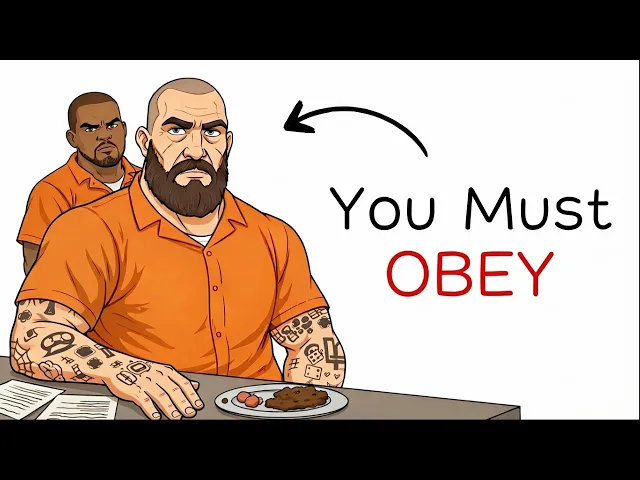
Level one, the new fish. You arrive at the facility in a van with no windows. Your hands are shackled to a chain around your waist.
The man next to you is crying quietly. You are not. You told yourself you wouldn't.
The processing takes 6 hours. They take your clothes, your watch, your wedding ring, the photograph of your daughter you've been carrying in your wallet for 3 years. They give you a number, not a name, a number.
They give you a uniform that doesn't fit, a bed roll that smells like someone else's sweat, and a set of rules that nobody actually follows. You are assigned to a cell block and walked through a hallway that seems to stretch for miles. Men look at you from behind bars, from doorways, from the yard beyond the reinforced windows.
They are evaluating you the way a predator evaluates prey. Not with hatred, with calculation. You don't know it yet, but the moment you stepped off that van, a clock started ticking.
You have somewhere between 24 hours and 2 weeks to figure out who you are in here. In the free world, you were a person with a history, a family, a job, a reputation built over decades. None of that exists anymore.
In here, you are nothing. A blank page, and other people are about to write on you, whether you like it or not. The first thing you learn is that every single person in this building belongs to something.
The Black Gorilla Family runs DB block. The Aryan Brotherhood has the yard on Tuesday and Thursday afternoons. The Serenos control the kitchen assignments.
The Mexican Mafia has arrangements with the guards that nobody talks about out loud. If you came in unaffiliated, if you don't have a crew, a set, a people, you are exposed. Neutral sounds like safety.
Neutral is the most dangerous thing you can be. You eat alone on your first day. You sit at an empty table and you feel a hundred eyes on your back.
A man sits down across from you. He doesn't introduce himself. He just looks at you for a long moment and says, "Where are you from?
" That question is not small talk. It is the most important question you will ever be asked in this building. Your answer determines everything that happens next.
Level two, the prospect. Someone decided you're worth something. Maybe it's because of where you're from on the outside.
Maybe it's because of your charges. Because certain crimes earn a certain kind of respect in here, and certain crimes earn the opposite. Maybe it's because someone vouched for you, someone who was already inside when you arrived, someone who knew your uncle or ran with your cousin or did time with your older brother in a different facility a decade ago.
The world is smaller in here than anyone on the outside could ever understand. You are a prospect now. You don't have full membership.
You haven't been jumped in or blessed in or whatever the particular ceremony of this particular organization requires. But you are being watched, evaluated, given small tasks to see how you handle them. They ask you to hold something, a small package that you don't open and don't ask about.
You carry it from one cell block to another during the morning movement when guards are rotating shifts and attention is thinnest. You deliver it. You don't ask what it was.
That is the correct answer. They ask you to pass a message to someone in protective custody. You find a way.
You don't explain how. That is the correct answer. They ask you to be somewhere specific at a specific time and do nothing except stand there and watch.
You stand there and you watch. Nothing happens. You don't know if it was a test or if you missed something or if everything went exactly as planned.
You don't ask. That is the correct answer. You are learning the language of this place, not the spoken language, though that has its own vocabulary, its own codes, words that mean different things inside than they mean outside.
You are learning the unspoken language. The way someone standing in a doorway can be a warning. The way eye contact held for exactly one beat too long means something specific.
The way a guard who usually stops at your cell to chat suddenly stops doing that. You are learning to read the temperature of a room before you enter it. You are learning that everything communicates something and that reading it correctly is the difference between going home on your release date and not going home at all.
Level three, the soldier. You are in now. The full patch, the blessing.
Whatever ceremony marked your entry into the organization, you went through it. Maybe it hurt. It probably hurt.
That was the point. You were a soldier, a foot soldier, the bottom of the organizational hierarchy, but no longer the bottom of the food chain. That distinction matters more than almost anything else.
You are protected. Not perfectly, not unconditionally, but protected. The men around you are your brothers in a way that the word brother barely captures.
You would bleed for them. Some of them have already bled for you in ways you may never fully know. Your job as a soldier is simple in description and brutal in execution.
You carry out orders. You don't question them. You don't negotiate them.
You execute them. The drugs that move through this facility, the protection tax collected from weaker inmates, the violence that maintains the hierarchy. You are the instrument of all of it.
When leadership decides that someone needs to be taxed, you are the one who delivers the message. When leadership decides that a message needs to be sent, you are the one who sends it. You don't plan these things.
You don't benefit from them in any significant financial way. You take the risk. Others take the profit.
This is the fundamental economic arrangement of every criminal organization that has ever existed. And you are at the bottom of it. But here is what the arrangement gives you that you cannot put a price on.
You walk into the cafeteria and men move. Not out of fear of you specifically, not yet. Out of respect for what you represent, for the organization behind you, for the network of violence and loyalty that your membership signals.
You have not been alone in a room since the day you got jumped in. That might sound like a small thing. It is not a small thing.
You know what loneliness in this place does to a person. You've watched it happen to other men. You are not going to let it happen to you.
Level four, the enforcer. You have a reputation now. It didn't come from nowhere.
There was an incident 6 months into your sentence that people still talk about in lowered voices. You don't talk about it. Talking about it would diminish it.
The reputation grew on its own, which is the only way a reputation like this grows. Leadership noticed. They always notice.
An enforcer is not simply someone who is violent. The yard is full of violent people. Prisons run on violence the way other economies run on currency.
An enforcer is someone who is precise. Someone who understands that violence is a tool. And like any tool, its value depends entirely on how and when you use it.
Uncontrolled violence is a liability. It draws investigations. It draws attention from the warden, from the FBI, from the federal oversight committees that occasionally take an interest in what is happening inside these walls.
Controlled violence applied surgically to the right person at the right moment for the right reason is the foundation of order. You are the foundation of order. You collect debts.
Not all debts are financial. Some men owe favors. Some men owe silence.
Some men have been talking to correctional officers in ways they shouldn't be talking to correctional officers. You have conversations with these men. Most of these conversations end with the other person agreeing to do whatever it is they should have been doing all along.
Some conversations escalate. When they escalate, you are prepared. You are efficient.
You feel less about it than you would have expected. You have thought about that. You have thought about what it means that you feel less than you expected.
You don't pursue that line of thinking very far. There isn't anywhere useful it can take you. Level five, the shot caller.
Leadership elevated you because you demonstrated something that most soldiers never demonstrate and most enforcers never develop. Judgment. Anyone can follow an order.
Almost anyone can carry out violence when told to. What almost no one can do is look at a complicated situation, one with multiple factions and competing interests and information that may or may not be accurate and consequences that ripple out in six different directions and make a decision that turns out to be correct. You've made those decisions.
You've been right more than you've been wrong. Now you are a shot caller. You run your section of the facility the way a manager runs a business district.
You have enforcers who report to you. You have soldiers beneath them. You handle disputes between members because members have disputes constantly over money, over women on the outside, over insults, real and perceived, over whose sell took whose commissary.
You handle disputes with other organizations. These are the negotiations that require the most delicacy. Because a negotiation that goes badly can mean open warfare on the yard, which means lockdowns, which means the entire economy of the facility grinds to a halt, which means leadership above you is not pleased.
You manage the money. You take your percentage from everything that moves through your territory. Drgs primarily.
The facility is swimming in drugs. Everyone knows it, including the administration, because some portion of what comes in comes through people on the payroll who work for the administration. You know who those people are.
You maintain those relationships carefully. You are also managing something more complicated than money or violence or territory. You are managing information.
You know things that could destroy people on both sides of the bars. That knowledge is your real power. It is also your greatest vulnerability.
The man who knows too much is always in danger from the people he knows too much about. Level six, the connect. You have served four years of a 12-year sentence.
In that time, you have built something remarkable inside these walls, a network. Not just within your own organization, but across organizations, which is something that almost nobody manages to do because the racial and territorial divisions of prison politics are almost geological in their permanence. But you found the seams.
You found the places where ideology bends under the pressure of economics. You found that the leadership of the Aryan Brotherhood and the leadership of the Black Gerilla family will sit down together if the business is good enough and the man arranging the meeting is trustworthy enough. You are that man.
You are the connect. Everything flows through you. The drugs that come in through the mail room, through visitors, through the guards you have relationships with.
The money that moves between facilities through commissary accounts and wire transfers arranged by people on the outside. The information that travels between organizations that officially hate each other and practically need each other to keep the whole operation functioning. You have relationships with people at other facilities across the state.
Your network extends beyond these walls in ways that the administration has no idea about and that federal investigators have been trying to map for 3 years without success. You are 41 years old. You have been incarcerated since you were 29.
The outside world has continued without you in ways that are hard to fully comprehend. Your daughter is 16 now. She visits twice a year.
She looks at you across the table in the visiting room with eyes that contain something you can't quite identify. Not hatred, something more complicated than hatred. You think about that look at night when the block is quiet.
Level seven, the underboss. Someone above you fell. That is usually how these promotions happen.
Not through a smooth succession, but through a sudden vacuum. a raid, a transfer to a higher security facility, a killing, an arrest on new charges, an overdose, a deal made with prosecutors that ends with the person wearing a wire and then disappearing into protective custody. The man who ran the organization inside this facility for 7 years is gone inside of a week.
The chaos that follows is immediate and dangerous. Everyone is watching to see who steps into the vacuum and whether the person who steps in has the weight to hold it. You step in, you hold it.
That process is not clean or simple or without cost. There are two weeks that you will not describe to anyone for any reason under any circumstances. At the end of those two weeks, you are the underboss.
The organization has a structure above you that exists primarily on the outside. Now, leadership that coordinates the operations of multiple facilities and the street operations that feed money and product into the prison system in the first place. You report to them through channels that are themselves carefully obscured.
Coded letters, messages passed through attorneys who may or may not know they are carrying messages. Contacts made during the brief windows of phone calls that you know are monitored, but that you have learned to use anyway because you know what the monitors are listening for, and you know how to say things that don't sound like what they are. You are running a criminal enterprise from inside a prison.
This is not a metaphor or an exaggeration. You have more operational control over certain businesses in certain neighborhoods in this city than anyone on the outside realizes. Level eight, the boss.
There is no ceremony for this. No one hands you a title. No one sends an announcement.
The men around you simply begin treating you differently. And that difference in treatment is the title. You are the boss of your organization inside this facility.
And your authority is recognized by the leadership on the outside. You have been incarcerated for 8 years. You have developed the ability to control enormous amounts of power from a 6x8 cell.
You know things about how institutions work, how information flows, how people can be motivated that most business school graduates will never understand because they have never operated in an environment where the consequences of failure are this immediate and this permanent. You manage dozens of men directly. You have lieutenants who manage hundreds more.
You have relationships with the administration that are never spoken about directly, but that shape everything about how this facility operates on a day-to-day basis. Certain things are permitted, certain things are not. The lines are understood.
When someone crosses a line, you handle it before the administration has to because the administration would prefer not to handle it if you handle it first. That arrangement suits everyone. You have also become something that you did not expect to become, a judge.
Men come to you with disputes that have nothing to do with the organization. They come to you because you are known to be fair, known to think before you act, known to reach decisions that the parties involved can live with. You sit in your cell and listen to a man tell you that another man owes him money from a poker debt that goes back 14 months.
And you ask questions and weigh what you hear and render a judgment. And that judgment is final. There is no appeal.
You think sometimes about what this means, about what you might have been in a different life where these particular skills were applied in a different direction. You don't spend too much time on that thought. It isn't useful.
Level nine, the legend. You have been inside for 11 years. Your name is known in facilities across the state, not because of any single thing you did, but because of the sustained and consistent application of intelligence and will over more than a decade in an environment designed to grind both of those things down to nothing.
Younger men who have never met you know your name. It has become something larger than you. You are aware of this and you are careful about it because a legend is a target.
It draws attention from prosecutors who want to add your name to indictments. It draws attention from ambitious men inside who see taking you down as the fastest path to status. It draws attention from organizations that have their own reasons to want you diminished.
You manage your legend the way you manage everything else carefully, strategically. You are also managing something that no one on the outside talks about when they talk about prison, which is the weight of time. 11 years.
You came in at 29. You are 40 now. Your body remembers things that your mind sometimes tries to forget.
The violence you have been part of. The men who moved through this world and are no longer in it. The decisions that seemed necessary and that you stand behind and that visit you in the hours before dawn when the block is at its quietest.
You sleep 4 hours most nights. The rest of the time you think, you plan, you read. You have read more books in 11 years of incarceration than most people read in a lifetime.
philosophy, history, economics, law. You understand the law extremely well now. You have filed motions that professional attorneys told you were impossible.
One of them resulted in a hearing that is still pending. You might actually get out early. You are not sure what you would do with that.
Level 10, the ghost. You were released 14 months ago. 14 months ago, you walked through a set of doors into a morning that smelled different from anything you had smelled in 11 years.
And you stood on a sidewalk with a bus ticket and $200 and a garbage bag containing everything you owned. And you felt something that you still don't have the right word for. Not joy, not relief, something more disorienting than either of those things.
The world kept moving while you were inside. The phones in people's hands are unrecognizable to you. The prices of everything are incomprehensible.
The rhythms of ordinary life, grocery stores, traffic, small talk, the thousand minor social interactions that civilians conduct without thinking, they do not come naturally anymore. Maybe they never will. You are out, but you are not free.
You report to a parole officer every two weeks. There are places you cannot go, people you cannot associate with, a list of conditions attached to your release that makes navigating daily life feel like crossing a minefield in the dark. Your record follows you.
Every job application, every apartment rental, every interaction with a stranger that gets to the part where they ask about your background, the organization is still out there. People reach out. They are respectful.
They acknowledge what you built, what you maintained, what you sacrificed. They offer you things. You listen.
You don't answer. You were trying to do something that 11 years of running a criminal enterprise inside a maximum security facility did not exactly prepare you for. You are trying to be a civilian.
Your daughter is 20 now. She is in college. She doesn't visit.
She sends a text sometimes and you answer it carefully, aware that every word you type is a negotiation with someone who has every reason to have written you off and has chosen not to yet. That yet is everything to you. You live in a single room in a transitional housing facility.
You work at a warehouse. You lift boxes and load pallets and come home exhausted in a way that is completely different from the exhaustion of incarceration. It is a clean exhaustion.
You are not sure what to make of that. Somewhere in a courtroom right now, a judge is reading a sentence. A young man is sitting at a table trying to process numbers, years, that don't feel real yet.
They won't feel real for a while. He will be processed and transported and handed a number and walked down a hallway where men will look at him the way men looked at you on your first day. He has no idea what he is walking into.
He has no idea who he is about to become. He has no idea that the place he is entering has its own complete world inside it. Its own economy, its own government, its own laws that operate entirely independently of and often in direct opposition to the laws of the country that just sentenced him.
He will figure it out. Everyone does. The question is what it costs him to learn.
The question is what is left of him when the learning is done. The cycle continues.