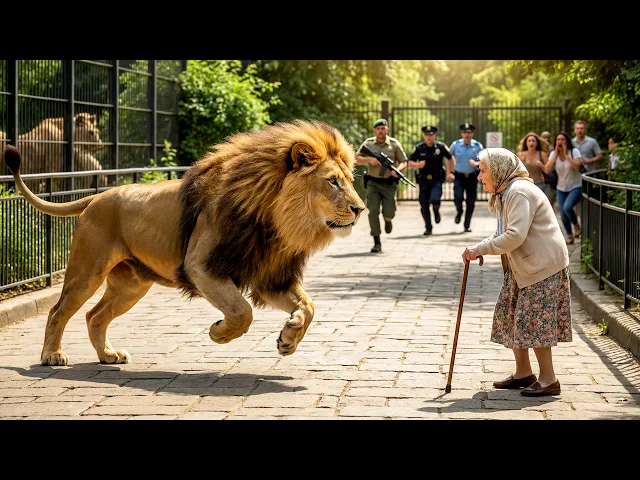
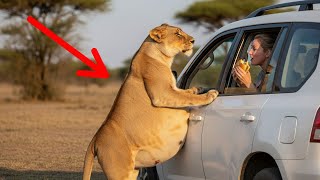
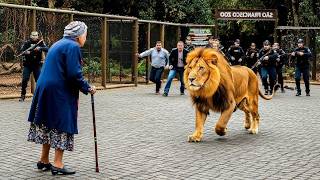
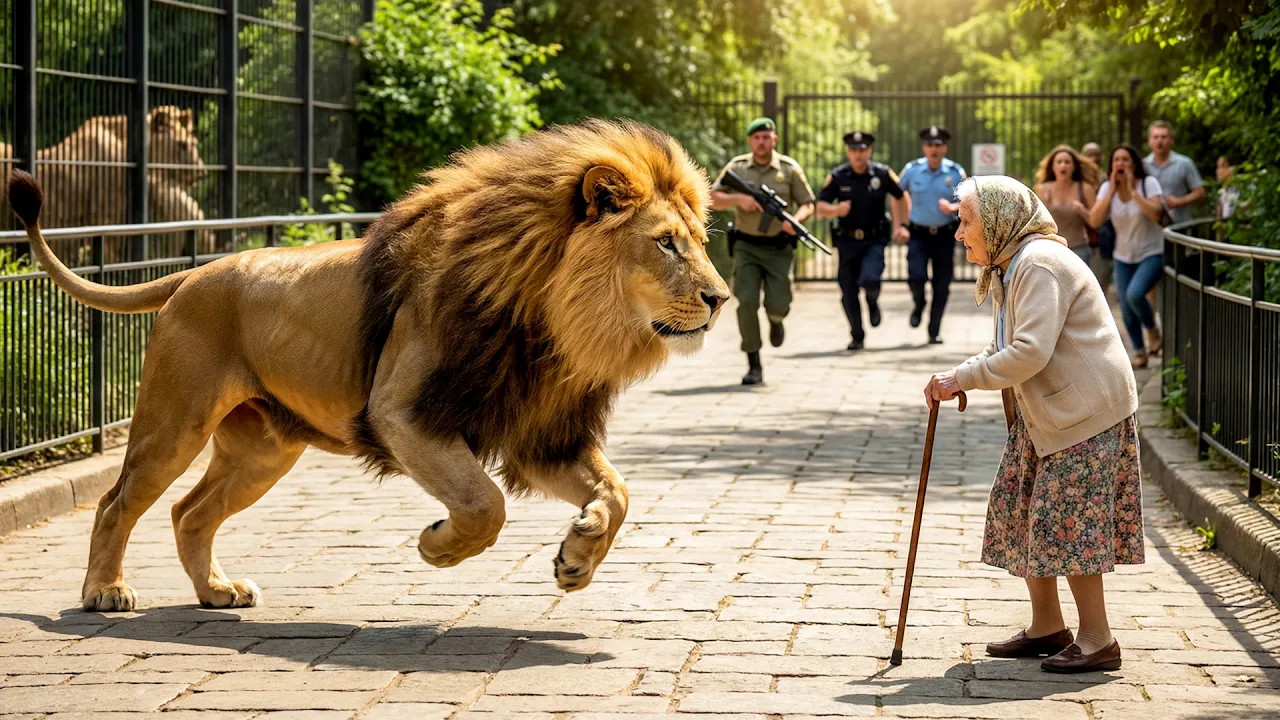
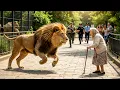
I was walking along the zoo's central path, checking the information signs, when I suddenly heard loud screams. At first, I thought one of the children had fallen or gotten lost, but the screams grew louder and soon turned into a full-blown panic. I ran toward the sound and literally froze in place when I saw a scene that could have been a real nightmare – a huge adult lion was running down the main path between visitors.
People scattered in terror, mothers grabbed their children and hid behind kiosks, a father shoved his wife and two small children into the gift shop and slammed the door, and an elderly couple froze at the fence of the zebra enclosure, afraid to move. The lion hadn't harmed anyone yet, but the situation was threatening. I grabbed the radio and screamed into it, demanding an immediate evacuation of visitors and a team with tranquilizers, then rushed to the lion's enclosure to understand how this could have happened.
The massive metal door to the enclosure was wide open, and the electronic lock hung on its hinges, clearly broken. I remembered that ten or fifteen minutes ago, a fire alarm had sounded throughout the zoo due to some malfunction in the technical building, and everyone had rushed to check if anything was wrong, and the automatic locks could have malfunctioned due to a power surge. Atlas—that was the lion's name—apparently simply pushed the door with his paw, and it opened, granting him freedom he'd never even dreamed of.
I ran after him and saw that he was running not toward the main exit, where the terrified visitors had gathered, but in the opposite direction, toward the service area of the zoo. The gates for food deliveries had been opened there today , and I realized with horror that if Atlas broke through them into the street, the consequences would be unpredictable. I ran after him, keeping him in sight, and heard the shouts of guards and the sound of sirens behind me.
Atlas did indeed burst through the open service gate, and I burst out onto the residential street a second later, just in time to see the huge orange cat disappear around the corner of a building. The street erupted into chaos—cars screeched to a halt, drivers panicked and scrambled back into their cars and locked the doors, a woman pushing a stroller screamed and ran in the opposite direction, nearly tipping it over, and a group of teenagers froze in disbelief at a store window. Atlas ran along the sidewalk, completely ignoring everyone, as if searching for someone— stopping periodically, sniffing the air, looking around, and then sprinting forward again.
I ran after him at a safe distance, holding the phone to my ear and shouting coordinates to the dispatcher, who was supposed to dispatch a team of veterinarians with tranquilizers. Atlas turned into a small park a couple of blocks from the zoo, and I saw an elderly woman sitting on a bench under an old oak tree, feeding pigeons bread crumbs from a paper bag. The lion slowed and began to slowly approach her, its huge paws padding almost silently across the grass.
I screamed at the top of my lungs to warn her not to move and provoke the predator, but she didn't seem to hear me over the noise of people running in panic. Several people walking in the park rushed for the exit, and someone pulled out a phone and started filming from behind a tree. The old woman turned toward the noise and saw the enormous lion a few meters away, and I braced myself for the worst, but instead of screaming in horror, she simply looked him in the eyes and said very quietly, almost in a whisper, "Atlas?
Is that really you? " What happened next I will never forget for the rest of my life. The enormous lion slowly lowered itself to the ground in front of the old woman, rested its massive head on her lap, and emitted a low purr, more like the purr of a giant cat.
The woman reached out a trembling hand and began to stroke its mane, tears streaming down her wrinkled cheeks. A minute later, zoo security and police cars drove up to the park, howling, and men with tranquilizer rifles jumped out. I rushed toward them, waving my arms and shouting at them not to shoot.
The senior guard looked at me incredulously, then at the scene on the bench where the elderly woman had her arm around the enormous lion's neck, and slowly lowered the barrel of his rifle. I quickly explained that the woman clearly knew this lion; there was some kind of connection between them. The guard ordered everyone to keep their weapons ready, but not to shoot.
I slowly approached the bench and asked the old woman to explain what was going on. Atlas didn't even turn his head in my direction; he simply lay there, his muzzle resting on her lap, his amber eyes half-closed. I sat down on the other end of the bench, so as not to upset the enormous predator, and as calmly as I could, asked her if she could explain how she knew this lion.
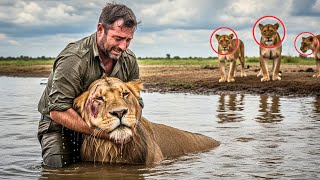
The woman wiped away her tears and began to tell a story that sent shivers down my spine. Twelve years ago, she was volunteering at a wildlife rehabilitation center. One day, rangers brought in a tiny lion cub found next to the body of a dead lioness— poachers had killed the mother for a trophy and abandoned the cub to die.
The cub was barely a month old, had a broken front paw, and had developed a severe infection. All the veterinarians said his chances were slim, but a woman named Margaret decided to try to save him. As she spoke, images seemed to unfold before my eyes—a tiny red bundle with huge, frightened eyes, a bloody paw being carefully cleaned and bandaged.
Margaret nursed the lion cub for three months. She bottle-fed him every two hours, even at night, gave him antibiotic injections, and massaged his paw. The cub gradually began to strengthen.
After a month, he could stand on three legs, a month after that, he began to take his first steps, and by the end of the third month, he had transformed into a playful cub who followed Margaret everywhere. I imagined little Atlas clumsily running around the enclosure, trying to catch his tail, Margaret laughing at his games. When the cub grew, the veterinarians took a follow-up x-ray.
The paw healed, but not properly; the bone was slightly crooked, and Atlas began to limp, especially after long runs or playtime. All the specialists agreed on one thing: he couldn't be returned to the wild because with such an injury, he simply wouldn't survive, wouldn't be able to hunt like the other lions in the pride, and wouldn't be able to escape danger. The only solution was to find a reputable zoo that would provide Atlas with a decent life, proper nutrition, and veterinary care.
Margaret personally contacted several zoos, researched their conditions and reviews from inspectors, and chose ours because we had an excellent reputation and spacious enclosures for big cats. She personally brought the now-grown Atlas, spent a whole day with him in his new enclosure, helping him adjust, and then left—one of the hardest days of her life. I asked why she hadn't visited him all these years, and Margaret explained that a week after Atlas was handed over to the zoo, she was urgently sent to Africa.
There, elephants were dying en masse due to drought and poaching, and experienced specialists were needed. She spent almost ten years in Africa, rescuing elephants, rhinos, giraffes, lions, and cheetahs. In fact, she was sure Atlas had died long ago—the average lifespan of a lion in captivity is ten to fourteen years.
A few months ago, Margaret finally returned home to retire, tired and aged, but happy to have helped hundreds of animals over the years. Yesterday, her granddaughter from out of town came to visit and persuaded her to go to the zoo, just for a walk, to look at the animals. They walked along the paths, looking at zebras, giraffes, and bears, and suddenly Margaret saw the lion enclosure.
The sign read: "Atlas, Male African Lion, Twelve Years Old. " She froze, disbelieving her eyes, and moved closer to the enclosure. The lion lay in the shadow of a large rock, and when Margaret quietly said his name, he raised his head and looked straight at her.
She saw the scar on his front paw—the same mark she remembered from a mishealed bone— and knew: it was HIM. Margaret wanted to approach the zoo staff, tell them who she was, ask permission to at least stand by the enclosure a little longer, but suddenly she became afraid—so many years had passed, she had no documents confirming her relationship with Atlas. What if they didn't believe her, what if they thought she was some crazy old woman making up stories?
She was at a loss, said goodbye to her granddaughter, and went home, but she couldn't sleep all night, remembering the way Atlas had looked at her. And this morning, when the fire alarm went off and the lock on the enclosure broke, Atlas simply pushed the door open and walked out. He didn't want to run away, didn't want to hurt anyone—he just wanted to find the woman whose scent, whose voice he'd recognized yesterday after twelve years of separation.
Lions have phenomenal memories and the ability to remember scents for years, and Atlas remembered the scent of the woman who saved his life when he was a helpless, dying cub. I sat there, listening to this incredible story, unable to contain my emotions. A crowd had already gathered around us—police officers, zoo guards, veterinarians with tranquilizers, and simply random passersby filming everything on their phones.
Atlas was still lying there, his head in Margaret's lap, and she was petting him as if he were a large house cat rather than a huge, dangerous predator . I knew the situation had to be resolved somehow—the lion had to be returned to the zoo because keeping him outside was simply impossible. But I also knew that if we tried to separate them by force, Atlas might attack, either defending Margaret or simply out of stress.
I called the zoo director and explained the whole story in detail. He was skeptical at first, rattling off security protocols, but I insisted. After lengthy negotiations, he agreed to a compromise: Margaret would receive a permanent VIP pass, allowing her to come to the zoo at any time and spend as much time as she wanted with Atlas's enclosure.
A special chair would be installed for her next to the enclosure. When I broke the news to Margaret, she burst into tears of joy. She leaned toward Atlas, pressed her forehead to his, and whispered something to him, and he closed his eyes and purred softly.
Then she stood up, and Atlas obediently walked beside her back to the zoo. The whole procession seemed surreal—an elderly woman in a summer dress, a huge lion at her side, and a crowd of people with guns and cameras all around. Margaret arrived at the zoo the next morning, just as it opened.
She brought with her an old photo album filled with moments in the life of the tiny lion cub Atlas—here he was sleeping, curled up on a blanket, there he was trying to catch a toy, there he was taking his first three-legged steps, there he was sitting in Margaret's arms, staring into the camera with his huge baby eyes. She showed me these photos, and I could hardly believe that this tiny, helpless bundle had transformed into the majestic beast who was now lying in his enclosure, watching us. Margaret sat down in the chair prepared for her near the railing, and Atlas immediately walked over to the glass, lay down on the other side so he was as close to her as possible, and they simply sat there, looking at each other.
From that day on, Margaret came every day, sometimes in the morning, sometimes in the afternoon, spending two or three hours at the enclosure. She brought a book and read aloud, telling Atlas about her life, what she had seen and done over the years in Africa, and the animals she had saved. Atlas always came up to her, lay down by the glass, and listened, his amber eyes intently following the movements of her lips, and sometimes he purred softly in response to her words.
Zoo visitors quickly learned of this amazing story, and many came specifically to watch Margaret and Atlas' encounters. Some filmed videos that garnered millions of views on social media, and journalists requested interviews, but Margaret politely declined publicity. She said this was her private time with Atlas, and she didn't need fame or attention.
I myself often stopped by the enclosure, watching them. I was amazed by how Atlas responded to Margaret—usually calm but rather indifferent to all visitors, he could lie in the shade all day, oblivious to the crowds of people at the fence. But as soon as Margaret appeared, he would literally come to life, stand up, stretch, and walk over to the glass, taking his favorite spot opposite her chair.
Sometimes, when the zoo closed and the visitors had left, I would allow Margaret to linger for an extra half hour, and in those moments of silence, their connection was especially noticeable. Atlas would place his huge paw on the glass, and Margaret would place her palm on the other side, and they would sit there motionless, as if time had stood still. Several months passed, and I noticed that Margaret had begun to lose weight, her face had become haggard, her movements had become slower and more careful.
I asked her if everything was okay, if she needed help, but she only smiled and said that she simply Old age was taking its toll, nothing special. Nevertheless, she continued to come every day, even when the weather turned bad and it started to rain—I saw her sitting in her chair under an umbrella, and Atlas lying under the canopy in his enclosure, but always within easy reach of Margaret. One morning, while I was making my usual rounds before the zoo opened, I stopped by Atlas's enclosure and noticed the lion was acting strange.
He was sitting by the glass, in the same spot where he usually lay during Margaret's visits, staring at the empty chair. Every now and then, he would let out a quiet growl, more like a plaintive howl, and I felt my heart clench. Margaret didn't come that day.
Nor did she come the next. By the third day, I realized something was definitely wrong and decided to go to her home, the address of which she had left at the zoo office for emergency contact. As I pulled up to her house, a neighbor, an elderly man watering flowers in his yard, saw me and approached.
He told me that Margaret had died three days earlier, in her sleep. She was found the next morning when her granddaughter, worried that her grandmother wasn't answering her phone, came to check on her. The doctors said she died peacefully, her heart simply stopping due to old age, without pain or suffering.
I stood there listening to these words, and felt tears welling up. I'd only known Margaret for a few months, but I'd already developed an enormous respect for this amazing woman who dedicated her entire life to saving animals and who found the strength to love and care even after years of separation. I returned to the zoo with a heavy heart and walked toward Atlas's enclosure.
The lion was still sitting by the glass, looking at the empty chair, and as I approached, he turned his head and looked at me. There was something in his amber eyes that made me stop—as if he understood Margaret wouldn't be coming again, as if he felt the loss as keenly as any human would. I sat down in her chair, and Atlas continued to look at me, then slowly lay down, rested his head on his paws, and closed his eyes.
He didn't make a sound, but his chest heaved, and I knew he was grieving. A week later, a lawyer representing Margaret's family came to the zoo. He brought documents that showed Margaret had made a will several months earlier, shortly after she met Atlas again.
She had left instructions that her small house be sold and the proceeds be donated to the zoo, with one condition: the funds were to be used exclusively to improve the living conditions of Atlas and the other big cats. The zoo director was amazed by her generosity and promised that every cent would be used for its intended purpose. I took personal responsibility for Atlas.
Every morning, I went to his enclosure first thing, bringing him the best cuts of meat, and making sure he always had fresh water and clean bedding. I talked to him, telling him about Margaret, how she loved him, how proud she would be of how handsome and strong he had grown. Atlas was noticeably depressed for the first few weeks, moving less, eating less, but gradually he began to return to normal.
He still went every day to the spot by the glass where Margaret used to sit, lay down there, and lingered there for a while, as if cherishing her memory. With money from Margaret's will, we significantly improved Atlas's enclosure—we added high platforms for observing the surroundings, more shelter from the sun and inclement weather, installed an automatic cooling system for hot days, and added new environmental enrichment elements—snags, stones for scratching, and different climbing levels. Improvements were also made for the zoo's other big cats—they expanded the space, updated the equipment, and installed modern veterinary facilities.
In the center of Atlas's enclosure, we placed a small memorial plaque with Margaret's name and a short inscription: "In memory of a woman who saved lives and gave love without limits. " Another year has passed. Atlas continues to live in his spacious enclosure, and I still visit him every morning.
He has become a true star of the zoo—people come from far and wide to see a lion with an incredible story, which has inspired dozens of articles and several documentaries. But for me, Atlas is more than just This landmark is a living reminder that the bonds between living beings can be stronger than any circumstance, stronger than time, and even stronger than instinct. Margaret and Atlas proved that love and memory know no species boundaries, that gratitude and devotion can live in the heart of even the wildest predator if someone once showed them true care and kindness.