Well, come on, Mr José, here again to take your Dipirona. My daughter, just tell me one thing. Does this medicine have any side effects that cause me to be in pain?
Rest assured that this medication is super safe and I am unaware of the side effects. Today I'm going to tell you everything you need to know about Dipirona bar Metamizol. So click the like button, subscribe to the channel and activate the bell so you don't miss any more videos.
Grab your coffee or tea and welcome to another Enfermagem Total video. You, nursing professional, are obliged to be there in your code of ethics saying that you are obliged to know the side effects, guide your patient, be able to answer their questions and have no doubts when administering a medication. So that's why this new series is starting here at Enfermagem Total, here on the channel, where I'll introduce you to some drugs that we use most in practice, whether in Brazil or around the world, so that you never have doubts about It's time to administer this medication to your patient and you can give that guidance exactly the way Corfen would like you to do it.
In fact, it is one of the steps of safe medication, that you have knowledge about this medication. What other names could this damn thing have? It's a hell of a name, okay?
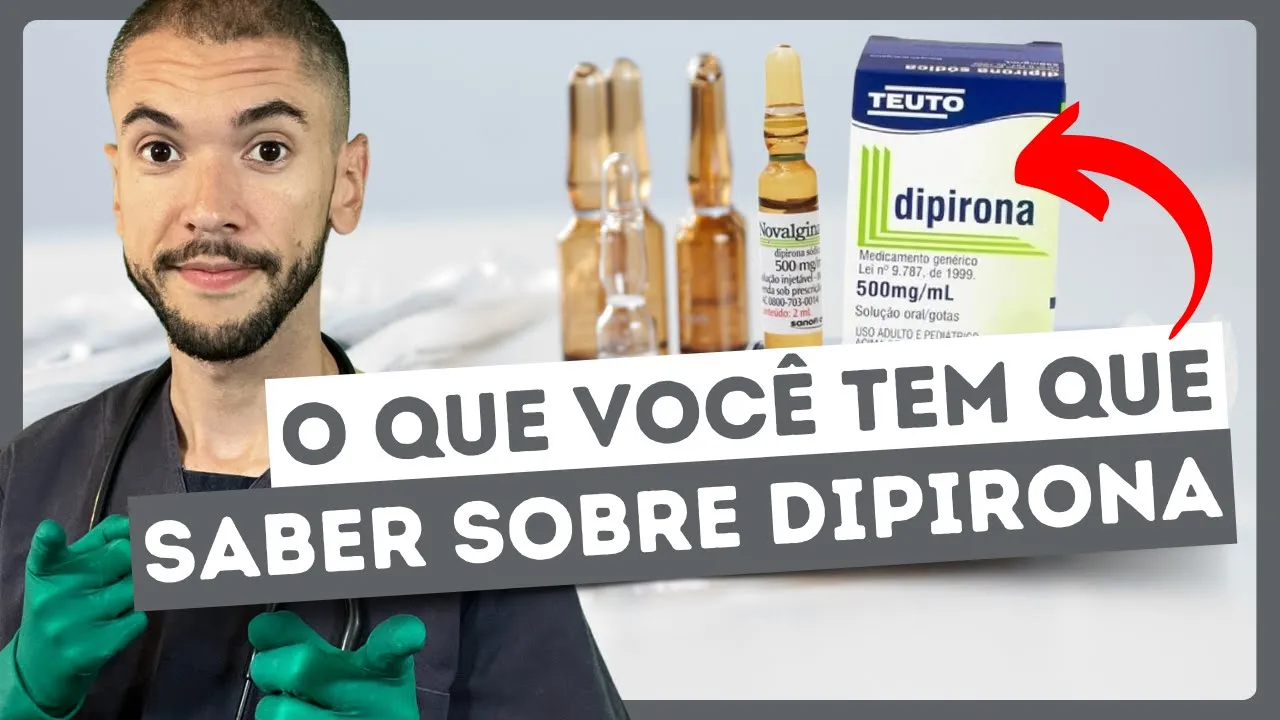
If you hear about algirone, anador, baralgim, difebreu, dipyrone, hostile pain, dorpiron, fendor, magnopirole, maxilivim and novalgin, we are all talking about the same medication, we are talking about the damn sodium dipyrone. What is dipyrone? What is metamisole?
If you come to work here abroad, it is important that you have the knowledge that they talk about metamisole. DIP for them is another medication, an extremely strong opioid, which would be DIP-DOLOR. In this case, we say metamizole, when we want to deal with dipyrone, okay?
So, if you hear about DIP, whether here in Germany or in any other country abroad, be careful as they will probably be talking about this opioid and not about dipyrone. Dipyrone is an antipyretic, spasmolytic and analgesic, of non-narcotic origin, which has a combined central and peripheral action. It acts both centrally and peripherally, look how beautiful it is.
And it is used to combat pain, spasms and fever, obviously. Antipyretic is something that is against fever, spasmolytic is against spasms and analgesic is against pain. Yes, I know, many people don't know that Dipirona also works against spasms.
In a much smaller, much less pronounced way, there are much better medications for this, but Dipirona C is also good for this. What is the duration of action of Dipirona? You took Dipirona, how long after it will take effect and for how long will it take effect on my patient or on me if I take this medication?
A tablet, if I'm going to take a pyrone tablet orally, it will take 30 to 60 minutes for it to start taking effect , in general we tell the patient 45 minutes for it to start taking effect, record this information there. With maximum concentration of 1 to 2 hours, then 1 to 2 hours after you take it is the maximum effect, the time when it will be having its best effect and the half- life, which is the time of duration, average of 5 hours. So, think that you took the diperone here now, let's make that naughty graph up here, you took the diperone now, in 45 minutes it will start to take action, this is in 45 minutes, its top action, here in the top, it will be 1 to 2 hours, and then the effect will start to wear off, it will take up to five hours to leave our body.
This is the curve that adipyrone makes in our body. As for the injectable solution, if you take adipirone powder intravenously, intramuscularly or administer it to your patient, the half-life and so on will remain the same, but it will start to act after five minutes. So this curve will not be that much, but it will be more pronounced, it will start to act much faster and it will take time for this effect to wear off.
What is the mechanism of action of dipyrone? How does it work in our organism? We have the graph here, it's easier for some people to understand because of the graph, but I'm going to read it here with you, okay?
The mechanism of action results in the induction of the synthesis of pyrogenic cytokines. That is, the body itself produces these pyrogenic cytokines, IL-1, IL-6 and tumor neucrosite factor and inferon, okay? So the body itself will produce this in the face of the microorganism, the toxin, so here it has come into contact with some microorganism, something that will trigger it, so the body itself, in a way to defend itself, will release cytokines that will connect to the cytokine receptors , these pulsuases will end up here, they will produce or they will stimulate the production of prostaglandin E2 and when this happens here, we will have the release of a neurotransmitter called AMPC that will result in an increase in hypothalamic temperature , a core temperature of the body, resulting in fever in the patient.
And where does adipirone come into play? Enter right here, at the time of this conversion. When the cytokine receptors are activated and they are about to activate the prostate glandin, adipyrone, paracetamol, non-steroidal anti-inflammatory drugs and ASS here, they end up interfering, they enter here precisely and block this stop so that the o body does not continue this production, this chain, and cause the patient to have a fever.
Very similar to this is also the mechanism of action related to pain. What are the side effects? This is perhaps one of the main things that you, nurse, nursing technician, nursing assistant, need to know.
Because you need to guide the patient during administration. MrJoão, there could be an allergy, you could have an allergy. If you have a pyronia allergy, or have never had it, but it could happen, you could have itching, you could have burning, you could have redness, you could have hives, you could have swelling, you could have shortness of breath, in this case they are all related to allergies, the change in heart rate, in blood values, could give something similar to anemia if you are going to collect blood soon.
So that's why it's always important to know whether you are administering this medication before or after a blood draw. If it is before, be sure to leave it as a note in the corner of the patient's blood test sheet that the patient had just taken Dipirona because it could indicate false anemia due to Dipirone. Fabio, it's very common, patients tell me that their blood pressure drops when they take Dipirona.
This ends up being more common with intravenous Dipirona, when you apply intravenous curved Dipirona , a transient hypotension usually occurs , we call it, and why does this transient hypotension, which is something that happens quickly and then returns, happen in this case. Because remember that the curve happens much faster, you have a peak of action much faster, so think that this blockage of prostate glandin production was extremely fast, very agile, this makes a very sudden change in your homeostasis, which is that It would be your state of health up to date, and that makes that sudden change, that crazy thing, the body responds like lowering blood pressure to do what? To sit.
The body is smart, it will lower your blood pressure for you, don't worry, I can't waste energy, I'm wasting energy on other things here, okay? So this usually happens intravenously, so one of the recommendations for you if you are going to administer intravenous dipyrone to patients is that they are sitting, because if they are standing and it happens, it might not happen, but if something happens transient hypotension, he will probably go to the floor. And this last side effect here is the reason why you cannot buy metamizole in the pharmacy here in Germany.
For example, in other countries the consumption of dipyrone is also prohibited because of agranulocytosis. Fábio, what is this? It is a rapid and marked reduction in leukocytes, your body's defense cells.
It's rare, very rare to happen, but it can. And that is why many countries do not allow excessive consumption of dipyrone. This is the case, for example, here in the country where I live, where I work, and metamizole, it is exclusive in an interhospital sector and even within the interhospital sector it is boring, especially when we talk about intravenous, generally, for my work in pediatrics, so in pediatrics it is super controlled, you have the quantity of ampoules and keep the hull, the same way we do, I don't know, with Midazolam from Brazil, we keep the ampoule, we have to show it, know how many we spent to ask for the next one, it's the same thing as with dipyrone, so see how people are traumatized by this and rightly so , right, because here there have actually been many cases of agranulocytosis, in Brazil not so many, that's good, but it could be happening , so know this, that this is perhaps one of the worst side effects of dipyrone, which is this marked reduction in lekocytes, which practically destroys our patient's physiological defense.
This part is also extremely important for those of you who work in nursing, or are going into the internship sector , or are researching dipyrone now. What are the drug interactions of dipyrone? Chlorpromazine decides to take dipyrone together.
Be aware that it could be causing severe hypothermia. So, chlorpromazine will accentuate this antipyrone effect of dipyrone and you will have Hypothermia will lower your temperature too much. Contraceptives end up increasing the period of activity of dipyrone, so if you are a woman, taking contraceptives and taking dipyrone, know that this effect, and then all the side effects in turn, if you experience any side effects, they they may be lasting longer than 5 hours, which was the half- life of dipyrone, so you may be lasting much longer , this effect, such a positive effect, which would reduce your fever, take away your pain, but in turn it can also increase the side effect.
And barbiturates reduce the effects of dipyronia. And finally, so that we can skip this class, what are the contraindications when you should not be applying dipyronia to your patient? Children under 3 months or weighing less than 5 kg, use the ruler, do not apply dipyronia.
Pills, right, in turn, are not recommended for children under 15 years of age. So, pirona, a tablet from 15 years of age, this was recommended by the manufacturers themselves and I even took it to create this Brazilian leaflet class, okay? Don't take it based on the leaflet here from abroad, take it based on the Brazilian leaflet, it is made clear that they do not recommend that you apply pills to children under 15 years of age, so opt for drops or suppositories.
but tablets from 15 years of age and pregnant or breastfeeding women are prohibited, do not take diipyrone because it can either cause complications in your pregnancy or , if you are breastfeeding, pass on this effect of diipyrone. for your baby where the dose you took is extremely high for a small baby and this can cause very serious problems and side effects in your baby. Well, I hope that from now on your application of dipyronone to your patient will be much safer.
If you have any questions related to dipyronone, which I didn't talk about here in this class, write to me in the comments and I'll give you an answer, if not I'll even bring you a video explaining your question. And I'll see you in our next video here on the channel. To the next.
Bye Bye.