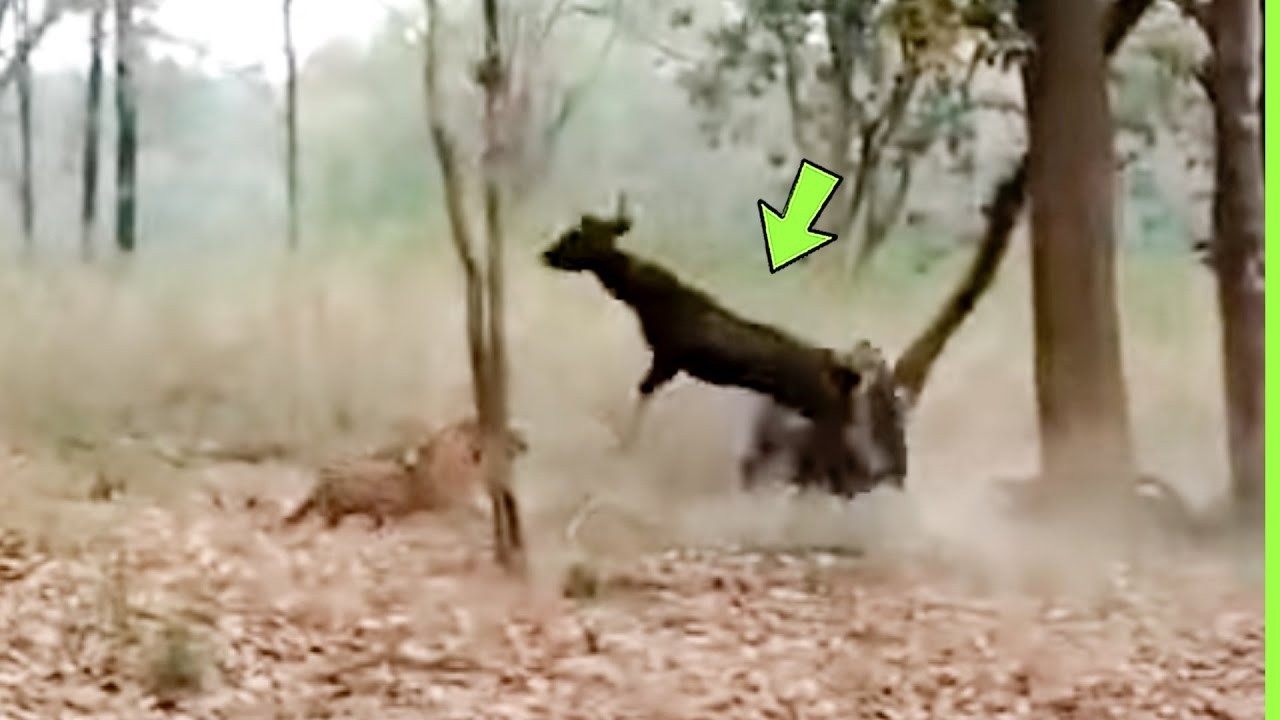
Have you ever wondered what happens when cute, cuddly wild cats suddenly become terrifying predators? Get ready to witness some of the most spectacular wildcat attacks ever caught on camera. From lightning fast ambushes to heartpounding battles, these aren't ordinary hunts, but extraordinary displays of raw power, speed, and unmatched killer instinct.
Brace yourself as we dive straight into the thrilling world of wild cats. The bobcat is a medium-sized wild cat primarily found in North America. It is distinguished by its short tail measuring between 4 to 6 in and a body length ranging from 2 to 3.
2 ft. Weighing 11 to 33 pounds. As a seasoned predator, the bobcat primarily targets small prey such as rabbits and birds.
seizing the opportunity to strike with swift and precise attacks. However, when food becomes scarce, it can hunt deer, especially the old, weak, or injured. With night vision six times stronger than humans, the bobcat can hunt effectively even in low light conditions.
[Music] When closing in on its target, the bobcat moves silently before suddenly accelerating to up to 29 mph to deliver a fatal pounce. It relies on ambush tactics, aiming for critical points to end the chase swiftly. Afterward, it drags its prey to a safe location to avoid losing its kill to other predators.
With razor sharp claws and exceptional climbing skills, it can leap as high as 9 to 16 ft to chase its [Music] prey. While hunting deer is impressive, the bobcat's primary food source is squirrels. Abundant in areas near human settlements.
This agility contributes to the bobcat's remarkable hunting success rate for squirrels, reaching up to 70%. In rare cases, bobcats may confront dogs, especially when they feel threatened or need to defend their territory. [Music] Although they are not large cats, they can put up a fierce fight using their tactical skills.
Hidden within the dense forests stretching from the US to Argentina, the ocelot is a highly agile predator with sophisticated hunting strategies. They are primarily nocturnal, relying on their sharp eyesight to navigate the darkness and their highly sensitive ears to detect even the slightest movements of their prey. The ocelot is perfectly camouflaged with a golden coat covered in black spots, allowing it to remain hidden and ambush its target undetected.
The ocelot is a versatile predator capable of hunting a wide range of animals depending on its habitat. A study in Venezuela found that 65% of the ocelot's diet consists of rodents, while in Brazil, they tend to favor hunting birds and reptiles. [Music] [Music] Thanks to their exceptional climbing abilities, ocelots can chase prey through the trees or ambush from above.
Meanwhile, their strong swimming skills allow them to hunt even in swamps and along river [Music] banks. High above, a troop of golden lion tamarind plays without care. oblivious to the predator lurking below.
The ocelot hugs the ground, its spotted coat blending seamlessly with the dappled light filtering through the canopy. A perfect natural disguise. Its cold, calculating eyes lock onto every movement, while its broad paws allow it to glide silently over the dry leaves.
But then a warning cry pierces the air. It shatters all of the Ocelot's plans. The prey has escaped, but the Ocelot's chase is just getting started.
The blackfooted cat, the smallest wild cat in the world, primarily inhabits the grassy scrublands and deserts of Namibia, Batswana, and South Africa. Despite weighing only 3. 3 to 5.
5 lb, it is an exceptional hunter, boasting a staggering 60% success rate, far surpassing even that of lions. Small but formidable, the blackfooted cat is a true master of the night. They can roam over 20 m across grasslands and deserts all night for prey.
Its large, piercing eyes cut through the darkness, while its ultra sensitive ears detect even the faintest sounds. With incredible agility, lightning fast reflexes, and adaptable hunting strategies, it takes down its prey precisely and efficiently, leaving little chance for any small creature to escape. The black-footed cat has a diverse diet, including mice, birds, insects, lizards, and small hairs.
A single adult can hunt up to 14 prey in one night, ensuring the energy needed to survive in its harsh environment. Despite its small size, the black-footed cat is one of Africa's most efficient predators. A testament to the fact that size does not determine effectiveness.
In the wild, this tiny hunter is nothing short of formidable. The cougar, also known as the puma or mountain lion, is one of the few big cats capable of thriving in many environments, from dense jungles and grasslands to high altitude mountains. With a body length ranging from 5.
9 to 7. 8 ft and a weight between 66 and 242 lb, it is one of the most successful solitary predators in the Americas. Unlike other big cats that often hunt in groups, the cougar is a solitary predator, primarily active at dusk and during the night.
Rather than engaging in long chases, it relies on stealth, patiently stalking its prey before launching a sudden, powerful attack. [Music] With the ability to leap vertically up to 18 ft and cover a horizontal distance of 39 ft in a single bound, the cougar can seize its prey before it can react. Guinakaco are the primary food source for cougars, but they also hunt smaller animals such as wild boars, rabbits, raccoons, and occasionally livestock.
An adult cougar can take down a guanako approximately every 10 days and often drags its kill to a safe location to feed on it over time. When necessary, cougars can roam vast territories up to 370 square miles in search of food. Although cougars lack the thunderous roar of lions or tigers, they are no less formidable in the wild.
As solitary hunters, cougars are fiercely territorial and rarely tolerate intruders. Their domain is everything. It provides food, shelter, and the right to survive.
When another cougar crosses the invisible boundary, a tense standoff may follow. It doesn't always end in bloodshed, but every step and growl is a warning. Power belongs to the strongest.
In this silent war of shadows, only the most dominant cougars get to decide who stays and who must vanish into the wilderness. The Lynx is a master of survival in the frigid forests and rugged mountains of the northern hemisphere. With an insulating thick coat, it can withstand temperatures as low as -50° F.
Despite its medium size, measuring between 2. 6 to 4. 2 2 ft in length and weighing 17 to 66 lb.
The Lynx possesses powerful long legs and broad snowshoike paws that allow it to move effortlessly across deep snow without sinking. Its tufted ears help retain warmth and enhance its hearing. enabling it to detect prey from great [Music] distances.
As a master of solitary hunting, the Lynx stands out for its patience and keen observational skills. [Music] Its diet primarily consists of hairs, squirrels, and birds, but during harsh winters, it may shift to hunting fawns or weak elderly deer. The lynx rarely engages in long chases.
Instead, it relies on stealth, gradually closing the distance while waiting for the perfect moment to strike. With its powerful leaps and lightning fast reflexes, it can take down its prey instantly before it even has a chance to [Music] react. In addition to reaching up to 40 mph, the lynx can leap as far as 15 ft in a single pounce, allowing it to chase down prey, or clear obstacles in dense forests swiftly.
This combination of strength, hunting prowess, and adaptability to freezing environments makes the lynx one of the most formidable predators of the wild Arctic regions. [Music] There is no way out for this marore. The caracal is a wild cat renowned for its speed, agility, and exceptional hunting skills.
Its powerful legs enable it to execute explosive jumps, swiftly snatching prey out of the air. With lightning fast reflexes and highly dextrous claws, the caracel can accurately catch birds mid-flight before they have a chance to escape. This rare ability makes it one of the few feline species capable of such a feat, solidifying its status as a formidable hunter, both graceful and incredibly powerful in the wild.
Primarily inhabiting the arid grasslands and rocky terrains of Africa, the Middle East, and India, the kacall is a highly adaptable predator. Measuring between 2 to 3. 5 ft in length and weighing 18 to 40 lb, it can take down prey twice its body weight.
Small analopes, hairs, rodents, and even large birds like peacocks can all fall victim to its formidable hunting [Music] skills. A caracel moves silently, scanning its surroundings for prey. Lightning fast reflexes.
Though the prey tries to escape, the caracall's raw power and razor sharp hunting instincts give it the upper hand. With effortless precision, it dominates the moment. As the dust settles and silence returns, its meal is now well within reach.
[Music] Possessing a perfect blend of speed, power, and sophisticated hunting strategies, wild cats have mastered survival in diverse environments. Whether in dense jungles, scorching deserts, or icy landscapes, each species develops unique skills to adapt, employing distinct tactics such as stalking, ambushing, or direct attacks to maintain their dominance in the food chain. Which wild cat impresses you the most?
Let us know in the comments below. Don't forget to like and subscribe to support the channel. Hit the notification bell so you never miss our thrilling videos.
Thank you for watching and see you in the next exciting adventure.