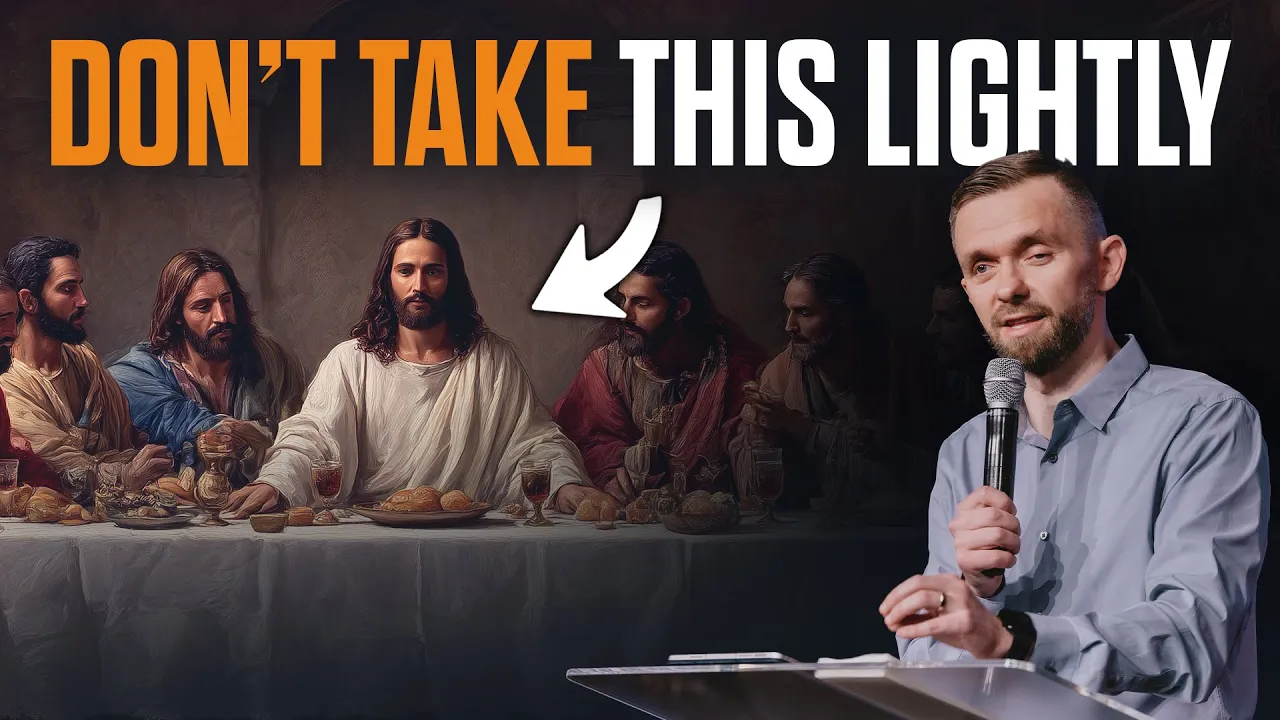
I want to take next few moments and talk about the meal, talk about the Holy Communion, talk about what happens when we take that. We must understand that in the beginning, when Adam ate the forbidden fruit in the garden, the Bible says the eyes of both of them were opened, but opened to their shame, opened to their sin. That meal that Adam and Eve ate brought death, brought sickness, and destruction.
Years later, thousands of years later, two disciples walked with the resurrected Christ on the road to Emmaus, and they didn't recognize Him. It was not until He sat at the table, broke bread, and blessed it that the Bible says their eyes were opened and they recognized Him. In Adam eating, opened our eyes to sin, but at the Lord's table, eating opens our eyes to the Lord.
Come on, it opens our eyes to who Jesus is. This is not just an event that happened 2,000 years ago; it is an event that Jesus tells us to celebrate and keep remembering, because there is power, there is mystery, and there are miracles that are going to happen when we begin to remember what Jesus did for us. I want to highlight a few things about the Holy Communion.
As we approach the Lord's table, and the first one is that in the early church, Holy Communion was central. The scripture says in the book of Acts 2:42, "They devoted themselves to the apostles' teaching and to fellowship and to the breaking of the bread and to prayer. " 1 Corinthians 11:20 it says, "Therefore when you come together in one place, is it not to eat the Lord's supper?
" It's interesting when Paul talks about the early church gathering; he's not talking about a parking lot, a coffee shop, a kids' ministry. He's not talking about a smoke machine, a 30-minute worship, and 40-minute sermon. He's not talking about even offering.
He says, "When you come together, don't you come together to eat the Lord's supper? " May I submit to you that in our Western world, we have reduced the Lord's supper to something at the end of the service. In the early church, it was the service.
In our thing, it just happens once a month. For them, this was the reason they gathered; they gathered around the Lord's table. When somebody was told to encounter the Lord, they didn't necessarily mean by what we mean today - you know, just open your Bible and read, they meant go to the table of the Lord, and you will encounter God, remember His death, remember His sacrifice.
It's interesting that the Lord's table was not just a side ritual; it was the main act of Christian worship. Early Christian gatherings were actually called agape feasts, meaning love feasts. They shared meals that were centered around the Holy Communion.
They were so central to the belief and the practice of the early church that the pagans and Romans accused Christians of cannibalism due to the secretive gatherings and the language that they used in their gatherings, called eating the flesh and drinking the blood of Christ, which shows this was not a side element to preaching, to music, to announcements. Contrary with the early church, the Holy Communion, the Lord's table, Jesus' cross was the climax; it was the center; it was the reason; it was the core; and it was the main attraction of the gathering. The second thing that I want to highlight is when Israel ate manna to survive the wilderness; we partake of Christ to thrive in our walk with Him.
I want you to notice in John 6:51, it says, "I am the living bread that came down from heaven. Whoever eats this bread will live forever, and this bread is My flesh, which I will give for the life of the world. " I want you to notice when Jesus compares the bread Israel ate in the wilderness, He doesn't compare it to daily manna that we like to compare it as, like if you just open your Bible every day and get a revelation, then this is your daily manna that comes from heaven.
The biblical context of the manna in the wilderness for Israel that sustained them for 40 years, according to Jesus, not according to Pastor Vlad, not according to your favorite YouTube channel preacher, according to Jesus. Jesus does not compare manna that fell from heaven that fed Israelites for 40 years to a daily devotional life. He compares manna to His bread, to His body, and to His blood, and He said, "The same way God gave manna every single day to Israelites to eat, He says God is now giving a bread; I am that bread; and if you eat Me, if you live off of Me, like Israel survived the wilderness, you will thrive in your walk with Me.
" Jesus is your daily manna. The Lord's table is where you get a chance to partake of the Lord's body. And that was given to you.
Jesus said in John 6:53, "Unless you eat the flesh and drink My blood, you have no life in you. " Which means the partaking of the Lord, receiving, and this is not only believing that Jesus died on the cross but actually taking part in that, remembering what He did produces life in us. This was shocking for Jewish ears because Jewish people believed you shouldn't be drinking blood.
So here is Jesus saying, "Drnk My blood. " It offended some, but I want you to see something in the scripture, in the Old Testament, 2 Samuel 23:17. David refused to drink water from his men who risked their lives for him by saying the following: "God forbid that I should drink the blood of these men.
" David wasn't talking about drinking the blood of his men; he was talking about this: God forbid I benefit from these men risking their lives for me. So when David said "drinking the blood of someone," he meant in the scriptural context is benefiting personally from someone's sacrifice. Now, his men didn't give their blood for David; they risked it.
The men Jesus Christ didn't risk His life; He laid His life down. He commands us, invites us to benefit from His sacrifice. He says, "Eat My body.
" Meaning, they broke through the Philistines' camp to bring David water, and David says, "I can't do that. I'm going to pour water out; this is the blood of these men. " But Jesus Christ, He breaks through hell; Jesus Christ breaks through sin; Jesus Christ breaks through sickness, demonic principalities, and powers; gives His life in return; and tells us, "You need to; this is not an option.
" The way you honor My life is that if you eat My flesh, drink My blood, meaning benefit from My sacrifice. You need to benefit. I didn't risk My life; I laid My life down; I gave My life for you as a ransom for many.
Drnking His blood, eating His flesh, means you personally benefit from what He did at the cross. Don't be like David; don't take that, spill it and say, "No, I can't do that. " Jesus invites you; He didn't risk His life to prove to you He's a brave God; he risked His life because His life is your only way to have yours.
In communion, we drink the blood of the One who died in our place, the One who quenches the thirst of our souls, not with water, but with His very own life. In 2 Samuel, chapter 9:1-19, it talks about Mephibosheth, and it says, "And so Mephibosheth dwelt in Jerusalem, for he ate continually at the king's table, and he was lame in both of his feet. " It mentions four times (2 Samuel 9:7, 9:10, 9:11) that Mephibosheth was eating at the king's table.
We know that David makes a covenant with his father Jonathan, Mephibosheth's dad, and now Mephibosheth is invited to the table of David because of a covenant his father made with David, not because of Mephibosheth's worthiness. What happens at the Lord's table is not because God made a covenant with you; it's because God made a covenant with Jesus. You remember at the Lord's Supper, Jesus did not say, "And this is the covenant you are making with God.
" He says, "This is My covenant; you're invited. " Because when God made covenants with man, men always broke them, but God made a covenant with His Son, Jesus Christ, and we are like a branch in Jesus, and that covenant cannot be broken because that covenant is made with Jesus. And we are like Mephibosheth; there is a covenant that's been made, and that covenant has been made between God and Jesus through the blood of Jesus Christ, and we are the recipients of that covenant.
I want you to notice that not only was there a covenant with another, but Mephibosheth was restored; everything that he lost. And when Jesus comes into your life, He restores what sin has stolen; He heals what sin has made sick; He mends what sin has shattered in your life. Jesus doesn't just come to clear your record; He comes to restore what the enemy has stolen.
That's why when you get saved, you begin to experience your family coming together; you begin to experience the business and the finances beginning to come together; you begin to experience your health improving. Why? Because Jesus restores.
Somebody shout, "restores. " Not only that, but Mephibosheth wasn't just restored; he lived in Lo-debar, which means "no pasture," far from the palace, but now he was brought near. We who were far off are now brought near to the presence of God.
What I find interesting is that when Mephibosheth was restored, Mephibosheth was treated kindly, but the part that keeps being mentioned four times: it was not about him getting his possessions from his father back; it was not even him being treated kindly by the king, which was nice and precious. It was the fact the Bible says this about Mephibosheth, a man who was lame in his feet, that he was invited to be like one of the king's sons, to sit at the king's table. Now watch this: daily, not annually, not on inauguration or big meetings, the king said, "I'm restoring you; I am pulling you out from this place of no pasture; I'm bringing you close, and I want you to sit at my table continually.
" It brings to my memory, because our King Jesus, we were crippled by the fall of Adam; Adam dropped us, and since then, all of us are born with a crippled nature, called sin nature. But our King Jesus, He came into our world; He made a covenant with God in His blood; He restores us; He brings us near; and He gives us a table that He invites us to eat at continuously. But at our King's table, we don't eat the pleasantries of the world; we actually eat our King's life.
Our King lays His life on that table and says, "Eat My flesh; drink My blood," meaning, "I want you to continuously feast at My table. " The Lord's table is the King's table. When Mephibosheth would sit under, His feet would be covered by that table; no longer was he lame when he was sitting at that table, but he would get out of that table still be lame.
But the table of our Lord Jesus Christ, it doesn't cover our shame; it changes our character; it transforms us, because He says, "If you eat My flesh, you'll have life inside of you. " You're not just going to feel better for a moment; you're going to be different. The Lord gave His life for us, and He wants us to benefit from it.
What happens at communion when we take communion? Four things must happen, and the first one is during communion, we look back. We remember the cross; we remember His broken body and shed blood; we remember the night He was betrayed and what He did for us that night.
This is what Jesus said: "This is My body, broken for you. Do this in remembrance of Me. " Communion is not about you trying to be worthy; it is about you remembering He was worthy, and that was enough.
It's about looking back. Anytime you take part in communion, look back to what He did on the cross. He said, "Do this in remembrance of Me.
" The second thing that happens when we take communion is we look forward. The scripture says, "For whenever we eat this bread and drink this cup, you proclaim the Lord's death until. .
. " Somebody say "until. " Until He comes.
Communion is not just remembering the past; it's about proclaiming His future return. Yes, every time you take communion, you're not just remembering He died and rose again; you're remembering His coming back. Come on, and one day we will have a supper with Him; the bride will have that supper with the Bridegroom in heaven.
Communion is also a time we look around. Somebody say "around. " Paul rebuked Corinthians for not honoring each other while taking communion.
Communion is not just about you and Jesus; it's about us and Jesus. Communion is not just "I'm just focusing on my relationship with the Lord, and that's it. " Communion is "I look around; how am I doing with people around me?
" If you're not doing well with those people, you have to repent. This is not about how you are in the Lord; it's about how you are with people as well. In fact, the early church in Corinth, how they had this communion, was not like this, where we have today.
They actually, it was more of like a potluck lunch or supper. Everybody would bring food, and they would have an agape feast, meaning this was a feast. That's why Jude says, "He says these people love to have seats in our love feasts.
" It was a love feast. And so what started to happen is the rich Christians who had plenty would bring their meal earlier, before the service, and eat it all as part of the holy communion. The poor Christians who couldn't afford to bring any food would come on time to church service and feel embarrassed because, well, there was nothing to eat, and the rich Christians ate everything because they didn't want to share.
And Paul writes this letter, and he actually rebukes Christians, and he says, "Why do you come early, before other believers, and make them feel ashamed? " He's like, "Isn't this whole thing about the body? " He says, "We have to discern the body.
" And it's not just talking about Jesus' body that was on the cross, but His body that's on the earth. Holy communion is not just thinking about the body on the cross; it's thinking about the body that's sitting next to you right now. So if there is offense, if there is bitterness, if there is unforgiveness, if there is hatred against another believer, and while we don't have this thing where the first person comes, eats their own food, and the other people don't have food, but we can foster unforgiveness; we can foster other things.
Paul says it's better not to take this communion if you harbor unforgiveness; if you harbor things against the body. Discern the body. This doesn't mean perfection, but it means purity.
This doesn't mean we come to the Lord's table, and we are sinless, but it does mean that if we have something in our hearts against somebody, we deal with that. And if we do take the communion, you'd better be going and repenting and forgiving that person right after that, because the Lord is not pleased if holy communion is taken, and His body is not discerned. Again, it's not just the body on the cross; it's the body on the pew.
And the next thing that we do is when we take communion, we look within. What does that mean? Paul says, "Let a person examine himself, and then eat of the bread and drink of the cup.
" Again, you don't need to be perfect, but you don't approach this table without examining your own heart. Where am I at with the Lord? Am I pleasing to the Lord?
And if there are things in your life that are not pleasing to the Lord, this would be a good moment to confess them. This would be a good moment to say, "Jesus, I'm not worthy in myself; cleanse me by Your precious blood; purify me today, in Jesus' name. " Amen, Amen.
One of the things that we're going to do in just a moment is we're going to take communion, and then afterward, we are going to pray for healing. And I want to highlight something in 1 Corinthians 11:29; it says this: "For he who eats and drinks in an unworthy manner eats and drinks judgment to himself. " Like I mentioned, not discerning the Lord's body.
For this reason, now watch this: I have not seen one example in Apostle Paul's writings where Paul gives reason why people get sick, except this one. Not one reason I've found in Paul's writings where Paul gives reason why people are weak, sick, and die prematurely. I would have thought Paul would say, "Because they have some kind of a curse.
" I want you to notice what Paul says: "For this reason, many, not few, many are weak, sick, and asleep. " This doesn't mean they fall asleep in the church service; this just means they died. That's a biblical, New Testament way; they're dead.
Weak, sick, prematurely die. Paul's saying this can harm you. Now, while this is scary, he also says, "If we would have judged ourselves, we would not be judged; but when we are judged, we are chastened by the Lord, that we may not be condemned with the world.
" If taking communion the wrong way can make you weak, sick, and die prematurely, imagine what taking it the right way can do. If taking the Holy Communion can make you weak if you take it the wrong way, you're not discerning the body; you're not thinking about the Lord; you are not thinking about Him coming back at all; it's just a little meal; you just kind of take it, and that's it, because it's a ritual. Or you hold a grudge against a believer while you're pretending to discern the body of Jesus Christ to honor His body.
Paul is saying that is wrong; God is not going to be pleased with that, and that actually can harm us. Now, these are scary words, but the opposite is also true. If taking it the wrong way can bring sickness, can bring weakness, and can bring even premature death, if you take it the right way, it can bring strength; it can bring healing; and long life.
Dr John Miller, a chiropractor who studied communion for over 20 years, discovered that communion is not just a memorial; it's a healing meal. Communion became a daily exchange for him. He says, "Chewing piece by piece, exchanging my sickness for His healing.
" Dr Miller's own healing happened like this: he had chronic headaches, and they disappeared as he took communion daily, focusing on Jesus' broken body. His friend's peripheral vision was restored during a late-night communion after a car accident. A woman with Epstein-Barr virus, 40% of her liver was destroyed, took communion three times a day, and a year later, her liver was completely healed.
A Florida pastor was diagnosed with kidney cancer; began recovering after his mother brought communion to the hospital. Jessica Kouliano's grandfather, Pastor Roy, he had terminal kidney cancer; he started to take daily communion; Jesus appeared to him and healed him. Not only was his cancer gone, but he received brand new kidneys, verified by his atheist doctor, who later said, "There has to be a God.
" Roy lived 20 more years after testifying of God's healing power by taking the Lord's Supper. I visited just a church in Florida where I heard this testimony, and I asked them to give me clear details this week, and they verified it and sent it to me. On October 2024, which was last year.
Iris Cortis Madrid went to the ER for severe abdominal pain and was treated for a large ovarian cyst with no signs of pregnancy in initial tests. Later, she was diagnosed with an ectopic pregnancy; her baby was in the fallopian tube; her life was at risk, and abortion was recommended. She refused the diagnosis; she cried out to God; attended a worship service; declared, her baby will live; and started to take daily communion, anointing her stomach with oil.
A week later, the doctors were stunned to find a baby growing and somehow connected to the uterus. 3 and 1/2 months later, after a dream from God, the pregnancy was confirmed to have moved supernaturally into the uterus, something medically impossible without surgery. God not only preserved the baby; just as He had previously healed her eldest son from autism, her pregnancy continues, and her story continues to be developed, and the baby is growing healthy.
She took communion three times every single day. I want to encourage you with something today, to treat this sacredly, because what happened on the cross changed history, and Jesus said, "Remember this; anytime you eat this bread and you drink this cup. " Whether you choose to do communion every day, whether you choose to do communion every Sunday, I want to encourage you that every single day you feast around the Lord's body; your encounter with God should entail you feasting on Jesus.
Yes, He's the living word, but Jesus gave Himself to us. Take a moment of reflection; remember what Jesus did; remember Jesus is coming back; examine your heart and examine your relationships. I want you to bow your head and close your eyes.
If there is sin in your life, if there are relationship things that you do that are not pleasing to the Lord, I ask you in all seriousness that you ask Jesus to forgive you right now. If you are here today and you're not a believer, this is a perfect moment to say, "Jesus, forgive me of my sins; I want to be saved. " And right there, where you are standing, the precious blood of Jesus can cleanse you and make you whole and make you new.
Every eye closed and every head bowed, say this with me, say: Lord Jesus Christ, as I hold your body, as I remember your blood, I look back with thankfulness for what you did on the cross. I look forward with hope that you're coming back. I look around with love, for those around me.
And I look within, cleanse me; purify me; and make me whole. And as I take this communion, I don't take it into judgement; I take it into life, to feed on your body; to feed on your blood; to receive benefits from your sacrifice. Thank you, Jesus.
I hope that this video helped you to grow in your walk with God. Imagine multiplying that impact through the world. Through this ministry, we've discipled over 160,000 students through our online school, created over 60 reading plans that over 2 million people have completed already, and published resources in 18 languages.
But our heart is bigger than content; we're feeding orphans, building homes, and partnering with missionaries on the front lines of the gospel. Would you consider becoming a monthly partner? Every dollar helps to reach, teach, and care for more people.
Click on the link below to become a part of this movement. Thank you.