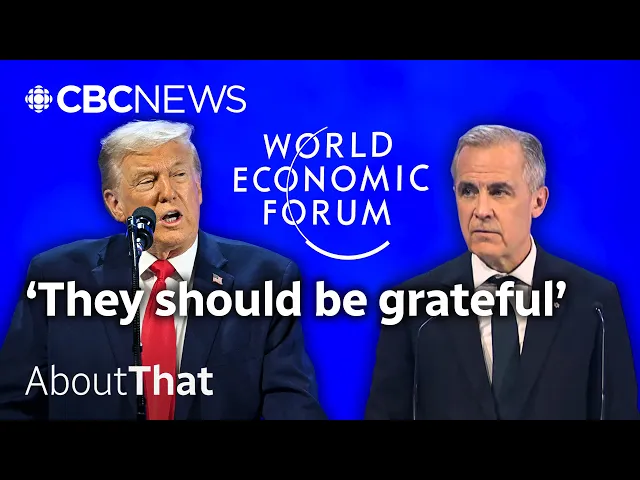
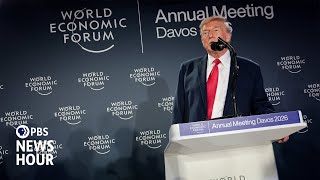
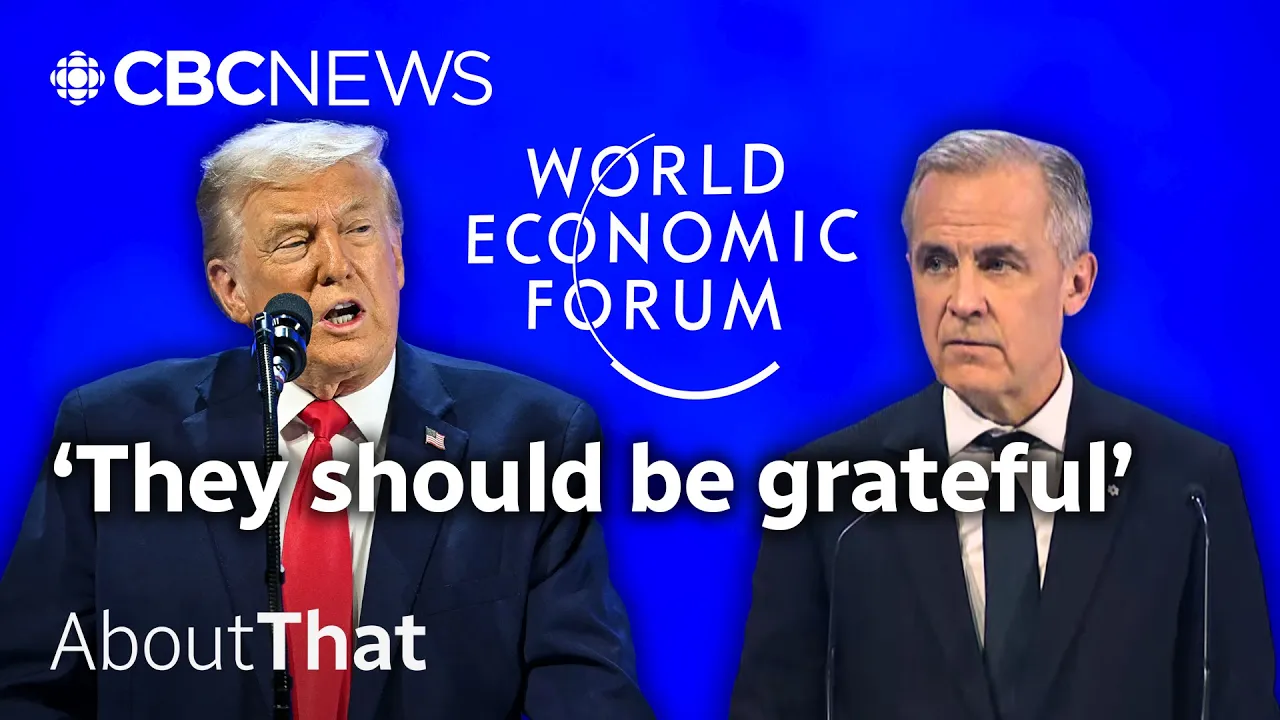
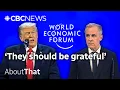
Canada gets a lot of freebies from us, by the way. They should be grateful also, but they're not. >> Donald Trump just gave a more than one-hour speech to world leaders in Davos, Switzerland.
It's usually an economic forum, but now more like a battlefield. >> I watch your prime minister yesterday. He wasn't so grateful.
They should be grateful to us. >> In that roughly hour and 15 minute speech, about 20 seconds were devoted to Canada specifically. I've already played you about 12 of those seconds.
Here are the remaining eight. >> Canada lives because of the United States. Remember that, Mark, the next time you make your statements.
>> I'm going to explain what the president of the United States was reacting to and on what level this sour an already strained relationship. >> There is a strong tendency for countries to go along to get along to accommodate to avoid trouble, to hope that compliance will buy safety. >> Well, it won't.
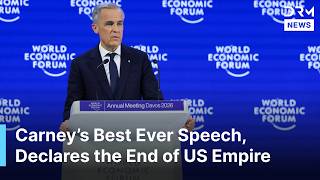
So, what are our options? >> The day before Trump spoke, it was Mark Carney's turn to address the room. His speech was in effect to frame the US-led world order as irreversibly ruptured.
And he made this point with a story. >> Every morning, this shopkeeper places a sign in his window. workers of the world unite.
He doesn't believe it. No one does. But he places a sign anyway to avoid trouble, to signal compliance, to get along.
This is a parable from an essay written by Vatzlav Havl almost 50 years ago, answering how communism sustains itself. The analogy here, of course, being with how the world plates Donald Trump. >> And because every shopkeeper on every street does the same, the system persists.
Not through violence alone, but through the participation of ordinary people in rituals they privately know to be false. Friends, it is time for companies and countries to take their signs down. >> Now, this is a clever bit of politics in the sense that like many grand speeches touching on prickly subjects, it's both direct and vague at the same time.
And maybe this wouldn't have been so provocative if not for two things. first that Carney's entire speech was about this about a strategic pivot away from America. But the second thing he named America explicitly this fiction was useful and American hegemony in particular helped provide public goods, open sea lanes, a stable financial system, collective security and support for frameworks for resolving disputes.
This bargain no longer works. What we have to do is what he called sort of a principled pragmatism being realistic, very hard-nosed about where we have interests and arranging our relations, our foreign relations on that basis. It's fascinating to me and very revealing that the prime minister is spelling this out as a statement of Canadian foreign policy.
>> Let me be direct. We are in the midst of a rupture, not a transition. You cannot live within the lie of mutual benefit through integration when integration becomes the source of your subordination.
Donald Trump, of course, was listening to all of this. After the war, we gave Greenland back to Denmark. How stupid were we to do that?
But we did it. But we gave it back. But how ungrateful are they now?
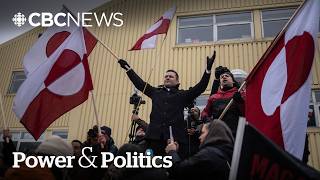
>> This word ungrateful seems to keep resurfacing with Trump and his administration. In Davos, he devoted a big part of his speech to ripping into Denmark for not wanting to sell Greenland to the United States. But two things about this framing of gratitude.
One is that it's more feeling than fact, almost like this is personal for Trump. But two, there's not really a clear separation between where Trump's feelings meet Trump's policies. Trump's attempt to force Denmark to sell its territory to the United States was backed up by what Denmark called blackmail.
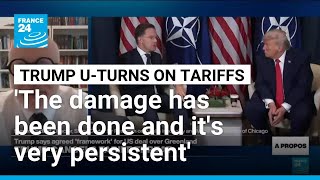
The explicit threat of tariffs starting at 10% escalating to 25 on European countries who oppose the US on this, though it's apparently possible that threat will be reigned in. Donald Trump says he and the head of NATO have agreed to the framework of a future deal with respect to Greenland. The US president also says he will no longer impose tariffs that were scheduled to go into effect on February 1st.
>> And Trump's feelings about Canada. >> They should be grateful also, but they're not. I watched your prime minister yesterday.
He wasn't so grateful, but they should be grateful to us. >> That was also linked to something much more impactful and tangible. We're building a golden dome that's going to just by its very nature going to be defending Canada.
Canada has already signal to the US government it wants to play a role in Trump's vision for continental missile defense. But it's not at all clear how that role could bend and sway depending on Trump's mood. And you don't have to look much further than Ukraine to see an extreme version of how this can play out in practice.
You should be thanking the president for trying to bring it into this. >> Have you Have you said thank you once this entire meeting? >> It's going to be a very hard thing to do business like this.
I'm going to tell you >> say thank you except that they're except you have to be thankful. You don't have the cards. You got to be more thankful >> because let me tell you, you don't have the cards.
With us, you have the cards, but without us, you don't have any cards. You're not acting at all thankful. And that's not a nice thing.
I'll be honest. That's not a nice thing. All right.
Uh I think we've seen enough. What do you think? Huh?
>> Again, it's tempting to just say this is politics. A few months later, they're shaking hands as if nothing had happened. But arguably matching the erratic nature of Trump's personal relationship with Ukraine's president.
You've got a less than coherent American policy position visav the war in Ukraine. as in the US is in Zilinski's corner until it's not. There's military hardware support from the US until there's not.
>> Presidents generally are able to make a distinction between their interests, their personal interests, their political interests and the interests of the country. Sometimes those things conflict and then we expect that a president will put the interests of the country ahead of his own or his party's interests. We don't see that with Trump.
We see him looking at relationships between countries as purely about how are people treating me? Were they nice to me? Do they respect me?
>> We take the world as it is, not as we wish it to be. >> It's hard to imagine Mark Carney feeling good about taking this kind of stand against Trump's presidency. The risk and the stakes are enormous with more than threequarters of everything Canada makes being sold to just one country.
A country which also happens to have a population, economy, and military somewhere between oh, I don't know, 8 and 30 times bigger than ours. But maybe Carney feels like he has no choice. I don't think that that Carney and other NATO leaders have had any option but to stand up and say this is enough.
Trump has spent a year injecting chaos and and disruption into every aspect of uh American policy whether it be domestic, international, military. Prime Minister Carney and leaders of other nations present at the World Economic Forum are starting to uh come to terms with the fact that they are going to have to figure out how to live in a world where the United States is not uh the stable anchor of a an international order. >> And so it goes.
For better or for worse, Carney has staked out Canada's new position. He claimed that ground when he signed a new trade deal with China. Everything is all right.
>> Everything is excellent. >> Mr President, together we can build on the best of what this relationship has been in the past to create a new one adapted to new global realities. >> He claimed that ground when he took Greenland's side against Trump.
>> We're concerned about this escalation uh to be absolutely clear. >> And he claimed that ground when he decided that much of the world could no longer count on the United States. of the new world order.
>> So where that leaves things now is the leader of the world's most powerful nation reminding another of his place. >> Canada lives because of the United States. Remember that, Mark, the next time you make your statements.
>> To which the response to threats like this is to find new ground and see who will follow. >> In a world of great power rivalry, the countries in between have a choice. compete with each other for favor or to combine to create a third path with impact.
We shouldn't allow the rise of hard power to blind us to the fact that the power of legitimacy, integrity, and rules will remain strong if we choose to wield them together.