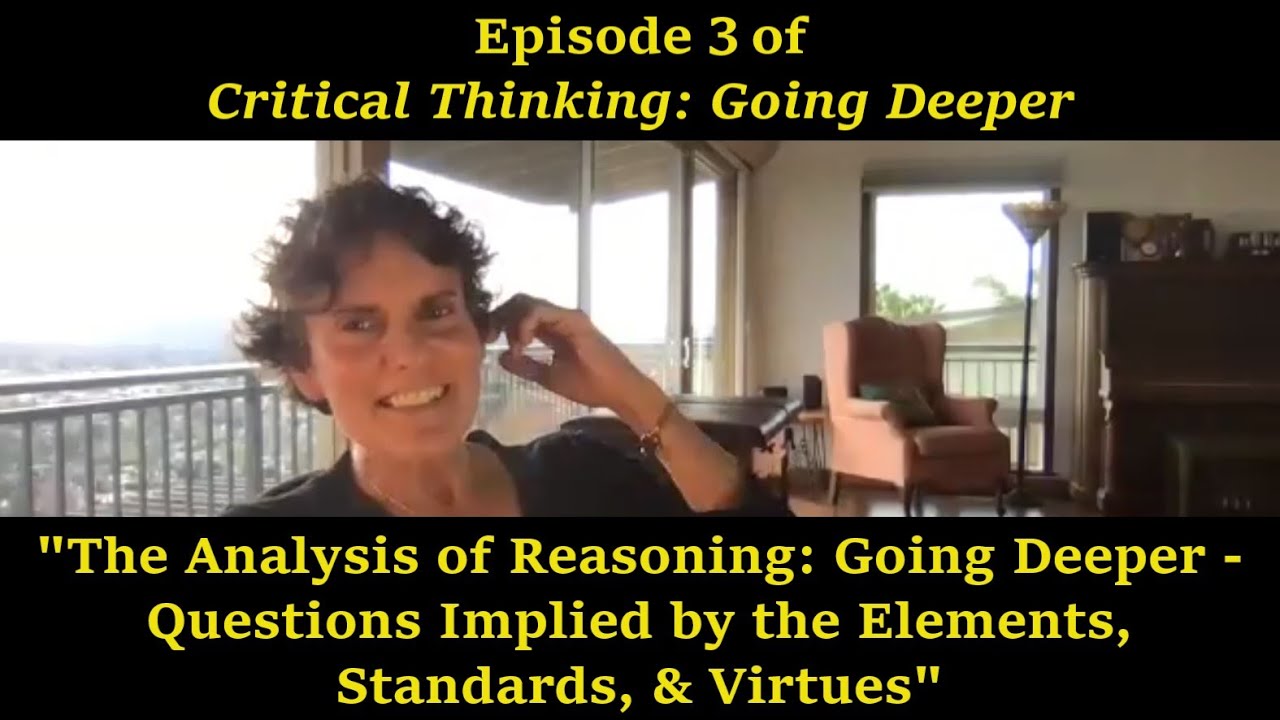
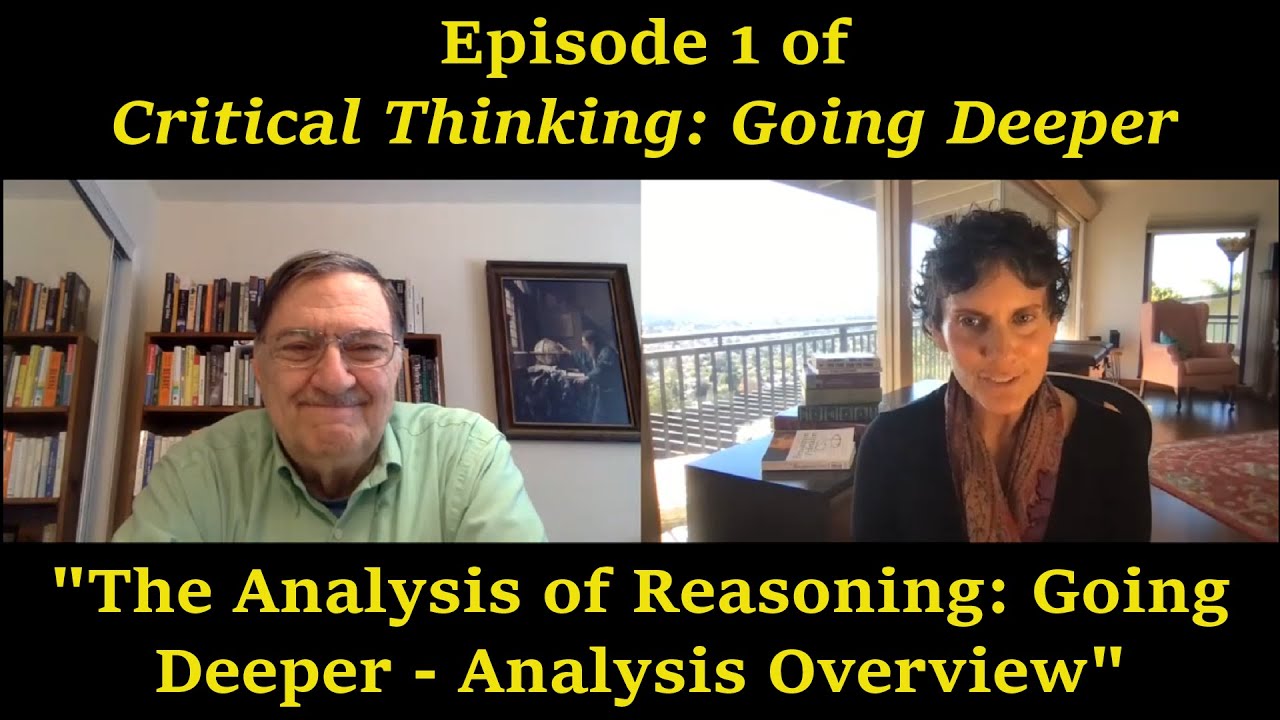
Hello welcome to this series on the elements of reasoning focused in this session on purpose and thinking this series again is entitled U the elements of reasoning going deeper for those of you who are aware of the elements of reasoning this will be a next step for you we're going to be exploring uh the question of purpose the role of purpose in thinking And how it's connected to the other elements of reasoning why it is important in human life and in human thought I'm Linda Elder and I'm here with my colleague Dr Gerald nosich we
are coming to you from the foundation for critical thinking and I'd like to begin if I could with you um Gerald just giving us a brief overview of the role of um purpose and thinking in connection with the elements of reasoning for those who are not aware of the elements of Reasoning as a starting place okay thank you Linda good to see you again um so the elements of reasoning we often describe them as the parts of thinking they are elements the way the chemical elements are the parts of all substances well the elements of
reasoning are the parts of all reasoning so there are eight of them uh briefly they they are purpose assumptions implications um point of view Information and a and a few others eight of them all together and the idea is that whenever you reason about anything you always have a purpose you're always making assumptions there always implications and consequences they're all you're always doing so from po some point of view or multiple points of view point of view is another element of reasoning you're always addressing a question that's f five of them so the elements of
reasoning are the parts of Thinking and one of and all eight of these are essential purpose is one of them so the idea is whenever we think about something whenever we're reasoning our way through something we have a purpose we have a purpose in mind or in the back of our mind purposes are sometimes unconscious we have a purpose we have a goal or goals we have objectives something we're trying to achieve so how does purpose fit with the other elements of reasoning well for This I could say actually two opposite things or nearly opposite
things one is that purpose underlies all the other seven so if I am a teacher and I my my goal my purpose is to teach my students to write better to write more critically meaning more clearly more accurately with greater sense of what's relevant to the issue at hand so my purpose is to teach my students to write better well having that purpose Bri generates for me assumptions like an assumption I'm Making is that I can make an appreciable difference for my students by teaching them about writing that they'll be able to write better and
implication of it might be that they are in fact writing better uh that purpose generates a point of view the point of view is a pedagogical point of view the teacher's point of view and that's the one I'm I'm approaching the whole thing from so purpose in a way underlies all the other elements so that's one thing I'm going To say next thing I'm going to say seems in a way almost the opposite but it's not really the opposite it's that what I've just said about purpose I could also say about any of the other
elements any one of the elements underlies all seven so take assumptions that's one of the elements of reasoning I'm always making assumptions so if I assume that it's very important important for my students to be able to write more clearly to be able to write Better and more accurately well that generates the purpose purpose is okay so my purpose is to teach my students to write better so on the one hand it looks like purpose comes first and assumptions come second on the second on the other way of reading it oftentimes in life assumptions come
come before come first or come earlier than purpose similarly implications and consequences so if I realize that an implication of teaching my an implication of learning to write Is that my students are going to write better and an implication of not teaching them to write means they're not going to be as successful in their life and their careers later on that can then generate the the purpose or just take point of view if I'm a teacher my point of view is that of a teacher I want to teach my students how to do things and
that means how to think about things and then carry them out so I might then say okay in order in keeping with that point Of view so what are my goals and I ask myself that question notice I haven't begun with my goals my purpose I've begun with my point of view so that's something that's true of the elements of reasoning they interlock with one another they interweave and there's no one that goes first that said I can say for the purpose of our work today I can so we could think of purpose as underlying
all the other seven so uh that's my brief Rec so yes thank you so let me let me just sort of clarify here and um maybe ask a question so my understanding of the elements of reasoning based on what you've said and based on my knowledge is that whenever we reason through anything these parts are present M and so that means that whenever you think you think for a purpose within a point of view based on assumptions leading to Implications and consequences we use data facts and experiences to make inferences in judgments based on Concepts
and theories to answer a question or solve a problem so we've got these eight elements that are there whenever we reason no matter what and so what that what what that leads me to ask is well if these parts are always present then it stands to reason that we as humans should be very aware of these parts because they're driving our Reasoning so but we and yet we really don't use these terms in human life very very much or very well they are used these terms all come from natural languages but um so we have
these eight elements so whether we're reasoning very well or very poorly these parts are present right yeah now um one of the things that's interesting before we go forward into purpose is that The the elements of reasoning presumably are conclusive meaning that these are the eight elements we can boil reasoning down to right and unlike intellectual standards where we're we're pulling nine or 10 or 12 or some number from a much larger um list and for many constellations and unlike virt where we have um a much larger set potentially Than we have with the eight
elements of reasoning so the the question then is um I guess more it's it's more of a fascinating part of this that in all of the time that we've been working with these eight elements in this form in this circular form um no one has ever come up and said well you're missing an element where we couldn't give them a reasonable answer as to why we were missing that element that that they thought was an element Right so it's it's um it's remarkable that that reasoning was boiled down to these eight elements yeah so we
have this powerful set of tools um developed by Richard and then with you working with him in the early 80s 1980s and I know that it was when you were working with Richard that the list went from I think nine to eight and then into the Circle and that is something that now we coming after that in history have this circle handed to us as it were on a silver platter so we didn't have to figure out these elements they're figured out for us and so therefore are is it does it make it even harder
to use the elements to appreciate the elements of reasoning when they've been handed to us this way oh yeah that's really obvious yeah of course you have purpose and you've got Question information differences yeah yeah that's interesting Linda that that's right and that that it's true of almost all reasoning when you reason something out well maybe for the first time after a while it starts to become it just becomes obvious uh I mean it's empirical things too I mean uh the continental drift and the way continents go go to one another you can look at
a map and you can see it's obvious how South America and Africa fit Together and North America fits with Europe it's obvious how these fit together but it wasn't obvious beforehand um very many things are like that in in science and in reasoning and I think it's true of the elements as well um there is something remarkable about it it's here's a thing that Richard and I used to say that these eight are the eight the eight so if you find something else that's an element of reasoning um Then either it's already on the list
implicitly or we need to increase the circle we need to add a new element but I have not heard anyone add anything that seemed that that wasn't already on it for instance uh hypothesis is an element of reasoning and we don't list it there but a hypothesis really is a kind of conclusion or assumption that's held tentatively so there's a way it's already on the list and you mentioned the Nine had in the circle the ninth one was reasons and uh we eliminated it because it made it more complicated and there's a sense of which
which reasons is already in the circle of elements so your reasons for believing something or doing something will be an assumption you make about it or an implication in consequence something you see happening or some information that you have or a concept that you have I've mentioned four of the elements so reasons is Actually one that that fits together with any with a number of the elements not all of them but but but all of them but but almost all of them so um yeah it is kind of remarkable but you're right it's hard to
appreciate them when you say here are the eight elements and the person says oh yeah oh oh yes I got oh right I got it um and it just goes away very quickly um and uh that makes it difficult to see how powerful they are just reverting to purpose for a moment Um sometimes it's very easy to to identify the per my purpose or my goals in doing X to y or Z but sometimes it's just extremely difficult or it's be very complicated and it's remarkable as you mentioned that we're much of the time quite
unaware of our goals or or even if we are aware of them we forget that awareness as we go through life many people want to get rich in order to be happy that's their goal and uh but they devote themselves to getting rich and They kind of lose the happiness part of it because they're engaged in making more money crude example but right well um it's it's hard to talk about one of the elements without talking about the other elements as you've mentioned so if that taking your example if that's the way that the person
is thinking then they're actually not thinking through the implications of of actively pursuing that purpose because if they if they Think that just making money is going to make them happy and that's then they they need to rethink they need to think through the implications of that belief and and and actually imagine themselves in that position and would that really be what made them have you see what I mean we're not good at thinking through implications when we think about our purposes right right and yeah and Thinking about purpose actually helps you see implications more
clearly it's part of what you said about becoming aware of our purposes um or our goals in doing anything yes so um can I ask you something yes so we one thing we were talking about earlier is um so it's not just a matter of identify my purpose or my goals it's also a matter of evaluating them uh right and I'd like to ask you um what do you think about that or what's the how does it work to be Evaluating my purposes that they're not just yes given yes it's interesting that was exactly what
I was I was I was on that line of thought because I think that when we think when we when we do use the elements of reasoning and we do when we do actively use the ter the concept of purpose it frequently is or these processes are frequently done in a somewhat superficial way so that we say okay well what's the purpose of science now that doesn't that seem that can be Taken deeply or uh simp superficially but we sort of think okay you're just going to apply it to science or you're just going to
apply it to this little problem or that little problem and all any of those may be significant in themselves so I don't want to diminish that point but in in a in pursuing these questions and let's say playing by the rules okay what's my purpose right now okay what's my purpose right now okay let's use the word purpose and let you Know then by doing by thinking of it that way we're sort of missing the the whole boat of critical thinking in the way that I think of critical thinking because critical thinking should set you
free if if it does nothing else it should Set You Free as a a thinker and and part of that freedom comes with achieving and pursuing purposes that have deep meaning for you personally and that connect with your ability to achieve your own Capacity in a world that is largely pathological so we we can't pretend as if we're reasoning in some kind of a sane world that's always sane and reasonable we're reasoning in a world that's just full of potholes everywhere yes there's a road yes we can get there but we we're falling into a
lot of holes along the way as thinkers so what I'm saying is that we're not I guess I could say it this way we're not thinking critically we're not we're not using the Elements of reasoning well and here we're focusing on purpose either to deal with these individual questions or the deeper the deepest questions for us personally which are focused on what we highly value and I guess in which we have belief in our ability to achieve these purposes right that's that last one uh you mentioned seems particularly poignant to me because part of evaluating
goals or purposes in society But I'm thinking much more on a personal level is really coming to terms with whether it's realistic to think of me as achieving them to think of myself as being able to achieve them so um I mean there all these movies about how you should follow your dream follow your dreams where dream is standing in for purpose achieve your goals you follow your dream that's a very important thing to do in life and the way those movies work out the person who follows his or Her dream achieves it and and
gets this great measure of fulfillment but in my experience many more people are hurt dramatically by following their dreams when they're unrealistic dreams um I uh had a student who was in Accounting in her last year and she very much wanted to be a poet and she came to me for advice and she says I want to give up Accounting in order to be a poet poet and I I because I have a streak of Romanticism in me she thought I was Going to say follow your dreams go out and be a poet and I
said oh whatever you do don't give up being an accountant in your last year I mean you may at some Future Point decide not to be an accountant but you you do need to come realistically to terms with whether you can achieve being a poet or whether you want to dedicate your life to becoming a professional basketball player when you're 10 years old so I know a lot of people who's dreams have been who been Kind of disastrous they live with disappointment for much of their lives so um well yes yes if I could so
this is all related to purpose in the way that I'm thinking of this but it may not it may not seem that way um that is obviously but for example when you're in school and let's say you're in middle school now or maybe even earlier but certainly by the time you're in high school the the um teachers that are concerned With you and your counselors at school that're concerned with your future will try to help you figure out you know what kind of job you can pursue and maybe they give you even one of those
inventory things you know so this is all about your purpose so so so what what so you as so so you imagine yourself you know looking at a a list in into into which you are to fit yourself and your future so you know one of these is Accounting and one of these is poetry uh and probably that's not even on the list because they're only including the ones where you can actually make money right because so we have to realize that our purposes to the degree that we even f that we are in active
command of our purposes our purposes still fit within capitalist uh culture and this again is one of the things that critical thinking helps us see that we're not you know sort of Pie In the Sky okay what is your purpose and well how are you going to just achieve your capacity well how do you do this and maintain your sense of self which should be a key purpose for all of us how do you maintain your sense of self in a world that is frequently um so dysfunctional and this is a very serious question facing
many people and we're losing people because they don't have sense of purpose they don't think that they can achieve sense Of purpose they're checking out as it were they don't see any point in trying to fit themselves into this this world that we've created as collectively as humans so I think what I'm saying is that what we what the our best hope is to have the highest ideals we can for ourselves while being realistic recognizing we all still have to make a living unless we were born independently wealthy right and then uh so we have
to make a living And that reality has to be has to fit into something that will not make me lose my sense of self as my purpose right right I yeah the the the sense of self is just this essential part of all purposes and there's a way to use an kind of old-fashioned term alienation there's a way in which that's a major part of alienation is that I go after this or that uh uh economic success financial success and I lose my sense of self or I get so wrapped up in my work Becoming
a workaholic that I lose my my sense of self I lose that self of mind so it seems to me to be essential that in almost all cases maintaining or enriching my sense of self my sense of who I am am and what constitutes me uh has to be part of has to be embodied in the whatever go other goals and purposes I have and it's not even just me it's as you say making our society better making our our not necessarily country but our the world a Better place um so now we're now we're
into some more complexities so not only do I have to let us say that I have these high ideals and let us say that I have a high sense of self and let's say I I lay out for myself as a high school student a plan for my future that seems reasonable based on these realities and that I can I can live within I can still feel that I can achieve something of importance whatever that may Be now that's going to be essential I think that will be an a necessary condition for let us say
self-actualization and yet we are continually having to fit our purposes into other purposes as you mentioned not only other purposes that I have for myself like to uh H to have certain kinds of Outlet such as let's say gardening or let's say extensive reading Time for extensive reading so we've got multiple purposes as we live a complex human life and then if we add children to that uh equation then suddenly whatever purposes you had to begin with they're all gone now and your only purpose is to raise this child is as it seems in other
words you and and this is is as we know a serious problem for parents because they become overwhelmed with parenting and they they they do lose often their sense Of self so imagine I guess imagine when you're in school being told these things being told that as you go through life one of the first things that you want to do is command your purposes and you want to have you want to you want to pursue and Achieve High purposes because you're capable of that imagine that everyone was taught that and yet you're going to have
to fit your purposes into other purposes the life is going to be complex and um you're you're you're Going to have to fit your purposes into societal purposes and some of those purposes will make sense and some of them will not make sense and you'll have to be able to distinguish the difference so that that's what we should be telling people rather than how you know do you think that you're inclined to be this or do you think you're inclined to be that yeah yeah Yeah so I would say that um this discussion of let
it say the achievement of high purposes and your own chosen purposes uh based in criticality so uh and based in ethics that this line of reasoning connects connects for me with existentialist thinking because they because there the focus is on the importance of Creating uh significant meaning in your own life and so for example Victor Frankle who developed logo therapy he's he he pushed this one idea with some others but this is the main idea the main idea is that you have got to find the meaning for you you you for you and he wrote
man search for meaning so is one book one example of one of his books so this idea that you can't achieve happiness unless you have developed and established these deeper meanings and Purposes for yourself and in frankl's case he connected it to his his being in the um Nazi concent ation camps and he could see that his his ability to survive was clearly connected to the meaning he was able to achieve every day and you know he was a medical doctor so he was able to help people and it was that as an example so
of course he had already developed the theory before he was imprisoned but my point is that and That's just one example of existentialist thinking and I do think that this conversation is is basically missing from Human Societies in many in many uh cases and and in that we're not asking people well what what are your purposes what what do you think your unique talents are what are your unique capacities what can you really um what can you Linda are you Gerald what what where what can you give and some people are able to find that
Path uh more easily and some people are going to pursue that path as it were no matter what kicking and screaming for example so you can take take for instance many musicians that I can think of who if they weren't a musician I can't imagine what they would be and it seems to be that's their way of surviving in the world not every single one of them but it's a pattern so life is strange I'm a musician I'll write music music about how life is strange Something like that and that's how I'll survive it and
that's how I'll give meaning to it and that's how I'll find beauty in it and that's all I can really do but I'll do that well I'll do it at the highest level of my ability and I I would like for everyone to have that belief in their own potency toward their purposes well let let me say just something about the meaningfulness of life and Achieving happiness and and I know you're speaking Loosely when you say achieve happiness because at least my experience is I can achieve happiness sometimes uh and other times not and other
times the opposite of happiness so it's not like finding life to be meaningful I just achieve happiness and I I and I know that if when Frankle says things like that he's just he's not he's speaking he's speaking Loosely he doesn't mean to imply that we can There's just the state of happiness and we can achieve it but but I also want to take something that seems to me to be more mundane but also very profound and it's that um having a grand uh having a large scale vision of myself and my place in the
world and trying to achieve meaningful goals and Find meaning in myself all of that is tremendously important but There's this Eastern phrase of chop wood carry water meaning after you've thought through all the ideas and you're finding meaning in the world you still have to wash the dishes right yes I'm very aware painfully aware yeah but by being aware of your meaning in life you can actually fit washing the dishes into the large scale and Find meaning in the the sensual uh aspect of it of having the Water run over your hands and having and
realizing that you are doing something that's to building toward the future not toward liberating the world but not going against Liber the world on the other hand as well so there are there are purposes and there other purposes there's a kind of hierarchy of purposes or that's not the right word uh because it's not like this is this is above this one they're coexistent purposes which fit together only in an uneasy Way um well the yeah there there's there is a lot um in that the the there there are many mundane things that we all
must do to live a human life and I think part of to me happiness when I when I say happiness I I don't mean every minute of the day that would be an impossibility but I mean a kind of state of Mind that is more like a sense of everything's all right everything's just fine right everything's um every I've got basically uh control over my life and as well as anyone as well as anyone can I can do the things I want to do and I feel are important to do and so um to me
that is what happiness is because if you're asking for more than that you're asking for like Euphoria all the time or something and that's a different matter But it is it is very important to be to be um careful in our use of terms and be clear about what we mean by a concept and that's one of the things that critical thinking helps us do so that's one thing I want to say so we we so but on the mundane so now you were giving the example of washing the dishes so the way that I
personally handle that is whenever I'm washing the dishes I turn on the music fairly loudly and I move I'm like dancing while I'm in the kitchen so um I I just move my my body any way that I can so I think okay so all right I'm gonna be doing this but I can still also listen to music and I can move so you see that's an example of how you can take a mundane thing that you have to do and make it into something fun and you know people I've seen this you know people
when they're uh some women or men that are like cleaning their house and they're Dancing around while they're cleaning their house so these are not trivial discussions right because if you're if you're having to wash the dishes how many you know minutes a day how many minutes are you quote giving up and how can you make that more palatable and that is to me an important purpose making life palatable all the way every day every step right if I can right so then that's shows that in many small Ways we can take command of our
purposes and our our um our thinking the other the other more generally and the other thing that what you said reminded me of is Stephen Cy's um his his focus on the IM the the importance of spending time thinking through questions that are not urgent but they're very significant uhhuh Uhhuh because those are the ones that tend to be neglected right this gets at the heart of the question what what is my real I don't like to use the term is my purpose in life as if it were handed down to me right but what
do I see as the most important purposes in my life and really at the end of your life you can you know you want to be able to answer that in a way that's satisfactory to yourself so you want to be able to say I Did what I tried to do and even though I may not have succeeded I did pursue my purposes as well as I could have in the world that we live in given the realities that I have had to face and that we have to face yeah a a difficulty in in
in that for me is um if I'm at if I'm at that if I were at the end of my life right now and I'm I'm in hospice and I'm thinking did I Achieve my purposes I I think I would probably say well yeah to a large extent yes or I did the best I could at them but to me there's also something very misleading about it uh in that the purposes I identify for myself now at my age are not the purposes I would have identified for myself 20 years ago much less 40 years
ago so if I actually if I had taken if I had made a list of my purposes at various times in my life these are my goals go these are My goals these are my goals um many of those I will not have achieved not only that but I will think wow why did I ever want to achieve that at all so there's this kind of misleading it's actually kind of egocentric uh there's this egocentric quality to it in that my present purposes my present goals seem in my mind as if they're the goals that
have guided my whole life where all I have to do is think back to adolescence when my goals were all over the place And some of them really completely unrealistic and um so uh so I I I agree with you like to the extent that as I have these mature goals that I've matured into a way of thinking about fulfillment of my life is whether I've achieved those purpose or or done my best given circumstances to achieve them yeah so or to further yeah that's that's interesting yes but that wouldn't necessarily be true well to
some extent it would most likely be true For everyone if you go all the way back to you know your team years so but uh they're I think for some people they have a clearer sense of purpose early on and they stick with that clear sense of purpose yeah and well there are lots of people who do that there there was I met a guy the other day who Tunes pianos he's been doing this all of his life um he's said he said that he decided to do that when he was in high school so
this is many decades later so there are some People who that that would just be one part of their person's life right but um so again we're complicated we're not just we don't just have one track that we're working on we're not just the professional person we're also uh pursuing Intimate Relationships or again we may be parenting we may be so yes we need but at any I think at any at any time in our life we need to be able to ask the question what are the important purposes for me that I'm Pursuing yeah
and do I believe in my ability to achieve re purposes that are realistic for me so if I wanted to do something like you know be the best basketball player in the world then that would be a joke because even if I'd started at the right age I'm way too short right so there isn't any point in pretending that you can do something that you're not capable of doing part of criticality is knowing What you're capable of right and so this is connected with intellectual humility but so I want to be and I have to
be realistic about what I can achieve but within that capacity there is so much room for growth for for everyone all of us will die with undeveloped masses of undeveloped capacities and I don't that that bothers me because it I remember as a child being told that we only use 10% of our Brain yeah turns out that's not true but but well well it didn't make sense then either but but in any case we know that we don't use and we don't develop our minds as well as we could as a rule and there's a
lot more development there and what I want to point out I guess very strongly is that we have to believe in our ability to achieve our capacities and that belief is very difficult for people to Sometimes um to I don't know exactly how say to come into that belief to actually believe that belief to to to accept that truth about themselves because in t instead we tend to self-handicap and tell ourselves how we can't why we can't that we're stuck in this job that we can't do that that we have to do that and a
lot of that is because of capitalism not all of it but some of it Well let me say that uh if I'm understanding you correctly I probably disagree with a certain disagree to a certain extent in in in this way in that um you are bothered by the fact that we have all these capacity that we have many capacities that will we will not fulfill or achieve within or even achieve to a significant degree and I I would say I'm in fact not bothered by that at all not even not even not even a little
so um so I'm hearing an Assumption in yours that there's some obligation or are there some impulse to fulfill all one's capacities and uh to me the impulse is well I'm gonna I'm gonna do the best I can in most in most situations and I I don't really believe I'm gonna have enormous success in fulfilling the the capacities that I have and and but what I really want to stress is that I'm really quite content with the amount of of fulfillment of my capacities that I have so I think that might vary from one person
to another I think I do agree with that with all that that you said to some degree and that one one thing is that as I was talking about uh achieving our capacities you see it's it's a bit of a trick trick situation because um anyone who has developed their thinking in a certain area let's just say could has let's say you spent a lifetime studying critical thinking Theory but but let's say instead of that you had studied something else as much as that well or something in another field as much as that or in
another field or any other field you see that you couldn't possibly achieve all of the let's say knowledge that you would be capable of because you've only got so many years to live even if you live longer than everyone else lives so so there that's why it's a it's kind of U the way that I said it was a Little misleading but let let's just say that what I what I think is very sad is that many people have uh a lot lot of capacity that they're not that they're not developing and then they suffer
and we suffer right right and in other words we need everyone thinking at the highest level of quality here on this planet that's the only way we're going to solve The problems is if we get some kind of critical mass thinking critically well that means you have to develop your thinking and you you've got to develop it also in certain ways yes I do think we have an ethical obligation so one of our purposes is to be concerned with the common good and that is something that some people dedicate their lives to you know that
purpose and other people do is do What they can while contributing in other ways you see but it's still is contributing to Higher Ground to a better world let me let me mention something about how very easy it is well let me hold off on the punchline to tell you the the setup for it so here's uh when I when I working on my book on critical them across the curriculum I actually read some books on management here's the dominant management Paradigm to engage To be a be a strong manager you have to think in
terms of three concepts you have to plan organize and Lead all right so that's the essence of management plan organize and Lead so but now here's the punchline for me notice that what they left out was purpose yes I see that plan toward what organize toward what lead toward what so's a way the dominant management Paradigm leaves out the most Central feature which is purpose right and That's that's very easy to do it's easy because we kind of take purpose for granted and don't articulate it in our mind don't denunciate it um so uh and
I think that's that's omnipresent I think that's in each of us as individuals uh in organizations in governments uh in schools uh me in virtually any context it's easy to overlook purpose and lose sight of it like so much of the foundations of critical thinking in other words they're so easy they're hard I say that very often but it's really true so you say you say well whenever you reason you have a purpose right okay so the person says yeah of course I have a purpose right right well yes but how often do you actually
use the term purpose right as a tool for living better right yeah and that means you've got to say well let's see when I'm in this this discussion or this disagreement with My intimate other do I stop and say wait a minute are we fighting right now are we arguing is this a what's my purpose right what's your purpose right what's Happening Here Right is this the way we want to live is this the way we intend to live together wow very nice example yeah that's right so we want to use the term purpose we
want to bring it alive and and we want to be a good activity would be to every day at the end of the day ask yourself how Often you even thought about your purposes that day you did you ever even think the word purpose did you did you ever bring that up or maybe you're already focusing on two big purposes that are significant to you so at the end of every day you can say well of course I did because I'm working on this book or I'm working on this article right or I'm working on
this project and that's very so then I could say all right what about yes but Remember what Gerald said that you're not just focusing on one purpose so what about your other purposes right right so you can't just lean on that every time and say of course I'm perfect I've got my purpose cut out for me yeah so you can say wait a minute what about your conversation with your daughter or your conversation with your son what was your purpose there you see and then when you when you um let's say you fail to I'll
speak for myself let's say fail to do The amount the amount of exercises that I think I need to do in in a given week let's say so I can say yes but I did all these other important things but I can say wait a minute yes but does does that do those purposes outrank your health because nothing should outrank your health right right how how can how can that be uh Oscar wild and one of his characters says health is the first Responsibility of Life yeah okay so but it's true because you have to
keep yourself alive and going right so you've got to balance these purposes and sometimes I say well yes but today I'm just gonna write my on my book that's it okay I'm not going to do any exercises and that's fine because that's that's what I decide to do right now but if that's what I do on a typical day then I'm going to suffer physically yeah and you you mentioned an Activity at the end of the day uh to what extent have I achieved or worked toward my purposes overall today um another activity that seems
to me to be in some way similar and leads to in my mind at least greater depth is to is to see the purpose behind the purpose behind the purpose behind the purpose in that their purposes tend maybe are always tend to be embedded in one another so here's another business analogy I'm not in business but it's a Marketing one and it's a man who's building a toy for his child and goes into the hardware store to buy a drill and the the marketing uh statement is um you you're a salesperson you think that the
person is coming in for because the person wants a drill but the P it's not true the person is coming in because the person wants a hole and he's using the drill to drill the hole now that that that but that's a whole range of things Because actually that's not right either the person's not after a hole a person's after a new toy for the child right and person is not actually after a new toy for the child but probably the person is after giving some joyful experience to the child now that might be the
end of it because kind of pleasurable Rich richy experiences might be goals in themselves but even that one I might say well I want my child to have joyful experiences so that his or her life can Be richer for having had the so purposes embedd in purposes so it would be a nice activity at the end of the day to ask okay so what are my purposes so I'm writing ah my purpose is to write this book and I been doing that all day so what's my purpose in writing this book and what's the purpose
behind that and what's the purpose behind that and I'm not thinking of it as a way of criticizing myself so I today I've failed to make the World to to achieve world peace I'm not thinking of it that way it's something to criticize myself for but just to put things in context and deepen my understanding of myself and and uh what I see as my role or or what's meaningful for me yes that's really powerful Gerald that's very powerful the the and this of course is connected to implications because as you were were thinking about
purposes and Purpose I was thinking implications these are these are implications in terms of purpose and um yes and that does take us to deeper ground and it does remind us to to stay on track because we can get off track in that process somewhere and so if your purpose is to have uh if you have a child and your purpose is for the child to grow up to be a caring contributing member of society then you can ask of how creating this toy for this child is going to Result in that maybe that's too
crude an example because we give our children toys for different reasons and not against toys I'm just saying that sometimes we do get off and and we we have a purpose and we it was a noble purpose but then the way it gets manifest is not necessarily in keeping with the original [Music] purpose um I want to just cover one other thing there are lots of things we Could cover but I'd like to bring this to a close in a few minutes if that's all right but I would like to before we close Focus just
briefly on it how we started by talking about the purpose and we started talking about purpose and relationship with elements of reasoning we talked about how the elements of reasoning are self-contained so to speak so these are the elements and we don't know of any others because any others we come up with we could fit Into these somewhere in one or more places therefore they're a little muddy and therefore they don't really deserve an element of their own so um so but within each element of reasoning we have as it were more than one word
so we have purpose we've talked about purpose but we there all there are other words that are let's say synonyms for purpose and ser of slightly different functions in the in the language so I Would like to just talk briefly about that for a couple of minutes now the ones that we typically think of are would you like to answer that the ones we typically think of in that oh um goals objectives are our Target um um an ill not a synonym but an illustration might be I'm climbing Mount Everest and the the goal is
the top of Mount Everest right and it's the one I'm taking the steps toward but goal um in In other I mean I use the word dream as in following your dream their dream means your goal or your purpose on a deep level so I think of those goals objectives desired outcomes I think of those as the main synonyms I would use in most context but many others appear in other contexts and we can expand the elements to for example not just human reasoning but to let's say even let's say other living U things such
as plants so we Don't say what is the purpose of a plant we say what is the function of a plant right say what is what is the um we might say what is the purpose of a cat we could say what is the function of a cat depending on how we're thinking of that so function is also a synonym in certain cases depending on what we're focusing on function's a function's A peculiar one though in that um in that uh I I actually purposely didn't mention it With objectives and goals and everything because it
it's in a different category in that um the the elements are the elements of reasoning right they're not the elements of things yes it's not like it's not like a uh it's not like the elements of reasoning apply to leaves on a tree right so leaves don't make assumptions they don't have implications and consequen our thinking about leaves has assumptions implication so but um and function kind of bridges that Because I'm thinking of what's the function of a leaf but really it would be better if if I were going to try to be really precise
and careful I would say what do I see as the function of the leaf that is to make it part of the reasoning but one of the one of the reasons we we emphasize function so much is that old pre- darwini view that uh that biological things were made for a purpose and that's all changed so now biologists use the word function rather Than purpose right so yeah so function is an interesting one to me with my yes so so we have we have different ways of saying purpose and they they these different ways these
different words serve slightly different uh purposes in the contacts so we might have in addition to the one that you ones that you mentioned uh we might have intent I don't think you mentioned that um what what direction am I going in so when when people say if somebody says um well The direction I'm going in today or the direction I'm taking in my life is as follows and somebody else said well you know she never mentioned purpose well she didn't have to mention purpose the same so I don't want people to feel that you
know purpose is like the magic word it's a word that is we've chosen as the most overarching for that element indeed yeah and but there are other ways of saying purpose yeah that seems to me to be a Good way of thinking about all of the elements that each of the wedges in in the circle of elements that we put out in that uh there are there are kind of a cluster of very similarly fun functioning terms um assumptions presuppositions what we take for granted and it's not as if one word it takes uh precedence
over the other it's much more contextual than that and it seems to me that's a good way of looking at it rather than kind of re kind of enforcing Some rule about which term to use yes and obviously we haven't really talked about the application of um intellectual standards to purpose right but we obviously need to be clear about our purposes we need to make sure our purposes are justifiable in context uh I don't know that it makes sense to say our purpose is accurate unless we you you told me what my our purpose was
and then I repeated it in my own words and that would that might Apply the standard of accuracy May apply there so we need to be able to take the elements of reasoning and decide whether they apply to this particular element so we obviously want to make sure it's clear that's justifiable that's as you've already mentioned relevant to the question at issue and so forth realistic we mentioned whether it was realistic or not right right and whether our purposes are consistent with one another so we have we may have put purposes that pull Us in
multiple directions right so one a person may be in a relationship with a person that's not maybe their ideal uh partner but then they have a child with that partner and so one of their purpos is to provide the best atmosphere for the child and to provide the best um care that they can and maybe they feel they have to stay together with this other person because they so they have multiple they have two purposes that are vying that don't connect and that can Cause and will cause uh problems and confusions and so we need
to be aware of this we need to be able to say okay my purpose here is this but I don't know that I can have that fulfilled right now because my purpose here is that and this is more important than that and I'm just I'm not saying that that's a justful fiable way of thinking in this example I'm just saying that that's an example of where you may have purposes that are at they're they're not consistent with One another and that that is going to cause problems for us in our thinking right and uh to
revert to something I said a little bit earlier about the changeability of our purposes or the changeability of my perception of my purposes or goals and so if if in your in the example you gave uh I the purpose of the person I'm with is not really the person I need to be with in my in my life but I'm going to stay with a person for the benefit of the Child and I recognize that that's the right decision to make and I weigh many factors and so I carry it out one thing that happens
to many people is that years later the child is now grown I can experience just great regret at not having gone down the road that was that I had contemplated before and I may not lose sight of the decision I made back then but it will no longer seem so clearcut especially in my feelings I think oh I wish I could have done x y And Z but in i instead and maybe instead doesn't even come in it can just be oh I I live with someone who is not uh fulfilling for for me or
for this for my partner either um so uh what happens often is that we lose sight and you can see it in uh in kind of major tragic cases where uh I want my adolescent child to develop real skills in the world and so I teach them to drive or have them taught to drive and I they take the car out and Then something some tragic event occurs uh when the child driving the car the Adolescent driving the car and uh my purpose was to help them achieve a achieve themselves to but the tragic event
can kind of erase that you think I should not have done that too early I I can second guess myself all over the place and and uh seems to me part of part of critical thinking about life is to make sure that I keep in my mind the reasonability of decisions I've made And the reasonability of the purposes I've chosen to pursue well it's it's a the the example that I brought up is a is actually a very maybe it was a a bad example maybe it was a good example because it's a very common
example but it's a bad example because it's not clear what it on the one hand it seems to some people you'd say well it's obvious you shouldn't stay together for the sake of the child because they're going to grow Up with people who don't really love each other and you're going to actually not achieve what you want to achieve in the first place but you'll think you you'll think you're going to achieve it that's one possibility but it's easy to say that when we don't take into account for example again capitalism what if by divorcing
the child now ends up in poverty so there are implications for that of that that we can't ignore so It's a very complicated kind of example and again a common one and I I don't say that there's an answer but I do say that we have two purposes or or or more and mostly we need to be aware of these purposes and be deliberate about the process and as Gerald it often reminds us and then afterwards we don't get to go back and and Bully ourselves and beat ourselves up for making the wrong decisions when
we used our best thinking at the time we didn't just Ignore critical thinking and just you know do what we wanted we did our best thinking and it turns out it wasn't the best thing to have done yeah so it it brings up for me a something I often begin a workshop with I ask people to identify some some circumstance in their life where they flought through something critically and another one where they haven't thought through something critically or or they' thought It through badly and and I people tabulate but then the critical thinking question
afterwards is how did you tell how did you tell that you thinking or not and uh far in way here's the most usual way people have of telling it's outcome and that is did I reason through it well I can tell because it turned out well that's not a good Criterion to use right because I can read through something very well and it can it cannot turn out well through Circumstances that I had no control over so the way to tell is that I take account of all the relevant information that I check my assumptions
as well as I'm able to that I that I look for the implications and consequences as well as I could back then and that's when I've reason it out well but outcome purpose another version of purpose outcome is is not a good indicator at all and it's the thing that people most use to use your good word to bully themselves after the Fact right didn't turn out that's that's I'm so glad that you shared that and actually my parenting example fits here as well so there there there're an unlimited number of examples of parents who
objectively did a very good job of parenting if we just judge their parenting and their at least one child end up to be a kind of rotten apple so you see in any any any parent who's ever been through that will say yeah yes I know what you mean I did all That I could not that I was the perfect parent and then I was very surprised when my child was an adult and they turned out to be very different from what I would have expected given all that I gave and all that I did
and all that I thought that I was doing right and it it goes the other way as well I I I kind of have this reputation of having been a very good father and uh and uh one of the ways people say it is they say well look at how well your your son Turned out but it's there but it's very doubtful to me that I can claim very much of the credit for that in that uh I mean I contributed fairly surely but but that doesn't mean that I'm a major part of the cause
I mean people say well you must have done something right well that doesn't mean you ought to have done something right I mean uh child children of serial killers can turn out to be fine human beings it doesn't mean that they their their Parents have done something right so yeah right yes this is this is the problem with you know DNA versus conditioning and you know we get to a point where where we can't because we we can't do an experiment on each of us say well we're going to take we're gonna take Linda we're
going to duplicate you into 10 different people and one we'll put in this kind of family and one in this kind of family and one in this so we we only get one chance at it well Gerald as always this has been enlightening and enjoyable and um thank you for the discussion yeah thank you too Linda this has been this has been really enjoyable and enriching for me I've I've actually learned the good deal from talk from talking about it it's always lovely when that happens it's uh it's kind of like the experiences I always
had after the conference when you and I and Richard would stay together for about a week and Uh and just talk about everything in the light of critical thinking so been very rich thank you it also shows that when we take any given Concept in critical thinking we can we can just continue to develop our understanding of that concept and go deeper and deeper with more examples and making more connections and we've never no one has ever plumbed the depth of the elements of reasoning right and so this this is a a beginning place for
that so Thank you again and we'll say goodbye and thank you to all of you who are listening and joining us today good night