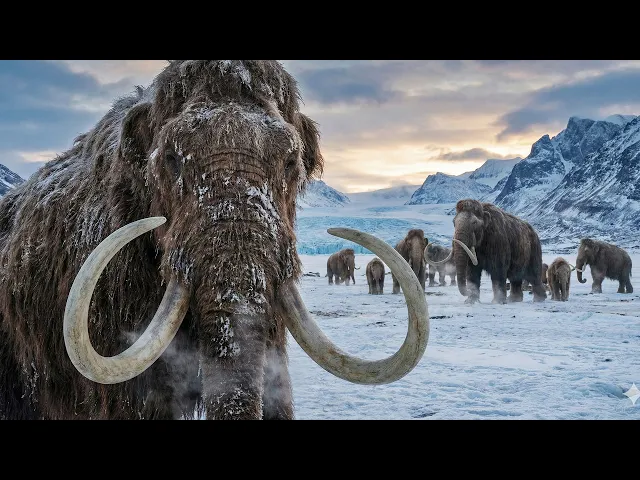
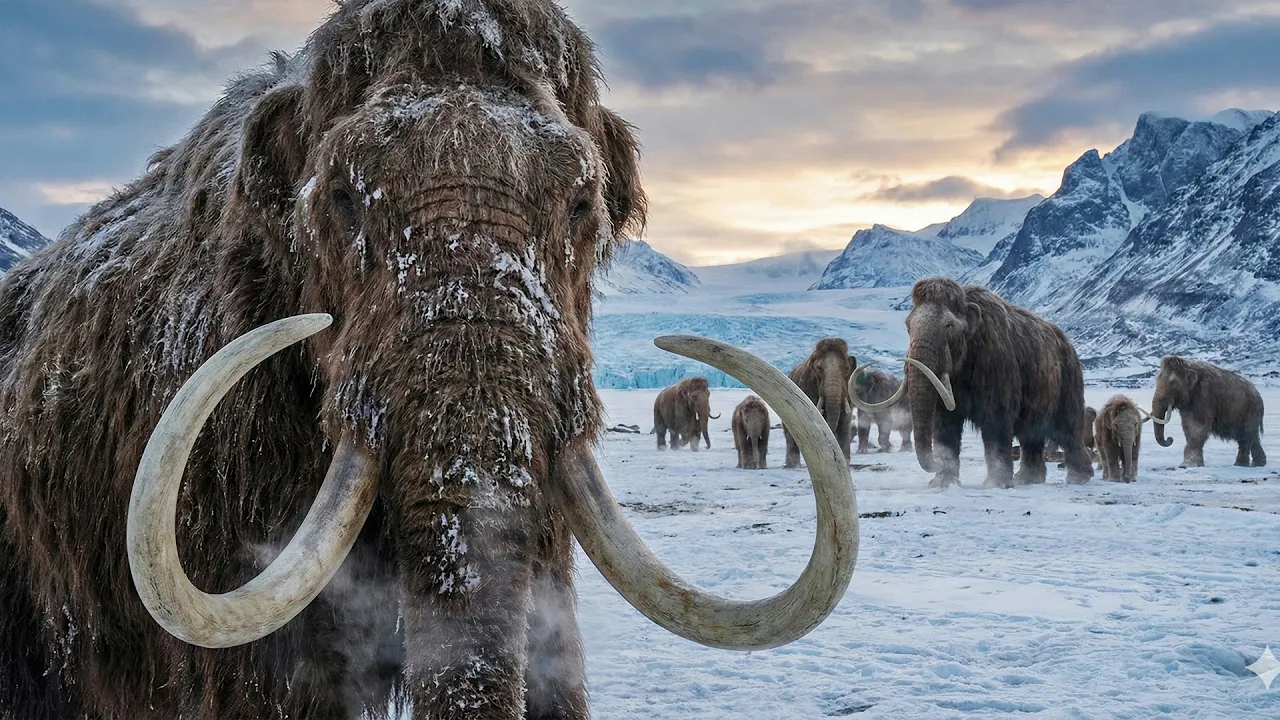
The wind blows across the frozen steppe. Once upon a time, there were thousands of mammoths here. Now only a small herd remains, slowly advancing through the wet snow.
The ice is retreating. Winter is no longer the same. And without realizing it, these animals are walking toward their end.
This is the story of how the mammoths disappeared. Not in a single day, not with a single catastrophe. But with a series of small changes, choices, mistakes, which ultimately extinguished forever one of the most incredible creatures the Earth has ever seen.
To understand their end, we must first go back to the beginning. Who were the mammoths, really? For us today, they are almost a legend.
Enormous, hairy elephants, with giant, curved tusks, lost in a landscape of snow and ice. But for thousands of years, for primitive man, mammoths were not a legend. They were everyday life.
Mammoths were close relatives of elephants. Some were larger, others smaller. The most famous is the woolly mammoth.
Up to three meters tall at the shoulders. Covered in thick brown fur. Underneath the fur, a thick layer of fat protected it from the cold.
Its ears were small, to keep warm. Its tusks, long and curved, could exceed four meters. They moved in herds.
Mothers, cubs, young males. They followed the pastures, searching for dry grass, moss, roots. They lived in a harsh world, but one they knew well.
A world of snow, wind, frozen plains, and immense horizons. Around them were other giants. Woolly rhinos.
Enormous bison. Saber-toothed cats. Cave bears.
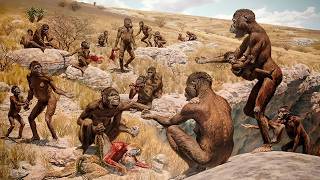
The last great ice age was a time of colossi. A cold Earth, but full of wildlife. For humans, mammoths were everything.
Food, bones, skin, tusks. A killed mammoth meant meat for weeks. _____________________________ For our ancestors, that meat wasn't a luxury: it was the difference between life and death.
They roasted it over a fire, smoked it, and tried every way to preserve it as long as possible. Luckily, today we don't have to chase a mammoth to eat. If you like the idea of traveling through history, including through what we put on our plates, there's also our cooking channel, which I curate with Giulia.
We start with simple recipes and traditional dishes, but each time we also share a little bit of history. If you'd like to take this journey through the kitchen, come visit us. But now let's get back to them, the mammoths.
______________________ Mammoths were used to make sinew for ropes, skins for tents, and bones for building shelters. In some areas, actual houses made from mammoth bones and covered in skins have been found. Engravings and drawings depicting them appear in caves across Europe and Asia .
This means that man not only hunted them, but also observed them, studied them, and talked about them. For the people of that time, mammoths were as much a part of their history as horses or cows are for us today. Yet even giants can fall.
The world of mammoths was built on ice. As long as the ice held, so did their lives. During the last Ice Age, enormous ice sheets covered much of the planet's northern hemisphere.
Sea levels were lower. Where there is water today, there were then dry land, steppes, cold prairies. Mammoths lived in this great frozen corridor that stretched from Spain to Siberia and beyond.
But the Earth never stands still. The climate changes. Always.
About twelve thousand years ago, the Ice Age began to end. Temperatures began to rise. Not in a day.
Not in a year. But slowly, century after century. The glaciers began to retreat.
Sea levels rose. The great frozen steppes were transformed. The dry grass that mammoths grazed shrank.
In its place came forests, swamps, new plants. For many animals, it wasn't a problem. Some adapted.
Others migrated. Mammoths, however, were cold-weather specialists. They had bodies perfect for the eternal winter.
But not for a world that was becoming warmer, wetter, greener. Imagine a herd of mammoths at this time of transition. The young struggle to find food because the grass is less abundant.
The old migration routes have changed. Where once there were frozen plains, Now there are swollen rivers, lakes, deep mud. Territories are shrinking.
Mammoths must share the best areas with other herbivores. The changing climate doesn't just bring less food. It also brings more disease.
Parasites that previously couldn't survive the great cold begin to spread. Less harsh winters also mean longer summers. And in longer summers , insects and microbes multiply.
For a single mammoth, one year may seem similar to the previous one. But if we look at the centuries, everything changes. Herds become smaller.
Some isolated populations disappear without a trace. But there was another protagonist. A small, agile, and much weaker animal.
Man. When the climate began to change, humans were changing too. Their weapons became more effective.
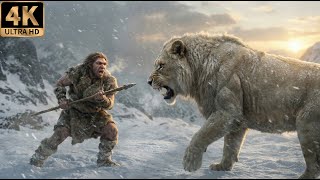
Spears had better tips. Hunting parties were more organized. Hunters knew how to use the territory, set ambushes, and exploit the animals' panic.
An adult mammoth was a dangerous opponent. A single charge was enough to kill a man. But once the herd panicked, a precipice, a frozen lake, or a swamp was enough to turn the mammoth's strength into its trap.
We have no evidence that humans alone, in a few generations, exterminated all mammoths. But we do know that wherever modern humans arrived, large animals often began to disappear. It's not just a coincidence.
The combination is lethal. Fewer suitable habitats. Less food.
More hunting. Every disappearing herd is a fragment of the future that fades. There's one detail that makes their history even more fragile: the size of the groups.
When a species begins to decline, it often doesn't disappear immediately everywhere. Small, isolated populations remain in still-favorable corners of the world. In the case of mammoths, some of these refuge populations were located on distant, cold islands, like Wrangel Island in the Arctic.
There, mammoths survived much longer than in the rest of the world. Even when they had disappeared from the continent thousands of years ago, small dwarf mammoths still roamed these islands , smaller than their ancestors, adapted to a limited environment. But living in small numbers, isolated, comes at a price.
Fewer individuals means less genetic variability. This means that diseases, defects, and frailties can spread more easily. All it takes is a storm, a particularly harsh winter, a disease carried by other animals or humans, and an entire population can be wiped out.
Eventually, even these last silent islands were emptied. The last mammoth on the planet died without knowing it was the last. For him, it was just another winter.
For Earth's history, it was the closing of a chapter. Yet, mammoths have not disappeared entirely. Not from the planet's memory.
The frost has preserved many of their bodies. In Siberia, in Alaska, in the permanently frozen soils, almost intact mammoths have been found. Not just bones.
Whole bodies. Skin. Fur.
Tendons. Stomach contents. Even eyes still recognizable.
Some were found by children playing. Others by hunters, or by those searching for ivory along the northern rivers. Sometimes the ground gives way, the ice melts, and from a wall of earth appears a huge, fur-covered paw, left there for thousands of years.
For scientists, these remains are a goldmine of information. From their stomachs, they can learn what they ate. From their bones, they can understand their lifestyle.
From their fur and teeth, they can understand the climate in which they grew up. From their DNA, they can compare them with modern elephants and reconstruct their family tree. Every mammoth found in the ice is concrete evidence.
Not just a dry fossil in a schoolbook. It is a real animal, one that walked, felt cold, hungry, and afraid. It followed the herd.
It protected its young. There is a final chapter in their story that directly concerns us: DNA. Today, we can read their genetic code.
And some scientists are trying to understand whether it is possible to create elephants with some mammoth characteristics. It would not be the original mammoth, but an elephant adapted to the cold, with more hair and more fat, to be made to live in environments similar to those of the past. The experimental idea is much debated.
Some see it as a way to better study the past and help certain ecosystems. Others fear it's just a dangerous game with nature. But the point is different.
For millennia, humans have drawn mammoths on cave walls. Today they rewrite them in computers, in DNA sequences. This speaks to how much power we have over the world around us.
The story of mammoths, however, isn't just a curiosity of the past. It also speaks to the present. Mammoths didn't disappear for just one reason.
The climate changed. Their habitats have diminished. Hunting has increased.
The herds have shrunk, until they've become too small to resist. It's a combination of factors. And it's the same combination that's pushing so many other species to the edge today.
Rhinos, elephants, tigers, polar bears. Animals that are normal to us, just as mammoths were to our ancestors. But tomorrow they could become just images in a book or skeletons in a museum.
If one day you pass by a mammoth skeleton in an exhibition hall, stop for a moment. Don't just see it as a prehistoric monster. Behind those bones is an entire herd moving across the snow.
There are cubs following their mother. There are stormy nights and long migrations across the ice. That skeleton is proof that even giants can disappear.
And it reminds us of a simple thing: today, we are the ones deciding the future of many animals. We can continue to consume habitats and species as if they were infinite. Or we can choose to protect what remains.
Mammoths will never be the same again. Their world of ice is gone forever. But their story is still here, preserved in the ice, in the earth, and in museums.
And every time we tell it, it presents us with a clear question: what will we do with the animals living on the planet today? If this story has made you see mammoths with different eyes, stay with me on this journey. On the Eclesso channel, every great story from the past becomes a new way to look at the present.