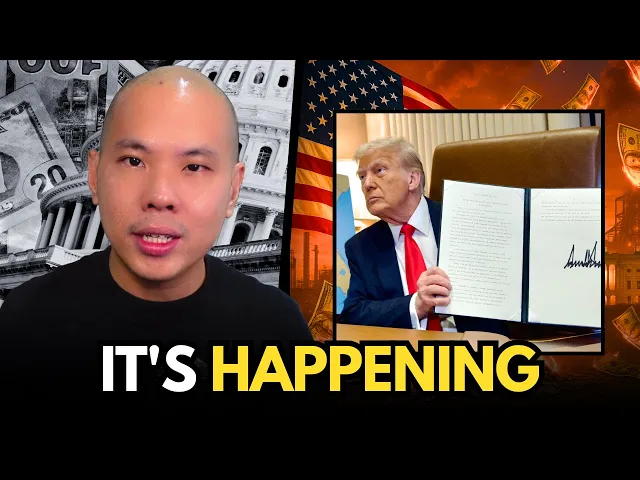
All right, guys. So, let's talk about the evolving trade war. Over the last week, a big development just happened that revealed to everyone what the playbook really is.
Now, the US is not interested in French shoring critical industries. The agenda is reshoring back to American soil. Any type of production Trump deems as essential for the US economy.
Now, chip production is one, automotive is another, but the latest bombshell to be dropped is the steel tariffs that will impact major economies around the world. And it won't exactly be awesome for the US either. Now, in just a few days, the Trump administration will be increasing the tariffs on US steel from 25% to 50%.
Trump wants to protect the US steel industry from what he calls foreign influence and unfair competition. So, the plan is to bring back steel jobs at any cost. And if you listen to his speech, it sounds really good.
Now, to the average steel worker in Pittsburgh, it definitely sounds like a victory here. We don't want America's future to be built with shoddy steel from Shanghai. We want it built with the strength and the pride of Pittsburgh.
It's Pittsburgh steel. It's US steel. And it's going to be something even more special when you get all that billions of dollars of new equipment that they're going to be investing right here.
Billions and billions of dollars. Now, firstly, China doesn't really export much steel to the US anymore. Since 2018, they have been facing punitive terrorists for over seven years.
The real victims of the terrorists aren't China. It's actually US allies and America's immediate neighbors. Now, this move is just going to torpedo further negotiations in the weeks to come.
Now, this chart shows us the top suppliers of steel and aluminum into the US market. Top of the list is Canada with $7. 1 billion worth of exports last year in 2024.
The second biggest is Europe with 7 billion and Mexico at 3. 5 billion. South Korea, Japan and Taiwan comes in at a combined $6 billion as well.
Now all these are US allies and they lies on the US market that blocks out China to survive. And now that Trump is going to tariff everyone, it's game over for many global steel meals, especially in the EU. Now, funny enough, China is at the bottom of the list.
They export less than $800 million worth of steel to Trump's economy. So this tariff increase is a nothing burger for them. But once again, we have to look deeper at why Trump is taking action now.
Plus, is this really a win for the US manufacturing as a whole or will the burden be thrown to the consumer? Now firstly, there's a reason why Trump is doing the deal today and it all has to do with Nepon Steel and this is a maneuver straight out of his out of the deal playbook. There will be no layoffs and no outsourcing whatsoever.
And every US steel worker will soon receive a welldeserved $5,000 bonus. That's very rare. People say, "Well, we'll move to another place and we'll do chips or we'll do something like chips.
" Somehow you don't want to do chips. I'm looking at these giant guys with the giant arms. You're not going to like doing chips.
Most importantly, US Steel will continue to be controlled by the USA. Otherwise, I wouldn't have done the deal. I wouldn't have done it.
Now, to put some context, the Nepon steel deal is not completed yet. Trump has not officially approved it. And we can look at the 50% tariff in two ways.
Yes, it would help Nepon US still protect their interest in this new tariff market. Cut away even more Canadian, Mexican, and EU steel imports to force Americans to buy local. Now, the US imports around 20 to 25% of the steel needs.
By putting up a brutal 50% tariff, Trump is able to force Nepon steel to give even better terms. And here's what Trump promised. US steel workers would receive a $5,000 bonus very soon.
And the proposed investment would be at least $14 billion as well. But here's the critical part. US Steel would not announce layoffs or outsource workers.
In addition, the blast furnaces will remain at full capacity for at least 10 years. Now, that's a set of very incredible promises. It assumes that the US will be able to re-industrialize everything and the demand for steel will be through the roof.
But if it doesn't materialize, the new company Nepon US Steel will have to keep paying workers even if they lose money. And is that even a physible promise? And it doesn't sound like free market economics to me.
Now I believe this is great for the steel workers. I mean how can it not be? Everyone working in a company will get guaranteed jobs for at least a decade and a bonus check.
So it's two thumbs up for them. But someone has to ultimately pay for it. The burden will once again fall on US consumers and taxpayers.
Here's an important chart that reflects this problem. The 2018 tariffs already showed why producting this industry might do more harm than good. Great for US steel workers, but the price will be paid by other sectors of the economy.
Steel producers grew their job count by over a thousand. Now, that's great news for the rust belt, but over 70,000 jobs were lost by industries that use domestic steel inputs that now cost more. It's super important we understand this fact.
Steel is produced by tiny sliver of the economy, but it's used by much broader group of manufacturers, auto companies, electronic producers, and even Apple. They all need steel. Your iPhones, iMacs, and TV screens, all this will now get more expensive.
As a result, the price tag ultimately goes up. How can you compete with more affordable Chinese products overseas? You simply can't.
According to steel and aluminum distributors, the 50% tariff will be very effective to cut away imports. Foreign steel meals won't be able to climb over that tariff wall. However, this would cause shortages as well.
And as a result, producers will likely announce price increases early next week. So, if you're in a market for a new car, prices are going to hit higher. We have the auto tariffs at 25% and exemptions aren't effective enough.
With the new steel tariffs coming, we can expect vehicle prices to jump by 5 grand easily or even $10,000. If you're going for high-end model, it will be the US consumer subsidizing the margins of local steel producers. But another iconic US company will be in trouble.
Boeing planes today still flood the world. You can find them at almost every airport, but the tariff war is going to make them even less competitive. Boeing planes are built using parts from all over the world.
Stabilizers from Italy, landing gears from the UK, and wings from Japan. And yes, domestic steel from the US. The tariffs are all going to drive cost higher.
So Boeing will be facing a tough call. Move production elsewhere to save cost or eat a terrorist themselves or raise prices and lose market share. So I hope you can see and appreciate the domino effect when it comes to the tariff war.
A 50% tariff on steel sounds great, but the effects can be really profound, not just to the consumer, but for major US industries as well. But let's shift gears. Let's shift focus to the big financial issue facing the US.
And I think you guessed it right. Debt and deficits. They're pushing the bond markets to breaking point.
Global bank JP Morgan is now warning that the bond market is going to crack. And it all has to do with overdoing QE and the incoming spending problem. Jamie Diamond is expecting an incident to happen in the Treasury market that will cause the Federal Reserve to step in, which means adding more liquidity to the system, which is a fancy way of saying money printing is coming.
Now, that obviously is going to cause an inflation problem and a deeper erosion of trust. And Diamond really laid a good one on the US. I I'm not as worried about CH and China is an is a potential adversary.
They're doing a lot of things well. They have a lot of problems. What I really worry about is us.
Can we get our own act together, our own values, our own capability, our own management? What you heard today on stage was the amount of mismanagement is extraordinary. And you know, I always get asked this question, are we going to be the reserve currency?
And no, you know, if we are not the preeminent military and the pre-minent economy in 40 years, we will not be the reserve currency. That's a fact. Just read history.
You know, now I think we will be. You know, Warren Buffett here would tell you we're enormously resilient. I agree with that.
I think this time is different. This time we're, you know, we we have to get our act together and we have to do it very quickly. So, Diamond kind of pointed out two things.
If the US isn't the preeminent military or economic power, the top dog in 40 years, the reserve currency status is done. The dollar will be toasted. The biggest worry isn't really China, but what the US themselves is doing to undermine their own progress.
And we really have to talk about the out of control deficit spending. Firstly, Doge the cost cutting department has failed. Elon has left and the final cost savings is a drop in the bucket.
We went from $2 trillion in promises to 1 trillion down to around 170 billion. And let's just assume every single dollar is accounted for that the savings are 100% true. It still doesn't move the needle.
The US deficit last year came in at $1. 8 trillion or 6. 4% of GDP.
Elon's cuts are less than 10% of debt. It's a valiant attempt, but the impact is just not significant enough. And some could argue it could even raise the deficit going forward because many people are now unemployed.
And let's not forget the big beautiful bill. Trillions of dollars will be borrowed and spent over the next decade. Things are turning into an emergency.
Now, Trump says that the bill will save $1. 6 $6 trillion. But calculations from various outfits say that it's just not the case.
The cost might outweigh the benefits in a very very significant way. The current debt trajectory is unsustainable. Deeper spending cuts are really needed.
By 2035, all metrics will take a big hit. GDP growth will be curtailed by 1. 1%.
Job growth will be hindered by 0. 7%. Private investments will also be down by 13.
6%. 6%. The difference in wages will be minus0.
6% as well. As we project this out over the next 20 and 50 years, the numbers get really scary. That reduces how attractive the US looks as an investment destination.
It means growth will slow down and demand for US bonds won't be as robust as before. And that in turn will put pressure on the reserve currency. The dollar might lose more relevance over time.
And this is how serious the debt increase is. We see a lot of people talking about bond yields rising. And most of the time we connect it to higher borrowing costs.
And that's 100% true. But there's also a direct impact on the national debt. The amount of borrowing year after year will rise because you still need to pay interest on the loan.
Last week, we saw the term premium hit nearly 1% or 100 basis points. investors push rates up for long-term US bonds and just a 10 basis point increase would add $351 billion to the 10-year deficit. This is a snowball effect that everyone here is very familiar with.
And that's why nothing can stop this train, especially not with the current bill and the tariff war. There are very few paths left to land a plane and either option will cause an immense amount of pain for Main Street. Now the first of course is to crash the economy, enter a deep recession and allow massive austerity for the system to detox itself, a big global reset.
And yes, that would mean all asset prices collapsing. The second will be to inflict the debt away, run the economy hot, and let inflation fuel growth take over because either way, the White House has to choose. Credit default swaps or CDS has risen to 52 basis points, the highest since 2023.
We know the US government won't technically default because they can just print money through the Federal Reserve. But the fact that CDS rates are rising shows that investors they're losing trust. It's one of those metrics that we can't ignore.
You can actually see this as an indicator of potential money printing. Many foreign investors are also abandoning the US and they're taking their money back home or to other markets. And the most popular place is to hit the places where the currency is strengthening against the dollar.
Now, foreigners bought over $2 billion in Japanese shares in the third week of May, and this brings the total to nearly 20 billion since liberation day. Japan's economy contracted in Q1. GDP fell by 0.
2%. They also have an incredible debt crisis going on and this tells you how crazy the markets are today that Japan's problems are less severe than the US at least to investors. So it is very important to watch the debt situation and the trade war.
Trump is now on the economic war path and thanks to the takeo debacle, everyone calling him, you know, he's going to chickenen out. I think he has something to prove. He's not going to stop.
But let me know what you think. Will Trump steal terrorist work or backfire? Will the markets punish endless government spending?
Is the day of reckoning coming soon? Let me know in the comments below. Stay safe.
Be sure to smash the like button and subscribe as we navigate through this crazy times.