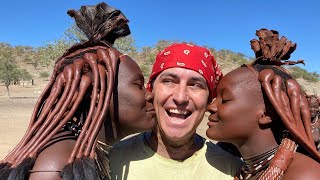
Hello. Today we'll be traveling through South Sudan's tribes. We'll get to know and observe them.
I'll be giving this super sour candy for the locals to try. [laughter] >> We'll also participate in a wedding where booze flows freely. Press the like button and be sure to watch till the end.
I'm flying into the depths of South Sudan, the city Capoeta, to visit other tribes. My destination is the small town of Caputoa. Due to climate change, there was heavy rainfall.
Drving would be extremely difficult, [music] so the little plane helps me out. Hopefully, the Russian hardware doesn't fail us. Look how beautiful the view is.
Oh, [music] [music] >> I'm here at Capoa. This plane can hold 10 people and some bags. Capoeta is tiny, so the airport's runway is made of gravel.
The runway is supervised by SUVs, and I'm greeted by children. It's hard to film here because of South Sudan's secret services. They dress as civilians, and I already had problems with them.
If it was difficult to film in Afghanistan, it's three times harder here. >> A worker with a whip doesn't allow the children onto the runway. If a child tries to slip through, they get punished.
>> That's them standing within safe range. There will be order. >> I arrived in Capua.
Small, charming, and tidy, lined with alleys, and full of fancy restaurants. Or so it might seem. There's a gravel road and a handful of houses.
While armed soldiers are being arranged for my protection, I go take a look around. Women are laughing as they chop up fresh meat for a group of people. I witnessed an attempt by the authorities to reconcile rival tribes.
They organized a village conference for tribal elders. The goal is to lay down their weapons of which there are truckloads. Heat.
Heat. Heat. Heat.
[music] Is she going to eat the rat? >> This one? Yeah, it's red.
They they do eating. Yeah. >> Looks shocking.
A young girl catches a rat and will eat it. But in poor and remote areas, this is normal in South Sudan. Bush meat, meat from wild animals, is commonly eaten, especially in rural areas near forests and savas.
For many communities, bush meat is a key source of protein and sustenance. Some animals are even considered delicacies and are sometimes tied to spiritual rituals. Adults hunt antelopes, wild pigs, birds, and reptiles like lizards or snakes.
Children, as you can see, go for smaller creatures. Bush meat can carry diseases like Ebola, lististeriosis, or parasites. Over hunting can also threaten certain species with extinction.
Hunting is banned in national parks and reserves in South Sudan, but such bans are often ignored. >> I'm up on a mountain overlooking a village surrounded by forests, palms, and cliffs. I'll leave you to enjoy the scenery.
>> I'm exploring the stunning nature of South Sudan, land that once teamed with wildlife. The Taposa people, who I'm about to visit, live in a region that used to have many elephants, especially near the borders with Kenya and Uganda. These areas were once crucial for hunting and illegal ivory trade.
Elephants were hunted not just for ivory, but also for their meat as food. Ivory became a form of currency, traded for food, weapons, or other valuable goods. Intense hunting for meat and ivory caused a major drop in elephant populations in South Sudan and surrounding regions.
During colonial times and later periods of political instability, the ivory trade was often illegal and linked to armed groups funding. During civil wars, some groups used ivory to buy weapons and gear. So, if you happen to have real ivory at home, remember this.
You may not only be linked to the killing of an elephant, but also to armed conflict and loss of human life. >> As I'm roaming the Taposa village, you can see these hay huts. They're for storing grains or nuts.
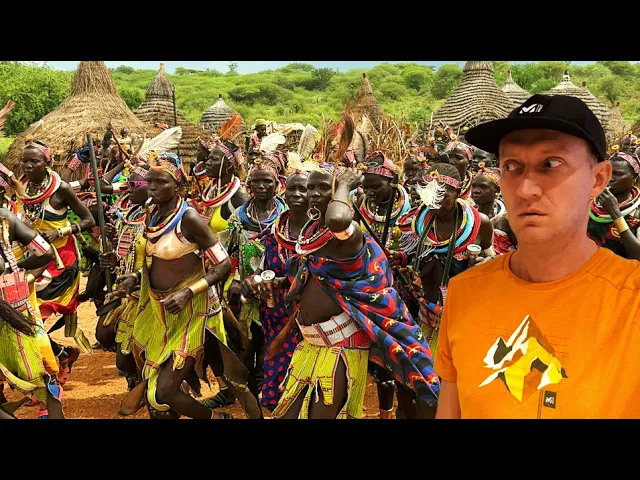
>> The Taposa are one of the largest ethnic groups in South Sudan. They belong to the Nelotic peoples and speak the Taposa language. [crying] They live in remote dry savannah and mountain regions mostly in eastern Equatoria near the borders with Uganda and Kenya.
They are known for strong traditions, cattle hering, warrior culture, and a unique lifestyle. At the tribe, I have a personal god. >> People can get out of control when drunk.
Cattle hering is the topos's main way of life. Cows, goats, [music] and sheep are symbols of wealth, prestige, and social standing. The number of cattle a person owns often defines communal [music] status and can be used to buy wives.
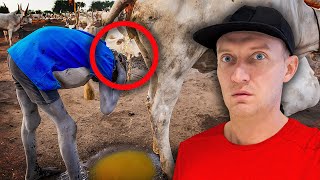
Cattle are also a vital source of food, meat, milk, and blood. Yes, blood. [music] It's mixed with milk and consumed during droughts when food is scarce.
The blood is usually taken without killing the animal by carefully piercing the vein. Cattle also play roles in religious rituals, conflict resolution, and as gifts. [music] [music] >> [music] >> Hair braiding is common amongst the Taposa women and some men.
They braid their hair into small intricate patterns or styles that can be highly decorative. These hairstyles can be elaborate paired with jewelry or ritual paint. Sometimes the braids or styles are made for rituals or preparation for war.
But more often, hair is kept short. They use natural tools to take care of their hair, wooden or bone combs. To moisturize and style it, they often use animal fat.
Truly an impressive village. These beautiful houses are made entirely from hay and twigs and bounded together by vines. [crying] The trib's women look interesting because of the scars on their legs.
Scarification is a key part of Toposa culture. Patterns are made using sharp tools. Then the skin is treated with plants to highlight the scars.
Scars usually mark the transition into adulthood. For men, they're often linked to warriorhood. Women scar their faces, bellies, or chests as a standard of beauty.
Raised scars are seen as signs of attractiveness and maturity. Scarred cheeks, forehead, or temples often show a person's tribe or social rank. For women, belly or chest scars symbolize fertility and femininity.
>> For men, chest scars may represent combat experience or courage. Scars on the arms or back are signs of strength and warrior spirit. >> He's got some chewing tobacco behind his ear.
These are the pumpkin pots of the tribe. They wreak 11 of 11. That means milk is kept here.
>> The village is actually huge. Here alone stands about 30 huts. Let's see the inside of a hut.
Okay. >> The woman is cleaning a pot. Notice what she's sitting on.
Cowhide. Historically, the Taposa are known as warriors. >> They often fight with neighboring tribes for pastures, water, or cattle.
They were also involved in civil wars due to their combiveness and loyalty. [crying] This is the appearance of a topaoa woman. Just look at these scars.
One is depicting a bull. The other arms the same. Very deep scars also of a bull.
The supposed worship nature's forces and their ancestors. The god of rain is the most significant since rain is vital in arid regions. Earth is sacred and symbolizes the importance of native land and ancestors.
>> The toposa woman is very decorated. Earrings of the lips and ears, African necklaces and scars. A truly striking tribe.
Young girls also wear jewelry. She's even got a cross. I'll be giving some super sour candy for the locals to try.
[laughter] >> [laughter] [laughter] >> Obviously, the candies really sour. They can't handle the sourness. They threw the candy away.
Well, the women didn't like them that much, but the men did. I've collected the trash. I tasted the candy myself, and it was incredibly sour.
The tribesmen carry a kalashnickel >> to protect their cattle against frequent robberies. And this guy has a metal rod for defense. >> [crying] >> Almost every local has a unique scar pattern on their forehead.
This woman's scars are stunning. She's brushing her teeth with a stick and they're white and healthy. Today there's a wedding and the women are getting ready.
They wear their best apparel. It's very interesting to look at yourself in the camera. >> Are there no mirrors here?
Well, whatever the case, it's still very fun. >> Bride price is key in Toa weddings. The groom pays a certain number of cows for the bride.
Marriages are often arranged between families, especially by the parents. Parents, relatives, and elders play a central role in negotiating the bride price and marriage terms. Parents make most of the decisions, but the bride and groom do meet before the wedding.
Emotional bonds and love are not prioritized. A man can have multiple wives if he can pay enough cows. Polygamy is often seen as a sign of strength and that he can support more than one family.
All right. [music] What an entrance. The trib's women have bedazzled themselves with jewels and feathers.
>> I was lucky to take part in a wedding ceremony here. It's a big and loud celebration with relatives, friends, and the whole community. There's dancing, singing, drums beating.
Traditional elements fill the air with joy and unity. During the wedding, [music] fertility rituals take place. Songs and dancers honor the marriage and wish for family continuity.
[music] Here [music] we go. People have come to the wedding from various villages. There's five times more women than men.
Wow, what jewelry. Look how they cover the babies so that they don't overheat with a pumpkin. The women want to pose and look at themselves in the camera.
>> [music] >> We are bringing the water or alcohol. >> That is alcohol. They taking to the [music] room and engagement.
>> Alcohol. Too much alcohol. >> Alcohol.
>> The Taposa make fermented drinks from local plants like sorghum or millet grains. Usually it's mild traditional beer. It's served at community events and rituals like weddings, birthdays, or harvest festivals.
This beer carries strong social meaning. It is meant to be shared. The tribesmen are sporting real leather hiding.
Ostrich feathers and there's lots of alcohol. They brought a canister of local beer which they share in a pumpkin bowl. They also brought weapons to the wedding.
Spears, bows, sides, various whips. A year ago, the government took everyone's guns to prevent conflict, probably for good. Different age groups and genders spend time separately.
Women, children, younger and older men all do their own thing apart. This guy with glasses and leopard hide is the groom. Seems he has lots of cows to afford a new one.
The Taposa live in a region with wild plants and grasses that have psychoactive effects. They are used both in medicine and rituals. Some wild roots or herbs are chewed or brewed into tea.
The effects are mildly calming or intoxicating. These herbs are used during long droughts or before battle to ease stress. The tribe also use plants that create a sense of euphoria or help numb pain.
Hallelujah. Hallelujah. Happy birthday.
Wow. [music] 3. An unbelievable amount of people from nearby villages have come here.
The men dance as if they're fighting invisible enemies. The women have their own traditional moves. Meanwhile, I got sprayed with some liquid, probably holy water.
During weddings, rituals, or other celebrations, members of the Taposa tribe use intoxicating methods to enter a translike state. This includes stronger alcohol, special plants, or what you see now, rhythmic dancing and drumming that lifts the mind. Such states are seen as a way to connect with ancestors, spiritual guardians, or the forces of nature.
The funny thing is that when I stand, the tribes people start to touch my arm and leg hair. They don't have that. Their arms are smooth.
Body hair is unusual to them. So from time to time, I feel them pinching me. We don't get Today you witnessed a truly stunning wedding, a whirlwind of dance and community.
It's amazing how people here live in close-knit communities, not shut away in their homes like we often are in Europe. Back home, it's mostly work and sleep. Here, it's work, connection, and celebration.
So, which is better? Drp a comment with your thoughts. Don't forget to hit that super thanks button below the YouTube [laughter] player and I'll see you next week.