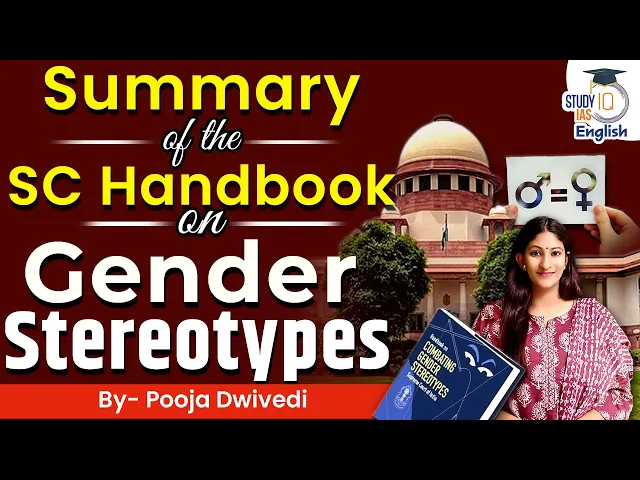
welcome to my class today in this particular class we are going to discuss in detail this particular handbook which has been released by the Supreme Court of India and it strives to curb gender stereotypes to understand it we first need to know what is a stereotype under that only we will be able to understand what are gender stereotypes you're also expected to understand the difference between gender and sex there is a difference between these two why does the Supreme Court need to release this particular handbook it understands that as humans we are filled with subconscious
bias we may not like to accept that we are biased towards a person if we do not know them completely they must just look like a representation of a sample but in actuality they are beyond that they are an individual similarly judges also have it judges are not free from it because it is a conditioning that every child goes through we have to understand that judgments have a profound impact over the entire country that is why it is important to use the correct thought of words so that the judges are not perpetuating these stereotypes or
gender typical roles that is why the Supreme Court has done it do not need to worry about note making because I provide the notes to my telegram channel that is by the name of Puja Devi upsc other than this if you want to talk to me about upsc you can also join my Instagram Channel now let's talk about stereotypes stereotypes are nothing but a set of idea or preconceived notion about what someone or something is like supposedly we have a boy or a girl named X this particular boy or a girl they belong to a
particular society in this Society it is observed that most of the children have not a very good academic background they do not have it so we will have a preconceived notion about this person X that they may also not be of good academic background this is nothing but a stereotype it can range from religious groups to gender or sex even to the place where you live at and this idea is generally wrong because we are judging them on the basis of their subjectivity on the basis of where they belong to we are subjective but if
we have to know about them on the individual level we need to judge them or understand about them objectively this is what the different this is what the Supreme Court also wants to do in any particular judgment even if the judges are legally correct they have to ensure that they are not using certain words which are perpetuating gender stereotypes or any other sort of stereotypes so it's an assumption or belief that individuals belong into specific social groups have certain characteristics or treats this person may be of an intelligent academic background but because they belong to
a specific society which says otherwise we are just stereotyping them now as you must be thinking that you are not biased you may not be actively biased but every one of us have subconscious biases we may not be a biased individual actively but passively if we meet somebody if we do not know much about them just few things about them and our brain starts to develop a pattern oh I also met a person of similar religious group or a similar state or a similar Union territory and they behaved like this now this person who also
May belong to a similar religious group or state or Union territory they are also expected to behave in a similar manner so everybody has the subconscious bias but Judiciary should be free from it because stereotypes impact the impartiality and the intellectual rigor of judicial decisions if any judge is biased even subconsciously and they have been conditioned every one of us is conditioned to behave in a certain way to use certain words from the very childhood and if the judge also does the same they may never be able to send the message in the society that
this word is actually having a connotation or an underlining meaning to it which is actually not very healthy for the society as a whole we should not look at any individual from a subjective point of view but also not but also but only objective point of view so the use of reasoning or language is very important here that is why there is a list of words which are not acceptable and preferable substitutes have been given for them I will go through that as well it also undermines the unique characteristic autonomy and dignity of the individuals
before a court and this goes against the constitutional principle of equal protection of laws supposedly if anybody any judges using terms such as devoted wife married you or you know devoted wife or they can use terms such as a woman of lose character so all this perpetuates the preconceived notion that such stereotypes they are compelling to be accepted so it goes against the constitutional principle of equal protection of laws which says that laws should apply uniformly and impartially to every individual irrespective of the membership to a group or a category supposedly there are two people
A and B a belongs to a low income background and B belongs to a high income background and they have caused some sort of financial malpractice wherever they are working because B belongs to a well-off background affluent background the judges may have a subconscious bias that they do not need to do certain things because they are already affluent but if we talk about a who already belong to a low economic background and they may have also done it they may have done Financial malpractices the judges may think that of course he is from not a
very good affluent not a very affluent background they may have done certain things like this so they can be fined more rigorously than b and if they are not able to pay the amount the fine to the court then what can happen they can be jailed and hence it will also perpetuate further that yes look at this person a he belong to this kind of background so correctly so they have been charged and hence jail so this is very important for us to understand this is the subconscious bias that I'm talking about also the judgments
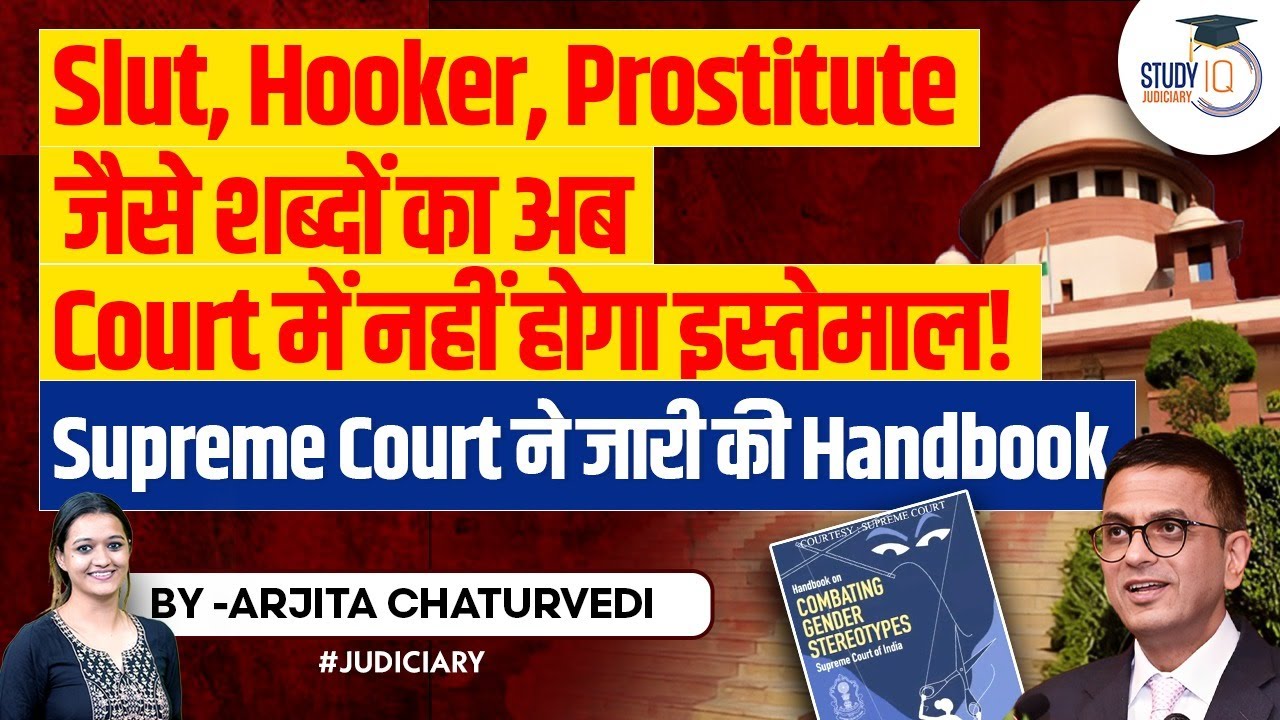
that are undertaken they can you know entrench and perpetuate stereotypes and franchise and if the judgments are using certain words which are not very healthy for the society such as adulteress Affair bastard this will definitely tell the society it is okay for even us to use that so adulteress has been termed as incorrect in this particular handbook we can say it is preferred that we should call them woman who has engaged in sexual relations outside of marriage a fair relationship outside of marriage bastard non-marital child or a child whose parents were not married biological sex
biological male biological female it should be text assigned at Birth born a girl or boy assigned female or male at Birth career woman is just a woman carnal intercourse is sexual intercourse chaste women is also just a woman child prostitute is a child who has been trafficked they are not mentally and aware and capable they are not above 18 that they can make that decision for themselves concubine or keep woman with whom a man has had romantic or sexual relations outside of manage beautiful wife faithful wife Good Wife forbidden wife is just a wife easy
virtue that means a woman of easy virtue is just a woman effeminate when it is used pejoratively it is accurately describing the characteristic using a gender neutral term that is confident or responsible person if teasing is not Eve teasing it is treat sexual harassment so thereafter this is showing us that even the Supreme Court wants to change ladylike is actually using a gender neutral descriptive of Behavioral characteristic like amusing or assertive layabout or sugar is unemployed so all these words which have been okayed by our society to Define any person undermines the Dignity of them
that is why it shouldn't be used now let's understand the difference between sex and gender sex is of course determined by chromosomes biologically they can be X Y or XX this is generally a biological thing one that use ones that you see at Birth gender is a socially constructed and enacted roles and behaviors that means a person who belongs to a certain sex should do certain things which are socially acceptable a girl should not laugh out loud this is a socially constructed role a boy should not cry this is a socially constructed Behavior acceptable behavior
by the society and when based on the sex one is expected to do those kind of behaviors which are socially acceptable this is known as gender stereotyping gender is more of a spectrum there are many women who do not actually are extremely you know in a way that the society May accept them to be a woman similarly for boys for men it can be the same there can be occupations as well a boy should not be a makeup artist a girl should try to do those kind of jobs which are domestic in nature taking care
of the family taking care of the husbands not you know there is also a fact that all women are not maternal they may not have maternal instincts but the society says that all mothers should have maternal instincts does the society ever ask the men do they have paternal instincts no so this is what the differences between gender and sex there is a stereotype women are overly emotional illogical and cannot take decision so how this will impact this stereotype will impact the professional career of any woman a person's gender doesn't determine or influence their capacity for
rational thought all women are physically weaker than all men while men and women as the physiologically different that is very true it is not true that all women are physically weaker than all men this is not true this is a stereotype a person's strength doesn't depend solely on their gender but also other professions other factors such as profession genetics nutrition physical activity women are warm kind and compassionate compassion is an acquired characteristic that can be developed and it exists in every individual unmarried women are incapable of taking important decisions about their life how does it
matter if a person if a woman is married or unmarried it doesn't actually depend on that it depends on how they have achieved experience throughout their time in their life but we have to understand that even the courts were not free from it a 24 year old woman's parents initiated habeas corpus proceedings that means to present the body of taking the production of their daughter when she married and moved away from them and in allowing the petition the Kerala High Court observed a girl aged 24 years is weak and vulnerable these two adjectives that were
used to define a woman a woman who was actually 18 Bill above the age of 18 years who was well capable of taking her own decision although it is socially acceptable that any person not a man or a woman but any person who is close to their family can take the advice of their parents and near and dear ones or Guardians whenever they are making decision about marriage this is social acceptable it is not mandatory the Supreme Court reversed this decision in shafin Jahan versus Ashokan noting that the high court was of the view that
at 24 she's weak and vulnerable capable of being exploited in many ways so this is perpetuating The Stereotype that women cannot take their own decisions or even if they do so they are under the influence of somebody else the high court has lost sight of the fact that she's a major capable of her own decisions and is entitled to the right recognized by the Constitution to lead her life exactly as she pleases the Supreme Court further rule that the Superior Courts when they exercise their jurisdictions parents Petra do so in case of persons who are
incapable of asserting a free will supposedly a miner is not able to do that and a person who is unable to make decisions with mental capacity okay moving on the most important suggestion or case here is the bhavani Devi's case and the vishaka guidelines bhavani Devi was actually a government social worker and she belonged to an oppressed cast and she intervened to prevent her child marriage now in 1992 she filed an Fir and she also gave the testimony that multiple dominant cast men violently assaulted and raped her as a retaliatory measure to show of course
that they will remain dominant in every way not only the cast but also sex and gender in 1995 the trial court acquitted the accused and the reasons let's see them members of a dominant caste would not rape a woman from an oppressed caste men of different cars would not participate in a gang rape older men age 60 to 70 cannot participate in a gang rape and it was improbable that a woman could be raped in the presence of her husband these were the reasons that were given and this acquittal caused National outrage because of the
Nexus with bhavani Devi's work as a government social worker now members of Civil Society they filed a pin in the Supreme Court of India seeking that workplaces must be made safe for women and that it should be response the responsibility of the employer to protect women employees at every step in 1997 the Supreme Court in vishaka versus state of Rajasthan laid down the guidelines to protect women in the workplace and there is also workplace passive subconscious bias that exists a person an employer who may want to interview two people for a job one is a
man another is a woman this question is very common among the women when are you getting married does it ever occur to the employer they can also ask the men the same thing because there is a subconscious bias this person is very Progressive in nature but there is a subconscious bias that women after marriage may not be as professionally ambitious which is completely wrong but the steps very steps have been undertaken by the Supreme Court to show that they are breaking away from the shackles of such thought process and Joseph Shine versus Union of India
our constitutional bench of the Supreme Court struck down the offense of adultery under Section 497 of the IPC many people said that the Supreme Court has made cheating you know okay it's not an offense but cheating or adultery is still a ground for divorce why was it struck down is very interesting because it penalized a man engaging in sexual intercourse with a woman who is the wife of another man this shows that that woman who is the wife of another man is actually the man's property and it did not punish a man who had a
sexual intercourse outside of marriage with an unmarried woman so this was the biggest difference that the Supreme Court cited it the Supreme Court said it punished sexual intercourse with the wife of another man but not any man who is also having sexual relations outside of marriage with an unmarried woman what about this bias the Supreme Court also rejected the pre-vaginum test or the two-finger test and the irrelevance of sexual history in the state of jharkhand it is said that any woman who has been raped she has to go through a two-finger test this is completely
unreliable and also undermines the Dignity of the Survivor or the victim as they prefer themselves to be called the testimony of a Survivor or a victim is inherently credible any Court must not be suspicious of any thought of testimony that is being given by the victim or the Survivor if there are certain here and there in the statement that may be because the person has go gone through so much mental harassment it should not be doubted merely due to incorrect assumptions as well women seek to foist false cases against men or the women lie about
having been raped this is also should not be assumed this should be first proved and not assumed in state of Punjab versus gurmeet Singh the trial court here refused to accept the Survivor of the victim's testimony due to certain preconceived notions because there were inconsistencies the absence of any physical injuries it must be evaluated with the context it can also happen that a woman wasn't able to resist the force that was applied on her to abuse her maybe she did not have injuries because of that and the absence of physical injuries must be evaluated contextually
in the facts of a given case it is not determinative that if she doesn't have injuries there is an absence of sexual violence state of uttar Pradesh versus chotilal is an important case in this regard where the Supreme Court observed that the Survivor victim had been gagged and threatened with a firearm 2. maintain relations so isn't that sexual violence just can be determined by the kind of injuries she has sustained it's a step in the right direction now it is time for us as a society to go through this handbook to understand that words are
carrying a lot of heft and energy that is why we must use them to vary appropriately and carefully thank you so much for watching