my name is Rona Murray and I work for ancestry and I'm joined by my colleague Joe Boogie who works for ancestry Pro genealogists all coming under the One Umbrella of of the ancestry company today we're going to talk to you about Irish Catholic parish records that are found on the ancestry website so to get started I thought I'd kind of go back to the basics just slightly and help you get to grips with what we Define as being a Catholic parish record So within the Catholic parish records collection what we were talking about mostly is
the sacramental records and by that I mean baptisms confirmation marriages and burials and opportunity to get a log of somebody's life as they interact with the Catholic church over their years it's mainly you know it's the backbone of um of any family tree in terms of tracing people at major events throughout their life um as they interacted with the church in terms of when should you use them the Catholic parish records are helpful when you're trying to go beyond civil registration so from a Catholic perspective civil registration would have begun for us in 1864 so
from 1864 onwards um um up until present day if you go to sort of Irish genealogy. you can get quite modern records for birth marriage and death records from a civil perspective where the state is in charge of recording such events but prior to that you're relying on the Catholic church and indeed the Church of Ireland um to record such events um major events in people's lives in terms of what years they cover there are some records that exist from 1740 onwards but the majority of the records you'll see come into play from 1800s and
1820s onwards and that is in relation to Catholic emancipation Catholic priests weren't necessarily comfortable in recording such information prior to that point um so where um you know kind of alliances were made in relation to some of the strict laws and and rules around Catholicism and the practice of such um 1820s you're sort of talking the the priests then felt more comfortable in being able to actually start to record details around their congregation in terms of baptisms marriages confirmations and burials I'm going to now talk about the Catholic parish records that you can find on
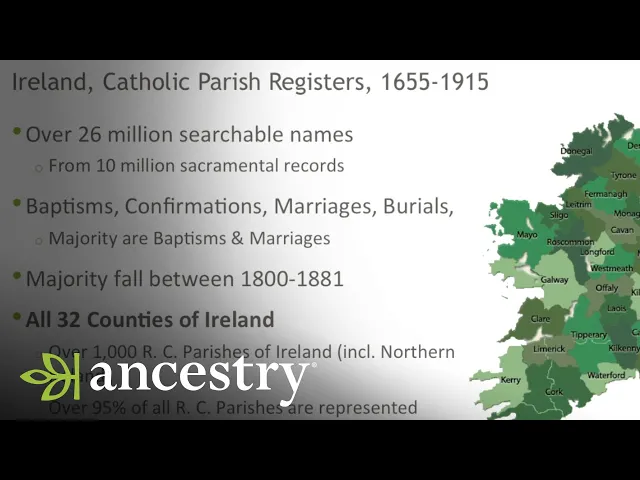
the ancestry website itself many of you may not be aware but ancestry actually has the world's largest online offering of Irish Catholic parish records when it comes to both images and indexes combinations they come from multip multiple sources and it's something that we've been working on for a number of years but the most recent trunch that really bumped up the numbers are in relation to the collection that come from the National Library of Ireland so in July 2015 the National Library of Ireland did an absolute Trojan amount of work around launching the images 373,000 images
of Catholic parish records now they were available to browse that was the capacity at which they could run that project and they did a very good job and at that point then ancestry were poised to take on the mammoth task of creating an index to those images so that you can have your Google type search of going in and searching your own family surname and your Parish location and being able to find um details on that so we we launched with a bang in March 2016 we had orti coverage we had Irish Times newspapers writing
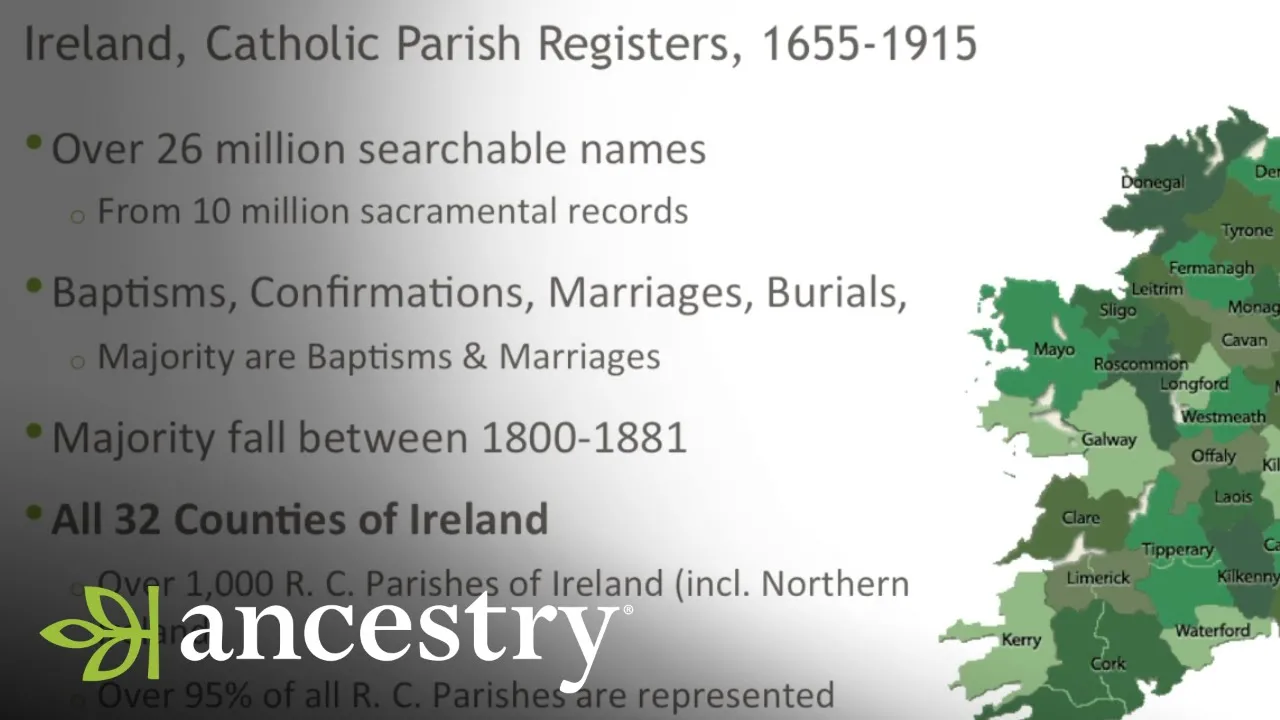
about us as well as who do you think you are a magazine and and it went Global in terms of what we achieved there are 26 million names within this collection it's absolutely huge and it's fundamental to researching your Irish family history so as I said 26 million names from 10 million sacramental records So within a baptism you're likely to find three names in terms of the child and both parents' names um all of which are searchable and Joe is going to talk about giving you some tips on how to get into the records in
detail in a few minutes the the collection on Ancestry is called the the Top Line there Ireland Catholic parish registers 1655 to 1915 the earlier ones of 1655 are actually death records from about the 17 queries that capture ages um from which you can then assume birth years of of the 1600s um the majority of the collection are baptisms and marriages the burial records that come into play are mostly for Northern Ireland and by that I don't mean our our current definition of Northern Ireland but what I mean is the northern part of the island
of Ireland they cover the full 32 counties of Ireland and um you've got over 1,000 Roman Catholic parish records covered within the collection that's over 95% of of every Catholic parish in Ireland is covered so if you're having trouble researching your family history Beyond civil registration and of course we know that you know Census records pre 1901 are tricky this is the collection you need to get into to populate your from a tree um kind of pre1 1900 there's 3,57 registers that were digitized by the National Library of Ireland and the majority of the collection
sto in 1881 reason being civil registration began in 1864 and the National Library on undertook the project to digitize these Parish records in 1950s 1960s they decided to add on a 15-year period to that civil registration start date to capture people at a point that it was not compulsory to register your birth marriage and death records so that is um the reason being that the majority of the records stop in 1881 um in the last sort of 20 to 30 years as I understanded uh work was done by the National Library team to go back
and capture parishes that would not participate in the original project and therefore some of those Parish years come all the way up into 1915 so you'll get some more recent records where they went back and did updates to fill the gaps in addition to the National Library collection oh sorry actually before I I touch on that I'll give you an example of of what it looks like just from an A Brief image perspective and as I mentioned Joe will go into detail on this this is a it's actually a baptism of my great grand Uncle
Christopher pool the 17th of December 1875 but the reason for showing you this image is to just set your expectations in relation to the format so in the SE in 1950s 1960s the National Library created microfilm of the parish records and it's this microfilm that was then taken and created a digital image from it so therefore you're looking at a black and white image um and and the master files were used by you know users coming into the library over the years and searching them so some some damage has been done to the microfilm the
images have only been created in the last sort of 10 years um so you can you can see sort of blurred edges and and um unfortunately not as as clear as if you're working with the original register itself but with that in mind it's a huge achievement for them to actually have been able to publish them online so um I think Kudo is there for for all the work that they've done around it this is actually an image that I got from ancestry in um showing my great grand Uncle Christopher pool just kind of showing
you how you can you can go and find a name and the date in a place and I got a hint from An ancestry member tree of a photograph of Christopher pool that I I never seen before so being able to share that with my granny was was really nice we have existing databases on Ancestry as well which is how we can say that we have the largest collection of Irish Catholic parish records these have been online some of them since 2013 some since 2014 so predating the record collection we launched in March that I've
just spoken about they um are a combination of baptisms marriages confirmations burials these covid-19 counties across Ireland so what we've previously seen covered the full 32 counties I'll read out the 19 County so that you're aware um we've got Arma Carlo Claire cork Donny G Dublin gway kildair leash limr London Derry La Mayo me Sligo tieri Tyrone westm and wicko so a substantial number of counties um from a private collector from which we got additional Catholic parish records these range all the way up until 1912 so unlike the National Library project these ones were done
in the last sort of 5 to 10 years um actually probably in 2012 um or in around that period and a 100-year cut off point was applied um so therefore the records in these collections come up until 1912 so for those other counties that you're searching you may see a gap that they only stop in 1881 in the previous collection but by digging into some of the other databases we've got you'll be able to to take your family further the great thing about this collection is that they're actually scanned from the original records so you're
getting a color image very clear very high quality seeing the original handwriting um and being able to zoom in to quite full capacity to actually read the records unlike the um the microfilm that an image was created from so I'm going to briefly take you through the type of information you're going to see across the sacramental records and then Joe's going to step in and give you some really good examples um from a pren perspective over the research that he's done himself um and show you how to actually find the collection and and do some
work around it so within a baptismal record what do we what do we get we've got the first name the surname date of birth can sometimes be recorded as well as the date of baptism the place of baptism so you're getting the Family Parish name um and the county that it falls into as well as the father's name and the mother's name this is an example from um the the second collection I referred to with the the colored images um this is wesland row and the second last line down the bottom is poric Henry Pierce
or in in this case Patrick Henry Pierce as it's recorded the 10th of November um I can't see the year oh 1879 so wesland Row in Dublin from a confirmation record perspective you'll get the name the date of the confirmation the age of the child as well which is very helpful to indicating the the birth year and which you should be looking as well was the baptismal record the place of confirmation in terms of the parish and again I have seen on occasion where father's name and mother's name have been recorded I must warn you
though in some parishes they did just like to put a list of the children's names and you don't always get the age and the parents name Association so it does vary but this is um quite a good example in terms of the amount of information you can possibly see then we'll skip on to a a marriage record example again you can see the the image straight away being the the black back and white microphone but this is from the the National Library collection um you've got the name of the spouse who's getting married the date
of marriage the place of marriage but more importantly you've got well perhaps equally importantly you've got the father's name and the mother's name of the Bride as well as the father's name and the mother's name of the the husband so in that sense you're getting a full family unit there and just confirming that you're looking at the right person when you're tracing your family history which you know we all like to do cross reference and triangulate our research to prove that you've got the right person the burial records are perhaps the least informative and as
I mentioned um more heavily recorded for the northern half of the island you've got the name the date of death age is very helpful to be able to to count backwards the place of death and sometimes you do also have the church L churchyard location if you're interested in visiting the grave site these ones come from the Catholic parish record it's um found on the National Library of irent I'm going to hand over to Joe now who's going to give you sort of an interactive um talk and relation to doing some searches and then showing
you some live images um and examples that he's he's uncovered in his research that's great thank you very much Rona um and just before I start on my particular section i' just like to point out say from a research point of view why it's so useful to understand the Providence of record sets that we find online and uh where they come from initially because more and more records are are coming online uh ancestry obviously has many different types of collections but it's crucially important when you do genealogical research to understand what was the original format
of the record set and then how they were created and put online because that can allow us to understand then that you know maybe why we can't find ancestors in them or if there's any potential gaps or what is the most useful information that we can get so the the discussion that we just had there gives you that real deep understanding of the variation of databases that do exist and what you can actually then find in them so as Rona was saying then um we have many different Catholic parish register uh databases on Ancestry and
I'm going to focus on our core collection which as want to refer to uh came from our partnership with um National Library of Ireland so when you log on to your ancestry account um one of the fundamental places that I always recommend for people to start is if you search if you select the search button at the top and then go all the way down to the card cat calog so the card catalog on Ancestry is essentially our list of databases um our list of the different types of record collections that we have so there
are tens of thousands of different types of record collections on Ancestry and by starting from the card catalog that will allow you to select particular databases from particular countries and particular time periods so that you can really hone in on the type of research that you want to do so for example when we select the card catalog then there is a title search and a keyword search on the left hand side so you can see then in this particular search example the word Catholic has been entered into the keyword search box and what that does
then is it brings up all the relevant databases then that are associated with records to do with the word Catholic so not only do we have the uh primary database then at the top Irish Catholic parish registers that contain the 26 million names but we have many other interesting and relevant records sets then from the anest website that you can also use when searching for uh Catholic ancestors in Ireland so this is the database then on the ancestry website and there are two primary ways then that you can search in this particular collection so what
most of you will be I'm sure familiar with is the the search functionality on the left hand side where you can enter that key information in relation to the ancestor that you're looking for so obviously their name uh any particular year of birth that you are familiar with or marriage or Deb H and then locational information as well and then there's also the facility uh towards the bottom of the page to enter information in relation to some of the family members so say for example for a baptism you might know of the parents' names and
you might want to include those parents names then as well to help filter your search results and what I would personally always recommend is not to get too specific with your uh search functionality uh I typically recommend that people uh don't don't do exact searches that they do kind of broader searches because you know there's many different quirks and peculiarities of the Roman Catholic parish registers H particularly when it comes to the handwriting of the priests and how they might have spelled uh family names and first names so for example my second name is buggy
uh it's typically spelled b u g y but you will see variations in the registers ending in ey or IE so if you use that broader uh search functionality you would capture all of the VAR of those particular names and just because you record your name today a certain way that doesn't necessarily mean that that's how it was recorded maybe 100 or 120 years ago the second way that you can search the record collection then is here through the browse functionality on the right hand side so again you might know of an event that occurred
maybe in a particular decade or you might just have a a particular Parish so it might be useful then to uh browse through the collection Page by Page and to pull out then the relevant entries that you are interested in and this can be uh very useful for example with uh Catholic families that may have had 10 uh eight 10 or maybe even 12 births and those would have all been registered in the uh sorry would have been registered in the collection so you know browsing a wide range of years then can ensure that you
find all the relevant entries that you're interested in so for example you would select the uh Roma Catholic dases first um there are some very good maps available online of Catholic dases uh for example example the uh Catholic Bishop's conference website has a very good diois and map and also Wikipedia as well also has some very good diois and Maps uh so if I collected the parish from where I'm from uh which is in the dasis of Cera in Lan and then I get to be able to filter down to uh pulone which is just
here and then when I select the parishes then it gives me the options of the uh different year ranges that are available because often you will find it wasn't just one book or one volume that was kept in a parish the was a whole series covering the different types of records and covering the different years then as well because it wasn't just the one priest who was in a parish over 100 and 150 years you had different priests and they would have kept different types of registers so you have the uh search functionality on the
left by the keywords and the dates and then also the browse functionality as well and there are many other databases then as well where the browse functionality is applicable on the ancestry site so I would always recommend that you consider that search search option as well as well okay so moving on then so we're just going to get into a little bit more detail about the records try and give you maybe some hints and tips and then also maybe pick out some specific case studies then as well so I've created uh what I call some
heat Maps here so what's very important to understand is the start date of the registers and also to understand then how that might uh play out in different counties in Ireland so there's a couple of broad kind of uh rules that we can follow when it comes to the start dates of the registers so typically we can say that as we move from the west of Ireland to the east of Ireland the start dates of the registers are earlier and earlier and broadly we can say then as well that in urban areas the registers will
start earlier um than in uh rural areas so I picked out two counties here on the left we can see County Kenny and on the right we can see County CLA so basically the brighter the color so the Reds and the oranges means that the parish the registers in those parishes started at an earlier date so if we look at the left hand side we can see that for red uh that means the parish register started before 1800 so just contrast Kilkenny with County CLA there's no parishes in County Clair where registers begin be uh
before 1800 and if we look at the blue color which means that register started after 1850 we can see that uh in a western Seaboard County we have many more registers than that begin after 1850 so it's important to remember this kind of idea that when we go looking for uh research and looking to do research in particular counties that we may be hamstrung by the starting point of the registers but what is important to remember that if you have a particular Parish that maybe doesn't go back as far as the time period that you're
looking for is to look at the neighboring parishes because the evolution of the parish system in 19th century uh Ireland followed the population movements so as as populations changed and as areas of expansion emerged new parishes were created so if you look at the very northern part of County keni we can see a small Parish there in blue indicating it's post 1850 so that is the Parish of mukali but we can see immediately below it then the parish register starts earlier so originally that was one parish and then after 1850 another Parish was created because
there was the population to have a church and to have services and to record baptisms and registers so if you're looking in a particular County and you find the register for that Parish doesn't start as early as you want look at the start dates of all the parishes around it and you might find your people of Interest then in that particular Parish so there are some other important people then to consider as well when we look at uh particularly the baptism and the marriage registers that we have the CORE family unit uh typically for a
baptism of the two parents and the child being baptized or of the the the marrying parties but we also have the baptismal sponsors and we have the witnesses to the marriages as well so typically we'll see two people listed for uh baptismal sponsors or marriage Witnesses but sometimes it can be just one person and sometimes I've seen example of examples of three people as well so this can be really really useful because often times these are the close people in that family's life they are friends they are neighbors they are extended family members and sometimes
when we're doing our research we get a little bit too focused on the family and the direct line that we are searching so we really have to consider uh their extended family members their friends and their neighbors kind of that community research because that could be the Breakthrough um that we're looking for on a collateral line that can help us to go back maybe one generation or maybe even more and for those of you who are doing research outside of Ireland as well uh this uh focus on the baptismal sponsors and also uh on the
marriage witnesses can be very very useful as well because a huge feature of immigration from Ireland was chain migration people following their friends and neighbors to different parts of the US Canada Australia and England and what's very interesting is that the the cluster of surnames in Irish areas that you find in New York state or California or New South Wales you can see those same family names repeated in the parish registers so the Murphy's are standing for the Kelly as baptismal sponsors and the Ryan are acting as marriage Witnesses for the Brennan's daughter's marriage we
see these names replicated in immigrant countries as well so don't forget the baptismal sponsors and the marriage uh Witnesses so I'm just going to highlight maybe some of the interesting things I've noticed I worked in these registers every single day and when you're looking at pages and pages of Catholic parish registers you kind of begin to notice kind of unusual things that are interesting for uh for research so this is a particular example from County CLA it's a Latin baptismal register from 1855 but what we can see here is a gap in the register uh
from about the 11th of June 11th of July through to the 28th of August and we have the simple notation of entries lost and it's it's an important thing to remember as well that sometimes we have our our Modern Eyes and our modern way of thinking that we're so focused today that all of our personal information has to be absolutely correct but what we might forget is that maybe uh a baptism may not have occurred in the church the priest might be recalling from memory he may have been writing it down on scraps of paper
with the intention of later uh transferring it into the register so here we can see an example that for whatever reason in that month and a half the entries were lost maybe he lost a scrap of paper paper maybe the priest died but it might be unfortunate for you that maybe that's when a baptism occurred and that's why you can't find it so you do see these kind of quirks of the entries interesting notations when you work in these registers a lot here's another very interesting example then from a register in County Mayo so um
the rules and regulations of the Catholic church has changed over the centuries and in the early 1900s uh a decree called Nate Maria came in and one of the aspects of that particular ruling was that when marriages occurred in Roman Catholic churches the entry had to be recorded in the baptism register in the parish where that person was was baptized so that was a noble intention but if you think about the reality of it it could be quite difficult that if somebody from Ireland immigrated to the United States or Canada it would be very difficult
to send word back to put a marriage in a baptism register in a particular uh part of Ireland but we see many examples of this in baptismal registers in the Roman Catholic parish register collection so here's one very interesting example it's uh from the 13th of February 1870 Mary Barrett who was the daughter of Richard and Peg Murphy from Cross townland in uh Kilmore Eris Parish then in County Mayo so a notation then has been written above her entry married John Higgins 27th of June 1928 in St Paul's Cathedral Pittsburgh USA so that's really really
interesting information and especially maybe let's say for example this was a sibling of one of your direct line ancestors and you you know she didn't marry in Ireland you never found out what happened and here is direct evidence then that this person immigrated to the United States and married in uh married in Pennsylvania so as I said it's not the case maybe that every single marriage was referred back to and recorded in the baptismal reg registers but because of the Nate Mary ruling then in 1908 I've seen a number of examples of this and if
you think about it if somebody immigrated and maybe got married in their 40s or their 50s or even in their 60s in the United States or Canada or elsewhere their baptismal entry in theory could be as far back as the 1850s and you may just get that notation then above their baptismal entry indicating about their marriage so uh some really really good genealogical information in this particular example so I'm just going to focus on a little case study then as well again to show about how when you're looking through the registers to not just focus
on uh one particular person and to consider the family unit as a whole so I was recently doing some research and I was focusing on a person called James Coy and we knew that James was from County gallway but we wanted to find out exactly where this particular person was from so we knew that broadly the James was born about 1859 and luckily we had their parents' name names from a Deb certificate from the United States parents named James Coy and Sarah donu so coy is obviously not a Kelly it's not a Ryan it's not
one of the super com an Irish name so uh we kind of look at some of the surname study tools that we have and kind of try and pick out maybe some particular parts of gallway where these names might be evident so we went looking for James then in uh the Roman Catholic parish registers in county gallway and we couldn't seem to find them so you know we used the broad search parameters and we came up with three interesting uh three interesting hits there was a James K 1863 uh Jacobus Koy because obviously um a
lot of the registers particularly in Irish speaking or more rural areas might be in Latin that was 1861 and a Jacobus C in 1860 but as you can see none of the parents names then here on the relatives uh on the right hand side none of them are James Coy and Sarah donu so we're frustrated we can't find the exact person that we're looking for but since we know the parents what we can try and do is uh searching by the parents names so we weren't we weren't able to find that where James was born
but typically families had more more than one child so there might be a good chance then that we could find siblings of James recorded in the registers so when we searched then in County gway uh just focusing on parents' names James and Sarah uh we found two really interesting entry entries so in AR draan Roman Catholic parish then there was uh patricius Koy uh so Latin for Patrick and then brigeta uh from 1869 so we can see the entries then here Patricia Koy uh from November and then the parents names and luckily then we also
get the townland as well so kardu in our draan Roman Catholic parish County gallway so we have two siblings of James here and we're still wondering why is why is it that we can't find James so I did a browse search I went Page by Page looking at all the koi entries uh I was mindful then of any maybe very unusual or very very different spelling variations maybe it was McCoy MC Mac maybe it was C Y without the e but we couldn't find any uh any example then of James but we were quite satisfied
that this was the correct family that we had uh parents' names matching the time period was relevant and based on our surname analysis this matched up with one of the the relevant Roman Catholic parishes but when we look at the uh start of each of the microfilms then or each of the registers in the collection we see that there's a gap in the baptismal registers so we can see that the first book goes from 1839 through to 1946 but then we have a gap of 20 years so this is most likely then why we couldn't
find James Coy's baptism we believe he was born about 1859 but unfortunately it fell within the Gap then from where they had either lost the register or for some reason the baptisms weren't recorded but luckily then as I said we were able to find evidence of his siblings and you know as genealogists we like to have uh follow the genealogical proof standard but one of the aspects of the genealogical proof standard is the reasonably exhaustible search so we felt at this stage we had done very very exhaustive search we had looked at all the registers
we had found relevant parents we had found two siblings and we felt then that this was the correct family in kaheru h townland in our dran Roman Catholic parish so that's an example then of how it's useful to sometimes focus on uh the parents especially when we're looking for baptisms and as I said then in the search functionality on Ancestry you can enter parents' names only and maybe focus on a county or a parish or a particular time period um so just as I'm finish up finishing up then um as I said I'm kind of
working in these registers every single day and you really find some very interesting uh little notations we saw some a really great example uh from the Scottish speaker previously of someone doing the drawings on the census document but here we can see a registered then from uh Athlon in County West me uh in 1815 and somebody has written at the bottom six long mon months after a while we we shall meet so I thought this was a really tender entry and it's very very curious as to who wrote this what would be quite surprising is
if it was the Roman Catholic priest who wrote it and who is he maybe longing for um but possibly it was a later entry it doesn't seem to be maybe the same handwriting or maybe the same depth of uh pencil pencil manhipster in 1815 but it's it's curious to consider and Ponder this fact that who was kind of bored in their job wasn't paying attention maybe was thinking about their loved one and decided to enter this particular example um in the register and thank you very much