hello Heroes today in lecture two we're going to be looking at the man best known for the Protestant Reformation Martin Luther and for your devotional you can see that I am drawing from fulcrum 7.com which in turn drew it from a man named Andy Ral with Bible Gateway looking at five favorite verses they might have been the favorite verses of Martin Luther and several of them uh make a lot of sense so I will just draw from that um for the devotional first is Romans 1:17 for in the gospel the righteousness of God is revealed
a righteousness that is by faith From First to Last just as as is written the righteous will live by faith the famous reformer Martin Luther identified this verse as one of the key Inspirations for his work Luther saw in it and in other verses like habc 24 a powerful reminder that it is through faith in God's grace and not through good works that humans are Justified before God and as I go through the remaining four I would encourage you to contrast this with what you know about the Roman Catholic Church of the time of Martin
Luther that we will get into more and more during this part of the course uh another favorite verse of Martin Luther's was Ephesians 2:8 for you are saved by grace through faith and this is not from yourselves it is the gift of God this is the Bible verse we gave to our first daughter uh we picked one on Joy from Nehemiah for our second daughter but Ephesians 28 is another verse that emphasizes salvation as a gift of Grace not something we've earned through our own Merit which is a key belief of the reformers a third
verse is First Peter 2:5 like living stones let yourselves be built into a spiritual house to be a holy priesthood to offer spiritual sacrifices acceptable to God through Jesus Christ one of the most provocative and controversial beliefs of the reformers was that because every Christian is considered part of the priesthood there was no scriptural basis for the office of priesthood as the Roman Catholic and Eastern Orthodox Churches understood it this remains a key distinction between these branches of Christianity to this day most Protestants see the need for pastors and indeed the most most recent church
that I pastored had in its bylaws the pastor leads the church board governs and the church members minister or as the phrase goes every member is a minister and that is derived from first Peter 2:5 every member is a minister a holy priesthood next comes second second Timothy 3:16 all scripture is God breathed by God and profitable for teaching for reproof for correction and for training in righteousness that the man of God may be complete equipped for every good work solos scriptura meaning the belief that the Bible contains everything we need to know in order
to be reconciled to God and live righteously was important to the reformers including Martin Luther this idea elevates scripture above all other authorities including the church and Christian tradition and in my life and Ministry that is the case the Bible is my Touchstone it is my authority from which my decisions flow both with matters of belief and practice and then the fifth verse and they're not necessar necessarily in order of Martin Luther's favorite but what is shared is Matthew 11 vers 29 and 30 which says accept my teachings and learn from me because I am
gentle and humble in spirit Jesus says and you will find rest for your lives the burden that I ask you to accept is easy the load I give you to carry is light the Protestant Reformation believe that centuries of church tradition had placed a heavy burden on the backs of Believers and pointing to verses like this one they reminded Christians that the gospel of Christ is meant to free people from guilt and sin the writer of fulcrum 7 continues to write that the problem today is that Protestants have lost much much of their protest instead
of reformation there is regression instead of restoration there is reversion instead of righteousness there is Retreat we need a new return to the Bible an abundant infilling of the Holy Spirit and a renewal of the great Protestant Reformation we need to say with Martin Luther as he did at the diet of vers here I stand I can do no other God help me that concludes the devotional section of the lecture now I give you a short introduction while there were many reformers Luther and Calvin are at the heart of the Protestant Reformation Luther was not
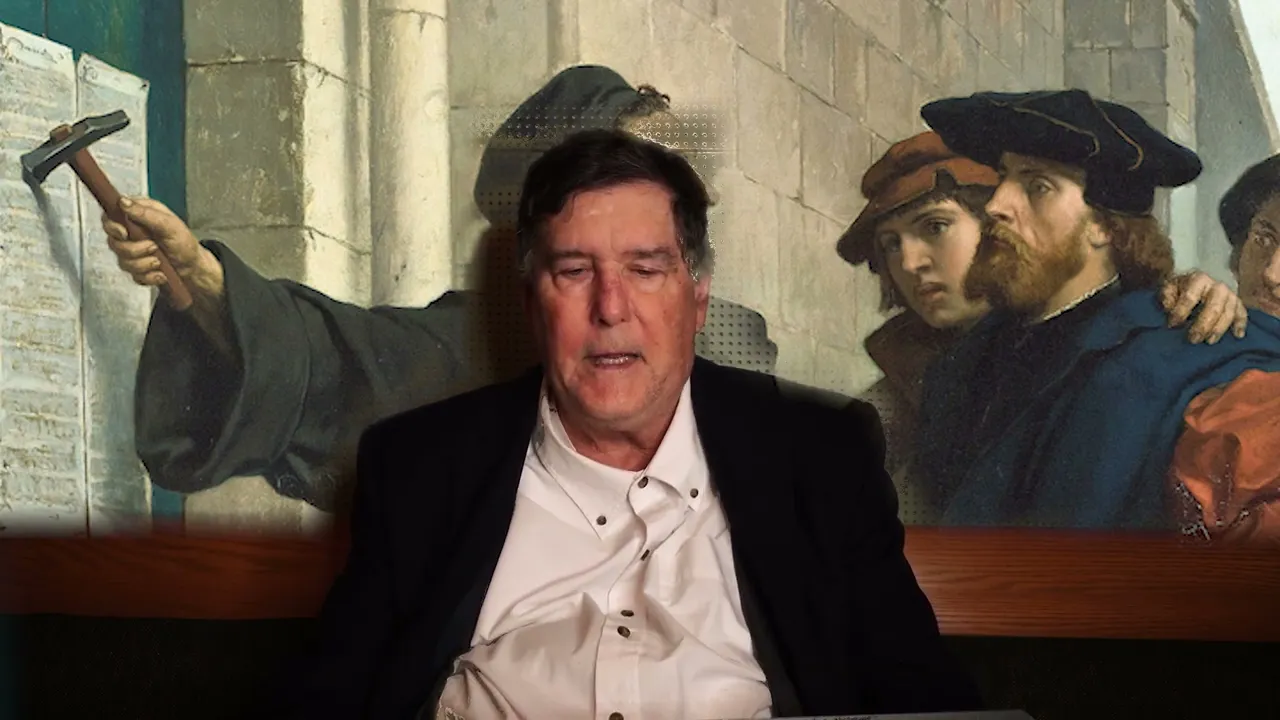
the earliest reformer nor did he initially want to leave the Roman Catholic church but with his 95 thesis posted on the wall that you see behind me or its reenactment the trans ation of the Bible into German his personal faith his marrying his beloved Kate his establishing a group of churches known as Lutheran and so much more Lutheran knocked down the doors of the Roman Catholic church and opened another biblically based way for believers to follow Luther and Calvin were at the center of the Protestant Reformation at first they protest tested the corruption of the
Catholic Church from within they wanted to reform the Catholic Church from within but staying within the Catholic Church became no longer possible the words Protestant Reformation remained as a description of these two leaders and many others and for this lecture I will focus now on Luther according to Wikipedia philosophy proved to be unsatisfying to Luther because it offered Assurance about the use of reason but none about loving God which Luther believed was more important reason could not lead men to God Luther felt and he thereafter developed a LoveHate relationship with Aristotle over Aristotle's emphasis on
reason for Luther reason could be used to question men and institutions but not God human beings could learn about God only through divine revelation he believed leading him to view scripture as increasingly important close quote I do have a warning for you my heroes Luther often used Vivid and strong words they might sound harsh to our ears but again remember Phil core's Golden Rule of History judge those in the past with the same understanding you hope people in the future will judge you Luther became an augustinian monk he experienced both turmoil and eventually a deepening
of his faith Luther read the words of Augustine and the works of Augustine both about the authority of the church but also about Grace as Wikipedia says Luther dedicated himself to the the augustinian order devoting himself to fasting long hours in prayer pilgrimage and frequent confession Luther described this period of his life as one of deep spiritual despair he said I lost touch with Christ the Savior and comforter and made of him the Jailer and hangman of my poor soul Jo Johan Von staits his Superior concluded that Luther needed more work to distract him from
an excessive introspection of looking inside and ordered him to pursue an academic career on April 3rd 1507 Jerome Schulz the bishop of Brandenburg ordained Luther in erfort Cathedral Luther was a teacher and the following year in 1508 Luther began teaching theology at the University of vitberg he received two bachelor's degrees one in biblical studies in 1508 and another in the sentences by Peter Lumbard in 1509 in 1512 he was awarded his doctor of theology on the 21st of October 1512 Luther was received into the Senate of the theological faculty of the University of Wittenberg succeeding
V sta his chair of theology he spent the rest of his career in this position at the University of Wittenberg in 1515 he was made provincial Vicor or pastor of Saxony and thuringia which is kind of over a large area which required him to visit and oversee 11 monasteries which in turn had men in each of those groups in his Province he gave lect on the Psalms and justification by Faith from 1510 to 1520 he also preached on Hebrews Romans and Galatians as he studied these portions of the Bible he came to the view that
the use of terms such as Penance and righteousness by the Catholic Church needed to be looked at in new ways he became convinced that the church was corrupt and its ways and it lost sight of what he saw as several of the central truths of Christianity do you remember what I said in the first lecture about the bondage to the corruption of bureaucracy well that's what Luther was seeing himself every day the most important for Luther as far as the central truths of Christianity was the doctrine of justif ification God's Act of declaring a sinner
righteous by faith alone through God's grace he began to teach that salvation or Redemption is a gift of God's grace attainable only through faith in Jesus as the Messiah this one and firm Rock which we call the doctrine of justification he writes is the chief article of the whole Christian doctrine which comprehends the understanding of all godliness Luther came to understand justification as entirely the work of God this teaching by Luther was clearly expressed in his 1525 publication on the bondage of the will which was written in response to on Free Will by arasmus whom
we looked at a bit in lecture one Luther based his position on predestination on St Paul's letter to the Ephesians 2: 8-10 against the teaching of his day that the righteous acts of Believers are performed in cooperation with God Luther wrote that Christians receive such righteousness entirely from outside themselves that righteousness not only comes from Christ but actually is the righteousness of Christ imputed to Christians rather than infused into them through faith and you might remember in church church history 1 the Continuum from Augustine to Pelagius and Luther's view very much follows that of Augustine
that salvation is all from God as is justification that is why faith alone makes someone just and fulfills the law Luther writes he continues faith is that which brings the Holy Spirit through the merits of Christ faith for Luther was a gift from God the experience of being justified by faith was as though I had been born again you read about that somewhere in the Bible his entry into Paradise no less was a discovery about the righteousness of God a discovery that the just person of whom the Bible speaks as in Romans 1:17 lives by
faith he explains his concept of justification in the small called all art articles the first and chief article is this Jesus Christ Our God and Lord died for our sins and was raised again for our justification Romans 3:24 and 25 he alone is the Lamb of God who takes away the sins of the world John 1:29 and God has laid on him the iniquity of us all you can see the Bible references in the PDF all have sinned and are Justified free without their own works and merits by his grace through the Redemption that is
in Christ Jesus in his blood this is necessary to believe this cannot be otherwise acquired or grasped by any work law or Merit therefore it is clear and certain that this faith alone justifies us nothing of this article can be yielded or surrendered even though Heaven and Earth and everything else fall close quote let's look now at the official beginning of in the context of the Reformation drawing from Wikipedia in 1516 there was a man named Johan tetel he was a Dominican frier he was sent to Germany by the Roman Catholic Church to sell what
were called indulgences to raise money in order to re build St Peter's Basilica in Rome into what it is today that amazing building Tel's experiences as a preacher of indulgences especially between 1503 and 1510 led to his appointment as general commissioner by Al Von brandenberg Archbishop of Mines who already deeply in debt to pay for a large accumulation of benefices had to contribute the considerable son of 10,000 ducats toward the rebuilding of the Basilica alre obtained permission from Pope Leo I 10th to conduct the sale of a special plary that means blanket indulgent remission of
the temporal punishment of sin half the proceeds of which albrech was to claim to pay the fees of his benefices pretty good work if you could get it that's he's taken 50% off the top of what the Germans were going to be donating on the 31st of October 1517 Luther wrote to his Bishop protesting against the sale of indulgences he enclosed in this letter a copy of his disputation on the power and efficacy of indulgences which came to be known as the 95 thesis Hans hillerbrand writes that Luther had no intention of confronting the Church
but saw his disputation as a scholarly objection to church practices and the tone of the writing is accordingly searching rather than doctrinaire heler bran writes that there is nevertheless an undercurrent of challenge in several of the thesis particularly in thes thesis 86 which asks why does the Pope whose wealth to get today is greater than the wealth of the richest crus or cresis build the Basilica of St p Peter with the money of poor Believers rather than with his own money Luther objected to a saying attributed to tetel that as soon as the coin in
the Coffer Rings the soul from purgatory Springs also attested as into heaven but that was a nice little rhyme there he insisted that since forgiveness was God's alone to Grant those who claimed that indulgences absolve buyers from all punishments and granted them salvation were an error Christians he said must not slacken and following Christ on account of such false assurances and the effect of these 95 thesis was kind of like that of a fire you might have heard of the many fires that struck Southern California in January of 202 5 most of them went out
of control well Luther's 95 thesis were like a good fire that spread across Germany and Beyond Luther's thesis are engraved into the current door of All Saints Church Wittenberg the Latin inscription above informs the reader that the original door was destroyed by a fire and that in 1857 King Frederick williiam IV of Prussia ordered that a replacement be made according to One account Luther nailed his 95 thesis to the door of All Saints Church in Wittenberg on the 31st of October 1517 and that is why that date is Reformation day and the Sunday before it
the closest to it is called Reformation Sunday and many years ago I had the privilege of being ordained on October 31st on Reformation Sunday Scholars Walter Kramer Goods trinkler ghard richer and ghard prous contend that the story of the posting on the door although it has become one of the pillars of History has Little Foundation in truth the story is based on comments made by Luther's collaborator Philip meenon though it is thought he was not in Wittenberg at the time the point is the 95 thesis are historical and the door provides a good focusing point
for those thesis according to Roland Bon on the other hand it is true and like I've shared what the point is the Latin thesis were printed in several locations in Germany in 1517 in January 1518 friends of Luther translated the 9 5 thesis from Latin into German and remember that the Gutenberg Press with movable type had already been invented so it was much easier to spread printed information in those days and once it went into German within two weeks copies of the thesis had spread throughout Germany remember the Wildfire I talked about Luther's writing circulated
widely teach reaching France England and Italy as early as 1519 students thronged to Wittenberg to hear Luther speak he published a short commentary on Galatians and his work on the Psalms this early part of Luther's career was one of his most creative and productive three of his best known Works were published in 1520 to the Christian nobility of the German Nation on the Babylonian captivity of the church and and on the freedom of a Christian here is what n writes about the diet of worms with the w pronounced like a V because of the German
language at 6:00 in the early evening of April 18th 1521 the hour had arrived for Martin Luther the scene was an improvised Imperial Hall in vers a modest city of roughly 7,000 inhabitants located down the Ry River from strawberg and just a little south of mains Luther 37 years old had been a monk for over a decade and a half he was appearing before Charles I who would be Emperor until 1 uh 1556 he was a young man of only 21 Who besides serving as king of Spain had been elected the head of Germany's Holy
Roman Empire and was therefore a successor to Charlemagne less than two years earlier the Imperial diet or formal assembly that convened at vers in January of that year marked Charles's first visit to his German lands the emperor understood Latin but had pursued his own education in his preferred French everything spoken in German had to be translated into Latin for him and also for the large company of Italian Church officials in attendance note that the proceedings were in German not Latin if Charles lacked experience as an emperor and if his linguistic skills fell short of those
of many others at assembled at vers including some of the princes there was no doubt about the extent of his power in his letter to Luther according him safe conduct Charles had introduced himself as by God's grace Roman Emperor elect at all times augmentor of the realm of Germany Spain both sicilies Jerusalem Hungary Dalmatia Catia Etc King Arch Duke of Austria and Duke of burgundy count of hapsburg Flanders and tyru Etc the day before on April 17th Lutheran appeared in the emperor's presence for the first time spread out on a table in the Imperial chamber
were Luther's writings a massive paper so large that Charles and his AIDS when first they came into the chamber expressed out that any single person could have written so much Luther had been summoned to vers to recant to give up his teachings he was being asked to confess publicly to his mistakes in what he had written about the gospel the nature of the church and the current state of Christendom when asked on the previous day whether he would recant Luther responded that the works were of several different kinds and then he requested one more day
to ponder his reply the Imperial secretary was not pleased for he as he reminded Luther and the assembled onlookers everyone knew why Luther had been given Imperial safe conduct to vers he had had plenty of time to prepare nonetheless because of the emperor's innate clemency Luther was granted his request but now he could delay no longer and the charge came once again come then answer the question of his majesty whose kindness you have experienced in Seeking a Time For Thought do you wish to defend all your acknowledged books or to retract some null continues Luther
who obviously had considered his reply carefully responded that his books were of three kinds some were works of simple piety that no Christian ruler or church official could possibly want withdrawn a sec second category were Works directed against the papacy and the Affairs of the papists as those who both by their doctrines that is teachings and very Wicked examples have laid waste the Christian world with evil that affects the spirit and the body Luther did not think anyone would want to defend the evils that those books attack but the Third Kind of writing Luther conceded
did contain some overly harsh statements which he was willing to consider retracting but only on one very important condition at this point Luther laid down his Gauntlet therefore I ask by the mercy of God may your most Serene Majesty most illustrious Lordships or anyone at all who is able either higher low bear witness expose my erors overthrowing them by the writings of the prophets and the Evangelist that is from the Bible once I have been taught I shall be quite ready to renounce every error and I shall be the first to cast my books Into
the Fire and so Luther ended his defense but he had not been explicit enough for the Imperial Court the emperor spokesman pressed him again Luther had not really answered the question would he recant or not deal plainly not with a horned or ambiguous reply then Luther spoke words that augured one of the most uh momentous changes in the history of Europe and one of the most significant in the history of the church since then your Serene majesty and your lordship seek a simple answer I will give it in this manner neither horned nor toothed unless
I am convinced by the testimony of the scriptures or by clear reason for I do not trust either in the pope or in the councils alone since it is well known that they have often aired and contradicted themselves I am Bound by the scriptures I have quoted and my conscience is captive to the word of God I cannot and I will not retract anything since it is neither safe nor right to go against conscience with these words protestantism was born praise God Luther's conscience was captive to the word of God to the living active voice
of scripture moreover he believed scripture clearly taught truths about human nature the way of Salvation and the Christian Life truths that he believed had been better ly obscured even obliterated but the very Church officials who should have been their most faithful by the very Church officials who should have been their most faithful Defenders with this dramatic statement and the most exalted company of 16 Century European could imagine the foundations of protestantism were sent out for all to see Protestants would obey the Bible before all other authorities and over all over authorities and what many Protestants
would find in the Bible was a message of salvation by grace at least substantially similar to the one Luther had discovered for himself in the pages of the scriptures at this point I'm going to back up and talk a little bit about myself it was not a fair fight everyone was against Luther but Luther with God's help was in charge of the meeting he won the meeting on a much smaller level in recent years I have taken on a city council on a matter of great concern to me and to the community in which I
lived I did not believe it was a fair fight because I had the truth and the community on my side returning to Luther a year earlier in June of 1520 Pope Leo the 10th wrote a document with the the Latin title exer Domin which means arise O Lord that sought according to no to bring Martin Luther to heal Pope Leo called Luther the wild boar from the forest whose tongue was a fire there's that word again more than he knew the pope was correct but whether he was correct in the sense that he intended that
Luther was seeking to destroy the church or conversely that Luther wre havoc on structures that separated people from the true God depends on what you think of Luther whatever else you say about him Martin Luther was a leader and at one point he said here I stand I can do no other God help me after the Pope's writings and the decision against him at the diet of Herms oh yes they found against him even though he spoke the truth Luther was placed in and protective custody at a castle or a fortress named wartberg he showed
his leadership by translating the Bible into German he didn't play Tiddly Winks or just read to while away the time while he was sequestered in the wartberg castle for 10 months Luther began to translate the New Testament from Latin and Greek into Saxon German you've heard that in England they are Anglo Saxons well Saxon is the German side Luther used erasmus's second edition 1519 of the Latin New Testament with Greek later developed into the textus receptus and annotations so arasmus played a role in Luther translating the Bible or the New Testament into German after leaving
the castle he revised passages obscure to him with the assistance of his friend the Greek specialist Philip mangon like arasmus Luther had learned some Greek at the Latin schools led by the Brethren of the common life uh a Catholic group arasmus had learned it in the Netherlands and Luther in mberg Germany these lay Brothers had added Greek is a new subject to their curriculum and thank God for their doing that in the late 15th century at that time Greek was seldom taught even at universities known as the September Bible this translation included only the New
Testament and was printed in September 1522 6 months after he had returned to Wittenberg Luther also published the Bible in the small octavo format the New Testament was printed using the Gutenberg movable type method according to Wikipedia the Gutenberg Bible also known as the 42 Line bible the mazarine Bible or the B4 2 was the earliest major book printed in Europe using mass-produced metal movable type it marked the start of the Gutenberg Revolution and the age of printed books in the west the book is valued and revered for its high aesthetic and artistic qualities and
its historical significance movable type led to the publication of Many religious and political tracks and books Luther's German Bible and its widespread circulation facilitated the emergence of a standard modern German language for the German speaking people throughout the Holy Roman Empire an Empire extending through and Beyond present day Germany it is also considered a landmark in German literature with Luther's vernacular style often praised by German sources for the forceful Vigor crof volis Deutch with which he translated the Holy Scripture the spread of Luther's Bible translation had implications for the German language the German language had
developed into so many dialects that German Lang German speakers from different regions could barely understand each other this led Luther to conclude that I have so far read no book or letter in which the German language is properly handled nobody seems to care sufficiently for it and every preacher thinks he has a right to change AT Pleasure and to invent new terms Scholars prefer to write in the Latin which they all understood but Luther's Bible translation based primarily on the Saxon Chancery language used in Royal courts in his n native upper Saxon dialect and enriched
with the vocabulary of German poets and chroniclers was a step on the path to a standardized German language as early new high German or hulo developed into modern new high German a contemporary of Luther's arasmus alberes labeled him the German Cicero as he reformed not only religion but the German language also uh cisero helped with the Latin language centuries before Luther's Bible has been hailed as the first German classic comparable to the English King James version of the Bible german-speaking Protestant writers and Poets such as ktoo herder and lesing ow stylistic qualities to Luther's vernacular
Bible Luther adapted words to the capacity of the German public and through the pervasiveness of his German Bible created and spread the modern German language Wikipedia continues that Luther's German Bible and its widespread circulation facilitated the emergence of a standard modern German language for the German speaking people throughout the Holy Roman Empire an Empire expending like I already said beyond present day Germany and I've talked about its implications for that and how it ties in with influence like the King James version here is what the great church historian Philip scha had to say about Luther's
German Bible the richest fruit of Luther's leisure in the wartberg and the most important and useful work of his whole life is the translation of the New Testament by which he brought the teaching and example of Christ and the apostles to the mind and heart of the Germans in lifelike reproduction it was a republication of the Gospel he made the Bible the people's book in church and school and home Luther's translation was remarkably free for its time as Luther's translation goal was to produce idiomatic Saxon German rather than a literal translation close quote and I
would say this would be a dynamic equivalent translation like The Message Bible in the late 20th century of American English by Eugene Peterson which is based on the Hebrew and Greek it might also be similar to the new uh international version of the Portuguese Bible which I will not try to pronounce here is what the link writes about the uh Portuguese translation the new verse internal embodies a translation philosophy that emphasizes both precision and readability the translator sought to create a text that would Faithfully convey the original biblical messages while making them accessible to contemporary
readers unlike some translations that lean heavily on formal equivalence the nvi employs a balance of dynamic equivalence allowing for natural phrasing that resonates with modern Portuguese speakers there have been several technological revolutions since the Gutenberg type there is the movable type books instead of Scrolls Mass Printing and distribution there was the Industrial Revolution what I call the electricity Revolution the personal computer Revolution the internet Revolution with digitization now there is the AI Revolution as well as Robotics nanotechnologies biologics and other all are coming together in the 21st century will Singularity be achieved should it be
well that is for another kind of a class but returning to Luther with his Bible he unified the German language and the German people even though there would not be a unified political Germany until the 19th century he also United people with his teachings at least in some areas and here is something of his teachings as far as Luther's teachings there is Sola scriptura which is scripture alone as Authority Wikipedia writes Augustine of Hippo is frequently cited by Protestants as a church father who taught the doctrine of scripture alone solos scriptura remember that Luther started
as an augustinian monk there was Sola fiday and solar gradia which I've already talked about salvation through faith alone salvation through God grace alone we've talked about the priesthood of all believers and now I come to Luther's marriage uh remember in the previous uh lecture I talked about um marriage of Catholic priests Wikipedia says Martin Luther as well as many of his friends was at first unsure of whether he should marry Philip meenon thought that this would hurt the Reformation by causing Scandal Luther event decided that his marriage would pleasee his father RI the pope
cause the angels to laugh and the Devils to weep 26-year-old Von Bora and 41-year-old Luther married on June 13th 1525 before Witnesses including Justice Jonas johanes buen Hogan and Barbara and Lucas krono a small wedding breakfast was held the next morning and the more formal public ceremony on June 27 was presided over by Bugan hugen the marriage of VOR to Luther is very important in the history of protestantism specifically in regard to the development of its views on marriage and gender roles while Luther was not the first cleric to marry because of reformation ideas he
was one of the most prominent as he argued publicly for clerical marriage and produced much anti-catholic propaganda his marriage became a natural target for his enemies based on Luther's descriptions his wife whom he nicknamed her Kate meaning she was kind of in charge exerted much control over his life but he also called her his beloved Kate now Luther like to write hymns as well perhaps you have heard or even sung A Mighty Fortress Is Our God it's his best known I encourage you to read the words it is so well done the powerful words and
how one verse flows into another but did you know that the melody is based on a pub song in other words a Melody based on a popular bar song that people sang together um not in church but then they started singing it in church because Luther put good words to it and these days it can be found in catholic hym books so it's come full circle I attended uh the mass of a member of the community in Iowa where I was pastor and because I was there early I was flipping through their hym book and
sure enough There Was A Mighty Fortress as our God as one of their hymns there was no opposition or condemnation of it it was one of their oppositions to sing and he interacted with arasmus as I have said and uh we've talked about him and uh Luther had a close relationship with Philip mangon he was a German Lutheran reformer he was a collaborator with Martin Luther he uh was the first systematic Theologian of the Protestant Reformation an intellectual leader of the Lutheran reformation and influential designer of Educational Systems he stands next to Luther and John
Calvin as a reformer Theologian and shaper of protestantism as I mentioned earlier about the diet of worms uh Luther wrote many things and his sermons were put into written form you can look up on Amazon something about the writings the many writings of Martin Luther including letters and sermons Luther has a mixed Legacy he did not set out to leave the Roman Catholic church but that eventually was forced upon him he said some very unfortunate things about Jews and the Jewish question I believe they were said near the end of his life and some believe
that he regrettably had dementia and may have said those bad words about Jews uh when he had dementia but he has had a profound impact obviously on Lutheranism and Beyond here was what Colin Brown has to say about Luther with regard to one of his last sermons remember what I said about Luther's strong language compare it with what brown wrote about Calvin and classical philosophy in lecture three Luther's last sermon at Rittenberg has gone down in history as a classical invective against reason the devil's but it is by no means an isolated attack on philosophy
those who have taken the trouble to con through the indices of Luther's collected works have experienced little difficulty in finding references to Aristotle as a destroyer of Pious Doctrine a mere sophist and quibbler an inventor of fables the stinking philosopher a bellig goat and a blind Pagan the list could easily be extended this sort has earned for Luther the reputation of being an irresponsible irrationalist it has also contributed to the widespread impression that philosophy and biblical theology have nothing to do with each other but this is only half the picture in a less heated moment
Luther reflected when I was a monk they used to despise the Bible nobody understood the Salter they used to believe that the letter to the Romans contained some controversies about matters of Paul's days and was of no use for our age scotus Thomas Aristotle were the ones to read circumstances change and the academic world has its Fashions like anyone else we might might substitute for the names of scotus Thomas and aristotles those of SRA heiger and wienstein but the situation Luther and Aristotle the situation Luther is describing is not at all that far removed from
that in Western universities today philosophy has seemed to make the Bible irrelevant and reason is taken over the place of Revelation for a man of Luther's temperament living in that age and under such pressures it is not surprising that he expressed himself in the way he did but as modern research has shown Luther was not condemning reason as such he himself employed it with great effect the real Target of his attacks was the abuse of Reason situations where philosophy had crowded out out the truth of the Christian faith reason had its legitimate place in science
and everyday Affairs it had its true function in grasping and evaluating what was set before it but it was not the sole Criterion of Truth for Luther there were three lights which illuminated human existence there was the light of nature where reason and Common Sense suffice to solve many of the questions of everyday life there was the light of Grace by which the Revelation in scripture gave Humanity knowledge of God which was otherwise unattainable and there was the light of Glory which belonged to the Future for there were many questions which scripture left unresolved there
were apparent contradictions like the sovereignty of God and the responsibility of man for his actions to which both scriptures and Christian experience testified but which neither e











![Trump, Musk tell Fox News’ Hannity that the public is ‘trying to drive [them] apart’](https://img.youtube.com/vi/cB5elKbwXdg/maxresdefault.jpg)