It's important to state the obvious: no saint had an easy life, and Saint Joseph of Cupertino was no exception. From a purely human perspective, everything was bound to go wrong. His father, for example, despite being a virtuous man, died prematurely, leaving the family completely in debt.
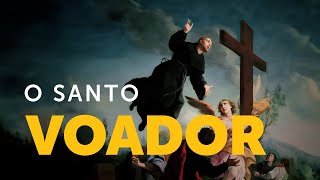
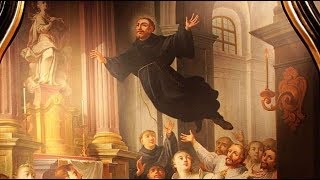
The family was evicted, creditors even took the house's furniture, and his wife, who was pregnant at the time, had to give birth to little Joseph in a stable, there with the animals, following the example of Christ. Later, this boy would become known for the many charisms he received from God, especially the extraordinary gift of levitation. Levitation is that special, mystical moment when the human soul is filled with divine love and is drawn, drawn closer to God.
That's why the expression "ravishing love" is used. Saint Joseph of Cupertino's entire journey was marked by such wonderful signs that glorified God's holy name. Through his intercession, he performed numerous cures and miracles.
Through his testimony of holiness, he converted thousands of people, for the humility of his soul was great. But this soul was only so easily carried to heaven because it certainly wasn't tied to the things of this earth. Saint Joseph of Cupertino .
Joseph was born on June 17, 1603, in Cupertino, a village in the Kingdom of Naples, Italy. His family was very poor and constantly struggled to survive. His father was a good man, but he was constantly in debt, fleeing from his creditors.
He died prematurely, leaving his wife pregnant and literally destitute. Joseph's life was marked by overcoming difficulties through divine grace, as the boy soon developed serious learning difficulties and suffered from fragile health throughout his childhood and adolescence. Some said that this poor creature wouldn't make it very far in this life.
Several times, little Joseph faced death. He had motor coordination difficulties, was somewhat clumsy with objects, was often ridiculed, and was also a laughingstock among his friends. Despite this, José demonstrated an admirable love for prayer.
Some noted that his intimacy with God was truly sincere. José realized his vocation was religious life. So, at 17, he went to the Friars Minor Conventual.
There, he had two uncles, right? So, he thought this might help him adapt to the lifestyle he wanted to pursue. The brothers of the order recognized the boy's virtues, as well as that he had many ecstasies.
But they became discouraged when they saw that the young man was very clumsy with things. He was always breaking the convent's objects, and since José couldn't learn anything, the best thing was to send him away. But José didn't give up.
Subconsciously, something was drawing him to the Franciscan charisma. So he sought out the Capuchin Friars. There, the Capuchin brothers conducted several tests to determine whether Joseph was suited to the community lifestyle.
They also realized that Joseph was very virtuous, but he lived a somewhat detached life. He couldn't concentrate on the simplest things, even dropping several convent objects. He easily forgot to perform some of the tasks assigned to him.
It is said that it was during this period that they began gluing shards of broken objects to Joseph's clothing. The brothers tried in every way to fit Joseph into the convent routine. They taught him various trades so he could develop his path, but nothing worked.
The brothers no longer knew what to do, and the solution was to send the young man away. Joseph would then have to abandon the Franciscans. These two failed attempts to enter religious life were a severe blow, a great trial for Joseph.
He was deeply saddened, realizing his heart was broken, shattered into a thousand pieces. However, he did not despair. He threw himself at the feet of his Most Holy Mother in Heaven and found peace again in the Immaculate Heart of Mary.
He doesn't know how long he remained there, kneeling in ecstasy, but he never forgot the words of that heavenly voice that said: "Joseph, do not be afraid. God uses the broken pieces to build the cathedral He desires. " Then, Joseph regained his usual joy, and his happiness was even greater when the Friars Minor Conventual invited him to try religious life again.
This time, Joseph was tasked with caring for some animals in the convent. This was a very simple task that he performed with contagious joy. He was often seen treating the animals well, talking to them, and this was reminiscent in some ways of the life of Saint Francis of Assisi.
The brothers observed that Joseph, despite his limitations, led an exemplary life. He practiced sincere prayer, perfectly maintained the spirit of obedience, and several supernatural gifts manifested through him. The brothers also realized that Friar Joseph had a vocation to religious life and beyond: he could very well be a priest, as was his dream, and everything indicated that this was also the desire of God's heart.
But to become a priest, Joseph first had to become a deacon, and to become a deacon, he truly had to pass a test. The brothers were aware that only a miracle in Brother Joseph's life could make him a priest. For Brother Joseph, the word "test" was synonymous with ordeal, and he would simply panic during these moments.
He would feel very ill, even fainting. On the day of the exam, he was diligent in his studies, but he couldn't retain what he studied, and his progress was almost non-existent. And when the day came to take the deacon's exam, Joseph trusted completely in the help of the Virgin Mary, and so he went to take the exam.
This exam was presided over by a very strict bishop. The bishop would essentially randomly choose a passage from the Holy Scriptures and ask the prospective candidate to explain it. If the candidate's argument was consistent with what the Church has always taught throughout the centuries, that candidate was prepared to become a priest.
The candidates presented themselves in order, one by one, and then gave their answers. When it was Brother Joseph's turn, the bishop opened his Bible with his finger right on verses 27 and 28 of chapter 11 of the Gospel of Luke. The bishop read this passage and asked Brother Joseph to explain the meaning of this word.
Here is the miracle that saved Joseph. It turns out that Brother Joseph was a great devotee of Our Lady, and this text from Saint Luke was precisely the only one in all of Scripture that Joseph could retain in his memory. Joseph meditated on this passage very often in his prayers.
This passage from the Gospel of Luke tells of Jesus being in a certain place, announcing the kingdom of God to his disciples and to a huge crowd. On that occasion, Christ taught how to pray the Lord's Prayer and spoke about the importance of a life of constant prayer. And behold, in the midst of that crowd, an anonymous, very courageous woman appeared.
This woman addressed Christ, saying, "Blessed is the womb that bore you, and the breasts that nursed you. " Brother Joseph explained this passage of Scripture so well that everyone was amazed at his eloquence and erudition. The bishop immediately approved Joseph for the diaconate.
But Brother Joseph still had to prepare for the priesthood examination. The conventual brothers strove in every way to improve Brother Joseph's studies, but they realized that Brother Joseph was in the hands of Divine Providence. Then came the great day for him to appear before the examining bishop.
There stood Joseph among several other candidates. He was indeed quite apprehensive and very aware of his human inability. However, as always, he entrusted himself to the care of the Blessed Virgin, especially when he saw the bishop call the first candidate.
This candidate responded splendidly in his response. The second candidate responded with impressive eloquence and was also approved. The third brother to present himself was praised for his wisdom and immediately received the bishop's approval.
And so it was with several candidates. Each one responded with solid arguments to the bishop's intricate theological questions. presented to them.
There were still a few candidates left to take the oral exam, but the bishop was already quite satisfied with the extremely high level of intelligence displayed by the candidates he interviewed. Right? Then, the bishop judged that the other candidates who had not yet been interviewed were also at the same level of wisdom, and so he approved them all, including those who had not taken the exam.
And among them was Joseph, whose heart leaped with joy. The more experienced brothers of the convent saw this event as a miracle of God's infinite wisdom. Brother Joseph was made a priest and, little by little, went from being that young man incapable of learning to the patron saint of students.
Despite this, Brother Joseph would spend the rest of his life classifying himself as "donkey," the dumb friar. After his ordination, Brother Joseph of Cupertino made great strides in his spiritual journey of love, joy, and humility. A good spiritual director once said that God calls all men to holiness, and to some He grants admirable intelligence.
And this is how we have great beacons of light like Saint John Chrysostom, Saint Augustine, Saint Thomas Aquinas, Saint Hildegard of Bingen, and Saint Bernard of Clairvaux, for example. This same omnipotent God also grants a high degree of holiness to men and women who are practically devoid of all natural abilities. It was more than evident that Friar Joseph of Cupertino was in this last group.
The brothers of the convent increasingly discovered Friar Joseph's virtues. He lived with good humor and simplicity of heart. He said he had never owned anything in this life and that, now living among the brothers, he continued to possess nothing.
Thus, according to him, it was easier to accept humiliations with detachment. Another of his virtues was his swift obedience to his superiors. The mortification of his will was truly extraordinary.
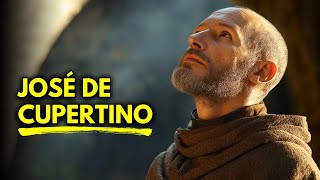
Friar Joseph had a strong connection with the Blessed Sacrament, with the angels, and, of course, with the Virgin Mother of God. A simple thought of the Immaculate Heart of Mary was enough, and there Joseph would literally fly toward an image of Our Lady. Other times, while praying with his brothers, he was seen levitating in profound ecstasy.
His extraordinary gifts became increasingly frequent, and his fame extended beyond the convent walls. Joseph was quite uncomfortable with this fame. He preferred the anonymity of his cloister, but he saw it as God's will, for the people who had lived like lost sheep began to attend Mass and the sacraments.
Many went to church simply out of the vain curiosity of seeing the flying saint up close, and these people ended up in line for the confessional. People from various parts of the world visited Brother Joseph seeking a word, spiritual guidance. Kings, princes, rich and poor, cardinals, and even the Pope visited Brother Joseph of Cupertino.
Pope Urban VIII was truly impressed when he saw Brother Joseph levitating with his own eyes. It is said that, on that occasion, Friar Joseph predicted the exact date of Pope Urban's death. Once, some local farmers skipped Mass in a rural chapel and went to work in the harvest.
So, Joseph went outside and spotted a flock of sheep grazing far away. He shouted for the animals to come to the chapel to honor the Virgin Mother of God. The sheep then began to run tumultuously toward the chapel, responding to Friar Joseph's request.
Upon entering the chapel, the sheep fell to their knees and responded with a song to the invocations of the litany led by the saint. On another occasion, the Poor Clare nuns in his town were not performing their religious order's duties well. So, Friar Joseph sent them a little bird to encourage the sisters to sing with greater devotion.
Many conversions, healings, and miracles were achieved through Friar Joseph's intercession. He observed seven Lents throughout the year. On some occasions, he ate only the Holy Eucharist.
He waged a true battle to rescue souls for the kingdom of God. To overthrow the saint's virtue, the devil, with great subtlety, suggested thoughts of greed. and attachment to objects.
The presence of Saint Joseph of Cupertino stirred life in the city. Many supernatural events marked the history of Saint Joseph of Cupertino. He personally did not consider himself worthy of the many graces God granted him.
He exorcised demons, made prophecies, and possessed the gift of bilocation, meaning he could be in two places at once. While living in Assisi, he received news that his mother, Mr. Francesca Panara, was dying in the village of Cupertino, about 700 km away.
Joseph appeared in his mother's room enveloped in a great light. According to witnesses, he arrived in time to see his mother take her last breath. At the same time, in Assisi, his brothers were weeping for him, and Joseph replied that his mother was now in heaven.
One day, someone decided to denounce Friar Joseph of Cupertino to the tribunal of the Holy Inquisition, claiming that the friar was posing as the Messiah and, lo and behold, they said he was deceiving a multitude of people. The accusation seemed yet another attempt to intimidate and silence Saint Joseph's fruitful apostolate. The truth is, the friar remained calm and, responding to the summons of the Holy Office, went to Naples to present his defense.
Clearly, the inquisitors found no heresy in Saint Joseph; on the contrary, they were astonished and edified in faith by this man's virtuous testimony. Even so, they deemed it necessary for Friar Joseph to remain confined to his convent cell and isolated from his own community, since, according to the tribunal, Friar Joseph's presence caused disturbances and embarrassment throughout the city. Of course, many people considered this decision absurd and arbitrary.
So much so that the Conventual Friars will do everything they can to reverse the situation. Friar Joseph, with his characteristic humility, obeyed without complaint. However, the Friar's isolation attracted more and more people seeking holiness.
The authorities then transferred Saint Joseph to several different cities, but soon the people located the saint's whereabouts and made pilgrimages to his place. The friar caused an uproar, and soon he was transferred again to another distant convent , until finally, the saint was transferred to the city of Osimo, also in Italy. And when he arrived there, he said, "This is my resting place.
" And it was there that he left this land of exile on September 18, 1663, at the age of 60. Immediately, that place began to be visited by pilgrims from all over the world, and numerous cures and miracles attributed to the intercession of Friar Joseph began to appear. Saint Joseph of Cupertino was beatified in 1753 and canonized in 1767.
His liturgical feast day is September 18. Joseph was a very simple man, lacking even the most basic natural abilities; however, he was touched by a special grace and became a Doctor of spiritual faculties. He lived in the turbulent 17th century, the century of Louis XIV, the Sun King; however, no one shone as brightly as Saint Joseph of Cupertino.
It turns out that Saint Joseph of Cupertino understood that the daily cross does not prevent the soul from flying to God.