The city of Boston faces two enormous problems, sea level rise in its harbor that is getting worse with climate change, and a dearth of affordable housing, pricing out many longtime residents. Solutions to one of the problems may compound the challenge of solving the other. Researchers have called this green genritication.
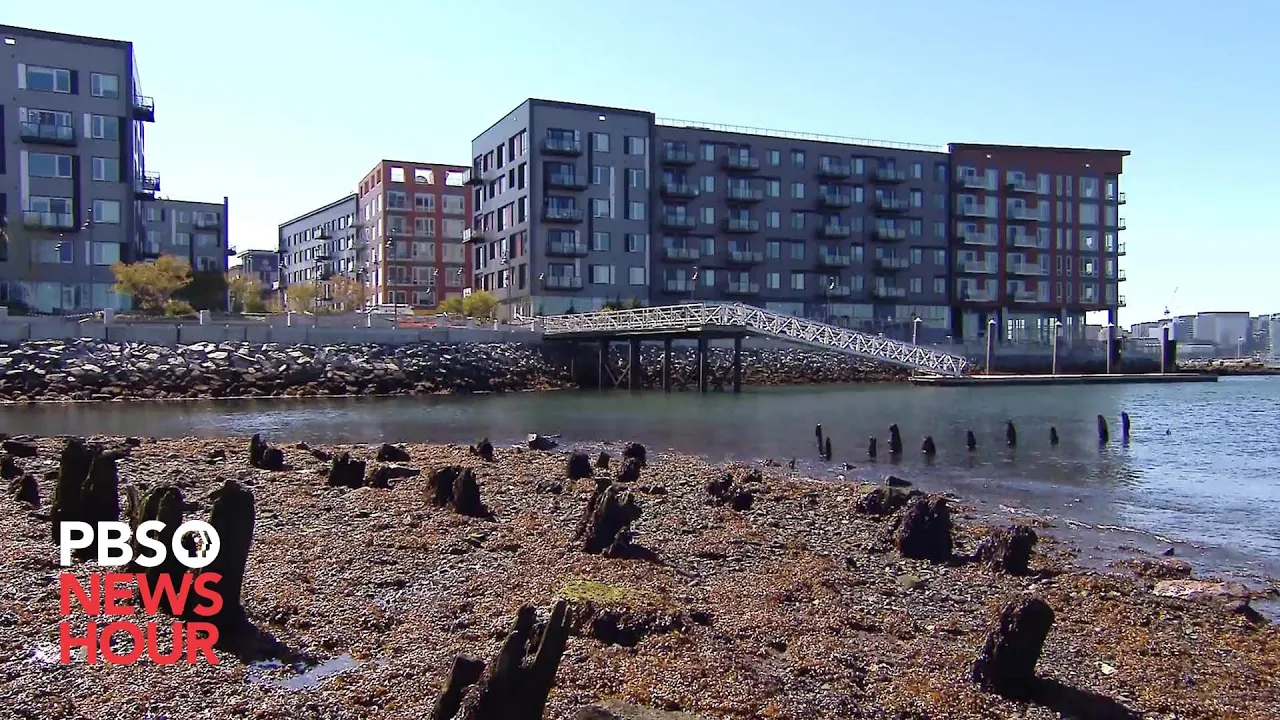
-- Green gentrification. Paul Solman reports on the fallout in Boston. Paul in east Boston, long home : To the city's latest wave of immigrants, sparkling new waterfront apartments where abandoned piers once rotted.
A brief ferry ride away, downtown Boston. Convenient. Stunning.
>> We unlocked a part of the waterfront that had been fenced off from the community and reintroduced it to the people free to calm use the place. Paul: And to folks dying to live here, says developer Nick iselin. >> We thought there was not such a thing as a one million-dollar condominium in Boston.
Paul: Which came to a startling $1 million for just 1500 square feet. But a major selling point for those who can afford it, the project is carbon neutral. As it says on its website, climate change ready.
A newly created living shoreline, with the stabilization of existing sea walls. New public open spaces support wildlife habitats, promote community gatherings, a kayak launcher, highlight recreational and programming opportunities. There are even a few dozen affordable housing units.
What is not to like? Are you from around here? >> I live here.
Paul: What about all these condos going up? >> They created a ghetto, a white ghetto. Paul: He feels unwelcome.
A group of students from east Boston high school, possibly more so. >> Last summer me and my friends were skipping rocks and they said we were disturbing them. >> They are snobby people.
>> They say you can't be here, but it is not private property. Paul: In fact, it's a public area, with public bathrooms, mandated by state law. >> We finally got the leasing office.
Paul: But, challenges community activist Kannan thiruvengadam -- >> Do I know there is a public restroom I can use? Those things have to be obvious, that makes a space welcoming. The sign is writing here.
Paul: Public restroom in port said lobby. And if you can't find a bathroom, how public is the space? >> Is it open?
It is locked. In fact, guitar player Rios and the students, off after a half day at school, were among the very few non residents on these 9 acres of public space. >> We used to live here and we were forced to move out.
Paul: You could not afford it? >> We were forced to move out, there is a lot of gentrification. Paul: Gentrification the age-old , problem of urban redevelopment.
>> People are getting displaced, there is not enough opportunity for people with middle to lower income or even a bit above. Paul: This is gentrification with a new twist, green development greening. Green gentrification, adding appeal to a project, and cost, implying -- >> There will be, little by little, a removal of socially more vulnerable groups, working class, middle-class groups.
Paul: Researcher Isabelle anguelovski champions climate control but enclaves like this, in her words -- >> Become islands of resilience, privatized. Paul: While their 47,000 or so east Boston neighbors are discouraged from coming near, if not forced out of town, as so many of the students we ran into were. >> I have to walk to school now, it is like an hour.
Paul: You walk an hour a day to school? >> It used to be 10 minutes. My shoes are messed up.
Paul: How long have you had those? >> A month. Paul: Meanwhile, those who get to stay will be at the mercy of time and tide.
East Boston, once five separate islands, is mostly landfilled. The sea level will rise 40 inches by 2070, creating a flood risk to half the neighborhood. Low tide not a problem, but a few hours away, storm surges like one in 2018 which flooded this complex.
It got up to the sidewalk? >> It came onto the ground level. I could not step on without being in the water.
Paul: And the east bostonians behind the development? >> This is a ramp. >> If rain falls, it will be here.
Paul: As for the promised amenities, that public kayak launch has become a tavern -- the living shoreline? >> This is meant to be the living shoreline. Where are the kids, the grass, the blue hair?
Paul: The fact is this very , project is now vulnerable to climate change. Nobody built in anticipation of the vulnerability because why? >> Because they were not required to.
The assessments had not been done. Paul: So, any fixes? Boston now has a new mayor, Michelle Wu, who ran on a platform of economic equity.
She has reverend mariama white-hammond to help implement it. >> I went to a little, all girls private school and the girls were afraid to come to my house, said they were worried they would get shot. Paul: White-hammond actually protested this project when it was first proposed some seven years ago.
>> We marched because we were deeply concerned the units built were not billed for the residents that were currently here. Paul: But how does she see east Boston development now, as the mayor's top climate adviser. >> It is not the melding of the old and new, it is the old being overwhelmed by the new.
>> If people live near a good part, the prices are higher, which means poor people live in the places nobody wants to live. Do not improve those neighborhoods? It is a real catch 22.
My family has as much a right to live near a great park as the people who live downtown. The problem is, if I upgrade the park in that community, property values rise. >> Gentrification is a problem.
It is happening for many reasons. Market forces, people are getting displaced. Whether or not we have green spaces here, that gentrification would be happening.
Paul: And thus the last question, to community activist la Battaglia. Green gentrification compounds the problem? >> It exacerbates it.
Paul: Exacerbates the problem of choice venues versus this land. -- A problem facing choice urban venues all over this land.

![Suburbia is Subsidized: Here's the Math [ST07]](https://img.youtube.com/vi/7Nw6qyyrTeI/maxresdefault.jpg)
![Why American Cities Are Broke - The Growth Ponzi Scheme [ST03]](https://img.youtube.com/vi/7IsMeKl-Sv0/maxresdefault.jpg)