I love driving this electric vehicle, feeling morally superior. Chinese brands will take up a significant portion of global electric vehicle sales. The single biggest technological change probably since the time we ditched horses and moved to cars.
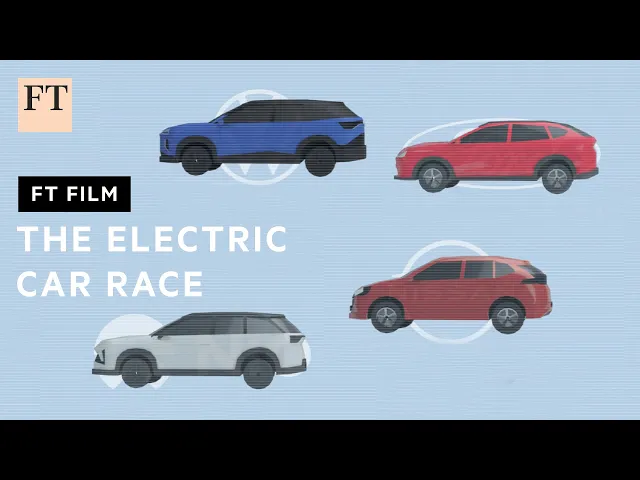
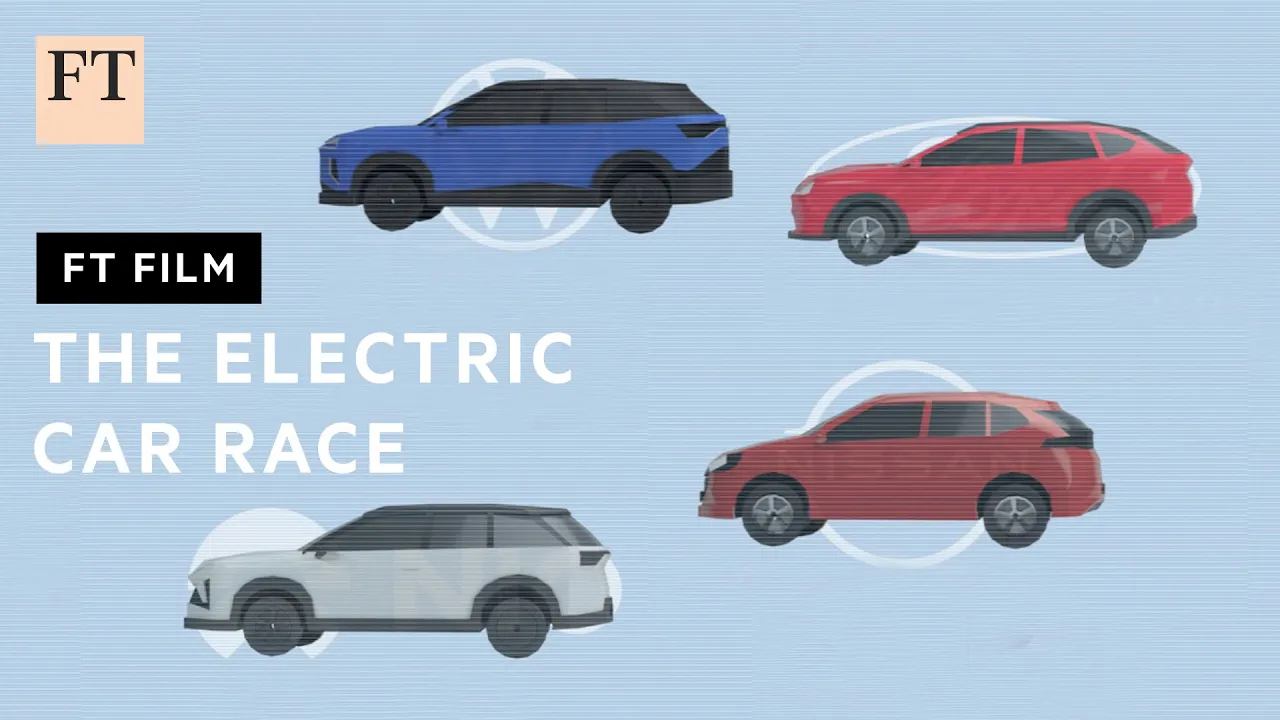
Unless you want to be Kodak and making film right up until the day that your company goes kaput, you have to get in the game. Representing Europe is Volkswagen's ID4. For the US it's the Ford Mustang Mach-E.
China's entry is the Nio ES6. And for Japan it's the Nissan Leaf. However, this isn't a game, and the electric car race isn't really about whose car is the fastest.
It's about whether some of the world's biggest companies can adapt to a technological revolution and whether they and the governments that back them can convince people to keep buying their cars as we try to create a zero-carbon world. The electric car race in the US is between Tesla and everyone else. A lot of these established players are going to be very, very serious competitors.
I think they're going to put up a hell of a fight. Tesla. Tesla.
Tesla. Tesla. Tesla came in 2012 and released the Model S, which showed what an electric car could be.
All transport, with the exception of rockets, will go fully electric. They have a rock star CEO, a retail investor base that sends the stock skyrocketing. But Tesla's had a rough few months.
This year there's been some consumer protests. Yes, Tesla has some very well-known quality problems. It's almost like they're a new car company.
Something I hear online a lot is the idea that Tesla and the start-ups are going to bankrupt the industry. Well, this is an industry that makes 19m cars a year. And Tesla last year produced half a million.
The idea that Volkswagen, or General Motors, or Toyota are going to be bankrupt in the next few years because of Tesla is just nonsense. When we see the might of some of the biggest companies on the planet, thrown behind whatever technology they choose, that's when the question is going to turn from is Tesla the one to beat to is it Toyota, the one to beat, is it Mercedes, the one to beat? Who are the winners at the moment in Japan?
You've got to say Nissan. So in China it's really all about the EV start-ups. VW wants to be the leader in electric vehicles in Europe.
General Motors and Ford have announced that they are going to be investing billions. The transition to electric cars will disrupt the car industry. The companies that get it right will be around for another generation.
Those that don't will disappear. This is going to be the auto market probably in 20 years. Nissan has established itself as one of the world's biggest producers of electric vehicles.
Volkswagen's spent more than a billion euros developing MEB, the expensive electric architecture that underpins its whole new range of vehicles, including this one. For decades China has wanted to have a globally-recognised car brand. They've never really been able to achieve that.
They have the biggest car market in the world. This revolution in the industry switching towards electric vehicles is the perfect opportunity for them to create a globally-recognised competitive automaker. Ford has come out with the F-150 Lightning, an all-electric version of their best-selling truck.
If the general population embraces the Lightning, suddenly Ford will be a huge EV player. What you've got is a lot of companies with extremely famous names, names like Toyota, Honda, and so on, that you would expect to be at the front of any serious race on technology, that haven't quite decided where they're going to jump yet. Do you do what Volkswagen's done and build a brand new all-singing, all-dancing system to underpin your cars?
Or do you do what Peugeot has done which is to offer the 208 but with a petrol, or a hybrid, or a full-electric version? So in China it's really all about the EV start-ups. The first wave was people like BYD.
They started creating taxi fleets that were sold to the government. They got in on battery technology. But then you had this second wave come in, and that's where you had the likes of Nio appear.
And they were really trying to follow more of the Tesla model. Now we talk about the Fab Four. So that's Nio, Xpeng, WM, and Li Auto.
The advantages of being an established car maker are colossal. Making cars is incredibly difficult. It's one of the reasons why so many of the start-ups who are hoping to get into the industry have really struggled early on at producing cars.
I called my parents last night. And I was like, the future is parked in my parking spot. It's quiet, and it's fun, and it's fast, and it's very comfortable.
It's got a kind of almost alien whir to it. Drving along with this feeling of moral superiority, I rather like that feeling. Electric cars have come a long way in the past 20 years.
So do they really measure up? There's a joke in the industry that electric vehicles are a little bit like pancakes. The first one is disappointing.
The second one is better. And the third one is just right. Well, this is the ID4.
It's the second pancake to come off Volkswagen's MEB architecture system. This car that I'm in, which is the Nissan Leaf, this is the latest generation of a car that was launched 10 years ago now and has sold more than half a million vehicles worldwide. Americans certainly seem to like this car.
Ford has sold 16,000 of them in the first half of the year. It's still important to mention, though, it's number two behind Tesla. I wish I could afford this car.
It's a nice drive. It's got some very pleasant touches here in terms of inner-city driving, lots of sensors. They all have the same attributes.
They're silent. They're very nippy. They accelerate very quickly because of the electric power.
They're thoroughly, thoroughly enjoyable to drive. And in some ways that makes it more difficult for the car makers. Because why would you spend £44,000 to buy one of these when you could buy something that's basically a bit like it for £20,000 cheaper?
I think once most people get in one of these they won't want to go back. The only thing that Americans trust less than an EV is a hatchback. I've got some grey hairs here.
I think I've been amongst the youngest people on the road. The car makers may be global, but consumers in the world's four biggest car markets want very different things from their vehicles. Americans like SUVs and trucks.
Trucks and SUVs just outsell cars, hugely. So there's a school of thought that broadly most people don't really care what their car runs on. That's why you saw diesel become very popular in Europe and then die over the last few years, because it suddenly became too expensive.
There is still a vestige of that kind of real love of the car, the combustion engine, of the noise and everything, in Japan. But you just feel, when you see them, that they're a dying breed. And I mean that in some sense literally.
They're older. They're not youngsters in flashy cars. A lot of buyers are young, particularly compared to Europe or Japan.
So here you really need something that's kind of exciting and new. You've got to have all the gadgets and gizmos. It used to be in China that really the foreign brands dominated, particularly at the higher ends of the market.
But now younger buyers, they're much more interested in buying local, particularly when it comes to electric vehicles. It's an important part of the move towards mass adoption of electric vehicles in the United States that car makers, like GM and Ford, are coming out with vehicles that people want to buy. GM has the Hummer.
Ford has the F-150 Lightning. Tesla has the incredibly weird-looking Cybertruck. The last three cars that we've passed have all been what's known as a Keisha small engine vehicles for which you pay a lower road tax.
I think if you can come up with an electric vehicle that competes on price with those little cars then you're off to the races. Americans do like to get in their car and drive. It reminds me of a joke that I really like which is that Americans think 100 years is a long time, and Europeans think 100 miles is a long way.
So the reason that we are talking about electric cars, the reason I'm even driving this electric car is not because consumers have been clamouring for electric vehicles for years and car makers have finally started to listen to them. It's because the government tells them they have to make them. The government has spent a huge amount trying to get this market off the ground.
We're talking over $100bn up until 2019. That created a lot of waste. But in the last couple of years everything has changed.
Tesla arrived in China, set up its Shanghai Gigafactory. And consumers really started to get interested in owning electric cars. Japan has not really thrown itself behind making me, as a consumer, feel there's no better choice at this point than an electric vehicle.
And part of that is the fault of Toyota and others. Toyota is an extremely powerful company. There was a direct correlation of when new European emissions rules came into force and when electric car sales really took off across the continent.
What you expect going over the next few years is every time the rules tighten, those are the years in which you are likely to see a very big spike in electric vehicle sales. There are about 115,000 gas stations across the US right now. And then we have Biden's thing about wanting 500,000 EV charging stations.
The expense for building 500,000 charging stations, they put it around $60bn. The reality is that what we're waiting for is a situation in which the private sector, the car manufacturers have made it so that I really don't have much of a choice. It's obvious to me that I need my next car to be an electric vehicle and that there's a big enough choice of good cars, that it's kind of a no-brainer.
Now, that's not really a government responsibility. So i China, you've really got to have the Chinese consumers on your side. But at the same time as that, you've also got to keep the Chinese government onside.
And you've got to be appealing to industrial policy here which wants to have cutting-edge technologies being developed in China. There's a real danger that government regulation is actually so stringent that it determines which car makers win and which car makers lose. The car makers in Europe are warning that pushing too fast may force them to cut jobs faster than they need to or may even force them to lose the great technology race to China and therefore threaten Europe's crown as one of the global automotive centres.
In China the shift to EVs has really been a whole of supply chain affair. You've got all this technological power sitting in Japan and still not quite that leap of faith to say, look. OK, we're going to go electric as a country, and this is where we're going to go.
Most people who are living in a big city they're not going to have home charging. It's pretty hard to get it into many apartment complexes. So that's why companies like Nio have come out and offered battery swapping, which is a very expensive technology.
That's something that in a lot of places wouldn't really work. But in China, there's the demand for it, because people want to be able to leave their home and, in the middle of a big city, to go out and do a quick swap on the way to work. One of the areas that Toyota and others are looking at is how to build a better battery.
You sense that that's exactly what they're waiting for at the moment. The other big technology that people talk about an awful lot is hydrogen. But producing it in a form where you can actually put it into the back of a car is very expensive and very carbon-intensive.
In August, the postponed Tokyo 2020 Olympics was supposed to have been a big global showcase for hydrogen technology. There was a whole idea that Japan could show off this alternative to plug-in batteries, to electric vehicles and subtly introduce the idea that hydrogen was the energy of the future. Society is going to have to find a way of storing renewable energy.
Now, that's likely to be hydrogen or with batteries. And what some people in the car industry say is it's quite likely that the long-term solution for cars is going to be whatever society as a whole decides is the best way to store energy. Wait a minute.
Isn't this a battle between cars and public transport? Japan has invested very heavily in public transport. I think what's going on now with electric vehicles is that other countries are catching up to the question of, how do we get people from A to B as cleanly as possible?
In China, like the rest of the world, there's a lot of talk about the possibility of shared mobility. But at the same time, that hasn't really started to dampen sales growth yet. And in part that is because, analysts say, cars are still a status symbol here.
It's very easy driving through the rolling English countryside past picture postcard villages to forget that we live in an increasingly urbanised world. There are lots of ways of getting around cities, and the car is almost certainly the worst of them. So who is going to win the electric car race?
Are Japanese companies going to win the electric car race? Well, I wouldn't bet against them. I don't know who's going to win, but I don't think it's going to be the US.
The Chinese government is confident that the Chinese electric vehicle market will still be the leading EV market in the world. Wherever you are in the world, it might be a bit slower. It might be a bit quicker.
But we're all going to get there in the end.