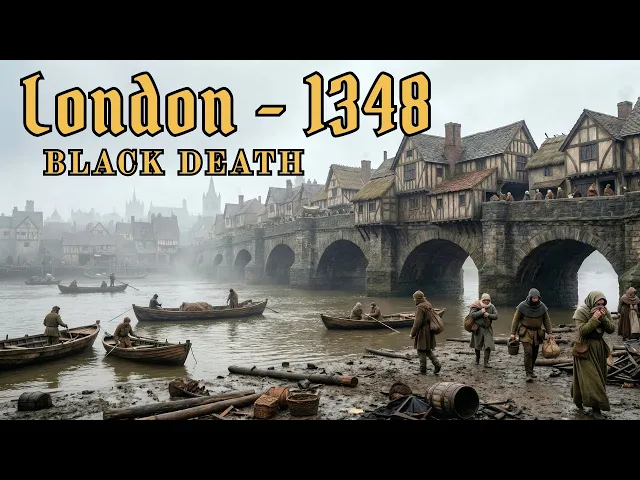
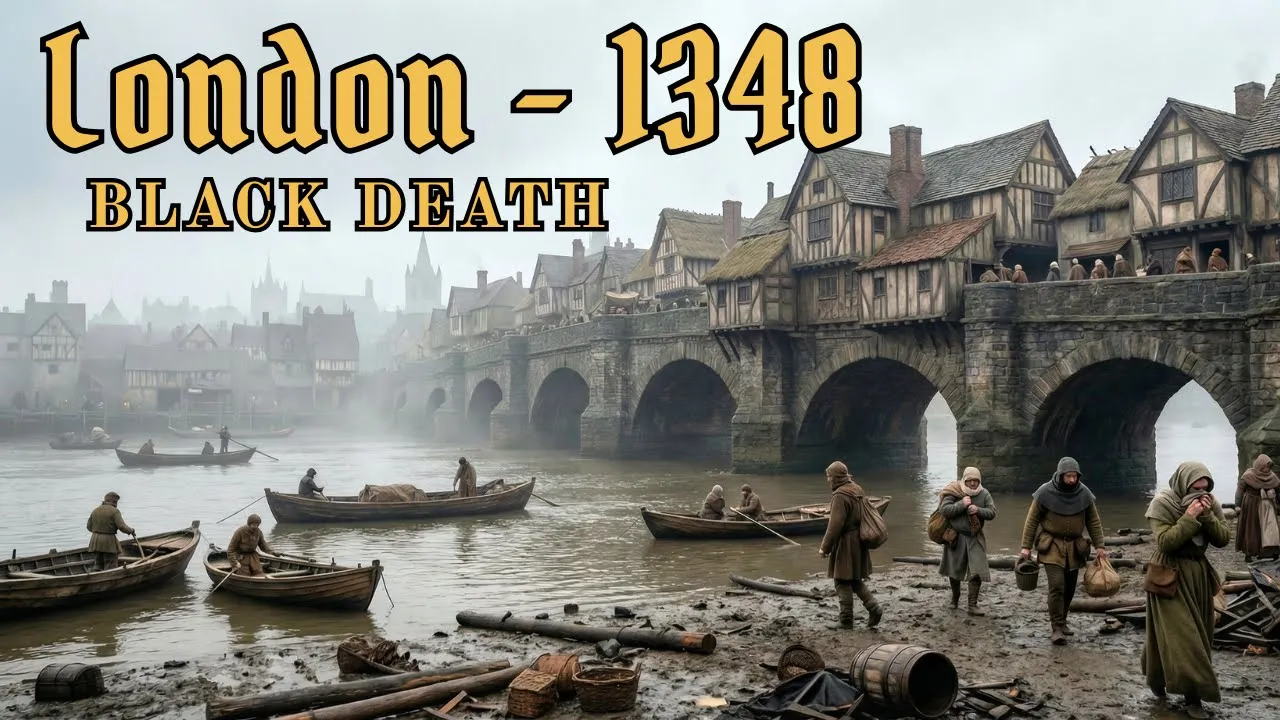
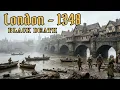
It's summer 1348 and London has no idea it's living through its last normal day. Within months, half its people will be dead. But right now, the tempame's glitters at dawn.
Werries cut through fog. Oes slapping water. Church bells ring from dozens of towers.
St. Mary Leau, All Hallows, St. Brides.
The air smells like woodsmoke, horsed, and river mud. You're standing at Billingsgate Warf, watching ships unload. Wool bales swing from cranes.
Italian merchants argue with English dock workers who don't understand a word, but know the value of money. Somewhere across the channel, people are dying in ways that don't make sense. Swellings in the groin, black fingers, death in three days.
But London hasn't seen it yet. Most people think it's just sailor gossip, war rumors, God's judgment on someone else. Today, we're walking through a city that feels eternal.
Let's see what ordinary life looks like before everything changes. London in 1348 holds roughly 50,000 people crammed inside Roman walls and spilling across London Bridge into Suffukk. It's a timber city, narrow houses with upper floors jutting over muddy streets dominated by old St.
Paul's massive spire. England is deep into the H 100red Years War. Edward III's campaigns cost money which means taxes on everything.
London finances the war through wool exports and imported wine. The money flows, but so does resentment. Three things matter here.
First, war economy. Bread prices climb. Wages stay flat.
Second, overcrowding creates daily risks. Disease, fire, crime. Third, there's talk from the continent about a pestilence spreading through Italy and France.
Ships arrive with stories of mass graves and emptied ports. Most Londoners dismiss it. Plagues happen elsewhere.
London will survive like it always has. Our route moves from the docks at sunrise to streets after curfew. Seven stops.
Morning to night. One day in a city with no idea what's coming. Stop one.
The wolves at Billingsgate. Early morning. The docks are already loud.
Sailors shout in French, Flemish, German. Steve Doors haul grain sacks. A crane groans under wine barrels.
The warf is slick with fish guts. One wrong step and you're in the temps. This is where London makes money.
Wool out, wine and cloth in. Italian bankers finance Edward's war with loans that'll take decades to repay. A laborer earns two or three pence daily hauling cargo.
Enough for bread, ale, and a shared bed. Not enough to save. He buys breakfast from a dock vendor.
Coarse bread and small ale for a half penny. Thieves work here. Guild enforcers watch for illegal trade.
Get caught and you're fined or in the stocks. A ship from Cala ties up. One sailor tells anyone listening about sickness in France.
You're healthy at breakfast, dead by supper, black marks everywhere, whole streets empty. Most people shrug. Sailors always have stories.
The market at Cheapside is filling up. Time to move inland. Stop two.
Cheapside Market. Midm morning. Cheapside is packed.
Timber stalls line the street hanging signs overhead. A painted boot for the cobbler. A loaf for the baker.
No one reads, so signs are pictures. Upper floors lean out so far you could pass wine across without stepping into the mud below. A baker's wife argues with a flower merchant.
Prices are up. War demand. Bad harvest.
She pays anyway. A chicken costs a penny. Salted fish is cheaper than fresh.
Near the stocks, constables drag a thief through the crowd. He stole bread. By noon, he'll be locked in wood with his head and hands exposed, pelted with rotten fruit.
Justice is public and fast. Fire buckets hang at every corner. The city burned before.
Timber and thatch need little encouragement. A town crier pushes through, ringing a bell. New taxes for France.
The crowd grumbles, but doesn't riot. Not yet. A servant hurries past with a full basket, heading toward the wealthier districts.
Let's follow. Stop three, a merchant's house near St. Paul's.
Midday. This is different London. Houses here have stone ground floors, timber above.
Some have glass windows, expensive, rare. St. Paul's spire looms nearby.
Inside a wool merchants family eats dinner, the main meal. Roasted pork, white bread, gasy wine. Servants bring courses.
Outside, beggars wait for scraps. The merchant reads a letter from Bruge. Business is good, but villages in Flanders are emptied by sickness.
Trade routes disrupted. He's worried about his investment, not his life. Plague is a problem for port cities, for the poor, not for men with stone houses.
Sumptu laws dictate what people wear by rank. Step out of line and the city reminds you fast. Across the river, people live very differently.
Time to see the other half. Stop four, the stews of Southwalk. Afternoon.
You cross London Bridge, the only temp's crossing, lined with shops creaking under their own weight. Southwalk sits outside city walls, outside city law, brothel, unlicensed taverns, bear baiting. The bishop of Winchester licenses the brothel, the stews.
Everyone knows the streets are filth. Open sewers, overflowing ces pits. Tenementss pack families into single rooms with straw floors.
Disease is constant. Dissantry, typhus, nameless fevers. A tavern is full despite heat.
A fight breaks out over dice. Knives flash before the keeper stops it. In a doorway, a prostitute coughs into a rag.
Deep, wet, painful. No one notices. Everyone here is sick with something.
Constable rarely patrol. The city pretends this place doesn't exist, but needs it. Bells ring for vespers.
Time to cross back. If you're enjoying this and want to support the channel, consider subscribing. It helps us keep making these reconstructions.
Thanks. Stop five, St. Bartholomew's Hospital.
Late afternoon near Smithfield. Augustinian monks run St. Bartholomew's Hospital.
A stone hall with shared beds and a chapel. Patients, laborers with broken bones, a fevered woman, a child with a blackening leg infection. The monks try herbal picuses, bloodletting, prayer.
Infection spreads easily. Beds are close. Wounds washed in water reused patient after patient.
No one understands contagion. They burn incense thinking bad air causes disease. A monk hears confession from a delirious sailor talking about bodies in Calala streets.
Piled like firewood. No one left to bury them. The monk prays, assuming it's God's judgment on the French.
It doesn't occur to him that judgment might cross the channel. The tower is visible to the east. That's next.
Stop six, the Tower of London, Dusk. The tower is powermade stone. Royal residence, fortress, prison, armory.
Inside, soldiers drill. Blacksmiths hammer arrowheads. Scribes record tax receipts.
The war runs on money and documentation. Below, in dungeons, political prisoners wait. The king's justice is final.
A messenger rides in from Dova, horse larded. Dispatches report plague in channel ports. Calala Bordeaux may be Mel on the south coast.
Officials debate. Close the ports. London lives on trade.
Shut the docks and the city starves. Merchants riot, so they wait and pray. It won't help.
Curfew is coming. Time to see London after dark. Stop seven.
The streets after dark. Night night is black. No street lights.
Just occasional torches and shuttered candles. Most people are inside. Doors barred.
Families around hearths using tallow candles that smell like burning fat. Chamber pots wait to be emptied at dawn. The watch patrols with lanterns calling hours.
10:00 and all's well. They look for curfew breakers and fires. In unlit lanes, thieves move quietly.
Through a tavern window, voices argue about plague rumors. A merchant scoffs. It never comes here.
A priest counters. God's will is not mocked. A laborer just drinks.
The argument fades. Candles go out. The temps flows on indifferent.
London sleeps, convinced of its permanence. No one knows that within 4 months the first cases appear. By winter the dead outnumber the living.
But tonight feels eternal. How do we know this? Tax roles show earnings.
Coroner's inquests describe accidents. Guild records list prices and penalties. Chronicles describe the plague's arrival.
Churches and walls survive. Manuscript illustrations show clothing and daily life. The gaps are real.
We don't know exact conversations, but we can reconstruct patterns. How do workers spent wages, how merchant households operated, what Soduk smelled like. AI visuals help us see these patterns reconstructed from historical research and checked against anacronisms.
History is reconstruction. This is what we can see. The city sleeps.
Last torches gutter out. Watchmen make rounds. People breathe the same air.
Drnk from the same wells. Live inches apart with no concept of quarantine. By autumn, ships from Malcolm bring plague up river.
First deaths are dismissed as fever. Then swellings appear. Then black fingers.
Then bodies pile faster than burial. London loses half its population. Entire streets go silent.
Survivors walk through a city of ghosts. But that's autumn. Tonight is summer.
Tonight, London is alive. Loud, crowded, filthy, normal. Next time, a day in London, 1665, when plague returns after three centuries, and the city has learned almost nothing.
For now, bells have stopped. Fires burn to embers. The tempame's flows dark under London Bridge.
This was the last normal day. No one knew it. No one ever does.