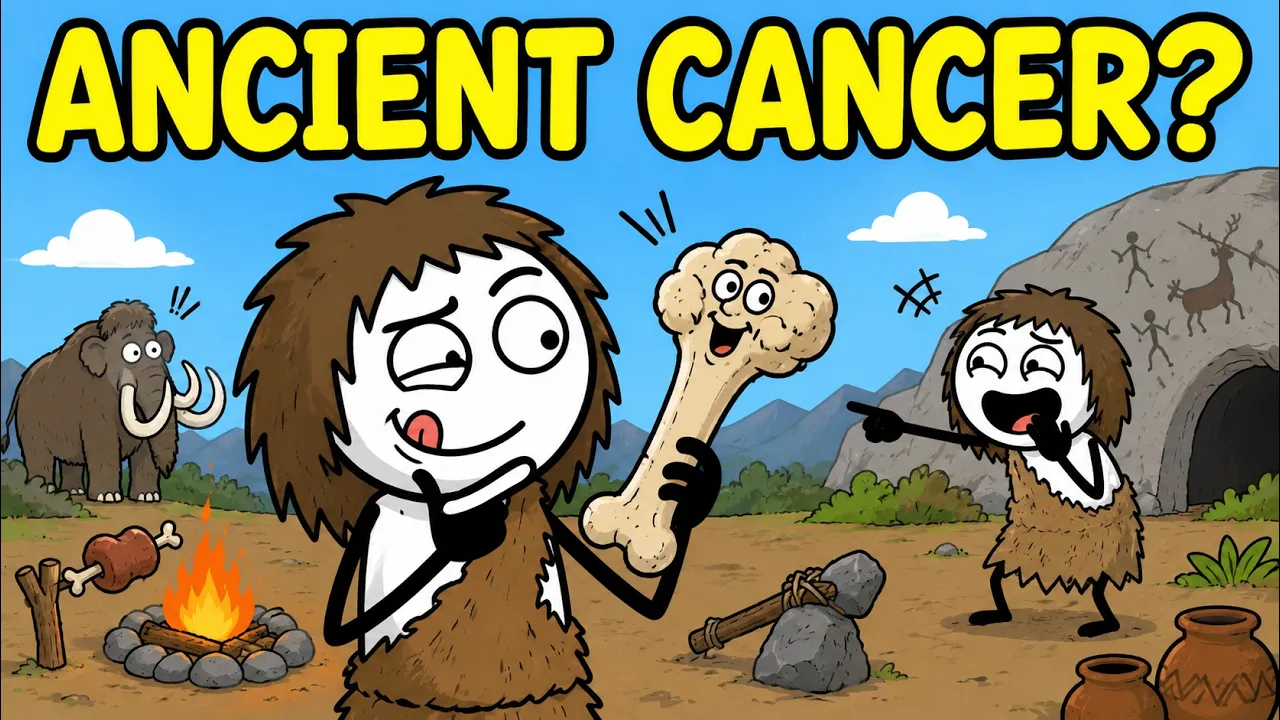
Cancer has a branding problem. We treat it like the ultimate modern disease born somewhere between cigarettes, chemical factories, and the invention of food that comes in a tube. Fair enough.
Modern life has certainly given cancer plenty of new opportunities. But cancer itself is much older than modern life, older than cities, older than farming, older than our species. Long before humans had hospitals, doctors, or that one relative who forwards miracle cure videos, cells were already making dangerous mistakes.
And that raises an uncomfortable question. Did ancient humans actually get cancer? Or is cancer mostly the biological price we pay for living long enough to complain about back pain?
The answer is hidden in fossilized bones, ancient skeletons, microscopic lesions, and a few prehistoric patients who never knew they were contributing to medical science. What those remains reveal is stranger than the simple story that cancer is new. Because the disease may be ancient, but the odds are modern.
Cancer did not begin with humans. It began with a much older biological gamble, convincing trillions of individual cells to cooperate. For most of life as history, being a cell was a solo career.
Eat, divide, avoid catastrophe, repeat. Then multisellular organisms appeared and suddenly cells had jobs. Some became skin, some became muscle.
Some carried oxygen. Some spent their entire existence producing mucus, which is not glamorous. But civilization collapses quickly without maintenance staff.
This cooperation required rules. Cells had to divide only when needed, repair damaged DNA, obey chemical signals, and when something went seriously wrong, shut themselves down through programmed cell death. In other words, the body became a society, and cancer became possible the moment one cell decided it was above the law.
A cancer cell is not an invading organism. It is one of your own cells with corrupted instructions. It keeps dividing, ignores stop signals, steals nutrients, manipulates nearby tissue, and sometimes travels to distant organs.
Biologically speaking, it is less like a foreign army and more like an employee who discovers the expense account has no limit. That basic vulnerability existed long before homo sapiens. Every time DNA is copied, mistakes can occur.
Most are harmless. Some are repaired. Some kill the cell.
But occasionally, a mutation affects the genes controlling growth, repair, or cell death. One mutation is usually not enough. Cancer often develops through a series of changes accumulating over time, which helps explain why it becomes more common with age.
The longer an organism lives, the more cell divisions it experiences, and the more chances evolution gives biology to misplace a decimal point. And this is not merely a human problem. Tumors have been identified in animals separated from us by hundreds of millions of years of evolution.
Cancer is not a glitch in modern humanity. It is a recurring risk built into the architecture of complex bodies. Yet large, long-ived animals complicate this logic.
Elephants have far more cells than humans and should mathematically be spectacularly full of tumors. They are not. This contradiction is known as PTO paradox.
Evolution has equipped some species with stronger cancer defenses. Elephants, for example, carry multiple copies of the tumor suppressor gene TP53, giving damaged cells more opportunities to destroy themselves before they become dangerous. Humans inherited defenses, too, but they are not perfect.
Natural selection does not engineer immortality. It favors traits that help organisms survive long enough to reproduce and raise offspring. A disease that usually appears later in life can slip past evolutiones quality control department.
So before an ancient human could develop cancer, no special technology was required. No cigarette, no pesticide, no suspiciously fluorescent snack. They only needed a multisellular body dividing cells in time.
We had all three. Ancient humans did not need to discover cancer the way they discovered fire or fermentation. There was no dramatic afternoon when someone pointed at a tumor and said, "Excellent.
Let's keep doing that. Cancer discovered them. " Every day, cells in the human body divide billions of times.
Each division requires copying an enormous instruction manual made of DNA. And even with sophisticated repair systems, copying errors happen. Most are corrected immediately.
Others do nothing noticeable. A very small number affect the genes that regulate growth. And if enough of those changes accumulate in the same cellular lineage, the cell can begin behaving less like a responsible member of the body and more like a tiny, highly motivated criminal organization.
For prehistoric humans, some mutations would have appeared simply by chance. Others may have been inherited. Certain genetic variants can weaken DNA repair or tumor suppression, meaning cancer susceptibility could pass through a family long before anyone understood what inheritance was.
Ancient people may have recognized that several relatives developed similar swellings or died in similar ways, but their explanation probably involved spirits, curses, or an ancestor who had offended the wrong river. Environmental causes existed too. Ultraviolet radiation damaged skin then just as it does now.
Naturally occurring radioactive materials existed in soil and stone. Some molds produced carcinogenic toxins. Viruses capable of disrupting normal cell behavior likely circulated among early populations.
While chronic infections could create repeated inflammation, forcing tissues to repair themselves again and again. More repairs meant more cell divisions. More divisions meant more opportunities for mistakes.
Then humans mastered fire. Fire was one of our greatest technologies, but it was also a smoke machine installed directly inside the house. Early shelters often had limited ventilation and repeated exposure to wood smoke would have filled lungs with fine particles and carcinogenic compounds.
Cooking reduced pathogens and made food easier to digest, which was an enormous evolutionary advantage. Breathing the kitchen less so. Still, we should not imagine prehistoric caves as oncology wards.
Many cancers require decades to develop. And ancient humans faced a brutal collection of faster threats. Infection, injury, childbirth, starvation, predators, and the timeless human tradition of making terrible decisions near large animals.
A person carrying an early tumor might die from pneumonia or a fractured skull before the cancer ever became fatal. That creates a strange archaeological problem. Cancer may have begun inside many ancient bodies without becoming the thing that killed them.
Soft tissue tumors vanished when those bodies decomposed. Small lesions left no obvious trace. Even aggressive cancers sometimes spared the skeleton.
So, the first prehistoric cancers were probably not rare enough to be miraculous, nor common enough to dominate ancient life. They existed quietly, hidden inside bodies already fighting everything else. Most disappeared without evidence.
A few reach the bone. Bones are terrible witnesses. They refuse to answer questions.
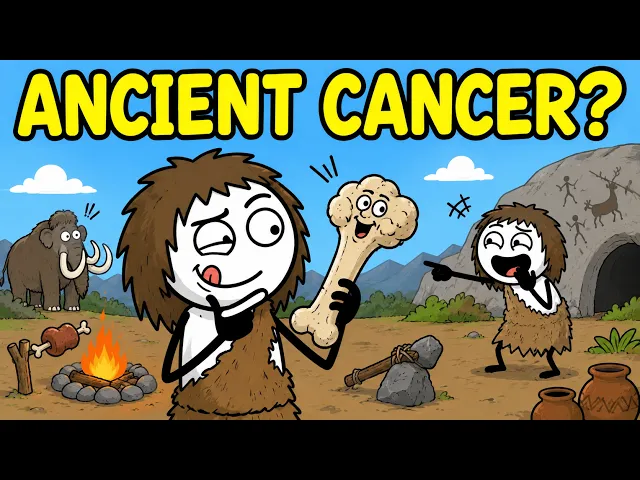
They lose important documents and they usually preserve only the most dramatic parts of a disease. But occasionally a skeleton keeps enough evidence to make a diagnosis more than a million years later. One of the oldest confirmed malignant tumors found in the human evolutionary record comes from Schwarran's cave in South Africa.
Researchers examined a footbone from an early hominin who lived roughly 1 7 million years ago and identified osteocaroma, an aggressive cancer that begins in bone forming cells. The patient S exact species is uncertain because the bone was found without a complete skeleton. It may have belonged to homoerastaster or paranthropus robustus.
Either way, this individual was not a modern human and the cancer developed long before agriculture, industrial pollution, tobacco companies, or motivational posters telling people to detox. Highresolution imaging revealed an abnormal mass growing inside and around the bone with the chaotic architecture characteristic of a malignant tumor. Osteocaroma can cause swelling, severe pain, and weakened bone.
The ancient individual may have struggled to walk, which in a landscape filled with predators was less a medical inconvenience and more an aggressively bad performance review. Another famous case comes from Cropina, Croatia, where a Neanderthal rib more than 120, Zerzone years old, showed evidence of fibrous dysplasia. This condition occurs when normal bone is replaced by abnormal fibrous tissue.
It is a genuine neoplastic disorder, meaning it involves unusual cellular growth, but it is usually benign. That distinction matters. Not every tumor is cancer, and archaeology becomes unreliable very quickly when every strange bump on a bone is promoted to prehistoric malignancy.
Later remains provide clearer examples. Ancient Egyptian and Nubian skeletons have revealed lesions consistent with metastatic cancer, where tumors spread from an original organ into the skeleton. A man buried in Sudan around 3,000 years ago had widespread bone damage, suggesting metastatic carcinoma.
Other ancient mummies and skeletons show possible tumors of the breast, prostate, bone, and soft tissue. Yet diagnosing ancient disease is difficult. Infection, injury, arthritis, and posterial damage can sometimes resemble cancer.
Researchers therefore combine visual examination with X-rays, CT scans, microscopy, and comparisons with modern pathology. Even then, careful scientists use words like consistent with rather than declaring that a pharaoh definitely had stage 4 anything. The evidence is fragmentaryary, but its message is clear.
Cancer was not waiting for modern civilization to invent it. It was already inside our lineage, quietly leaving scars in stone. So why does the ancient record contain so little cancer?
One possibility is obvious. Ancient humans genuinely developed less of it. Many cancers are strongly associated with aging and prehistoric life was extremely efficient at preventing people from reaching retirement.
Infant mortality was high. Infections were dangerous. Injuries that now require antibiotics and a few embarrassing hospital forms could become fatal.
Even people who survived childhood often died before the decades when many cancers become most common. This does not mean everyone dropped dead at 30. Average life expectancy is distorted by the enormous number of early deaths.
Some ancient people reached their 50s, 60s, and beyond. But fewer people lived long enough for slow growing tumors to accumulate the mutations needed to become clinically obvious. Modern environments also added major risks.
Tobacco use, industrial chemicals, air pollution, certain dietary patterns, reduced physical activity, and longer exposure to carcinogens have increased the incidence of particular cancers. Modern humans did not invent cellular mutation, but we did become exceptionally talented at creating subscription services for it. Still, the opposite possibility is equally important.
Ancient cancer may look rare because archaeology is almost designed to hide it. Most cancers begin in soft tissue. Lungs, breasts, intestines, liver, pancreas, and other organs usually decay after death.
Unless a tumor spreads to bone, calcifies, or survives through mummification, it may leave no trace. Even when cancer reaches the skeleton, only a small fraction of ancient human remains are preserved, discovered, identified, and studied with modern imaging. That is a brutal sequence of filters.
First, the person must develop a tumor. Then, the tumor must affect bone. Then, the skeleton must survive animals, weather, soil chemistry, grave robbers, construction projects, and archaeologists who are understandably more excited about golden objects than a suspicious looking vertebrae.
Researchers also debate whether some ancient lesions have been misdiagnosed. Bone infections can imitate tumors. Benine growths can appear aggressive.
Damage caused after burial can look pathological. A dramatic diagnosis attracts attention, but scientific caution requires less cinematic language. There is also a deeper evolutionary puzzle.
Cancer risk depends not only on exposure, but on genetics, immune function, reproduction, hormones, nutrition, body size, and lifespan. Ancient populations live differently from us, but natural does not automatically mean protected. Nature produced venom, parasites, famine, and teeth with no replacement plan.
It was never running a wellness retreat. The safest conclusion is not that cancer was absent, nor that it was secretly everywhere. It was probably less common in some forms, hidden in others, and unevenly distributed across populations and ages.
Ancient cancer was real. Its statistics decomposed. Once humans settled into villages, cancer entered a new phase of its relationship with us.
It did not suddenly appear, but civilization changed the conditions in which it could develop, spread, and finally be noticed. Agriculture created more reliable food supplies, larger populations, and eventually more people surviving into older age. It also produced new problems.
Repetitive diets, nutritional deficiencies, crowded settlements, infectious disease, and long hours spent inhaling smoke inside enclosed homes. Humanity had invented the permanent address. Unfortunately, so had several health risks.
Fire remained especially complicated. For hundreds of thousands of years, it cooked food, provided warmth, frightened predators, and turned evenings into social events. But indoor hearths also exposed families to smoke day after day.
Fine particles and carcinogenic compounds entered the lungs of people who had never purchased a cigarette and would have been deeply confused by the concept of a smoke break. Farming societies also stored grain and stored grain could become contaminated with molds that produce aphletoxins, substances now known to increase the risk of liver cancer. Domesticated animals and dense populations may have helped certain infections circulate more efficiently.
Some viruses and bacteria can contribute to cancer by damaging cells, altering growth controls, or causing chronic inflammation. Then came writing which allowed disease to leave evidence outside the skeleton. Ancient Egyptian medical texts described unusual swellings and hard masses.
The Edwin Smith papyrus copied around the 17th century B. C. E.
from older material includes a description of breast tumors treated with cauterization. Its conclusion is startlingly blunt. There is no treatment.
That may sound primitive, but honesty remains an underused medical technology. Ancient healers did not understand mutations or metastasis. Tumors might be blamed on blocked bodily fluids, divine punishment, imbalance, fate, or forces that were medically difficult to invoice.
Treatments included surgery, burning, herbal preparations, dietary changes, and ritual practices. Some may have reduced pain or infection. Others mainly demonstrated that humans have always responded to frightening diseases by trying absolutely everything nearby.
Cancer also gained symbolic power. A mysterious growth inside the body could become a sign of corruption, curse, or spiritual disorder. Illness was rarely treated as purely biological because religion, medicine, family, and politics were not separate departments.
A ruler s disease could become a national omen. A healer s failure could become a theological issue. Yet civilization brought one more critical development, organized observation.
Physicians compared symptoms, recorded cases, and past knowledge forward. Tumors stopped being only private tragedies and became patterns that could be studied. Humans still could not defeat cancer.
But we had begun to recognize the enemy. Today, cancer feels uniquely modern because modern life allows us to see far more of it. More people survive infections, injuries, childbirth, and childhood diseases.
Medical systems detect tumors that ancient people would never have named. Imaging reveals growths before they become visible. Screening finds abnormal cells before symptoms appear.
Treatments keep patients alive long enough for recurrence, remission, and statistics to become part of ordinary conversation. Longevity changes the equation. The longer we live, the more times our cells divide, the more DNA damage accumulates, and the more opportunities dangerous mutations have to cooperate.
Modern medicine has therefore created a strange paradox. By protecting us from many causes of early death, it has made age related diseases more visible. That does not mean modern exposures are irrelevant.
Tobacco, industrial pollutants, certain infections, alcohol, radiation, and other carcinogens genuinely increase risk. Some cancers have become more common because our environments changed. Others appear more common because detection improved, and some are now less deadly because prevention and treatment advanced.
The honest answer is inconveniently balanced. Cancer is ancient, but modern life reshaped it. It is not proof that civilization poisoned a previously perfect human body.
Prehistoric nature was never perfect. It was simply less documented. At the same time, calling cancer entirely natural should not become an excuse to ignore preventable risks.
Lightning is natural, too. We still avoid standing under a tree while holding a metal pole. The ancient bones from Schwart crayons matter because they collapse the comforting distance between us and deep time.
That early hominin had no word for osteocaroma. No biopsy, no chemotherapy, no understanding of why walking hurt. But inside that foot cells were breaking the same basic rules they break in human bodies today.
That continuity is frightening but also strangely unifying. Cancer is not a punishment designed for the modern world. It is one of the costs of being made from living cells that must constantly renew, repair, and cooperate.
We inherited extraordinary bodies from evolution. We also inherited their loopholes. So yes, ancient humans had cancer not because they ate processed food, ignored wellness podcasts, or failed to purchase enough supplements.
They had cancer because they were complex multisellular organisms living long enough for biology to make mistakes. The disease is prehistoric.