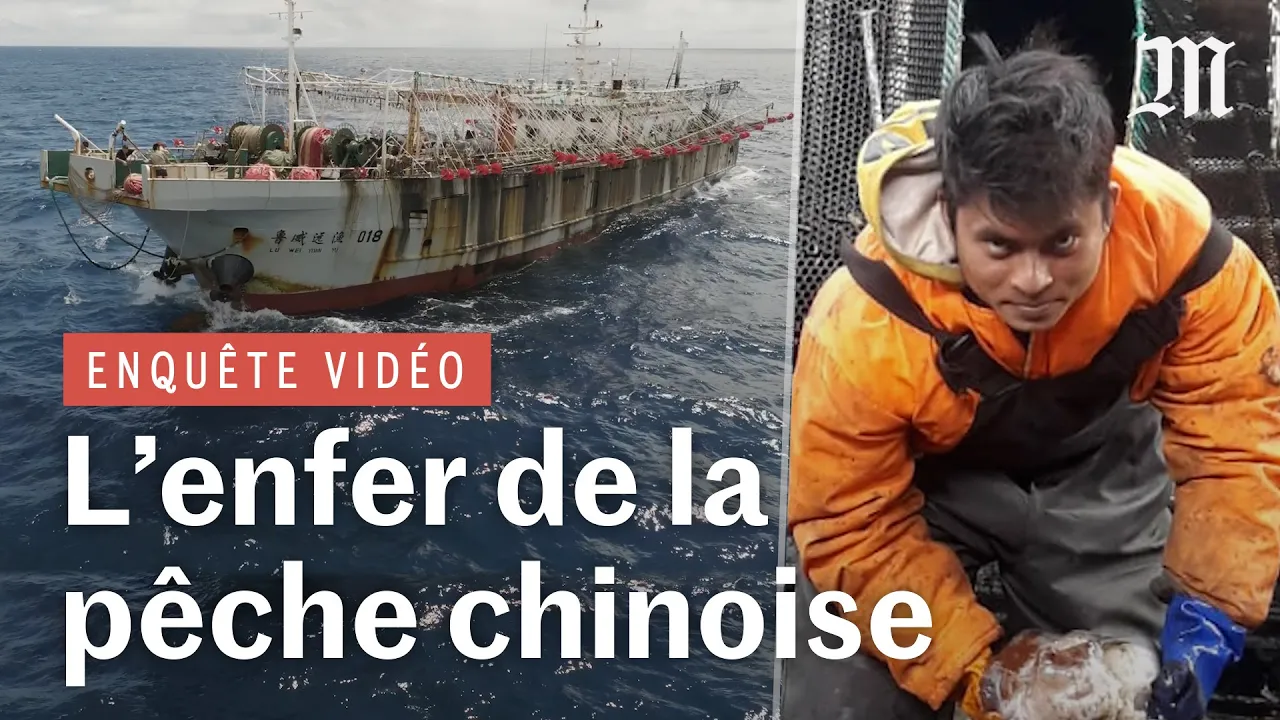
In July 2018, a young man named Fadhil left his home in Indonesia to work as a deckhand on a deep-sea fishing vessel, a Chinese squid boat, the Wei Yu 18. Fadhil is 25 years old and venturing out to sea for the first time. He boards the Wei Yu 18 at the port of Busan, South Korea, where he joins a crew of 9 other Indonesians and 20 Chinese.
From Busan, the rusty, red-and-white steel-hulled ship travels for several weeks to South America, exploring the deep-sea fishing grounds off Peru and Chile. The men work 12 to 24-hour shifts. They usually sleep during the day and work hard at night, when extremely powerful lamps are used to attract the squid to the surface.
On board, as on this other boat we were able to film, the men sleep 4 to a room on wooden bunk beds. The foam mattresses are soaked with condensation dripping off the walls. The Indonesian crew drink rust-coloured water that tastes of metal.
Their Chinese neighbours have bottled water. To shower or wash their clothes, the Indonesians use seawater. Their only rations are rice and instant noodles.
Violence aboard the Wei Yu is commonplace. Sailors describe blows to the head, slaps and kicks. The crew chief and captain often complain when Indonesians don't understand instructions given in Chinese, when they take too long to untangle a fishing line or drop squid on deck.
In August 2019, after spending over a year at sea, the Wei Yu 18 is struck by an epidemic of Beriberi, a severe and painful form of malnutrition caused by a deficiency of vitamin B1, also known as Thiamine. Symptoms include complete body swelling, intense fatigue and, if left untreated, death. Experts say that letting fishermen contract, and die from, Beriberi is criminal negligence, as the disease is easily preventable with a balanced diet or vitamin pills.
If it does occur, it can be cured. At a time when a third of the world's fish stocks are overexploited, fishing fleets have begun to travel ever-further and stay at sea ever longer, in the hope of catching the minimum necessary to stay profitable. This is particularly true of Chinese fishing vessels, which stay at sea for up to 2 years at a time.
To do so, Chinese captains rely on transshipment. Catches are unloaded at sea onto these refrigerated vessels, enabling fishermen to stay at sea almost indefinitely. This practice considerably increases the risk of developing Beriberi.
Too weak to work, Fadhil stays in his quarters while the other Indonesian sailors take turns watching over him. He becomes too tired to sit up. He vomits up everything he eats and drinks.
To treat him on board, he is given the Chinese equivalent of ibuprofen in packaging that indicates that the medicine has expired. The captain claims that Fadhil cannot go home because he has signed a 2-year contract with the agency that recruited him. This document shows that Fadhil only signed a 1-year contract.
A period he had just completed when he fell ill. Over the next 2 weeks, Fadhil's condition deteriorated rapidly. He had difficulty breathing.
He could no longer stand. He could no longer urinate. Then came the convulsions.
The other Indonesian sailors decided to transfer Fadhil to Ramadhan's room, where he did all he could to comfort his dying friend. Several days after Fadhil's death, the captain orders his body to be buried at sea. He claims to have received permission from Fadhil's family in Indonesia.
The captain orders the men to build a wooden coffin. They fill the coffin with metal weights and wrap it in an anchor chain to ensure that it sinks. Fadhil's body is then abandoned at sea.
Fishing is one of the most dangerous professions in the world. More than 100,000 people die every year. How many of these deaths are due to forced labour or negligence?
Fadhil's story is representative of the huge problem of sailors held captive on fishing vessels that have been at sea for several years. It is also the story of a disease that could have been eradicated more than a century ago.





![Trafic de cocaïne : notre enquête inédite sur la lutte anti-drogue en Bretagne [Documentaire]](https://img.youtube.com/vi/5pwwUUQI5Og/maxresdefault.jpg)