What if I told you that in the Soviet Union, gender affirming care was a thing as early as the 1920s, and actually kind of a thing throughout the majority of its lifespan. For example, in the 1920s, Soviet doctors got together to help determine how the justice commisseri should proceed in the case of a man wanting to live life as a woman and ultimately decided that, yeah, that's fine. Go ahead, girl.
In the 1960s, a Soviet doctor pioneered the first complete female to-male reassignment surgery, or SRS. In the 1980s, there were doctors in St. Petersburg and Moscow giving SRS operations and telling newspapers that trans people need to be treated with dignity.
The USSR certainly wasn't a queer utopia. I wish it had been. That'd be so cool.
But no country really was a beacon of queer rights in the lifespan of the USSR. So, like, what do you expect? However, at various points in time in the USSR, there were standards for gender affirming care, legal ways to change one's gender marker, and even queer marriages.
And that's what this video is going to be covering. We're going to talk about what gender affirming hair was like throughout the lifespan of the Soviet Union by going over a few case studies of actual Soviet trans people, going more in-depth into the little tidbits I just shared. And there's going to be a whole bunch of Soviet history sprinkled in.
Then I'll discuss what we can learn from all of this more broadly. When people think of the Soviet Union, I doubt that they think of the trans people that lived in it. But as with any country at any point in time, there were certainly trans and gender non-conforming people there.
and their stories are important to talk about, especially now when the global rise of fascism and conservatism has led to attacks on trans healthcare and attempts to stifle, erase, and suppress the histories of transness, which is historically what fascists tend to do and who they go for first. Like how literal Nazis looted and burned books from Magnus Hersshfeld's Institute for Science, which by the way, there were Soviet doctors and even politicians like Alexander Colintai involved in Magnus Hersfeld's World League for Sex Reform. and Soviet doctors even held a vanguard role in the international sex reform movement.
Fun fact, but yeah, with all the attacks on trans people and trans healthcare and all that, I think it's good to talk about historic trans people who existed. Anyway, before we jump into what life was like for trans people in the Soviet Union and talk a little bit more about gender affirming care in the Soviet Union, I wanted to talk about today's sponsor, Aura. Have you ever Googled yourself and been like, "Wow, there's way too much of my information on the internet.
" It's pretty freaky looking yourself up and seeing that your home address, phone number, and other private information is just there online for literally anyone to look up. Not only are data brokers earning billions from sharing that info without your consent, but them doing so also leaves you much more vulnerable to identity theft because sometimes those extra secret security questions like, "What street did you grow up on? " are literally something anyone can look up online.
Yikes. Plus, those sites make removing your info intentionally difficult and sometimes require you to give even more of your personal information to do so. Luckily, Aura takes care of the hard part by automatically removing your personal information from these data broker websites and keeping it off.
I know there's a lot of services that do that, but Aura has way more features for basically the same price all in one app, including a secure VPN, an antivirus, a password manager, real-time fraud alerts for credit and banking, and more. Aura also includes $5 million in identity theft insurance protection in case the worst happens. I'm not leaving myself and my family vulnerable to data breaches and brokers, and you shouldn't either.
You can try Aura for free for 14 days at aura. com/revolutionary. In those two weeks, Aura will get to work scrubbing your personal info from these data broker sites.
Thank you, Aura, for sponsoring this video. Now, back to the video. Yiny/ Yuggina was a true non-binary icon and also one half of the first same-sex marriage in the USSR in 1922.
But before we talk about them, we need to discuss some historical context and what the 1920s were actually like, what the general vibe was at the time. Sorry, planned. In the 1920s, scientists across the world were learning all sorts of new interesting things about endocrinology, gender, all that fun stuff, and realizing that biological sex was actually a pretty unstable category.
Birds were just spontaneously changing sex. In 1923, Scottish geneticist Fae Crew wrote about how he successfully transformed a hen into a male chicken. In 1924, American biologist Oscar Riddle published a case study in the American Naturalist describing his observations of a female pigeon catching tuberculosis and then transforming into a male pigeon.
And these are just two examples of many such studies demonstrating the malleability of the categories of male and female. Riddle even said that this sort of transformation was wholly probable in humans and that could probably happen to anyone even without their knowledge. You might wake up tomorrow and be a woman.
Which, I mean, that gender transformation thing literally is the experience of some interex people who are assigned one gender at birth and raised as that gender, but then go through the opposite gender's puberty out of seemingly nowhere. So, yeah, it's a real thing. Also, apparently, we figured this out again recently.
Bro, people knew this like 100 years ago. Of course, birds can change sex. Anyone can change sex if they're brave enough.
So, anyway, that was the scientific state of the world. lots of openness to new ideas about gender and hormones and all that fun stuff. Meanwhile, in the USSR in 1922, the Bolsheviks abolished the old Sarist criminal code and put a new one in place which resulted in them decriminalizing sodomy which had been illegal in the military since 1718 and in general since 1835 in the Russian Empire.
In 1921, the year before, the USSR and Lenin adopted the new economic policy, which allowed for the existence of some capitalist enterprises to revive the economy. Because it turns out having a multi-year civil war that's actually like 14 countries invading a new nation trying to attempt socialist construction for like the first time is not good for production or the economy. Especially considering the Russian Empire was a semifudal 85% peasant nation and didn't really have a lot of means of production to seize.
So obviously they weren't producing that much to begin with. When it came to the topic of homosexuality and gender non-conformity, Bullshik revolutionaries didn't really write about that. Revolutionaries like Alexander Collandai certainly wrote about relationships, love, and the abolition of the family via the socialization of women's labor and the introduction of women into public life, which Marxists like the Bolsheviks consider a prerequisite for women's liberation.
Watch my Soviet women video if you want to learn more about that. But the discussion of the topic of queerness was mostly led to Soviet medical professionals who held a plurality of views ranging from extremely progressive even today to not so progressive and kind of cringe, which we'll learn about later. Also, at that point in time, when a Soviet doctor wrote a case study about a queer person, it was often because that queer person had been arrested for some unrelated matter and ended up in a forensic psychiatrist's care, or because they intentionally saw a doctor to get help with their confusion.
But in Yugheni's case, it was the former. Yeni was not confused. Yughini was very secure in who he was.
After becoming an orphan at the age of 17 in 1915, Yenya started presenting as a man, becoming Yeni Fjodravich with the help of forged documents. During the revolution, Yughenei worked as a political instructor for the Chika and fought on the southern front of the Russian Civil War. In 1922, Yughini courted and eventually married a woman in the provincial town he was posted in.
Somehow Yuggini's new wife had no clue that Yugeni was not actually a man, but just a probably non-binary person and very convincing boy drag. But other people in town apparently knew. And those rumors eventually reached his wife, who confronted Yugenian, who of course admitted that that was indeed the case.
I'm not actually a man. Ah the rumors also reached the local authorities who attempted to charge Yeni with a crime against nature but their poorly constructed case failed and the commisseriate of justice ultimately recognized the marriage as legal because concluded by mutual consent which is how the Soviet Union became one of the first countries to ever have a legal same-sex marriage in 1922 if not like the first. After this whole ordeal yeni's wife had an affair with her male co-orker and had a baby who Yudgei adopted.
After a few years, Yugenei left his wife and kid to follow his soldiering career to Moscow, but then got fired in 1925. Yay struggled to transition to civilian life and began drinking and being promiscuous with other women, even getting a second unofficial wife, breaking gender divorms by becoming the toxic man sleigh. To be clear, the problem is the patriarchy.
And even queer people are not immune to patriarchal thinking, especially in the face of great trauma, which like becoming an orphan at 15 is probably extremely traumatic on top of being queer in a heteronormative society and being a soldier in a civil war and all that. No hate to messy queer people though, like amongst us hasn't been messy at some point. Let he who has never been a messy cast the first stone.
It's sure not going to be me. Anyway, the reason Yugeni ended up in the care of a forensic psychiatrist was not because he was too messy or sledding around too much, but because in 1926, complaints began to accumulate that she was impersonating bureaucrats and party members for profit, and her drinking led to disorderly conduct. She found herself repeatedly before police and courts for hooliganism and extortion until Dr Adelstein examined her at the Moscow Health Department's Bureau for the study of the personality of the criminal and criminality.
I mean, I guess that's kind of messy. Is impersonating bureaucrats being a messy gay? During Yuini's tenure as Dr Adelstein's patient, he continued to present as male, and the doctor never really attempted to cure him, remarking that the social future of such a subject is very difficult, but that's society's fault, obviously.
While in Dr Adelstein's care wrote him a text called a history of my illness explaining their gender non-conformity in scientific terms citing Freud Craft Ebbing and Havlock Ellis and pleading for the existence of a world where people like her are accepted. According to Healey, elite psychiatrists acknowledge that her reading of recent international scientific literature was impressive. I can't keep Yuggini's pronouns straight, so I hope I'm not confusing anyone by using all the pronouns for them, but honestly, I feel like they'd be into that.
Yeni wrote that the neuter gender is only recognized in grammar and is applied to inanimate things. In reality, however, people live among us who do not fit neither the one nor the other gender. Such beings must be called people of the neuter or middle gender.
People of the middle gender will begin to feel a sense of responsibility before society and become useful to it only when that society stops oppressing them and strangling them due to its lack of consciousness and its petty bourgeoa barbarity. A true non-binary icon in homosexual desire in revolutionary Russia. Dan Healey notes that although at this point in time people knew that animals could change biological sex and that advances were being made in endocrinology, Yenia, interestingly enough never sought to medically transition via surgery or hormones, even though she certainly would have been aware that that's a thing that can be done.
Yeni simply hoped for a future where people like her were no longer disrespected. Yugenia pleaded in effect for the social and political rights of the intermediate sex using arguments consciously borrowed from the essentializing scientific justifications of homosexual emancipationism. Her assumption of a male gender persona, one traditional way for ambiguous to order their position in the world, was thus transitional, for she envisioned a world in which gender and sexual ambiguity would be understood by medicine and respected in a knowledgeable society.
The revolutionary faith in science to end archaic moral strictures and to bring rationality to human relations was a powerful tool not only in the hands of bolevik legislators and medical practitioners but in the hands of ordinary individuals who manipulated it to justify their own desires. I don't have the full text that Eugenei wrote but Healey does give us a few quotes directly from it. Professor Freud justly points out that people who are in aual sense perverted ought not to be considered degenerates.
No one can consider people of the intermediate sex physically or mentally ill. One may count among the number of men with an abnormal deviation of sexual desire. Leading writers Oscar Wild, Wittmann, Verlain, artists Michelangelo, and musicians Chaikovski.
And this clearly proves that it is impossible to dismiss people of the intermediate sex to the category of the mentally and psychically disturbed. It would be preferable when judging homosexual persons. if their personality and mental capabilities were taken into account before all else and not their actions which are a private matter.
Just as for normal people, I mean, hey, those are sound arguments. Slag. Anyway, when I read about Yughini or read his writing, I feel like we have a lot in common as queer mad Soviet communists.
Not that I'm from the Soviet Union. I mean, I'm from the former Soviet Union, so close enough. My parents are from the Soviet Union.
Not that I'm a non-binary he, him, any all lesbian. I'm a non-binary they them bisexual. Slightly different, but close enough.
I just find the very cool and interesting even though Dr Adelstein was basically like this text clearly proves that this subject is a little dulu and insane, which like okay. And is it really that insane to think that people who others think are a little weird would one day be accepted instead of being smothered by petty bourgeoa disrespect? Is it insane to love women?
That sounds super reasonable to me. Comment down below if you love women. Me personally, I'm I'm a fan of women.
Getting a peek into Yini's writing also shows us that a lot of the ideas we have and the topics we think about right now are not new. They're not new inventions. A lot of discourse is ancient.
Even though this is like a hundred years old, which isn't ancient, but still. And when you study history, you learn how all of these things that we're thinking of and discussing right now are basically just reconfigurations of the same stuff other people already thought about and discussed before. It's also just a nice reminder that non-binary people have always existed and always will.
I mean, that's not the term that was used at the time, but still. According to Soviet historian Adina Rald Duggina, when discussing these queer Soviet subjects of the 1920s and early 30s, we're talking about a generation of people whose homosexuality, while it was still conceived in primary medical terms, was not a reason for self-suppression, was not perceived as an illness to be cured, but was instead conceived as an integral part of their identities. Many of them counted on the idea that the new government would not just tolerate them.
They hoped it would treat them as legitimate participants in the socialist project because as one of the men I'm researching wrote in the mid1 1920s, "The majority of us fought for this government from the very first moments of its existence. " And they had good reason to believe that this absolutely applies to Huggini who never sought legal or medical channels to transition and kind of just took matters into his own hands by forging documents which is highly illegal and I do not endorse. And at the same time he believed in the revolution.
He fought for the revolution. Like it sounds like he was a messy but also a principled communist. Oh my god.
Look, I got two cats. Oh, Yiviani truly believed in that better revolutionary future where people like him were accepted. Also, the Soviet state never actively tried to re-educate him, though some medical professionals did suggest that, but that never happened.
Obviously, this is not an incredible example of gender affirming care on the Soviet Union's part, but it is an example of how one non-binary person tried to build the life they hoped the revolution would give them and affirmed their own gender. Look at his little face. We do have examples of actual gender affirmation via government channels in the Soviet Union though.
In January and February of 1929, the expert medical council met up at the behest of the health commasard to help the Justice Commisseriat formulate a response to Citizen Commun, a transwoman from the Tatar ASSR in her request for a sex reassignment. Their ultimate decision of, "Yeah, that's fine. Go ahead, girl.
" which I mentioned earlier in the intro is absolutely interesting. But before we get there, we have to go over the journey that got us there and how the doctors actually discussed this case. Obviously, it started with a transwoman making a request to the Justice Commisseria to legally change her gender marker from male to female.
Because there was not really a law on the books or a medical standard or anything like that for dealing with the issue of gender transition specifically the justice commisseria had to ask the health commisar Nikolai Samosko to advise because issues of sex and gender were considered to be the domain of medical experts if you remember. Leslie Fineberg writes in their article progress and regression sex and gender in 1930s USSR that these deliberations did not demonstrate a uniform view nor were they devoid of the prejudices or limitations on understanding of that era but they were taken up with genuine scientific concentration and the impact of and respect for the work of Dr Magnus Hersshfeld leader of the German homosexual emancipation movement was still apparent in the USSR. The February 8, 1929 meeting opened with psychiatrist Bruceilski claiming that in the USSR, the question of transvestites, which was the terminology back then, was not particularly frequent.
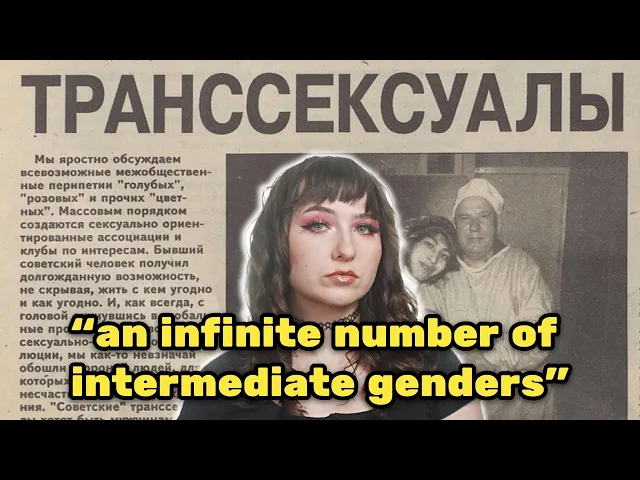
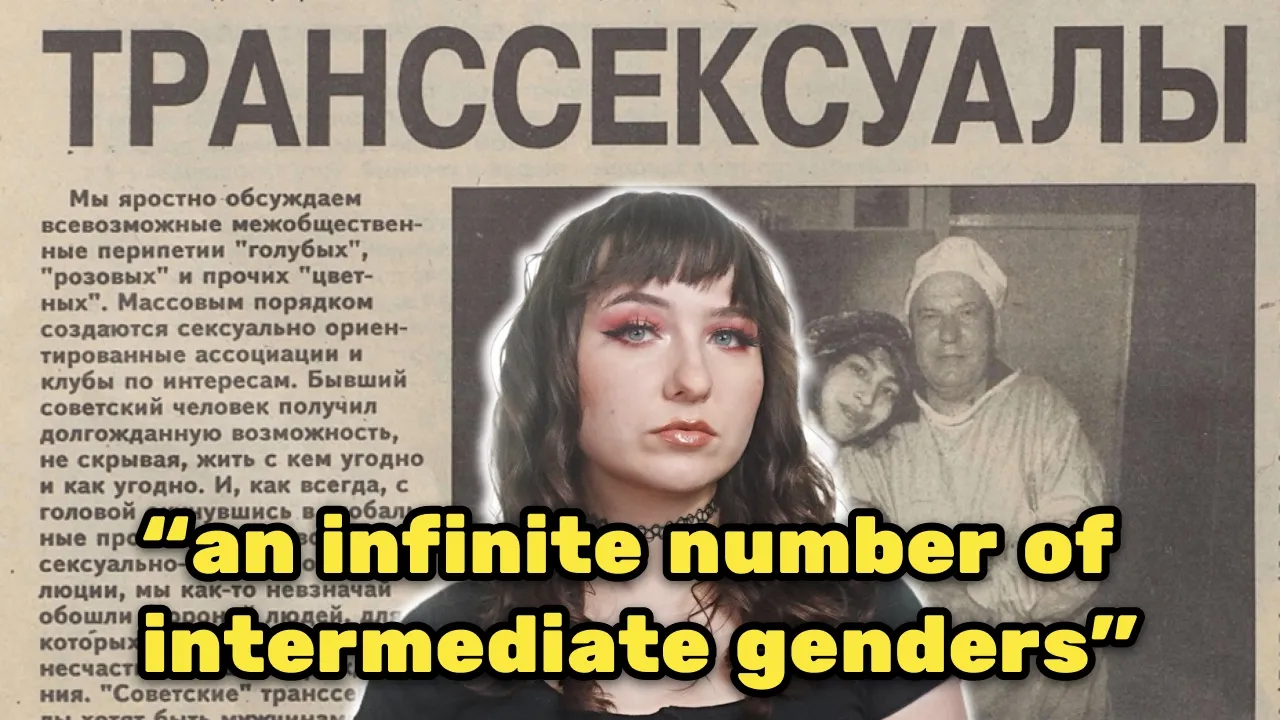
Unlike in Germany, though, he pointed out Adelstein's newly published case about none other than Ya Fodna and even read from her history of my illness. During the discussion, biologist NK Gauv declared that of course there is no intermediate sex, but rather an infinite quantity of intermediate sexes and that in humans it occurs very frequently, perhaps more often than among animals. Again, remember that at this time everyone was like, "Wo, animals just randomly change sex.
" So to say that about humans made a lot of sense at the time and still does because we are once [clears throat] again learning that birds can change sex. Duh. and you can too if you want.
Kovv also disagreed with Brussilovski and stated that maybe people wanting a gender reassignment wasn't as common in the RSFSR, the Russian part of the Soviet Union, but it definitely was in places like Kazakhstan. If you saw my video about why the USSR criminalized homosexuality, which you should definitely watch, this mindset was very much rooted in the patriarchal and great Russian chauvinist idea that feminine men were a marker of backwardsness, whereas masculine women were competent and loyal to the revolution. Glov did also say that cross-dressing females like Givini should only marry women under medical supervision because unfortunately his wokeness only went so far.
But no one really agreed with him at least. Avia Rahmanov discussed two cases of masculineized women in the Red Army, one with a husband and kids and one without, stating that both cases were fine and not in need of intervention and that each issue should be handled on a case-by case basis. Of course, there's a problem with handling things on a case- by case basis, especially when you have a giant country that you're in charge of, but we'll talk about that in the conclusion.
Clinical psychiatrist Gandushkin also disagreed with Brussilowski and said that actually the question of transvestites was very frequent in the USSR even outside the backwards areas and that he constantly encountered requests for a change of sex. He even said he actually had a female patient under observation in his [clears throat] Moscow clinic who wished to become a man and that he was concerned about the legal position of doctors attempting sex reassignment surgery. Healey writes that the prospect of changing sex like transvestism thrust the problem of the citizens registered sex to the poor and Gandushkin and others present repeatedly expressed concern that doctors could not work independently on such patients.
Cooperation with legal officials to enable changes to the individuals officially recorded sex through Zags an agency of the justice commisseriat would be required. Equally worrying was the question of doctor's criminal liability in such cases. Kanushkin recounted a 1928 case he reviewed in Moscow's city health department Mazdra of a medical practitioner who changed X and made women of men and vice versa using rather primitive operations.
The case never reached the courts because Mastrav was able to bury it. Ganushkin probably doubted that this resolution had in fact been the right thing to do. This was as near as any council member would come to a plea for ethical guidance.
Yet Ganushkin's extraordinary revelations also suggested to his colleagues that changes of sex for humans were feasible or imminent. A prospect made plausible by recent developments as well as the utopianism of the cultural revolution. These doctors were literally like begging for guidance on how to handle this issue.
But the USSR never really had a unified party line on the topics of gender non-conformity or transess or gender transition. So doctors were in charge of making these decisions. But without a political line to adhere to or an understanding of what was and wasn't legal or ethical, they didn't really know what to do.
So everything had to be handled on a case-by case basis, which sounds extremely bureaucratic and inefficient if you really think about it. as Healey states and homosexual desire in revolutionary Russia. Indeed, health officials looked forward to the clarification of the right praa of transvestites to enter into marriage with persons of the same sex and the right of doctors to produce operations to change the of transvestites.
The experts in the meeting decided that taking into account that homosexuals in some cases are mental hermaphrodites, the neurossychiatric commission believes that the issue of them should be considered in relation to the legislation that exists regarding hermaphrodites. They based this decision on a 1926 document that the Russian telegram channel called a spy in the archives actually found. This document basically covers how to handle when a hermaphrodite or interex person in more modern terms wants to change their sex name and surname at the civil registration office zags.
Like the fact that this existed in 1926 is absolutely wild and shows that although Soviet society wasn't perfect by any means cuz nowhere is. There were at least some points in time when the Soviet government attempted to take into account the reality that gender and sex are not perfectly binary clear-cut categories and molded the system based on that reality in the 1920s. Because of these meetings which ultimately deferred to this document, Kamyuv was allowed to go ahead with her gender transition and live life as a woman, wearing female clothing, changing her name to a female one, getting new documentation, and removing her from military registry.
We don't really know if she got any surgeries or hormone treatments or anything after that, and those were more rare at the time anyway. But legal gender affirmation is definitely something, especially in the 1920s, right? But we do know for a fact that there were definitely trans people in the USSR that did take HRT and get gender affirming surgeries.
Unfortunately, due to a ton of different factors, the Soviet Union criminalized sodomy in 1934, specifically between men. Gay women were never criminalized. If you want to learn more, got a whole video about that.
The focus at that time was on rapid industrialization, the development of heavy industry and militarizing the nation to defend it from the oncoming world war against the literal Naz. As a result, scientific research into gender, psychology, and all that fun stuff was paused. No more official meetings on how to deal with gender transition requests.
No more doctors writing case studies about their queer patients or publishing their patients writings. None of that for a while, unfortunately. Of course, there were still trans and gender non-conforming and queer people in existence.
obviously, but we just don't have any known record of them as far as I'm aware. Interest in psychology as a research topic didn't really pick up again until the Crusoe, if I call him Krus Krusv, would you understand who I'm talking about? Interest in psychology as a research topic didn't pick up until the Kruevth though unfortunately through a lens of pathology because it was seen as pointless to study normal sexuality.
Also according to Healey, disputes between various physiological disciplines, urology, gynecology, and endocrinology for a share of the psychological turf had the effect of undervaluing personal experience and emotions regarding sex in favor of technical interventions designed to correct malfunctions and defects in a mechanistic fashion. Also, the USSR was always kind of in a weird position where it really struggled to attain a state of normality. It started off as a country under attack by the world's imperialist powers and continued to fight off imperialist aggression and the threat of enslavement by the Nazis.
Then it spent the remainder of its existence attempting to recover from the trauma of World War II while continuing to fight off imperialist aggression in the form of the literal Cold War. It was only under Brev that Soviet society finally felt some internal sense of normality. When 27 million of your people die in a world war and then your literal allies turn against you immediately after, it's kind of hard to deal with.
Who knew? And the USSR's focus on external threats and internal recovery seems to have shaped Soviet priorities just generally. Especially in this case, it makes logical sense that in a country historically focused on defense and remediation, scientists would prioritize diagnosing and treating pathologies over the pursuit of optimal well-being for its populace.
That is why unlike in the GDR, we don't know how often women were having orgasms in the USSR. Probably not as often as the GDR, honestly. Anyway, with all that out of the way, let's talk about Inakinti.
In the winter of 1968, plastic surgeon Dr Victor Colbears received a phone call from biologist Vladimir Dimikov asking if he'd take on a patient named Ena, a 30-year-old engineer trying to change her from female to male. When Dr Colbears spoke to Ena. She said to not bother trying to talk her out of it because she was convinced that nature had made a mistake and she wanted Dr Kbears to correct it.
She was repulsed by interactions with men and had already tried everything from hypnosis to hormone therapy to overcome this. But literally nothing helped because sometimes the only option is to transgender. That's just how it is.
Kenbears apparently had a whole moral dilemma about it because he was afraid to intervene in something ordained by nature and even asked priests what to do. One said he had no right to interfere in God's work, but another said that if nature had made a mistake, fixing it would help the Lord. Also, he wasn't the only one involved in the decision.
A medical council was convened. There was an endocrinologist, a psychopathologist, a gynecologist, and a psychiatrist on the panel. They all agreed that conservative treatment methods were very unlikely to succeed in this case.
the head of the Lafian Republic's health ministry had the last word. He gave his permission but did not actually sign any papers. So while the decision was being like officially finalized, it sounds like he had a lot of time to ponder it over morally and scientifically.
Two years specifically. At that point in time, only four female tomale sex reassignment surgeries had ever been performed, but they were incomplete, leaving the patient with two sets of genitalia basically. So the patient could still get pregnant and menrate.
I mean that might be dope for some people though, but not everyone wants that. So after reading all the literature, Kalen Bears decided that if he were going to carry out this surgery, he'd do it fully, complete with a hyctomy and all. Kalen Bears also talked to Ena's mom before doing any surgery, who told him that Ena had already attempted side three times and that she was afraid the next time she might not be so lucky.
Ena's mom told him, "I can come to terms with my daughter becoming my son, but I will never get over it if I were to lose my child. " In September of 1970, after making Ena jump through hoops, like actually watching the operation on an interex patient, introducing Calbears to Ena's mom, making Ena wait 2 years and being like, "Um, actually, I won't do that. " So, Ena wrote a whole letter explaining the struggles she was facing.
the way I think, my psyche, and therefore all of my behavior, all of the tiniest particularities of my character, and even the smallest nuances of my personality, plus everything that I care about, which is to say, my whole inner life is completely shaped by my masculinity. And constantly hiding this is unspeakably hard. I live like a spy on enemy soil, except my life is even harder.
A spy at least knows that in time someone will come and take over for him and he will again become himself. While for me there isn't and can't be any hope that one day someone will relieve me of the necessity of living forever behind a mask. From constantly playing the role that I hate from wearing the clothes that disgust me.
From having neither friends nor family. From being afraid of being myself even when I'm around the people closest to me. After all of that, Kbears finally performed his first operation on Ena, who he called Ena Kinti from this point, but whose real name we literally don't know.
He tried his hardest to stay anonymous so no one would find out his secret in part because Kales advised him to, but he probably just didn't want to be found. Which if we lived in a society like what Fodna was dreaming of where people would be accepted no matter what they are, he probably wouldn't have had to do that. We just need a society where we accept people for who they are.
It took nine operations total plus HRT of course to complete Ina's transformation starting in 1970 and finishing in 1972. In between surgeries, Inacanti would leave Ria to go back to Moscow to work. Kalbears also helped him get new documentation with a new gender marker providing medical records and documentation of the operations.
7 months after his final operation, Ina send Kalbears a letter writing, I look at life and value the kinds of things that probably only old people value. Life itself. The internal struggle between the two selves that had raged inside of me used to cut me off from the entire world.
Until the end of my life, I will consider you my god. I don't know if this is from the same letter because Anakanti wrote Crownbear's many letters throughout his lifetime, but Inaaganti also wrote, "Thank you for everything you did for me. The result of the surgeries exceeded all my expectations.
I never hoped that all my secondary sex characteristics would change, but they did. Most importantly, the split that tormented me for years is finally gone. I can now live among people in the new legal identity.
That alone is a miracle, and I owe that miracle to you. My previous life pushed me into a dead end. I even considered whether there was any reason to go on living.
Now all those dark thoughts are behind me. I feel great, like someone reborn with a new thirst for life. I feel strong enough to make up for everything I lost in my previous life.
And I can't worked as an engineer for the rest of his life, but tried to keep a low profile. He got married twice and apparently told them that the scars from his operations were actually from a car accident, which again is not something people would have to lie about if we just accepted everyone. Even though this was clearly a successful set of operations and Inaqinti was much better off, Soviet Minister of Health Baris Petrovski was furious at Calbears for performing an unsoiet procedure that contradicted the ideology of the Soviet state, which no, it didn't.
There was no party line to transess. So, I'm sorry, Soviet Minister of Health, but you are wrong. You are wrong.
The Soviet state didn't say, "Don't be trans, bro. " They said, "Don't do butt stuff with other men. " That's a different thing.
Yeah. Unfortunately, that's very cringe. But Ken Bears also really only got a slap on the wrist and successfully continued his plastic surgery career until his retirement.
So, good. But the procedure was also kept secret for another 20 years despite being a scientific marvel at that point in time. Also, what's kind of wild is that in 2014 when interviewed by Muskovski Conamoy, Calbear said he thinks that they're handing out too many sex reassignment surgeries, but that that's also like the only option for some people, like the five patients he performed it for, which is like so weird for him to think because he knows how much he changed people's lives for the better by giving them gender affirming care, but thinks that the desire for that can't be like natural among more people than he'd expect.
I don't know, man. Maybe a lot of people are just trans. Also, like if you trust people to be themselves and accept them for who they are, you don't need to worry about people who are not transitioning when they really shouldn't because they'll be secure enough in who they are that they won't try to become something they're not.
And this isn't related to the Soviet Union, but I think trans hopes who are worried that trans people are transing children don't realize that the way to make sure your child never does things out of social pressure, which the trans agenda apparently is. It's the social pressure to transition, is to make sure they know how to resist social pressure and feel okay saying no to things. But that's antithetical to their goal of controlling their child.
So like, transphobes have created a contradiction that they obviously can't handle. Anyway, isn't it cool that the first complete female to-male SRS surgery was performed in the Soviet Union? That's a fun fact.
With Pistroga came increased public attention to previously taboo topics. There was a lot more societal openness to topics of gender and sex and a lot more discourse about it. Once again, just as pluralistic as in the 1920s.
In 1989, the newspaper Vicheria Musva published a story about a young woman who requested that Moscow Medical Center turn her into a man. The author of the article wrote that transsexualism is a mismatch between one's biological and legal sex and gender identity. Also writing, "Can a normal person reject what nature gave them?
" But that's the point. Transsexuals are mentally healthy people. Yet every hour, every day, they suffer because their minds and souls are male, but their bodies with all the primary and secondary sex characteristics are female.
If your headaches, you take a pill. But nothing can ease this pain because it's the soul that hurts. And it won't stop unless decisive steps are taken by changing these people's sex.
doctors are in fact saving some of them from. Unfortunately, the subject interviewed on the article, Ura described his fears and explained that though his parents saw his suffering, they were still against his transition because they're afraid it would mean social death, that I'd have to leave town so no one would recognize me or point fingers. I'd have to start my life over somewhere new.
In 1991, shortly before the illegal dissolution of the USSR, Vichery Muska published another article about transness. A Soviet doctor interviewed for the article stated, "Transexualism is a relatively common phenomenon. We just couldn't talk about it publicly, not even in medical journals.
These operations are now being performed in Moscow in St. Petersburg. The methods are welldeveloped, but not everyone needs this surgery.
Special medical commissions composed of psychiatrists, endocrinologists, and other specialists decide each case. It's essential that society treat these people with civility, not hostility. The rate among them, especially teenagers, is high.
This issue must be addressed on all fronts, medically, socially, and legally. Man, it sucks knowing that the Soviet Union was finally taking steps towards treating queer people with dignity after decades of pathizing. and knowing that all that progress got wrecked by capitalist shock therapy and the illegal dissolution of the USSR.
It's awful. Hates it. The USSR's case-bycase pluralistic approach to transness shows us that when a country doesn't have a unified approach to empowering a marginalized group and meeting their material needs, which will differ from the needs of your average person, you end up in a scenario where some people in that marginalized group end up totally fine, but others don't, which while better than being actively hostile towards the marginalized group is still not ideal.
As you can see, some trans people in the USSR like Kamyv and Inanti were able to get exactly the results they wanted and the care they needed. However, others were not so lucky and were either forced to stay closeted in fear of the social stigma they would face or faced violence or even forced institutionalization as a result of their transition. Though anti-trans violence probably occurred much less frequently in the USSR than in the US today where there's an epidemic of anti-trans violence and anti-trans legislation being introduced or passed in like every state which is terrible.
You should absolutely fight against that. Like even if you're not trans, if you support trans people, that supports you too because when things are good for marginalized groups that are going to be better for you. The USSR started off with a lot of hope for the future and the acceptance of a plurality of different viewpoints.
But any viewpoint that does not affirm the individual's right to be who they truly are is incomplete at best. And I think Soviet ideology didn't fully grasp that. Especially when people like Woody who wrote in his article proletarian humanism that homosexuality is a corrupting force and that there is already a sarcastic saying destroy homosexuality and fascism will disappear were considered influential in the USSR.
Like h shut up nerd. Boo. Don't tell me what group of people to hate.
Let me hate individuals on their own merit, not because they belong to a group someone else told me to dislike. If I hate you, it's because of you alone. Anyway, no one can tell you who you are.
Society can't tell you that. The government can't tell you that. Only you can uncover that by living your life and learning what lights you up and makes you want to keep living.
And sometimes you find out what that is by finding out what makes you not want to keep living. Like we saw in Ena's case, the Soviets at least believed that a new consciousness would arise from socialist construction, which absolutely happened and which was lost with the illegal dissolution of the USSR. I just think they didn't realize that there would still be individuality that the economic base can't shape.
Oopsie. Accidentally doing a mechanical materialism and thinking that changing the economic base will somehow give you full control over people's gender and sexuality. Oopsie.
Nope. Not how that works. It also teaches us that designing society or anything really for the average rather than for the extremes and outliers means that society only works for people who are close enough to the average but not for everyone.
And obviously you'd want a society where everyone can thrive. In the Soviet Union's case, policy was very much centered around the ciseterosexual man and woman whose identity revolved around their career, marriage, and ethnic group. None of which are bad things to build your identity around unless you're like a weird ethnist who hates the humanities.
But there's people who exist outside of that particular mold who end up not being included as a result and sometimes end up facing terrible trauma because of it. As a society, I think it'd be good to try to avoid trauma. We learned from the curbcut effect that designing society to meet the needs of the most marginalized.
Those accommodations end up improving material conditions for basically everyone else, too. Curb cuts for wheelchair users are also helpful for cyclists, rollerbladers, parents with strollers, people with limited mobility using other mobility aids, etc. Closed captions originally meant for deaf and heart of hearing people are also helpful to those of us with auditory processing disorders as well as people who are learning a new language, people who have trouble focusing or even people who are currently in a loud environment.
In the same way, structuring society around meeting the needs of the most vulnerable populations will make things way better for everyone. We can also learn from Cuba's 2022 families code, which passed with 66. 85% 85% voting in favor that with the power of participatory democracy and getting people's input about their own experiences, you can actually structure policy and society according to how things actually are and not accidentally deny reality and make things harder for marginalized people.
The family's code affirms the reality that within Cuba there are a multitude of family structures, defining family as something based on affection and emotional ties rather than blood relations. It's also legalized gay marriage, legally enshrined gender equality for all genders, and given more rights to children, the elderly, and the disabled, and way more cool stuff, but that's for a future video. This allows for the typical heterosexual family unit to exist while also affirming that some families and people don't necessarily fit into that mold, and that's okay because they still have the protections and dignities they need regardless.
I don't know if that's exactly the direction the USSR would have gone in. But given the softening of public opinion towards queer people in the 1980s, that was wholly probable, at least eventually, because at some point as a dialectical materialist, you have to contend with reality. And the reality is that queer people always have existed and always will exist.
And if you don't accept reality, people will probably revolt at some point or at least demand to enact change somehow because where there is oppression, there will be resistance. And all of that can only be done under a socialist system where workers own the means of production. Thanks for watching.
This video was made possible by my fabulous patrons on Patreon. If you like my videos, consider joining this fun community for early access to adree uncensored videos, monthly exclusive patrons onlyly videos that you can help pick the topics of or ask questions for if it's a Q&A and the ability to app with a group of insightful like-minded people. You can also send me a onetime tip on Kofi or PayPal.
And remember to like and subscribe and share the video with anyone you think would like. It really helps support the channel. If you've gotten this far, leave me your favorite bird emoji because as we know, birds can also trans their gender.
Good for them.