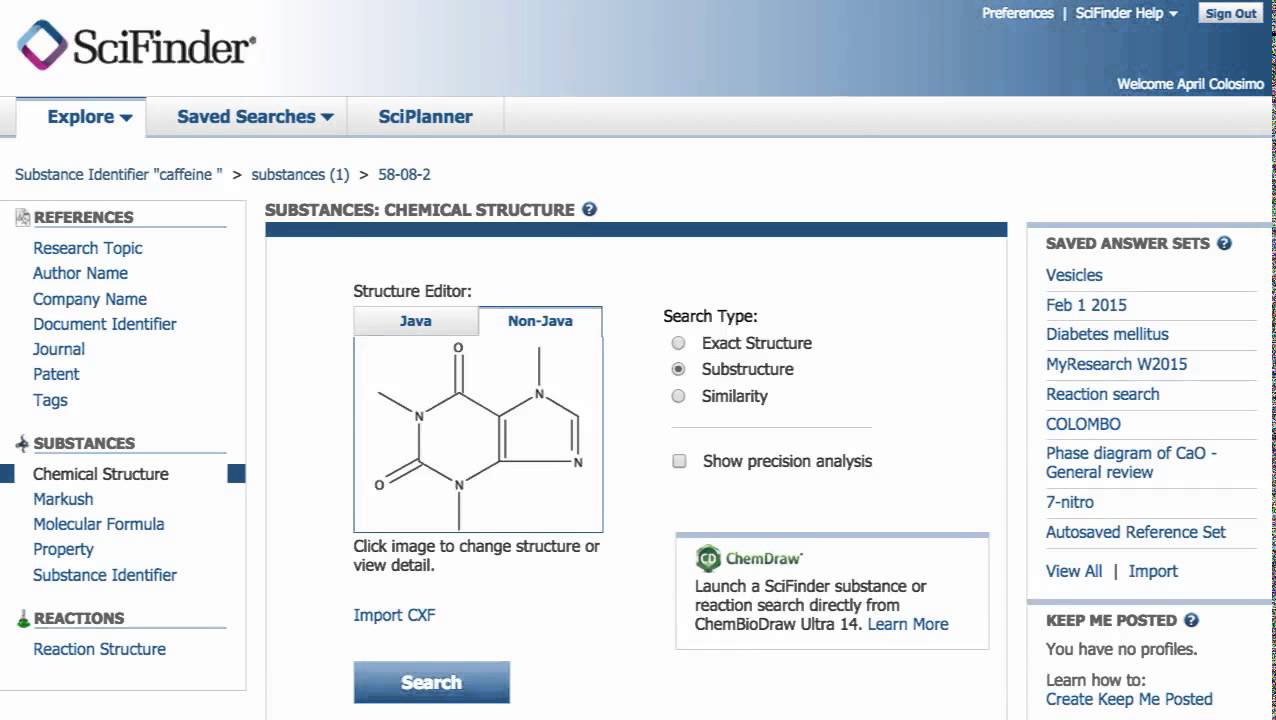
If we are looking for a substance and we know what the substance name is or maybe that we know the CAS Registry Number then of course it's very easy to cover and select "Substances" and then enter that name or that CAS Registry Number in the box and then click on "Search". However, if you don't know the name or maybe the name is very complex and it would be difficult to type that in, then the other option that we can consider is of course to draw our structure. And to search for a substance by its structure, we need "Substances" selected, and then we can come over to the far right of the query box or search box and then click on "Drw".
This will open up the CAS Drw window. We have our drawing space right here and on the left and on the right-hand side, we have two panels that will allow us to create a structure. Now to give you a basic orientation of the main functionality of the CAS Drw window, then first of all we can see on the right-hand side we have at the top what we would see as the main atoms that you are likely to select in a search.
Now you will notice that under hydrogen and chlorine there's also a triangle in the corner. Under hydrogen, we find deuterium and tritium, and under chlorine, we find the other halogens: fluorine, bromine, and iodine. Now if there is an element that you need to use in your search that's not represented right here, what we can do is come over to the left-hand side and the third button down on the left is "Select an Atom to Drw".
When you click on that, that will open up the Atom Window and of course you can go and make your selection. So for example, if you're interested in alloys or inorganics or anything with a metal in it, then of course we can go and select the metals from within the Atoms Window. There's also the bonds that we can use the default is a single bond but there are also options to select a double bond, a triple bond, or the very useful and specified bond that will account for a bond to be either single or double or triple.
We have some main ring systems in the lower right-hand side for five-membered and six-membered rings, and then the final button right here allows us to select the number of carbons in your ring system, so that can be between three and 15. Over on the left-hand side, we have the pencil which allows us to draw bonds or ring systems freehand, the very important eraser of course if you're starting out with your structure search and you want to make any kind of corrections, then there's the eraser. We've already seen of course the Atom Window and then we also have the ET or what we call the Shortcut Menu.
So I can select a shortcut for let's say a methoxy or a trifluoromethyl and then we have "X" meaning variables so I can use these variables if perhaps at a position within my structure I want to allow for maybe any halogen or perhaps any metal or even for the cyclic systems where I want to allow for any heterocycle for example, and then out of more advanced level, we have what we call the "R Groups" that then will allow us to define what goes at a certain position and when we define our own R Group variables, we can select specific atoms but we can also include variables and also shortcuts. So to draw a fairly simple structure, I'm going to draw the structure of Favipiravir, which is an antiviral, I'm going to select my Cyclohexane ring, and I just drag it across and click and that will then release that. Now notice that where my cursor is it's still there as a Cyclohexane ring so whatever you select it stays at that unless you decide otherwise.
So if I want to go back to my single bonds I can of course come right here and click on "Single Bond" and then continue. Down in the lower left, it will tell you what it's going to draw at any position and because I opened up the R Groups a little bit earlier on, it thinks that that's what I want to do, but I'm going to enter in carbon there so I'm literally just going to type over that and then the default is now my single bond and my carbon. Another way to go back to the default of single bonds or carbons is to hit the space bar on your keyboard and that will also reset to the default.
Now I can use the Double Bond to create a double bond but also as the single bond already exists, if I click it a second time, it will change that to a double bond and likewise at this position as well. I'm going to put a single Bond at that position and then over here I'm going to do the same thing. Drw one there and then from there where you see the red circle means that you are at the end of the node and you are in the correct place to draw another Bond.
I'm also going to draw here a double bond and the same right here as well. I'm going to make some selections of atoms to put into my structure. First of all I'm going to select "Nitrogen" and drop that in at this position and also right here and even at the end right there and right here I'm going to put in "Oxygen".
Now of course I can select "Oxygen" from the palette or indeed if I go to my keyboard what I can do is just type in an 'O' for oxygen and that will also do the same thing. There are in fact a number of shortcuts that you can use and to find the information around the shortcuts, if you click on the question mark, that will give you the complete list of the keyboard shortcuts. I'm going to put in fluorine at this position and then also oxygen again right here, so I've drawn in my structure.
Now at this position it is actually NH2 in the structure but if I leave it as it is then it's going to assume that that would be hydrogen there. However, if you want to draw the hydrogens in, then of course that is absolutely fine if you want to explicitly draw them in or indeed the other option would be a come across to the shortcut menu and then you can go ahead and you can select "NH2" and position that right there as well. Notice when I do open the shortcuts and when I hover over any of these it will explain to me what it sees as that representation, so I see a structural image as well of the NH2 so that is how I can draw a fairly simple structure into the CAS Drw window.
Now I am using CAS Drw but there is in fact another draw option that you have and that is to use ChemDoodle, so if for example you have a touch screen device and you want to draw your structures using that, then you can certainly do that using ChemDoodle.