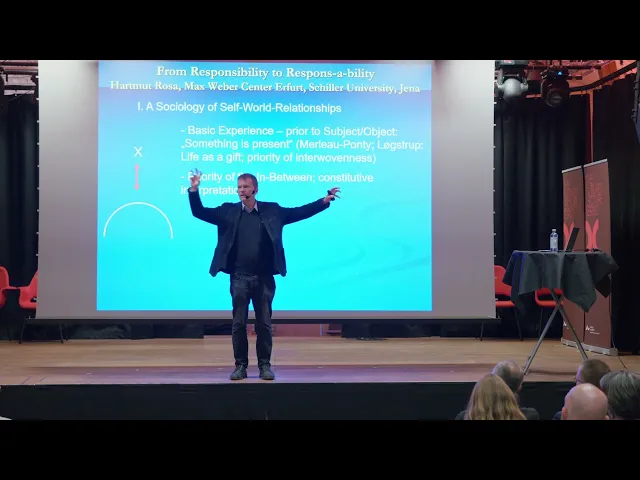
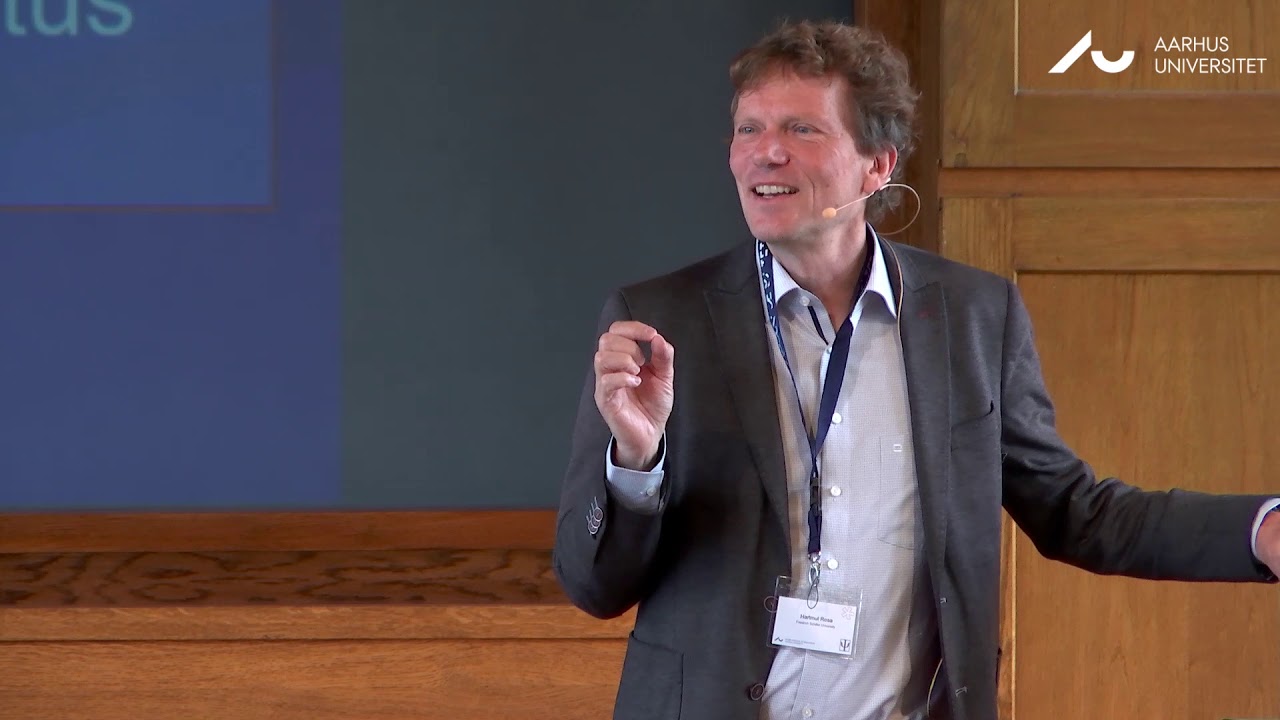
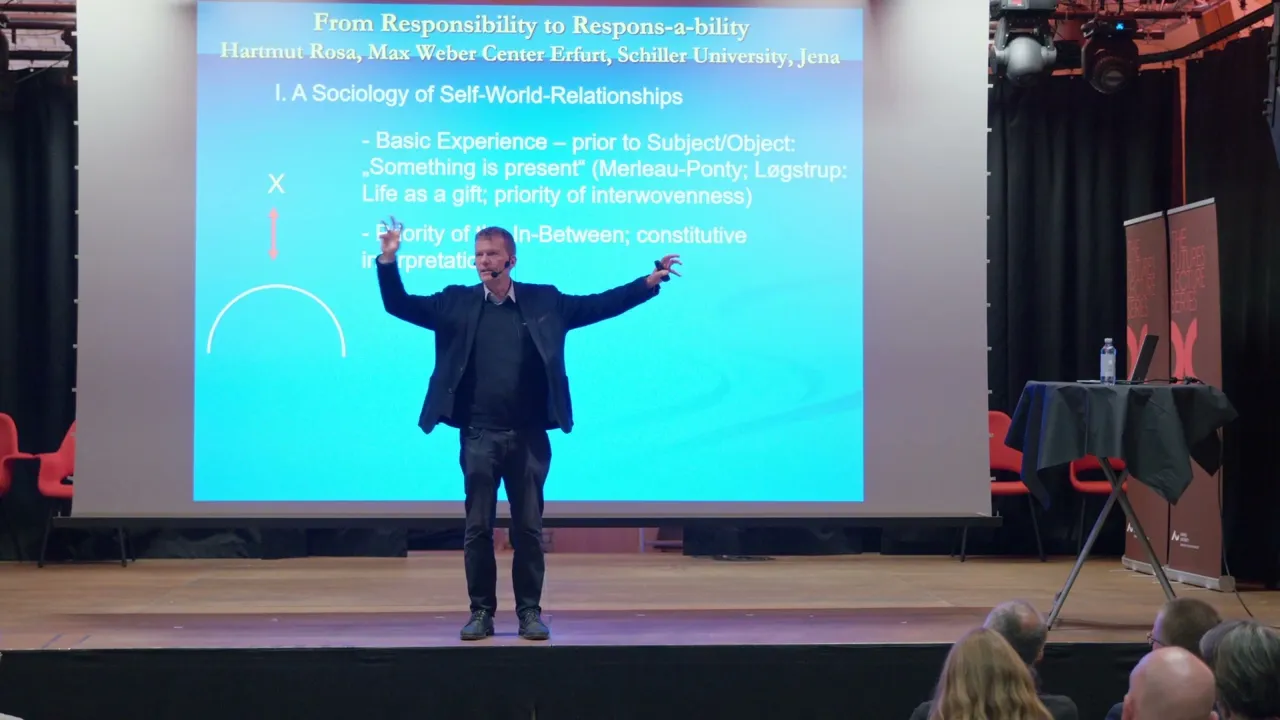
Good evening everyone on behalf of the faculty of Arts and the school of culture and Society it's a great pleasure for me to welcome you here I am Anne-Marie perus I'm bystein for research and I'm also a philosopher so I want to welcome you all to today's lecture by Professor Hartman Rosa who is Professor in general and theoretical sociology at the Patricia University in Indiana and also in charge of the advanced Institute at yina we have had the privilege of welcoming hardwood water several times here in office we just talked about you were here once
in the business of social sciences Department in 2013 but I also know that the publication alienation acceleration was actually it was published in at overusu University in 2010 so even before that yes so um through Professor Rosa's insights we are compelled to recognize the profound impact of modern society and capitalism on our lives roses comprehensive understanding of the Dynamics surrounding modern subjectivity draws inspiration from a synthesis of critical thought existentialism and hermeneutics the insightful and sensitive nuances in his understanding of our modern lives is something many of us draw on in our work our own
work across all the disciplines [Music] um at the University and outside the University so among the audience today I know that not only the PhD students that you have just talked to and met with earlier today they are here present is also many of our leading theologians psychologists philosophers anthropologists sociologists journalists and many more Here present is also the people who have translated your work introduced it to a Danish audience audience and many many readers of your work are here readers of the work on acceleration also to the very rich book on resonance from 2016.
the books on on Facebook and why democracy needs religion and also your work on pedagogy I also want to share with you the public some of the emailing With Hardware Rosa before today because I ask you whether you were open to the idea of going back to the love and sympathy the drat between people you talked about in an interview with a few years ago and um and and that interview you were asked about the relationship between resonance and love and whether and I also ask you whether you you would accept my invitation to Talk
about the philosophy of Love friendship parental love we talked about next in Lieber and also the erotic love and of course sympathy I also mentioned to you and maybe I I'm not the first thing to mention that to you but I also mentioned to you that I found some similarities between your thinking and the thinking of the Danish philosophy in theologian from 1955 which was integrated later on actually on only a year later in the Ethical demand as chapter seven so I also admit to you that there was I I did say that in this
chapter there were some quite white dragon or religious or metaphysical um ideas in that text but I also told you that there were some quite interesting filmological views on love and on loneliness and human it's a dependency you accepted to include Louis stop and I'm very grateful you did So I also promised you back then that there would be I would find some very good discussions I found two very good um professor in anthropology a lot of Minard and professor in philosophy Thomas facts so you will talk today about the your contributions to sociology and
maybe touch upon the concept of future even because it's cause a future lecture I don't know um it's a series of lectures where some Of I think some of the people you also draw Karen Barrett um have been here before you so um you will talk about love friendship and sympathy and even connectedness and thank you and so much for um I thank you so much for being here and I really look forward to to your uh welcome right thank you very much Anna Marie the powers for this very kind introduction and to you and
to you the dean and the department and the school and the university for inviting me again I I have a bit I have a bit mixed feelings because I think it's the sixth the sixth time I'm now in August and last uh yesterday when I arrived I I thought I I was in a hotel I had not been before and I thought well let's see what I can find my way around and I actually could so I was really proud it Feels a bit like coming home right so I really like Ojos but so that's
the good part but the other is that I'm a little scared and nervous because on the one hand there are so many people here right I think I could never live up to all the expectations and on the other hand as you just mentioned Barat and latua and all these people so I'm a little scared but I will do my very best the other part why I'm scared is because I have to deal with all of this right with love And with friendship and with Stroup and with resonance and with the future and I only
had 40 minutes but since I'm an expert on acceleration I think we will get I hope we can we can deal with this right so the idea is actually I want to um to uh to move in five in five it's five or six I forgot steps together with you right I want to very briefly outline what I what I tried to do overall I call it the social sociology We just talked about it in the master class it's very hard to translate it adequately into English right the sociology of self-world relationship you could say
or our relationship to the world then I will briefly present the resonance conception which which is at the core of how I would think about love and friendship and then I will really focus on love and friendship as two specific forms of relationship right Which I think of course they are really they are essentially forms of resonant relationships at least we think of them and we try to live them as forms of resonance and then I would I think I try to think first about the differences between the two and then about uh solidarity as
one other form which I think has to do with the Lewis group The ethical demand I think he says if I read him correctly I found it very interesting indeed to think about him And that the ethical Demand only becomes kind of relevant when natural love Fades or fails right so if if I'm in love with someone then actually you don't need an ethical demand but what if someone is in trouble or asks something of me whom I don't love right whom I rather don't want to have right this is when Society needs a form
of solidarity for example and be needed in social groups and in society at all so what about that I will try to think about it and then finish With a few considerations of forgiveness which is very interesting for what I try to do and for example of course also so let's start I mean I think I want to do a sociology which really starts from uh from the question of of relationship it's already something Louis Trope would would share right I think we have to understand that human beings are not just by their nature related
to each other and to the world or maybe by our nature we are related to each other and To the world but the way we enter into contact we we form relationships that always depends on um on on social conditions and and Society you could say nevertheless I think we could start with maurismo Ponte for example it's clearly a phenomenological approach right he says I find this very convincing right he says the first moment of consciousness of awareness either of a baby or when you wake up in the morning or when you Were unconscious right
there is a it's really interesting when you wake up or someone wakes you up in the middle of the night and then there is an awareness something is there something is present right the presence is the first moment right and this presence the sense of something is here goes before self-awareness oh it's me right you might actually have forgotten who you are but you know these rare moments where you don't really Quite know who you are and what the world is right and then it only develops the the the the the separation between the subject
and the object the me and the world is already kind of a second step right so the first question is uh something is present one could say this is the the first gift moment Lewisville talks about and now the interesting question for the sociologist is about the nature of this presence and the nature of this uh Relationship right I think this is clearly socially formed right whether the world which you encounter is threatening or dangerous or indifferent and cold or anticing and calling or so that depends on social context some prior experiences and so on
but what is important is that I would really claim and I think this is true brought that the relationship you could say the entanglement or the interwovenness comes before being a subject and an object so When I talk about self-world relations it's not that I think there is a self here and there's the world there and now let's see how the two interconnect but the two are already always already kind of interpenetrated and interwoven and it's out of the nature of connection that we develop a self and that the world takes shape outside right and
this and then you know Charles Taylor the Great Canadian philosopher Has a strong influence on me right and he he would say via interpretation all the way down and I think what he means is that the the this the relationship between us and the world is not given it's not but not at least not just biological but it's interpretation and we and it's uh so what so what I am as a subject and what the world is depends on processes individual and Collective processes of interpretation and therefore it's not Starting with a subject object dualism
in the Descartes sense right I'm not claiming there's the subject here in this at the object there there are many forms of inter penetration and what can be can become a subject on object forms out of this and I think our experience to the our being in the world has these two sides which we can distinguish namely an active side right I'm you wake up in the morning and there's a world and this Hasn't and and then you either you want to or you have to explore it to move into it to see what's there
or to get work done also so it has an active site you you approach the world but the world also approaches you you experience it right and it's quite interesting and social others see you can actually distinguish two kinds of people right so one kind of one one sort of people one one type starts really with the with the with the With the active part I want to see the world I want to explore the world right I want to move in the world right so the idea is I move the world is there but
others have the other experience right they would say you never know what the world has in store for you right what the world does to you so so so the Dynamics can start on either side but it's always a kind of dynamic um active and passive interpretation of self and world and what I'm looking for really Right now I think that's a part of the problem we have as a society that we can think of this relationship to life to the world only in either I do something I'm active I'm the doer or I am
the done to the victim something is done to me I throw or I am thrown we think really of life's even of social life of the world always along these lines either I do something or something is done to me while processes of life particularly in Society also very often you cannot really clearly say who is active and who is passive it's the in-between it's being partly active partly passive like in a dialogue or in a conversation in such a group but sometimes you cannot say it's my idea or it's your idea the idea comes
out of the in between right it's kind of circulating social energy that's what I want to work on next and we could actually call this Medio passive it comes from Linguistics right It's half active it's not just half passive it's also half active it's having having participating in the world so this is where I want to get it and the world of course can be the world of things of objects the social world of other people and the subjective world what I what I the experiences I have with myself now we're already at the second
no it's still no no it's there no it's still the first step yeah yesterday I changed it And I decided that this is still the first step right what is the main relationship we develop in our society that's the question the sociologists will ask right and in order to understand this I I use for quite some time we find it in the acceleration book no you find the idea in the acceleration book but the term you find in the resonance book we live in a society which is operates in a mode of dynamic stabilization which
means Don't have the time to explore it at length but it means that we permanently need to achieve growth economic economic growth you know the Danish government always wants growth the German governments wants grows the EU wants growth the Americans the Chinese the everyone right we need to grow not because people are hungry in Denmark or don't have enough clothes or don't have enough cars or don't have enough houses or so but because otherwise you cannot Maintain the system in the sense of the jobs the Health Care System the universities the pension schemes and so
on of course you also have people who are hungry and don't have homes but actually economic growth is not really for them because they can't afford to buy all these things right so we have to grow exactly in those segments at elements where we already have too much particularly too much for the environment so this is my kind of Critical diagnosis of present Society it has of course it has to do with the logic of capital circulation money commodity money Prime which means economic activity is only done money is invested for example you open the
shop let's say McDonald's invests money or whoever it might be right um in in in with the hope that they could get more money out of it right you invest something with a hope to make More money so the whole logic of capital investment of economic activity follows this logic investing something in order to get a prime a rent a profit some form of earnings however you a surplus value however you do it then you we would have to go into a economics which we don't do here but the but the logic is that the
system only that's the definition here stabilizes itself Society can only stay as it is stay as it is means keep our Institutions if we permanently accelerate innovate and grow now that means if for example you think that life is stressful right now I could really predict next year it will be more stressful right it's kind of it this is a kind of necessity it's been going on for 250 years right there will never be there's there's no limit to it it's never enough right we all the Technologies are kind of accelerating live communication transport and
so on And if you ask when is it enough or if you think of economic growth when do we when do we produce enough then the economists will tell you never we always need to grow okay so that's the logic of our social system right so and it leads to technological acceleration the acceleration of social change and the acceleration of the pace of life right you could really say it has an escalatory logic and you see the consequences of the S this escalatory Logic um everywhere there are also there's also talk about the great acceleration
in the 20th century right where you really see the use of resources and energy consumption and coal consumption and all of these things go up all the time but also the pollution and the emissions and so on right so it's a kind of escalatory tendency of um of our society but this is the structural side And it's connected to what I call the cultural side right we as the selves it's about self-world relations and ours told you something about my analysis of the of the structural side right of the institutional fabric but the selves in
this in such systems are driven on the One Hand by fear by the fear of losing out of not being fast enough but it's now done through parametric optimization right to Define parameters of your body of your mind of your everything and but Particularly also of your capacities and performances in shop right in University like oros there are lots of parameters how many students do you have how many research money do you make how many doctoral degrees do you give per year how many foreign investments do you have and so on lots of parameters and
we need to improve and work on all of of them incessantly other otherwise we fall back and we cannot maintain what we have so ourselves in this society and Organizations are driven by fear but also um but full there's a but but we are not just the victims of this institutional logic right we are also driven by the hope of extending expanding our Horizon of what we can make available or attainable or accessible in the world so I I call it well right so we permanently intend it's really interesting you use the word good think
Of when do you tell something oh that's really good my claim is we always use this term if someone tells you that his or her Horizon of availability attainability accessibility has grown right someone earns more money if someone has a faster internet access or a bigger house or a new degree or diploma or so it's always this logic of um increasing the Horizon of what we can make visible of what we can make controllable accessible usable and so on Okay and and now my claim is that this actually creates a mode of aggression on the
individual and on the collective side towards the world right a mode of struggle right people individuals in this society and and organizations are always in a kind of you could say combat mode in a mode of aggression right I mean you see it in on the individual side in the morning I always ask how do you get up in the morning not when you slept enough or When the sun comes up or when the crows but you're you're awoken by the alarm clock you're alarmed to the world and then you're confront the to-do list right
you're in a mode of aggression and his mode of aggression but it has a complementary side in the in the collective side our society right we are in a kind of science tries to peer deeper into the universe deep into matter and so on technology tries to get a better hold of everything the economy Is it a permanent mode of aggression so individually and collectively we are in a in a mode of aggression against the world the world becomes a series of points of aggression and I actually think lost group in in his um in
the ethical demand he distinguishes between two interpretations of the of life on the one hand at least two maybe maybe more but also of different forms of he's always wondering whether we are self-concerned right or this kind of Closure in yourself it reads sometimes a bit like Luther right the homo in corvatos in six so if some totally being immersed in oneself and then you are focused of course list would say even such a self clearly has relations but these relationships are then based on reciprocity and I would also say also on responsibility right it's
your responsibility to do something yet if I I do something for you if you do something for me in return so you only Invest in such a logic into a relationship we talk like this I invest into a relationship if it follows this logic of money commodity money Prime I invest in a friendship or I invest in love if I get something back right if it people sometimes talk like this if I lose has written a lot of fish right in parship also when you go to the internet and you try to find a partner
right people might actually say you know we are together and as long as As You Profit from it and I profit from it let's do it and if we don't profit anymore then we finish it right that's that that's exactly the mode of I would say it's the mode of aggression and it follows this logic of capital accumulation you could say I mean how what what kind of mode of life is this right it's really one where people have a mindset and I don't blame them where we all the time try to accumulate increase we
follow this logic Right we try to accumulate and and increase and the capital we have either in terms of money you have to make money with to secure money maybe you have to try to get more money that's economic capital but also health now Max Vemma says he quotes about um Benjamin Franklin remember that time is money right and of course people he says well don't sit just lazily around you could work and make money and then I I Thought well but in modern society most people young people for example are not so much concerned
about making money that's true but if even parents will tell them or they will tell themselves but remember that time is time is Health it's bodily Capital right you could do something for your health go for a walk go to the gym try mindfulness or something else right so I would really say if people are not obsessed with money they are very often obsessed with Their bodily capital and to the bodily capital or embodage Capital it's it's it not just Health it's also the good looks right try to have more muscles and I don't know
what else you could somehow get an operation to get away do away with the wrinkles also on so that's another form of capital then the body becomes really a field of aggression too and the logic is you accumulate bodily capital or embodied capital and you Might if you sit at home right and you're not working and you're not going to the gym you might think that time is social capital you could actually call your older colleagues and see where maybe he has got he's got a good job offer for you also right away I mean
Social Capital relationships are always a form of capital because as module reminds us right we can always draw on those we know whom we can call if we need or so Right so we are investing either in economic capital or in health in embodied capital or social capital or in cultural capital in the form of Education or in a symbiotic Capital trying to uh to improve on our recognition scale so that's the law that's one form of that's one form of leading a life and one form of forming relationships right the relationships then follow this
logic of accumulation and are basically driven by a mode of Aggression right and I think at the collective level are on all three levels my claim is that this is leading to a huge problem why we need the ethical demand and maybe Lewis drop because in the end in this way we realize a form of life a collective form of life in Denmark and in Germany and the EU which we can Define as a mode of aggression on three levels on the macro level we are in aggression towards nature right you see it with the
Extractive industries we have to have more and more even Alaska is no longer sure and so on and maybe we need Mars and the moon right to extract things increasing the Horizon of availability attainability accessibility and and thereby we polluted and we heat it up I really want to look at the energy I think my next book will be on social energy so circulating social energy but also on how social energy relates to psychic energy of course but also to the The physical energy we use up and I think we have an energy problem right
because heating up the climate actually means um we're burning it up it means even accelerating the atmosphere right so we burn up the atmosphere and we burn out from the inside on the micro level which comes here right it's interesting right we have a we have a heat problem down here and we have a heat problem up there and wherever you go in the world right now people tell you that we have Incredible mental health problems right there really there's a new study in Germany which says now it's but it's Way Beyond 40 we would
say they are close to burnout but when you look to the data on young people it's really really frightening right I think this is for me burnout is a consequence of the mode of aggression as are maybe the fact that the autoimmune deficiencies are increasing maybe even this is a sign of Auto aggression and I think we see Inc We definitely see there's empirical data which proves it increasing aggression on the social level between people for example politically right the Trump fans are ready to kill the the Liberals and and the other way around that
the brexiteers are ready to to kill the remainers and the Germany those who are in favor of vaccination those who are against it and so on and even in Brazil or in India you see this kind of polarization which Might now also take hold in Denmark and on the middle level and even War has come back to our society I've had this really threatening uh and frightening and frustrating right in the 21st century we are back to a situation where the plague the pandemics which is a form of the plague and at War are our
worst problems right those have always been the problems of mankind so actually I think we didn't move a step ahead since Since man came along on Earth but in in addition to these problems plague and War we also have the climate crisis and the nuclear threats so it doesn't look like we have made much progress with this form of life and this form of relationship so now interestingly along all these levels nature social relationships and even self-relationships we do have counter Concepts right we do have the idea of a different form of relationship and this
Is why I think we do not have to invent something new it's already there I think I've had this really interesting we have it on all forms right so when people think of love the modern conception of love is not enough for mode of aggression it's not in mode of capital accumulation all right it's a it's every it's really it's it's not that you want something through love the idea is that love is a pure form of relationship in itself right and it's the same with the Family ties right you don't want to capitalize on
your kids at least you shouldn't right I mean it's yeah it's quite interesting that we see that that it's not true that family ties and family relations are immune to the logic of aggression and accumulation they're very much infused and penetrated with it but our conceptions of how you should raise your children right and I think it's not just lip service it's true the ideas that you kind of that we relate to The children as a as a pure relationship you want to develop them right to give them their boys to see them grow independent
of making use of them of increasing your is your horizons never come back to this in a in a in in a second I mean I find this yeah I find this interesting when you watch Hollywood movies right you can really see it's always the same story I mean it's interesting to think about it sociologically why do they they only Have this one message Family Ties right it always comes back to the family ties right and the world is getting Bleaker and Bleaker and darker and darker it's full of thugs and Warlords and criminals and
everything is bad but there is the family so modern society really has it becomes true the family as this counterworld to the logic of accumulation and aggression right um and there's also there's there's an amazing amount of conceptions of Friendship as a counter sphere right true friendship I mean it's the modern notion of friendship is the same it's in the same sense right it's not putting each other to use it's not a kind of capital investment but it's a it's the antonym of instrumental relationship you might know the The Untouchables the the DVD or the
movie the film I mean right it even says the different approaches to mind the different forms of I I I would say A Band of Brothers or The world World Cup which is it's two other interesting books where you just can see that we have very vibrant in the live conceptions of true friendship what it means to have a true friend Sheila for example you might know Sheila The Pledge right he says friendship is the highest form of relationship in this world so we have other forms of intimate family relations and friendship but there's also
this idea of solidarity young people when they are frustrated I Mean there's so much anger in the world right and then they think what would you want to have different probably they wouldn't talk about love and friendship but about solidarity between human beings right this is still a strong conception that there should not be just competition but solidarity and I think solidarity clearly is a form of relationship that is beyond it's non-aggressive and it's not not in this actual relative logic right and we have This strong sense that our relationship to Nature is wrong right
so this is why sustainability is is such a has an attractive force in a deep environmentalism and things like that right a different form of relating to Nature not just using it you see it in animal protect action but also in people caring about the glaciers or about the forests it's a different sense of relating to Nature right and then we have things like mindfulness it's the Yearning for a different form of relating to ourselves not in the mode of aggression I have to to I have to become Slimmer and and and and and Tanner
and more athletic and I don't know anything else and I don't know what else but it's the idea of mindfulness a different form of relating to the self and with the self to the world right so what I want to say is that in all the Spheres which I just try to present to you as spheres of aggression we have counter Conceptions right there are different forms of relationship different forms of self-relationship different forms of social relationships different form of relationships to the environment and different forms of intimate relationships so and I think this what
I try try to present is two different forms of um of self-world relationships you find the Lewis troop as two conceptions of life or the two dominant conceptions of Life now I want to now of course you might you might already guess my idea is that we can actually we can we can kind of Define this other form of relating to the world as resonance what resonance is a different form of relating to the world it's by its very nature that's not so good is it just on my screen but I don't know but you
will deal with this I can actually go through resonance without Looking at it so it's a different form of a relationship which is not in its in in itself in any form um aggressive you know I mean you can if you look at it philosophically of course it's close to what Adorn on Hawkeye must say though this Modern Way of being in the world and to the world right is trying to get control to gain control make the world for fukpa in all its aspects right to dominate and to control and what I just Said
about these other forms of relationships they do not they by their very definition cannot ask for controller domination but resonance is a different form of relating to things to people and it has four elements and the first element is affection something speaks to me right all of a sudden you are touched by something it can be something you hear music for example or a talk it can be someone you meet right of course it can Be erotic attraction or whatever it can be erotic about someone you find interesting right or a child that comes up
to you also or even a cat that is is around your feet right all of a sudden you're touched by something something so the interesting thing is that for me resonance starts at least conceptually not with something I do but with something that has done to me something that affects me all of a sudden Bruno latuo has already given the Futures Series a future lecture a lecture in the future series he says hearing a call right you feel you feel called by something I think this is the crisis the psychological crisis of our time we
lost the capacity to hear a call right we think I have to do this I have to done that to do that there's this parameter and that parameter which I need to optimize and you never feel called by something right it starts with really It's you know it's a world relationship the world something some part is calling me so that's the first part of resonance and then the second is you answer it right you reach out to it you seek to connect to it I think that's also the core of building of Education what young
people are asking for this form of relationship man why do you come to such a lecture I really claim it's the hope for some form of resonance that something might happen it doesn't have To be me one of the other um the discussions or someone your neighbor says or some idea you get when you walk out or so right um but something that speaks to you right something that somehow affects you something that seems significant to you and the interesting part it only becomes a resonance when you answer it you do something with the idea
right it affects you you react to it and it might change you And by the way here the affection that you kind of feel affected because it's important to you of course that's that I think is what uh Lewis group tries to capture with natural love what he says we have to the people we love or our children right it's a kind of we naturally feel affected to them right and I but I think actually what I think in resonance course maybe Beyond Lewis group at least I didn't read it in in the parts I've
read is this kind of that It's a kind of double for me it's a kind of you know it's resonance is a movement it's a Dynamics which always has this two sides something moves in and something moves out that is what creates the Dynamics and this opposing what I call emotion from immobile moving outward has this sense of self-efficacy I have the capacity to reach out to the other right this is what Lewis group discusses when he says when I love someone I have the hope that I'm loved Back that I'm loved too but I
think there he controls kind of two I don't I'm not sure I think to I mean two equivalent Parts it's almost he says himself it's a form of reciprocity but I think it's a a process something going in and something moving out from both sides right I mean that's the that's the nature of resonance and it can of course it has a dialogical side we discussed that this morning buba writes on this in the ish two but seeing Right it's this form of something is moving inward is touching me it's moving me it's gripping me
right and I answer it I move out to it and if this happens I'm not staying the same right it's what people say when they make experiences strong experiences of resonance they would say after that I was a different person when you do biographical narrow in interviews this happens very often people tell their life and say something happened to me And after that I was a different person I was transformed right and but but then the fourth and the final point is what I call unfathite and this is why why resonance is a kind of
at odds with the modern logic of control of football because you cannot buy resonance you cannot bring it about you cannot engineer it you never know when it happens you go to such a talk but maybe there is no resonance you find it totally boring Rosa said all of this Already last year I will move to the new parts in a minute right and so so maybe there is no resonance it's the same you go to a museum you hope that one of the paintings will speak to you but maybe it doesn't or maybe you
go on a holiday trip you hope that you will really get into a new form of experience with nature with a different form of culture but maybe it's boring you find the same boring hotel which you've always found so so you Don't know whether it happens and what is worse if it happens you don't know what it is right maybe there is a new idea today which I have not heard before but you have no clue what it is and what it does to you and what the result will be right so resonance is essentially
unpredictable this is only important for me now I now I actually I will go over this very quickly I just claim that these forms of resonance can come in four X's or four Dimensions right one is resonance between human beings and this is where I will go next with love and friendship right as I've already said we think of a love relationship as a resonant relationship and a friendship as a resonant relationship and I believe that democracy only works if there is some Assumption of it I'll come back to it with a solidarity point right
but then we also have resonances with things with objects with objects of art But in fact also with the objects there is some no problem actually that's alienation right of the things so we but we have it with objects with objects we work on or with them for example if you're if actually I have a doctoral student working on drugs and the drug driver the truck drivers really develop a form of resonance with their cars right you have to listen to the engine you have to develop a feel for it you have to answer it
and so on So uh that's what I call the diagonal or material forms of um of the can I cannibal yo good and then I think there is a kind of what I call vertical or existential form of it's it's it's a connection of resonance to life or nature as a whole list group writes about this he is he uses really Life Trust in life for relationship to life and overall and there it can be something like you know the opposite of self Um objectification or verification when you do parametric optimization you you actually consider
yourself as as a as a couple of parameters as a whole sum of parameters and then you work on them then you're not in resonance right being in resonance with your soul your psyche or your body means listening and answering that's the mindfulness part right in this sense right so this is mindfulness sustainability um which actually I'll come back to that In a second and solidarity on this uh on on this uh count right so and and now as I always say resonance is not Harmony actually resonance requires and learns to obsess this very close
clearly he insists that we never feel what the other field the one we love for example right or we are in friends with it there is always there remains essential difference because I do not completely feel what you feel even if I'm in love with you there can be resonance between The two so we can only resonate with something that is other that is perceived as others so difference is a necessary requirement right it's I I claim it's not creating identity it's not creating Fusion right resonance lives on the fact that you encounter some other
which you accept as another as a difference but then you can Bridge the difference at the price of changing who you are right so I think we have Theories of identity and we have theories of difference and resonance is kind of Bridging the Gap temporarily at the price of changing who one is and by the way I find this uh this this quite interesting when uh Lewis group contemplates on loneliness um you can really see uh or at least my interpretation is that there are two forms of loneliness in German the language is quite nice
one is einzamkite Being einzam the other is right and and you know that what's the difference is I mean if you're isolated the bad form of of the iron's arm card right is being cut off from everything which means nothing resonates right I'm totally alone it's the empty list who talks about the story right it's the empty silent Universe world you live in a lion sign is the is is the opposite experience right he's an Indian and a psychoanalyst he Says there are moments of a line sign which is creates kind of erotic field between
the subject and the world it's like hundreds of threads which are calling you you feel in in a kind of resonance with the universe or with nature with life with your surroundings right so there are two forms of of of of connecting to the world so now let's look at love and friendship now I really as I already said I think That love is really defined along the four elements of resonance something affecting you and it's incomplete love if only I love someone but the other person does not love you back I mean right as
we know this is quite can be quite hurtful I would say it's incomplete resonance but if it's a real resonance right then it's the exactly consisting of those four elements it's not just that I'm deeply affected by someone I have the capacity to answer And to reach out and to actually touch the other two and this always has a transformative effect the art of love as from would say and of course uncontrollability is an essential feature of love if you can control the other love is dead but nevertheless people try to seek about it and
there's also a problem of looking for the partner through the Tinder or something right you want to have complete control about whom you meet right I think this Is kind of killing the uncontrollability requirement in love um okay and foreign of course we have this what he calls natural love the idea is that you develop a resonant relationship to your child you want to listen as closely as purely as possible and to answer with your own voice in order to allow this this child to develop right to uh to um to develop his forever voice
in a kind of constant dialogue with you right so We think of as I already said in Intimate Relationships as well as um relationship to children as forms of pure love right so love is our and and it's so hard to to uh to realize it to achieve it in a world that is running on parametric optimization and dynamic stabilization and it has a number of psychological preconditions and dispositions right you have to accept now well your vulnerability I mean as we all know falling in love means making Your yourself vulnerable in in many aspects
and respects right and uh this is why looks talks a lot about the necessity of trust right you have to kind of make a jump because as I said you know resonance the logic of our resonant relationship is you let yourself be affected and touched by something which you cannot control and this means you will be transformed in a way you cannot control and this is super risky and I would actually say in a in a Society in a social structures where you have to optimize and where you are in permanent competition it's an irrational
Behavior you should not actually enter into resonance but this is creates the tension of Modern Life right on the one hand our yearning for resonant relationships on the other hand are structural logic which actually says it's mad don't do it right it's also because you don't know the outcome of such a relationship and this is why People of first try to control whom they fall in love with you do this through Tinder and other things right and they say well it will only last as long as we both profit from it along the parameters that's
very difficult right and it's clear that if you are traumatized if you have made the experience that being touched is being hurt then you will not enter into such a relationship right so basic trust is a psychological and an existential requirement which is quite Difficult and as I said as we all know we cannot enforce love if no one loves you or you don't love anyone you cannot bring it about and certainly you cannot bring it about that you fall in love with that person because he he or she has the highest form of capital
for you that doesn't work at all right all right so this is why I like to talk about the guitar model of the self right itself is only capable of love If it's open enough to be touched or affected right but close enough to answer in his or her own voice right it's this tool it's it actually it's a dual um conditioner tool requirement being open enough and being close enough for being open enough for touched and being open enough to be transformed but being close enough uh to answer so you have to have the
capacity to let yourself be touched and you have To have enough trust and self-efficacy that you will be capable in answering and I really think there is a lack in this self-efficacy individually and socially right but a lot sometimes people ask me after I give a talk well what do I do if someone lacks the capacity of of of resonance right and I think it's not so much a lack in the capacity of being affected but it's a lack in the capacity of answering self-efficacy right when you you see it In Social discourse I mean
when people say if we let all the foreigners the migrants come to Denmark or Germany then we will be transformed where the thing is yes then Denmark will change but it's not just something that will happen to the Danes and they will be the big gyms right it's a process of transformation but you need to have self the Trust In self-efficacy we will be capable of answering and dealing with it and developing Okay and as I already said the relationship is essentially open-ended you don't know what the result is and when it will end in
these forms right but what I really find interesting you know I mean loving someone is very interesting is this active or passive think of it I love you is it active or passive of us we would say it's active because I do something but the sensation of Love is beyond my doing right it's Kind of I'm it's affection it's done to me so I would really say love is in itself is a kind of it's in between active and passive it's something that happens to me right this is why we say I was falling in
love right I was falling in love doesn't sound like something I'm actively doing right so love and and all forms of resonance right are already forms of Medio passivity it's like you listen to music I mean it is already interesting listening to music is that Active or passive again the grammator the grammatical form is active I listen but in fact you hear right something is calling you it's very hard to not listen to it I mean you could decide that I won't listen I will follow my own thoughts but listening to music is already is
also in a major passive voice right um something something is done to you something is you do so and and and this I found really interesting because looks list hope Really talks a lot about whether it's self regarding or other regarding we have in sociology and in economics of course all the time we have discussions about egoism or altruism might do do you do it for yourself or do you do it for others and I think the whole text of list for me this is a strongest sense can I do something against just press okay
okay fine um whatever So I think I I think I I always thought so too it's it's just wrong to ask it's in in love right do you do you love for yourself or for the other I mean of course you could say you do it for yourself but it's you'd when you love someone you are ready to do everything for this other person right so he says Lewis group says it's one act and I think this is really important when I prepared this lecture I realized it for the first time right that my idea
with The I was always fighting this idea of egoism and altruism right and because I thought well if you really you know if resonance works right it's kind of something going on between us and it's good for me and good for you and at least probably really is very good in explaining you don't think of it what do I gain what do you gain it's so stupid right I mean the good the good thing is is in the in between it's the interconnection and of course if if a Mother loves the child or father of
course parents love their children do they do it for themselves or do they do it for the children pass and he says it's stupid question right I mean they do it for themselves and for the children right because it's the relationship which is the which is the which is the good they are aiming at and I think this is really true for all forms of of resonance but you see it clearly in love the question is it's is Love self regarding or other regarding is a non-Christian right it's it's wrong and you know I mean
even I mean I do okay and when I do if I got sample when I do something even in a I do summer camps for highly talented I always come back to this example for highly talented uh students so it's about 100 students right and it all the time I think it's a kind of it's a result it's a resonance explosion that happens every summer right so if I ask Do it do I do it for me or do I do it for them I think that's a stupid question too right I mean I do
it because it's such a great experience for me and for them so so it's so um it's the media passivity and this overcoming of egoism versus altruism is important and and lyrics group says it's wrong to think it's not just an action where I gain something and you gain something and then we can see what I gain and what you gain but the gain is in the in Between it's the relationship itself right and there are other forms of this relationship but my favorite form is dancing I have to make it again even so I
think I did it last year here um when two people dance right you could say it's it's a kind of Medio passive in the sense it depends on what dance it is but it's a dance it's a Lindy hope I think which is a variation of Tango and the thing is that it's not always the man leading or not always the woman Leading it's a kind of in between and therefore you could say it's a media passive tense at one point the one person is leading at the other point the other person is leading but
the dance is at its best at the climax when you cannot tell who is leading it's as if the dance leads right what's going on but it's in between we know also we also know this from making music when people in oh no it's not true come on oh when I should already Done it okay I I swear I'll be done quickly so Hana Island so I really want to go to Anna art at this point because she says that's the moment of natality that's when the new is born right it's starting in the in
this interspace in the inter in in in the in between right and now the the the the point I really want to make is that for me resonance implies and ethics of care which is something we want to get at collectively why is this it's because When you're in resonance with something it this can be a person it can be a child it can be a the person you love but it can be a piece of music maybe I'm in resonance with Beethoven right let's assume this because in the other times it's clear when I'm
in resonance with Beethoven I somehow will not like it if Beethoven is played in the supermarket or in the elevator or so right I think no that's not doing Justice to to it right it's this sense of I want to kind Of preserve it in the in in its own voice in its own in a reality right resonance is you know it's the experience that something out there is really important it it's a source of value in itself it's not because I like it but it's really important it's like people want to preserve Ice Bears
or glaciers not because they are good resources for us that's what Lewis group says right but because it's the it's the feeling but it's important in itself Right and therefore you want to preserve it without being part analystic it's not I know what's good for you in ethics of care which is better analystic I know what's good for you that's not resonant right resonances I want to preserve the voice of the child of the person of the homeless whoever it is has in itself and as of itself right so you so if you're in resonance
something you will never hurt or destroy it it's kind of impossible because resonance is The experience of a source of value outside of yourself right and what what Charles Taylor calls a strong evaluation I mean I don't know how I managed to get up to to lose so much time I think it's basically it's the same with friends friendship has the same nature but there are a few differences right friend friendship for example you know for family is what we do do deal with in the everyday life while friends are in the non extra in
non- everyday life In the extraordinary moments where you go for a walk or so it's not institutionalized of course they can become Witnesses of allies particularly when when families break apart it's very important to have that right so you could actually say they gain in importance uh here it's interesting that there seems to be a there seems to be a limit to care we have for friends because you would not kind of care for their bodies when they fall sick while We do it uh while we do it with the with family members through it
but it's uh but and this I find interesting I just wrote a book on heavy metal and it's interesting a rock band is conceived as a resonance system right and yet there you see that resonance is not just Harmony right between Ian Gillen and Blackmore and John Law there was a kind of resonance going back and forth and it's what continentality the creativity was in the in the was in the in between Like between Paul McCartney and John Lennon or Roger Waters and Pink Floyd and it's interesting readers or Rock Fans they always care that
the band is preserved right that that even if members change it's a kind of it's a resonant Unity like in theology it's the Trinity which needs to be resident and so so I know it's all the same I'm sorry you will clearly have I will give whoever is interested I will give you the slides for this I'm I'm sorry I I spoke for so long but let me finish with this with solidarity I find this really interesting you could say okay okay resonance Theory might be good for having a friends and even a rock band
but what about the people of the other rock band right I don't like the other band because I compete with them or with the with the people I dislike the the migrants they should stay away right we have a great resonant Denmark or Germany Or whatever it is so the migrants should be away um so this is where I think Lewis too would say that's where the ethical demand counts but in my view and I think he has a similar idea if you do this all right I mean you could say the affection is missing
are not affected by the homeless person or by the by the uh by the migrant right but um so so that but so it would mean resonance does not imply you care for The others but my claim is if you look into the eyes of someone or you hear the voice of someone a living being right there is a kind of call emanating it's an idea you also find in adono Minima moralia all right it really means it's it sometimes it's literally someone calling out when you walk through hours right someone might say oh can
you share a dime all right can you give me some some food or so and then you really see how you have to Dispositionally close or no go away right or whatever you do whatever you do to strike him or her off you see it's a dispositional closure right and if as a society for example we say oh we don't care about the migrants they should stay away right then you really seeing the voice in the eyes in the in the hand in the gesture this kind of closure I call it dispositional closure so I
would really say the price of closing yourself off against the call of living beings It's true for animals too if you leave the industrial farming is closing our eyes and ears against the pain of the animals for example we can do this right we can make more profits right and get be cheaper meat and tasteful meat maybe but the price is closing off right to the to a living animal to to to to to part of life which is calling us and this as a society this closure to the call right this close closer to
affection comes at the price of our loss Of reasonability this is why I wanted what to say reasonability being capable I call it dispositional resonance individually and so socially that we are capable of being resonant beings in a resonant society means we need to be callable and able and willing to answer and this has something to do with attentiveness all right what are we attentive to what are we listening to this is why I think what we need to become is a listening Society right Right now we have this kind of closed angle attention you
could call it concentration on the parameters or this parameter and that parameter and a little better there and some more steps and a little more Mindful and so on which means we're kind of totally non-attentive to a calling World outside and we pay the price of becoming less and less callable and in that sense we lose our capacity to resonate which would be very Bad but now we have two discussions and all the open questions we can answer then thank you very much so sorry for being too long [Applause] thank you hello and Thomas please
come to uh the scene and bloody maybe first yes London is Professor of anthropology working on but you've worked quite a lot in Africa and the themes that you're working on this Um trust forgiveness also and time and temporality and the Thomas sweat Spencer is Professor in philosophy uh working on the philosophical anthropology existentialism or extensive philosophy and hermeneutics so um and you're also interested in forgiveness but particularly and I we have worked quite closely on Hannah Iran's concept of natality and forgiveness so I'm afraid we we cannot Miss that part um so please can
you begin say a few words about forgiving so it's still your kids yeah the the Forgiveness but I think you know residents because of its kind of essential own for football card right it as I said it makes us always vulnerable and in the interaction in the relationships we are always hurt right it's kind of impossible to not get hurt in this process right I mean there are Always moments of friction and some of those frictions hurt right and the the in our abnormal reaction to hurt is closure right so if someone's something hurts I
kind of try to to close against the the other and therefore I think the individuals as well as societies can only be remain resonant if they overcome this Pro process of of closure you actually see it in an argument which people have in love or friend or in friends right lovers or let's say lovers Or friends they they reach a point where they argue and then the argument gets somehow bitter and then there is this it's very interesting where you actually could see how you fall out of resonance because at first you're kind of deeply
you're arguing with arguing is not a problem right but at this point where it hurts and I say what did you just say you know what just off or something of this so I tried and that you're there you see the moment of closure and you Really see this in the eyes and in the face and you see it everywhere it's this kind of and you hear it in the voice right and in the words it's kind of now I no longer want to be in this open process of which I cannot control now I
want to control I want to dominate and actually I want to hurt at this point and the question is how can we overcome it and it's really interesting of course it requires a moment of forgiveness of starting a new and I find it I would Really like to do a phenomenology of it you can really see if two people are in a kind of hostile relationship trans hostile when it changes back you see it it starts with the eyes right the glance changes you see the openness comes back I'm ready to listen again to try
again right it's this it's a change in the voice it's a change in the death strategy it's a change in in the boys in the eyes and in the in in everything being ready to kind of make a cut and Start a new one this is what an R calls natality that we are not forced as human beings to Simply continue along chains of interaction which then get more and more bitter but to to make make a break and to get get this process started again and maybe what is restored is trust and trust is
the essential element I mean yeah I mean you know I I was in Holland recently and I gave talks on for feedback and there was a theologian who said he thinks the main problem of Society is that we lack trust and I think that's so true we lacked as Lewis trop says right trust in life but it really means trust in others for example even trust in our own body for example if I get a cut here right people have the tendency oh a doctor needs to look at it right I think this is already
a sign of I mean not trusting life not trusting others not trusting the body we don't even trust our breathing right I could pollute I could kill myself by Breathing I could I'm not against wearing masks I think it was definitely necessary at this time but it somehow has kind of materialized our distrusting world even the basic process of breathing in and breathing out could kill ourselves please I invite you in now Lord wow thank you very much well um I think I'd like to start with a with a question that does not follow on
the the Forgiveness thing but um about time and temporality and I thought there were certain signs on the computer saying risk of burnout or update uh the battery is slow so I think we need to take that seriously and just slowly no but um I thought I would give you a little break by telling a story of how I I got to know your work students had told me read this book this is very important I looked at it and I thought I don't have time for that yes you know Who has time to read
sick academic books these days and then the corona epidemic happened and we all had to leave universities I went to our summer house with the family with our dog Sat by the fire ocean was there and there was suddenly time to read through big books and engage and this is it is that precondition of having time that I want to discuss with you because you on the first page of your book you Say acceleration is the problem you show us also here but then resonance is though the solution and I think you do that very
convincingly but I'm just thinking Hmm isn't there something about the preconditions for resonance for love for those you know Deep Emotions and actions to actually happen that needs a kind of slow down and I know you don't want to be called the deceleration Guru but I am I'm also interested in why is why this fear of deceleration it's almost like uh societal fear that we don't we are we're so brainwashed with growth growth Pros more you know more Publications every year bigger grants every year we want more better um to a degree where we almost
cannot even think even you oh great brain here that's a digital I mean yeah I'm totally accelerated I Always said silver I said um no I I mean I I I I agree with this diagnosis right I think I think otherwise but I nevertheless have changed the diagnosis a bit because I would say acceleration is not perceived I mean it's not the structural problem right a faster internet connection is not per se bad it's bad when it goes together with the dynamic stabilization this need that you can only keep what you have through acceleration right
here So if the doctor comes faster in a case of emergency that's not the problem either and by the way it's very interesting boa out has exactly the same it brought out is to when everything is too slow right you sit in the workplace and nothing happens then you suffer the same problems at Bernard so I so I would say it's not just that speed is always bad and slowness is always good right that's what I what I necessarily what what I wanted to say but I and and I Wanted to say that slowness is
not an end in itself it's as you just said but slowness might be or deceleration might be a precondition for being capable of getting into resonance and I totally agree with this because I always say I mean the time pressure is resonance killer number one it's really true right I mean if I my my I always use the same example if I have to get catch the plane at the airport I may not listen to your argument right or listen to the music That comes from somewhere or watch this beautiful image I see I have
to become deaf literally to catch the plane at the airport and we are always catching the plane at the airport all the time right there is this to-do list I have to so I agree that uh that uh that it would help a lot to slow down right but it's not an end in itself and I would also say we cannot just slow down if you slow down in an acceleration Society you just pay the price right so we have to change the So social mode which is dynamic stabilization which we have to overcome right
but we are also I mean you write about this yourself that we are at a point of planetary burnout yes Democratic burnout Auto burnout so many people suffer from from burnout and other kinds of stress related so there's just something about still being stuck in this cycle of course then we have to jump to a whole other area of Resonance and love and the economists will be happy with us because then we can we can run and race and laugh more and feel more solidarity but we're still running yeah no that's the huge danger I
mean this is not how it works but I mean it cannot work this way I totally agree with you I mean I agree with this kind of burnout and it has to do with the Futures by the way I did not talk about that but I really think we are we are approaching a state of collective Burnout the society is in a state of Bernard not just because of ecological reasons and you can actually see it One symptom of it's it's really interesting it's on an individual level depression and burnout there are very close right
and you can really describe that in them as Chrono pathologies right it's it's a it's a it's a disease of our sense of time and when you're in the depression you lose the sense of moving towards the future a meaningful future And even of having a a meaningful past you kind of disconnected your your kind of suffocating in temporarily and I think this is exactly what we have as a society we are no longer see a meaningful future we want to move to right and there is no there is no conception of the future which
we want to have I mean there is the climate disaster there's the war there is the plague there is the economic breakdown lots of apocalyptic images but for quite Some time we lost the future we want to move to and I think right now we're also losing the past because we realize the past is not uh the the enlightenment story of progress right at least not just it's also the story of of colonialism racism sexism and other things so this is really kind of we have lost this temporal sense connecting to the past and connecting
to the Future so what we need at this point is really what the German word says right to stop Really means listen up right I mean it's interesting the German word Alfred is quite nice really I mean most of you understand that right it means literally to stop no it no it means it means to stop but literally it means everyone is listening right and auf is upward right stop for a moment it I would say become callable again so so yeah in that sense I I would go for us for a stop and for
a break yeah I think we have the same word in Danish I like this let yourself be called but I'm also very glad that you mentioned this and you talked about it the the Mental Health crisis yeah um and and and also I'm wondering if we can connect that prices with the global care crisis and migration not that you talked about I mean in Denmark in the global North generally I think we we really do see uh you know serious mental health crisis and we're realizing now That we need to invest in it but it
it seems almost too late because the money is being you know given them but there aren't enough nurses there aren't enough hands to help on the other side of the globe Global South we have quite a lot of people with time lots of time and Care capacities we don't want to let them in um there's something about the balance in the world regarding this that seems uh And and and I think it's quite interesting that you mentioned this film The Untouchables yeah with you know uh white men in France who's been taken care of by
a black man from Senegal Noir somewhere which I think in a in a way create some hope for the scenarios we might see in the future if we want to yep I totally I totally agree about the care crisis I I would agree it has the same Route like the mental health prices and it's a loss of this it's it's a loss of the resonance capacity right be caring for someone means I mean I really this has been really important for me I have a doctoral dissertation also kind of be written right about a KR
and resonance right but but I really think the the the decisive point is this this attentiveness Right Care has a lot to do with and Tiffany's fried being capable of of Of perceiving the Care needed by the others but of course the answer cannot be I mean on the one hand I mean for the shortage of Labor power of course I would say immigration seems to be a good solution but you know the problem with the care chains then the then for example the women are taking care of white old men and they are missing
in their own so so that certainly will not be the complete solution and there right I think my hope really is I mean the the Other point you you raised quite rightly right is how do we we cannot leave the society as it is and just create individual Oasis of resonance right I have my this is exactly what we try to do right I have my Oasis of my family as a safe haven right or my friends which I cherish and and and and relieve the structure attacked on there are enough studies which prove this
this does not work right it doesn't work it love if I lose it's really good to read but it Doesn't work with families either and we are really killing our young people and we with this we we we we we train them into this mode of aggression right which makes them incapable of resonating and therefore they have burned out that depression you know I fight the most telling example is really from South Korea and the other pressure is highest I would say from all we know right of it they are so hard-pressed for uh um
getting the high school diploma and Getting them a good uh High degrees and so on and then and for a number of reasons the pressure is really highest and they are not there are there is a kind of the the some of the young people really commit crimes to be imprisoned and they tell you and this is we really have to think of this they tell you only in prison I can really be free for a moment I mean think of this a bit so paradoxical but it's so easy to Understand right because in and
why is it because I mean of course is reduced at maximum that is the Horizon of what is available attainable accessible is almost zero and therefore for a moment you can free yourself from this kind of pressure right so we have to change the structures and this we cannot do individually and but I believe that resonance can be the yardstick because we know what a residence School looks like what residents in education Is we know what resonance in KR is we know what resonance in dealing with animals and plants is we know what resonance in
politics and even in the media is this is why I insisted in the beginning we have this sense of what it would mean to be to be in resonance right so I want to use the idea to reform our institutions but it's hard enough say more about that same one yeah maybe I also want to include Thomas here Resonance as a yardstick yes yeah thank you so much um that might link to to the very last remark I mean um I'm so impressed by by your ambition um in in resonance book and acceleration book coming
from philosophy you know um when he said philosophies then you were doing a perfect philosophical job in the sense that that You're telling what time it is um it's acceleration time stupid Bill Clinton would have said right so it's um it you really put um the nail on the top um but you're also not but and you're also add a normative Dimension to the to do to the notion of resonance and that's why Aina the way I now jump in with that Donald you mentioned him at the very last slide Escape kind of lifting sleeping
famously quote in Minima moralia um and instead of now developing another I don't know lecture something no I want to to tell a story um from Denmark um you know in 1996 um there was the eagle of hounding peace um right and he he he opened the tour of horse the first time ever a Danish Sportsman did this um and the whole country was in your theory was the diagonal sphere of resonance and you do it in the book with with the zoma mesh and I take it two times imagine Denmark right we won the
Tour of hops and and and people uh who who despite the differences had this fellow feeling the solidarity this togetherness this resonance with Bianna with us the yellow uh shirt And um he even got uh a celebration with the Prime Minister celebrating that this was by far the most impressive achievement an individual Affairs taken then rumors came up maybe he was still right maybe it was fake maybe and he said no it was oh at least I wasn't tested uh positive Ten Years Later he admitted I took all the and they get so he was
skeeted You know if resonance as you're writing in a strong reading in your book is the soul Criterion for a normative assessment of well-being and the resonant life then the Danes in 1996 were in the state of resonance at least as an experiential quality they believed to be so but now 10 years later I mean it it's difficult it's at least against my ethical intuitions the hence If resonance is the cartoon of evaluation for social cultural practices and life firms as such as with in the book also would would insist um I would like I
I I I cannot see it as more than just in quotation marks and necessary condition for will being not a sufficient condition because for instance as the example could show and in terms of love and solidarity I could also had framed the Example with the informal informants in in the DDR where even marriages is no in Eastern Germany years later you find out that the person you're in love with wasn't informal in I am from the Stasi right where somebody who who just told the authorities what you have done so the accomplish it shows or
wants to to to to ask you whether resonance is um It's these are two questions connected is resonance only a necessary condition um and if if it is only necessary what is the sufficient sufficient condition and here again coming from philosophy I would suggest something like justice or other ethical criteria at least as a as a fallible and and not substantial um the other thing is who is in charge to to assess if it is an experiential quality then the subject him or herself then the People in 96 were resonant or it is the social
expert the theorist of resonance who is capable of assessing life forms and structures also with the historical distance and assess them whether or not these really are genuinely resonant or not but then the notion of resonance loses its experiential character which was so strong in the first place and it was also so convincing by the way in in the acceleration book because you you with with both Concepts you try to to to To Gap or close the gap between micro and macro sociology between the the the actor age and perspective and the systemic perspective right
but but here I see a problem I don't convince me yeah I mean no I I I mean obviously I think this is a very important point and I think of course a lot of arguments are I can see the strength of your argument And the problem right but I I still have the hunch I want to try right to be kind of monomania I can claim no it's I would really still at least I would try right giving you the point maybe I'm totally wrong but I want to try to say no resonance is
the Criterion and actually alive in resonance I have a lot I have I mean what is a good life I would really say a good life is a life which is a kind of um able to establish and sustain axis of resonance in all four dimensions Socially materially existentially and in the cell free armored but then that is a good life and I don't don't I claim I do not need a additional criteria and let me let me take your your example right and the question would be with the other is right whom do we
claim resonance for right I mean so was there for a moment kind of resonance within the Danish people well maybe right with a sub I mean not for everyone of course not yeah yeah But that's the point many yeah that's the I mean that's the point right you you would in in forms of resonance you would never say for everyone you would just have to look at it you know my main my first answer really would be that I say resonance for me is not just subjective experience I always say resonance in the first place
is not an equality of the subject it's a form of relationship all right and I can actually measure or I can you probably I Can measure these relationships along the four criteria right so for example my my favorite example is if we too discuss right and I say after the discussion it was such a resonant conversation and you say it was the total opposite right he never listed once rise he just eating he never listened to my arguments he didn't even understand it right I think actually people could judge or if you could have a
camera we could see were the criteria Of resonance satisfied which means listening and responding taking out if the arguments being transformed by it right so I would because you all said who judges I think there is some in between right and not just the subject because I say it's all resonant right I'm might be wrong it wasn't resonant I was talking to myself right I was kind of convincing myself but no one has I never listened to you so I was wrong in my judgment I think that's possible that Doesn't necessarily mean that you or
someone else is in a better condition but it's possible Right to say that uh to to judge it from the outside you know what I mean I mean I mean it's it's possible to be self to lose to the death delusions about oneself even though it's hard to say someone else the expert can do it right and look I mean what is wrong with this Gianni Reese thing I mean what I mean I would say it's possible that for a certain segment of Society at least they got a kind of resonance in the sense of
listening and answering I react to it and then I go out to the street and I met people I'd never met before and we talked to each other and actually I learned things about my neighbor I had known I would say that's resonance right and it's not non-resonance because pianos was doped right so and I would actually I would ask you back what was wrong with the doping exactly yes yeah it's I think I Find this really interesting and because I would say the criteria you would then have to bring in right I don't think
it's Justice I mean maybe I'm not against Justice right but I would say of course I'm not against justice but but I really think there are two problems with doping one is the kind of self-instrumentalization what beyond the Reese does is non-resonant to his body he kind of it's an aggressive self-relationship the other is he's Lying to the others to his conceptors yes and the lying is a non-resonant relationship so what you criticize is the total lack of resonance between bianaris and you know lying is killing resonance and that's the same in this you know
to say I'm done in a second try the other example is very interesting you said in East Germany let's say two people I would say there are two possibilities if the one person only faked love right Then of course that's a crime then it wasn't resonant because because I only try to convince you you are so nice I love you and then I think that's not resonance because clearly it does not satisfy the four criteria right being but if they really were in love and the other person just wasn't I am which they didn't know
then it was still resonance I would say but would it then also be um a lie a good life I mean consider I mean that that's the Adano quote right Skip kindness let's say that that that those that the couple both of them sincerely love each other they are affected in love but still one is cheating to um on a different scalar of of very important venues um would we really mean that this life is is a good life I mean I don't know I mean I fight the I don't want to quote quite convincing
in a certain sense not in a complete sense I would really say but what you said what we said we live in a system of um uh of dynamic stabilization I see it in my life you all see it in your life right where all the time we have to make out of compromises between optimization and resonance all the time and I really I I even think I I can become a theologian too if when I sit in an examination in my office right I really think that's probably what the Christians mean with the original
sin Because there is a student in the front let's say in front of me and I think I know for this person if I now give him an A or her right it would really help him or her so much right it would really probably car but I don't know it let's dramatize it and say save her life but on the other hand I don't want to cheat on the criteria for an examination and on sociology so I cannot give her an age she didn't know anything right so I should give her a d so
I would say That's what it means there is no right there's no right in London wrong conditions I mean I think we permanently have to to live in that sense I think the the this I aim thing I mean it you know I don't know the problem I see is only just that's that um resonance is the soul that you've in the book you would all even use the monism of resonance at some point as the Socrates of the sole criteria now I have the answer I really think you know I insist on the sole
criteria because I think whenever you have the feeling there is something else I can really show know its resonance and now let's look at I think I was confused by your question because there are two questions one is is it still true love the other is is it a good life and I would say the the I am the the starsy person is not leading a good life because he in so many situations it's exactly closure right I Cannot really speak my voice and I cannot be honest with you and I have to be careful
against the transformation so I would say this is a kind of clearly damaged life so this I am person I mean if you have to fake your identity right to try to get information from others I mean you might not do it in the loving relationship but in others it's so clearly permanently violating the Logics of resonance that he is not having a good life but that does not I would have To know more about the relationship he's having with uh he or she is having my my intuition would be that oh this Strikes Back
to to the ignorant person who all through her life thought that she was engaged with a different person yeah and this kind of betrayal then uh backwards from historical experience and new knowledge okay okay re-evaluates what what I thought to be resonance so that there what what was experienced in T1 as resonance is not resonance any longer in T2 and that means that that you have to account for True resonance or um non-genuine or Faked resonance and hence we have we we are in need of more criteria half a Mass for instance would take uh
you know this sorry you know uh and and that would be three uh possibilities to to you know to tune the resonance Criterion to make it a really successful in my view Um uh yeah substitute for philosophical ethics yeah thank you um I'll bring blood in and then open for yes questions um not have a mass but very minored well thank you and I don't think I I'm not going to continue we already had a discussion about the dark side of the possible Dark Side of resonance that you are rejecting and um we might invite
you a little more often to always to Convince you that maybe maybe the maybe the theory would be even more strong if you could include this but my question foreign I'm an anthropologist I work in Africa um and so far most of your work and your thinking is receiving quite a lot of restaurants from from this quite audience here um I'm just wondering how is your work being received in the global South and Is this I mean sometimes acceleration is not exactly the problem there sometimes stagnation is a problem but is this a universal theory
for all of us um or is it something very specific historically maybe even you know a little bit romantic middle class Christian Europe yeah I know I mean let me say maybe one sentence on the dark side I mean you know I just want to fight I I really Think I mean why I mean there are lots of dark sides in our lives rather than in society right and there are a lot of dark sides connected to phenomena of resonance the only thing I I think is that that the criteria of judgment is itself resonance
right that the capacity to to to to to to to resonate I think I would exist on this well when it comes to the global south I mean it's quite funny I was invited to China I feel quite quite A time some time ago because they wanted me to speak about how they can accelerate development and other things and I thought well no that's not the right one but anyway but no but the fact is I mean I think I think I mean the fact is I think it's really true now now actually the the
acceleration stuff are best sellers in China because they suffer exactly the same problem right but I I would really say exactly the same problems and even And I was just in Brazil and you know invited by the psychiatrist conference they are Association they said they had their the Congress on mental health problems in accelerated crisis at times and they actually claim that it's worse in Brazil than in Europe because they do not have the welfare state or at least the remnants of a welfare state right kind of um and and by the way even in
Abidjan I got an invitation I was really surprised In the Ivory Coast right the French Institute had 14 lectures on resonance which is which is Africa right and I wanted to go there but it took too long I had to speed up okay um I I think it the probably the I mean the perception of the acceleration as a problem is a kind of middle class problem but it's a kind of almost globalized middle class problem but the two connected problems burn out right alienation and and Suffering from competition is something that that the underprivileged
know very much and very well and sense of resonance unclaimed everyone that has I mean that's really what distinguishes me from adono I think we have this sense of resonance which is a kind of true sense and he would say no it's just the wrong side of the wrong Society but I believe that forms of resonance ideas of resonance practices of residence you find all over the world And it connects quite interestingly with when we were conceptions in Latin America or with Chinese conception so so I'm quite hopeful and I'd like to know more about
Africa actually and I think also um you're working on the what makes sound into music and I imagine that the music that interests you is music from all over the world absolutely or because then it becomes interesting when when do people perceive sounds as a kind of Source of resonance you know but that's that's another lecture that's another lecture so we'll open up for questions