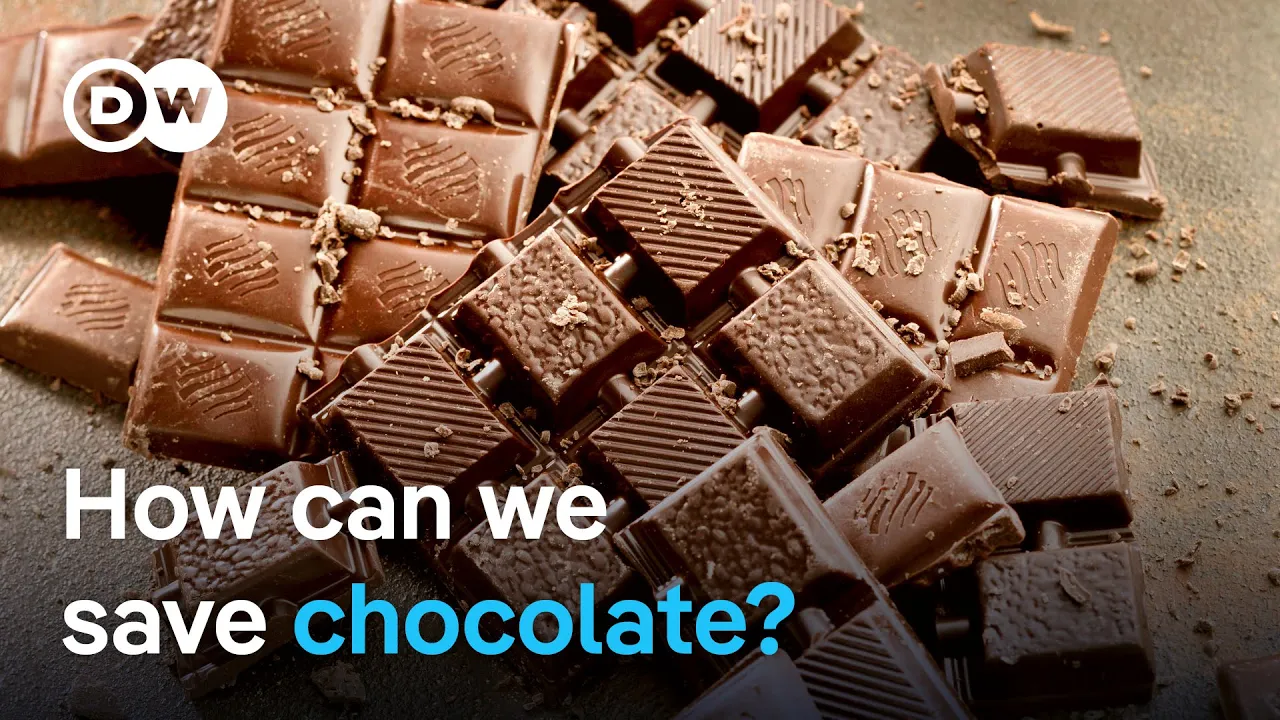
Chocolate! Irresistible chocolate! Who doesn't love it?
But while demand is growing, the threats to chocolate production are growing too. Chocolate is in danger because the way it is grown is imbalanced for people and the planet. The cocoa plant is more and more limited in resources and at risk.
Millions of smallholder farmers earn way too little and only a fraction of the entire cocoa fruit is used. These two entrepreneurs from Switzerland have taken it upon themselves to “save the chocolate! ” We'll show you how one of them gets more out of every cocoa pod - but first, let's talk about another innovation: chocolate grown in tanks.
That’s right. Christian Schaub's start-up Food Brewer makes cocoa - right here. The tanks contain water, sugar and nutrients - and an ever-multiplying cocoa cell culture.
But how does it work? Basically, you can take pieces of tissues and isolate it and give it the best nutritious environment and make them grow. They just remember that they are plant cells and they multiply easily when you provide the best conditions and here in Food Brewer we specialize in that.
We are providing the best conditions to the cells and they just basically multiply happily. At the end of the brewing process, liquid from the tank is dried and roasted: the result is cocoa powder. The technology's able to produce any type of cocoa - without large-scale cultivation or the logistics of transportation.
According to Christian Schaub, his chocolate is indistinguishable from the naturally grown kind. It is not unnatural. It's very natural.
So the cocoa we harvest from our process is real cocoa, real cells. They're delicious. They have, by the way, no contaminants, so no heavy metals.
They're good and free of contaminants, and I think this is even better than what you harvest traditionally from classic farms. But we want to find out what consumers think. We take to the streets of Switzerland, where citizens consume an average of nine kilograms of chocolate a year.
Would they buy chocolate from a lab? I guess how it’s made would matter a little bit, but more so, the flavor overall. The end product is what matters.
After the invention of milk chocolate in the 19th century, Switzerland became the home of the chocolatier. Soon, it became a hub for production. World-famous brands are still based here today.
The Swiss export their chocolate and pralines all over the world. Of course, cocoa beans don't grow in Switzerland. They're sourced mainly in West Africa - where around 70 percent of the world's cocoa grows.
Large areas of rainforest have been cleared. But crop failures and decreases in arable land due to global warming, not to mention the poor pay - are forcing many cocoa farmers out of business. That's where our second Swiss company comes in.
We can incentivize farmers to continue growing cocoa, and we disrupt actually the supply chain that it is a possibility for the future because it will not work in the future that small farmers work the way they did in the past. Anian Schreiber's company Koa produces juice and flakes from cocoa pulp. This adds natural sweetness and a fruity note to chocolate and other products.
To do this, the company buys what was previously considered waste: the pods and pulp. Traditionally, only the cocoa beans are used, while the pulp – here you see a close-up of the entire fruit, as well the husks are utilised, so it's a very small proportion. You've got in this entire fruit, you've got around 30 of these beans and that accounts maybe for 25 percent of the entire fruit, the rest as of today cannot be used.
Food Brewer is convinced the future of chocolate isn't in the pod, but rather the tank. They hope to produce 50,000 times more cocoa on the same area - for a fraction of the cost. But the technology is yet to be approved.
The product is very good today, so the only thing we have to do now: We have to make it available, we have to scale it. We have to make sure we produce enough of this delicious chocolate, and it will be sold. I think the bottle neck is not the market.
I think the market demand is bigger than what we currently supply. However, if we talk about real chocolate with the full indulgence we want to have I think there's still a case why we should continue using farmed cocoa beans, and if we do that, then we should do it in a sustainable way. What do you think?
Could innovation save our beloved chocolate? And is brewed chocolate the real thing? Let us know in the comments below.