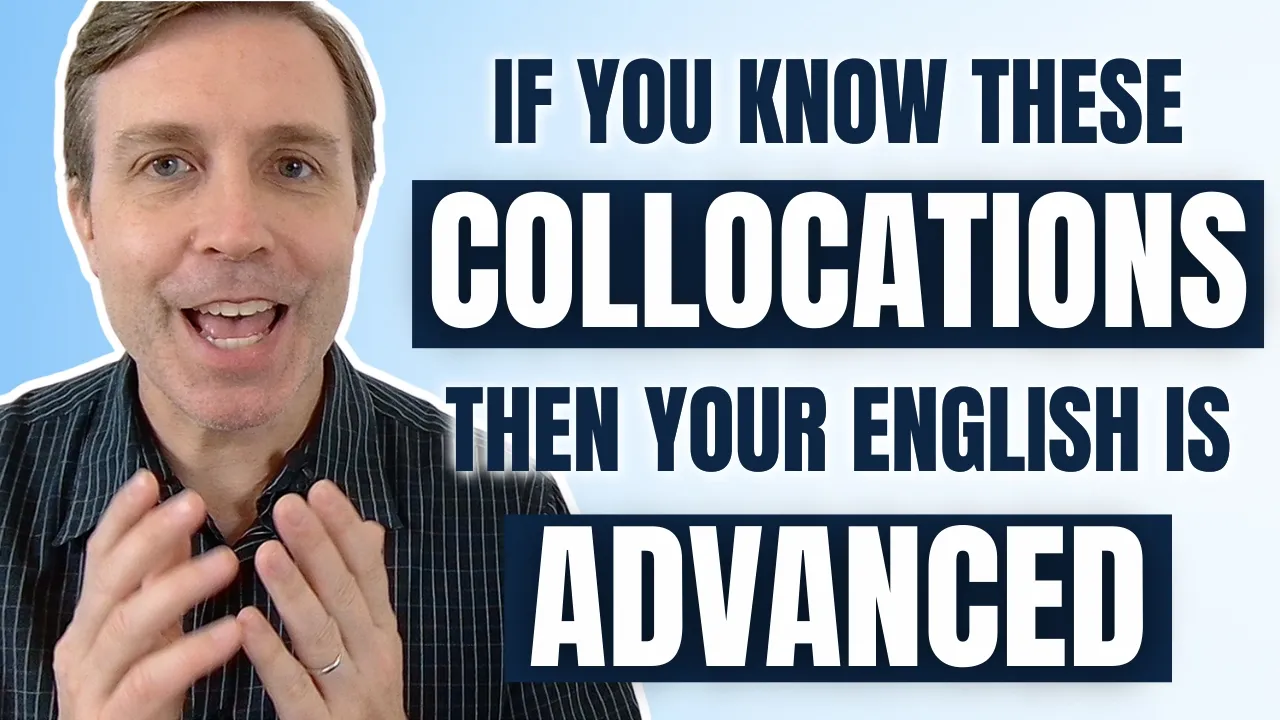
Today, I want to help you supercharge your vocabulary by teaching you many different collocations, which are words that are frequently used together. And the phrases that I'm going to teach you today are really at a B2 to C2 level. So, if you are able to use them in conversation, it's just going to help you sound a lot more natural.
And if you are someone who wants your vocabulary to take off like a rocket, please subscribe, turn on notifications. That way, I can become your teacher. My name is Wes.
The channel is Interactive English. It's all about helping you reach your fluency goals. Let's begin at a B2 level.
These are phrases that I think are pretty common. Upper intermediate essentials. And we'll start with the word crucial.
This is an adjective that means extremely important or necessary. And some phrases with this word include a crucial factor or crucial element or crucial evidence or even a crucial role. And in this case, you may even use it with the verb play.
Say saying saying that someone plays a crucial role in something. She played a crucial role in the negotiations. The other thing that I'll point out is that these phrases may be followed with the preposition in like in the example that I just gave you.
But to give you another example, I could say the weather was a crucial factor in our decision. And then finally, if I want to give you one more phrase, this time with an adverb, and I want to add emphasis, I could say that something is absolutely crucial. And I say it like that just to add that emphasis because I think that it is absolutely crucial that you learn these phrases.
Try to use them because it is going to help you develop your overall fluency. >> It plays a crucial role in the lives of many animals, including these small fiddler crabs. And I realize I left one crucial element in the bedroom.
>> Yes, I I didn't want to frighten the girls, but it is absolutely crucial you keep your true identities under wraps. >> The next set of collocations are with the word terms. This is a noun that refers to conditions in an agreement or the way something is expressed.
So you may hear somebody talk about favorable terms. And in that case, it's a good thing if you have favorable terms or with a verb to dictate terms. and you're trying to control the situation whenever you dictate terms.
A very common phrase would be terms and conditions. I think that everybody, you and me, we should always read the terms and conditions. You could say that someone is on friendly terms with someone.
And the phrase on friendly terms would really refer to a relationship. >> My ex-husband and I had been divorced for 5 years, but we were on friendly terms and we kept in touch. You could even replace the word friendly with good.
You're on good terms. Or if you want to say the opposite, hey, we are not on good terms. And then we could use it in the phrase in terms of something when referring to a particular subject.
Maybe I ask you about your job and you say in terms of salary. The job is great, but the hours are really long. The Tyrells are our only true rivals in terms of resources and we need them on our side.
>> Wrongly. This is an adverb that means in a way that is not correct or not fair. And we're going to follow this with some different adjectives and because of the meaning they these phrases really have a negative connotation.
Like if you say someone was wrongly accused, he was wrongly accused of the crime. Or maybe someone is wrongly convicted or wrongly imprisoned or wrongly informed or even wrongly mistaken. >> Sorry, you were wrongfully imprisoned, Simpson.
>> I don't know. I guess I hoped you were another cop wrongly convicted of crimes you didn't commit. >> We are wrongly accused just because the feds say it.
>> Now, let's look at some collocations with the word academic. This is an adjective that really refers to things relating to schools, colleges, or universities. And I think quite often you will hear people talk about someone's academic achievement or academic performance.
We could use it with the phrase academic purposes. The library's resources are intended for academic purposes. Time-wise, you will definitely hear people talk about the academic year.
And you could also use it with academic rigor. And in this case, the phrase really refers to high standards. The course is known for its academic rigor.
and I wouldn't want to jeopardize the academic performance of a weaker student. >> We invite you to return as an instructor for the 1954 1955 academic year. >> This perfectly encapsulates what's wrong with higher education, privileging athletic and alumni contributions over academic rigor.
>> And then there's the word temper. This is a noun that refers to the tendency to become angry easily. And there are some common verbs that you could use with this noun.
Most commonly just to say that someone has a temper, to have a temper. You could also use it with lose, to lose your temper. Please do not lose your temper.
And in that case, I might also tell you to control your temper. You could use it with that verb as well, to control your temper. If I want to use it with some adjectives, I could say that someone has a short temper and they just get angry very quickly.
Or if I want to emphasize just how severe someone's temper is, I could say they have a vile temper. I think it's good to avoid people that have a vile temper. >> You won't lose your temper, will you?
Promise me that they they won't make you angry. >> He has a long memory and a short temper. >> Would you keep that violent temper of yours under control?
>> Now, let's move into some C1 collocations. More a little more advanced fluency. And we'll start with the word ethnic.
This is an adjective relating to a population group with a common national or cultural tradition. And quite commonly, people may refer to an ethnic group or maybe they celebrate ethnic diversity or even refer to a group of people as an ethnic minority. You could ask about someone's ethnic background like where do they come from?
If we're talking about conflict, in that case, people may talk about ethnic tensions and there is some conflict going on. We're really at a crossroads. The impending environmental apocalypse juxtaposed with simmering ethnic tensions.
>> There's a difference, Daryl. You can't hate people because of their ethnic background. >> You do know uies are a real ethnic group that actually exists.
>> Then we have the word pose. This is a verb that means to present or cause something, especially a problem or difficulty. So, in general, these phrases are likely going to have more of a negative connotation.
If someone were to pose a threat or pose a danger or even pose a problem, you could say something poses a risk. Smoking poses a risk to your health. And then well this is not really negative but somebody could pose a question.
Often this is a little more formal if uh I were to pose a question and say what are the ethical implications of AI but I don't want to be very formal. That's not who I am. But I'm still going to pose a question to you right now.
Will you please go ahead and hit that like button if you're learning some new and useful phrases. For the first time in our history, humans pose a threat to our kind. >> Your honor, as you can see, my clients are elderly and infirm.
Any incarceration could pose a serious health risk. >> I'd like to pose a question that I'm sure is on everybody's mind here today. >> Immediate.
This is a great word. It's an adjective with a couple of different meanings. So, it could refer to someone or something that is close to or is a cause or effect of someone or something.
And with this meaning you could use it with the phrases immediate effect. You know what is the immediate effect of something or your immediate surroundings? >> The immediate effect of the war for Elizabeth is the same in one sense as so many other young people living in London.
>> It also means in the present like as soon as possible. And in that case you may hear somebody talk about an immediate response or immediate danger. I do not pose a threat, so you are not in immediate danger.
Or you could use it with the phrase immediate future. What is going to happen in your immediate future? >> Well, as long as you can keep your mouth shut for the rest of your life, you're in no immediate danger.
>> I won't tell. >> Tomorrow, my Spanish exams with Senor the unforgiving. My main concern is for my immediate future.
>> Then we have alternate. This is an adjective with a couple of different meanings. The first is to happen one after the other repeatedly.
And some very common collocations include alternate days or alternate weeks. That's really the time period we're going to use. We're not going to often use this adjective with minutes, hours, or years.
>> Colin was a good blow >> and you were happy with Celia. >> Alternate days. >> It also refers to a plan or method that can be used if you don't want to use another one.
And in that case, you may hear somebody talk about an alternate plan. Or maybe you're going somewhere and you're going to take an alternate route or you're trying to figure something out and somebody has an alternate explanation, >> right? But what if they don't?
You need an alternate plan. >> Traffic. >> Give me an alternate route.
>> Then there's the word insight. This is a noun that refers to a deep understanding of a person or thing. And you may often use it with some adjectives like valuable insight or fascinating insight.
You could also follow these phrases with the preposition into. I could say, "I hope these lessons provide valuable insight into some of the slight nuances in English. " When using it with verbs, you could gain insight or offer insight or say that something provides insight.
I used it in the previous example of these lessons, providing insight into those slight nuances. >> This is our one chance to peak behind the curtain and gain insight into young womanhood. >> What valuable insight did you glean as a result?
>> Well, I thought they could provide some insights that might improve your love life. >> Now, let's have a look at some C2 collocations, a real masterass. And we'll begin with the word abrupt.
This is an adjective that has a couple of different meanings, but most of the phrases really refer to something that is sudden and unexpected, often in an unpleasant way. So, someone may talk about an abrupt change, or maybe the car came to an abrupt halt, or maybe you're referring to someone's abrupt departure. And very commonly, you will use this word when talking about an abrupt end.
If this lesson came to an abrupt end, I'm sure you might be surprised and hopefully you'd be a little disappointed too because I still have more collocations that I want to teach you. >> And uh it was so well it was such an abrupt end. >> Godzilla just made an abrupt change direction.
He's moving very fast. >> This word also means using few words in a way that may seem rude. And a collocation that you may come across or you could even use when describing a person is abrupt manner.
So it does have a negative connotation. I could say her abrupt manner offended many people. >> I assumed you know working on Wall Street, curly dark hair, prominent nose, abrupt banner, and I'm sorry, am I still talking?
>> Then there's paramount. This is an adjective that means more important than anything else. And you could say that something is of paramount importance or of paramount concern.
Perhaps you want to talk about your paramount goal or your paramount interest. And if I want to use it with a verb, a common collocation is to remain paramount. In my opinion, the quality of these lessons must and will always remain paramount.
I can't leave by the furniture. >> Your safety is a paramount concern to us. the life and safety of King Joffrey be of paramount importance.
>> The next set of collocations are with the word invasion. This is a noun that has a couple of different meanings. The first refers to the act of entering a place in an unwanted or annoying way or or just by force.
So really, these phrases have a negative connotation. If I'm talking about an invasion of some group, I could say, "The small beach town experiences an invasion of tourists every summer. " If I say this, then that would imply that I just don't like the tourists being there.
I could add emphasis using the phrase massive invasion. if I were to say there is a massive invasion of tourists. And the other two phrases are more war conflict related if I'm talking about a full-scale invasion or an imminent invasion.
>> All of Gotham City is buzzing about an imminent invasion of flying sauces. >> Well, no. >> Tonsillitis adoiditis is in Chinese medical an invasion of heat and wind.
>> This word also refers to an action that affects someone's life in a a negative way. And a very common collocation is an invasion of privacy. So if someone were to try to look at your phone or check your emails or they're asking a lot of personal questions, you may feel like that is an invasion of privacy.
>> Holy pepperoni. >> Okay, this is an invasion of privacy. >> Remember you and then create ads for other stuff you might want to buy.
>> So it learns information about me. Seems like an invasion of privacy. >> Then there's toll.
This is a noun that has a couple of meanings. The first refers to the number of deaths or casualties. And in this case, you may hear people talk about the death toll or the human toll.
>> No word on casualties yet, but we can assume the death toll is catastrophic. >> It also refers to a heavy cost. And I could use it with an adjective like emotional.
There's an emotional toll on someone. And if I want to use it with a couple of verbs, I could say that something exacts a toll on someone. This is a little more formal.
I think most of the time people are going to use the verb take and say that something takes a toll on someone. If I want to put some of these together and give you a real example, sometimes I have to work over the weekends. I'd rather spend time with my family, but when that happens, it Yeah, I feel like it can take an emotional toll on me.
But, you know, I got to do it. Quality, quality remains paramount. >> The toll was visible.
The emotional toll that it was having on both of us, especially um especially my wife. >> Forgive him cuz there's nothing you can do about it. It's taking a toll on you.
>> Then there's undo. This is an adjective that refers to a level that is more than necessary, acceptable, or reasonable. And there are some common nouns that you can use with this word when talking about undue pressure or undue stress.
That's not a good thing. Or maybe somebody is getting undue attention. You could also talk about undue influence.
This phrase you might hear more in a legal context as well as undue hardship. The context might be more about finances but also legal. I could say this outrageous fine will cause undue hardship to the family.
>> Ma'am, you said that serving on this jury would cause undue hardship. Can you elaborate? >> Now, look, I'm not trying to put any undue pressure on you and Mario.
>> The statute requires proof that there was some undue influence. Someone threatening the residents of San Piper Crossings. >> I know I just gave you a lot of different phrases and and don't feel like you need to memorize them.
And I don't think you should try to memorize them. Try to learn and familiarize yourself with them passively and then slowly start using them actively. It's it's a all a process building your vocabulary.
Hopefully, you're using some of them already. If you enjoyed this lesson and learned something new, you can let me know by hitting that like button. As always, thank you so much for watching and I will see you next time.
So long.