[narrator] The mythical creatures of our nightmares and fairy tales are huge, magical, and often fearsome. But how is it that certain beings have appeared everywhere and at all times throughout the world? Is there perhaps an element of truth behind these myths?
Scientists are finding astonishing answers in their search for true monsters. Appearing from the haze of history as if from nowhere, the dragon is one of the best-known and oldest of all fabled creatures. All over the world the dragon is the main figure in sagas, fairy-tales and modern fantasy stories.
Sometimes it is a dangerous opponent, sometimes a powerful ally. [translation] There is no doubt that the dragon has always been one of mankind's oldest and most fanciful conceptions. Drgons appear in the myths of the Teutons and the Romans and in stories about the Christian saints.
Throughout East Asia, too. In China, Korea, and Japan, the dragon has always been a fabled creature. In the western world the most famous tale is that of Siegfried, the dragon slayer, in the Nibelungen saga.
The fearless hero faces the dragon alone. [sword swishes air] The roles are clear. The dragon represents evil, and it is the hero's duty to kill the beast to protect his country and its people.
[dragon roars] [screeches] The victor then acquires the strength of the vanquished. Siegfried bathes in the dragon's blood and becomes invulnerable. In the Siegfried saga the dragon is a huge, dangerous monster, a creature it takes a true hero to kill.
Whether we're talking about a saint's tale, like the one in which St. George slays the dragon with his lance, or in the Sylvester legend. In the Europe of the Middle Ages, the dragon was the personification of evil.
Even the Bible tells of a momentous struggle with a dragon. In the Book of Revelation the archangel Michael and his angels battle against the beast. The dragon is even compared with the Devil.
"And the great dragon was hurled down, that ancient serpent called the Devil, or Satan, who leads the whole world astray. " We mustn't forget that in the religious visual imagery of the Middle Ages the dragon symbolizes Hell itself. In church art, the gateway to Hell is portrayed as the gaping jaws of a dragon.
Ever since the ninth century there have been countless depictions of the gateway to Hell as the jaws of a dragon which menaces sinners with its sharp teeth, swallows them, drags them down into the depths, or envelops them in flames. But how did the dragon come to embody Satan and at the same time symbolize Hell itself where the souls of the damned languish? One possible explanation can be found in Iceland.
The unique nature of the world's biggest volcanic island has given rise to mysterious sagas. For the people of Iceland, mythical creatures are part of everyday life. Biologist Tryggvi Gunnarson has a workplace which literally conjures up dragon fantasies.
This region in the south of Iceland is known as Brennisteinsfjöll. The name means "Sulfur Mountains. " A monster could be lurking behind every rock.
But the Thrihnukagigur is something very special. Here, you can descend into the maw of Hell as a visitor. This volcano is not only the deepest vertical lava shaft on planet Earth, but it is also pretty much the only cinder cone, only lava chamber accessible to humans on the planet.
An open cable lift takes the visitor some 120 meters down to the bottom of the magma chamber. At the heart of this dormant volcano a unique world opens up that is as large as the interior of a cathedral. The once boiling lava has left behind rugged rock which in the light of the lamps shines red, gold, green, and violet.
The chamber smells of sulfur, like the breath of a dragon. [water drips] It's a perfect living room for a dragon with all this volcanic activity, these beautiful colors, and then the dragons eye here up on the wall. It's almost looking down and guarding its treasure.
Even the opening which lets in light seems like the eye of a massive creature which has its gaze fixed on the visitor. Caves have always been places of amazement. .
. but also of horror. In the minds of men, the danger became a sleeping beast which should on no account be awakened.
[translation] There are many caves and they are often dark and damp. Many have not been set foot in for thousands of years. And whatever is found in there is unbelievably strange.
At the same time, of course, from a more psychological point of view caves symbolize all our fears of the unknown. Thus, the dragon is often an image of what man fears. For Christians that is the Devil and Hell.
But the dragon myth is much older. In ancient Greek the word drakón means "to eye. " [screeches] At first the term was used to describe every large species of snake without poisonous fangs.
And anyone who has ever seen how a large snake devours its prey can well imagine that such a gigantic animal aroused primeval fears. The snake dragons of Uruk are among the earliest depictions of dragons. Created 5,000 years ago, the creatures have a long, serpentine neck and the body of a hoofed animal.
One theory is that early observers could not tell precisely that here a hunter was devouring its prey. So the two animals were depicted as one. Once the prey has been swallowed, the snake no longer looks quite so serpentine.
Many portrayals of the "draco-bipeds," the two-legged dragon, could have been based on a constrictor during the digestion process. The dragons of the East cannot deny their serpentine origin either. However, they tend to be found more in water than in caves.
In contrast to the dragons of the West, Asia's dragons are seen everywhere in all their splendor. There is no hero wanting to slay them! [translation] In East Asia, too, of course, there are dragons that are dangerous or can harm people.
Basically, though, the relationship towards dragons is one of respect and, occasionally, of reverence. People simply try to get this powerful creature on their side. As early as the third century BC, a Chinese scholar by the name of Wang Fu described the dragon as a hybrid creature made up of nine animals.
It has the antlers of a stag, the head of a horse, the eyes of a hare, the belly of a mussel, the scales of a carp, the talons of an eagle and the soles of a lion. The characteristics of these animals are also found in the dragon. The Chinese emperor ruled over many peoples and the dragon became the symbol of his power.
He even saw himself as the descendant of a divine dragon. That is why the seat from which he ruled his vast realm was known as the Drgon Throne. [translation] In ancient empires one of the imputed qualities of the ruler was that he was able to control the weather, which is, of course, of vital importance to agriculture.
Moreover, in China the change of the seasons was also directly attributed to imperial rituals. And in these rituals which affected the seasons, a dragon, or various dragons, was very often addressed because it, or they, prevailed directly over the elements. Thus, the Nine-Drgon Wall near the Forbidden City in Beijing depicts several dragons rising out of the ocean together to conjure up wind and rain.
Drgons are also regarded as masters of the monsoon which is both a blessing and a threat for the people of Asia. Not only the absence of rain but also an over-abundance of it can be disastrous for agriculture. Even today dragons are an integral part of the townscape in modern Asian cities.
The dragon long since progressed from the bringer of rain, to fill people's bellies and make them happy, to a general symbol of good fortune. Consequently, the Chinese New Year is always celebrated under the sign of the dragon. If he is honored he will bring good fortune for another year.
Even today the dragon of the East does not need any wings in order to fly. Yet in the West dragons developed powerful wings very early on. But where exactly does this concept of a winged dragon come from?
The first documented evidence of snakes that could fly is found in a report written in 450 BC by the well-travelled Greek scholar Herodotus. Every spring, apparently, the Egyptian city of Buto was attacked by fearsome flying serpents. The defenders of the town managed to kill the beasts in large numbers.
Later, based on his report these drawings of the flying reptiles were created. He traveled to Egypt himself to investigate this story. And he spoke to priests in Egypt who took him to a valley in the desert and showed him heaps upon heaps of skeletons of flying serpents.
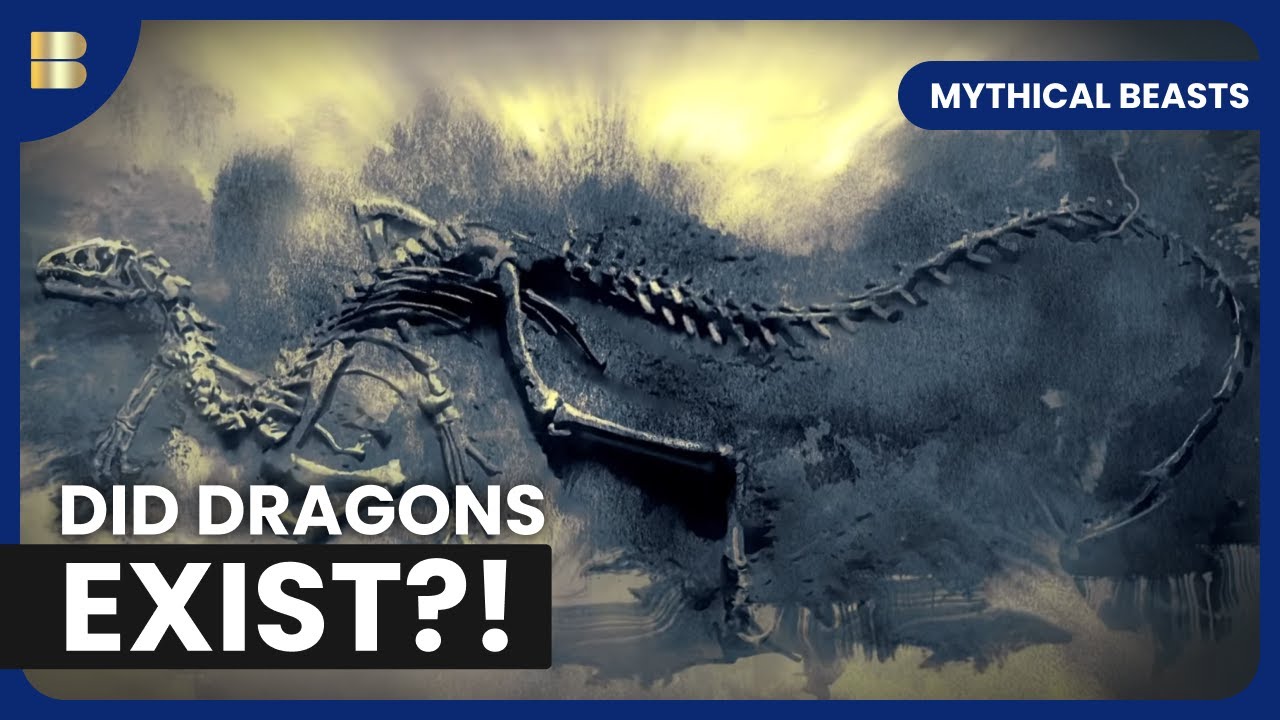
We don't know what he really saw. It sounds like it was a fossil bed of some sort, heaped up with fossilized skeletons that were unrecognizable to the people of Egypt and so they identified them as flying serpents. Paleontologists now working in Egypt have discovered a lot of fossils of dinosaurs, flying reptiles.
It's tempting to think that perhaps Herodotus saw something like that. For a long time scientists saw no link between dragons and fossil finds. The earliest reports of dragons and corresponding works of art came from the Mediterranean region.
However, there was no evidence of fossils of flying saurians being found there. It is only of late that science has begun to focus on North Africa. One particular surprise was the discovery that during the Cretaceous Period, about a hundred million years ago, the Sahara was populated not only by land-dwelling dinosaurs but also by dinosaurs that could fly.
With a wingspan of five meters, the flying dinosaurs of the Sahara were of an impressive size. So how did people in classical times react to the discovery of such large bones? And what sort of a creature did they imagine when the bones of flying dinosaurs mixed with those of other species?
If you imagine you're a farmer in the time of Homer, 8th century BC, you're plowing your field, you plow up a thigh bone, a femur you can recognize it because it's a femur, a thigh bone, you measure it against yourself and it's taller than you are. You don't just throw that aside, you try to explain it. Fossils like that demanded explanation.
The Greeks and Romans were very excited whenever they found evidence of what they believed were heroic figures or giants or monsters that populated their land in the golden age of myth. They collected these fossils and they brought them to temples and labeled them as perhaps a monster. [narrator] This Corinthian painted vase from the 6th century BC indicates the Greeks' love of fossils.
It shows Herakles fighting the sea monster Keto. But here, Keto is portrayed not as a dragon or a snake, as was customary, but as a huge fossilized skull. But fossils don't explain everything.
Why do so many dragons spit fire and leave death and destruction in their wake? In the Arab world of the Middle Ages the dragon was a common astronomical and astrological symbol. Written around AD 1000, the Book of the Images of the Fixed Stars presents, for the first time, the concept of a giant snake inhabiting the heavens where it causes solar and lunar eclipses.
It is also said to be responsible for the appearance of comets. In Christian Europe even celestial bodies were interpreted as dragons. In 1533 a shower of meteorites came down over Bohemia and the Vogtland.
A chronicler wrote, "dragons flew in swarms and wore golden crowns. " From Iceland to Indonesia, from China to the Mediterranean, it is above all volcanoes that have served as impressive models for a fire-breathing dragon. [explosion] Many ancient peoples tried to explain puzzling natural phenomena like a violent geological upheaval, like earthquakes and seismic activity, volcanos, floods by attributing those activities to monsters.
Especially monsters that were buried in the earth. [volcano rumbles] But if these regions are so dangerous, why do humans still settle in the immediate vicinity of volcanoes? The answer: fertile farmland.
. . and gold.
Volcanos are effectively like conveyor belts. They can bring gold to the surface. The magmas that feed the volcano are enriched in gold.
And then n the magma chamber there is a water phase and the gold dissolves in that water. And that water then moves to the surface. As it moves to the surface it cools and you form veins that contain gold.
If we look at the distribution of the most productive mines worldwide, we notice that they are all located in regions that are seismically highly active. So a volcano is something of a conveyor belt for gold. A lucrative volcano can contain up to 1,300 tons of gold.
And it is here that we find the original motive for killing a dragon: its hoard of gold. The early hero, you see, was no savior of the world. He was a thief who had his mind mainly on one thing: seizing the dragon's treasure.
Herakles, the Greek hero, used cunning to steal the golden apples of the Hesperides which were guarded by Ladon, a serpent-like dragon with a hundred heads. In the original Nordic saga, even Siegfried killed the dragon Fafnir for its treasure. It was only in the Song of the Nibelungs that he slew the beast to free the land from the plague.
The dragon Fafnir was defending a large hoard of gold treasure and that's a very common motif about dragons around the world. Drgons or serpents or monsters of some sort often are defending treasure, especially gold. Some scholars have suggested that perhaps the Scythian goldmining prospectors wanted to protect their gold from strangers and invaders and so they devised the story of fierce griffins that would attack anyone who came near the gold.
It's an intriguing theory. Wherever a volcano is smoldering, gold in plenty is to be had. [dragon roars] It is likely that early prospectors made up tales of terrifying dragons just to protect their mines from thieves.
[roars] Many mythical creatures are frightening. From a modern point of view, however, a hoofed animal with a horn is particularly popular. Anyone hearing the word unicorn today certainly doesn't associate it with a monster.
A unicorn is regarded as a beautiful, extremely rare, and exceedingly pure creature. But what exactly is behind this dazzling appearance? After all, no-one, it is said, is allowed to approach a unicorn, apart from a virgin: someone who is just as pure as the creature itself.
So for a virgin, an encounter with a unicorn holds no perils. But anyone else gets speared by its horn or they die when they touch it. So is the unicorn, after all, a fabled creature with a dark side?
[translation] A unicorn, of course, isn't just a horse; it has a pointed weapon on its head. This fact can be incorporated into a fairy-tale along bogeyman lines: if you're not a good person, if you are not pure inside the unicorn will come and it will know. And then you'll be in real trouble!
It's the same as with the bogeyman who is waiting outside except that aura of the unicorn makes it even more horrific, of course. [trumpets play fanfare] At all events, in the Middle Ages the unicorn's aggressive side also made it appealing in the field of chivalry. It appears in various coats of arms as the symbol of courage and strength.
. . and is usually depicted as a wild animal with a dangerous horn as a weapon.
The origins of the unicorn myth are obscure. For a long time, the oryx was seen as a possible source. Seen from the side these shy animals are identical with many depictions of unicorns.
An early report about a unicorn comes from the Roman commander Julius Caesar. This is how he describes it in his famous De Bello Gallico. "There is an ox in the shape of a stag between whose ears a horn rises from the middle of the forehead higher and straighter than those horns which are known to us.
It was also thought that artists' imagination had been stirred by the animals portrayed on the Ishtar Gate in Babylon: only one of the two horns can be seen. But today that is regarded as less than likely. [Simek] Naturally, we do not know for certain where the unicorn myth originated.
Today, simplifying theories for instance that the unicorn stems from profile depictions of bulls in the region around Babylon are actually rejected. The trend is more to the belief that such fabled creatures have existed for an extremely long time in the Near and Middle East. Yet even the first Indian images of unicorns are reminiscent of bulls.
In the course of time, the unicorn changed its shape. Sometimes it resembled a horse. Then it looked like a donkey.
Here a virgin is catching a unicorn that is scarcely bigger than a goat. The fact that in medieval tradition a unicorn can only be caught by a virgin goes back to a positive Christian interpretation: just as Christ could only be born through Mary, a pure maid, a unicorn can only be caught by a virgin. For Christians, the unicorn became a symbol of the power of God.
In the Middle Ages agreement had to be reached on whether a unicorn could be caught at all, because magical powers were attributed to the animal, especially its horn. Hildegard von Bingen was also convinced that a unicorn had healing powers. The abbess became famous for her drawings of certain treatment methods.
And it was she who founded folk medicine. The methods were revealed to her in visions in which she recognized the healing powers of plants, stones. .
. and the unicorn. "Prepare an ointment from the liver of the unicorn," she advised, "and it will heal all leprosy.
" Or, "make shoes from its hide and you will always have healthy legs and feet, because its hide is imbued with great potency and health-giving properties. " [birds tweet] It was mainly the rich and powerful who were interested in the magical powers of unicorn horn. Right up until the late Middle Ages unicorn horn fetched up to 20 times its weight in gold.
My Lord, I have come straight to your court from the land of the unicorns! Unicorns? Nilcorns might now be more appropriate.
The reason for its popularity was that the horn of the unicorn was said to have healing powers and, in some magical way, could even identify poison in beverages by causing them to foam. Magical drinking horns! Thus, many a hated ruler hoped to extend his life through the power of the unicorn.
The main traders for this precious product were the Vikings. Many alleged unicorn horns came, in fact, from narwhals. The spiral tusk of the male can reach a length of three meters and weigh ten kilograms.
The Vikings hunted narwhals in the Norwegian Sea on a large scale. From their ports and trade centers in the north they supplied the whole of Europe with the coveted commodity. From the 13th to the early 17th century they held a monopoly on unicorn articles which earned them handsome profits everywhere.
In time, of course, word got around that the horn came from aquatic creatures. But instead of querying such products, wishful thinking was aligned with reality: a unicorn swimming in the sea was simply a marine unicorn. As long as the poisoners remained inactive for fear of being discovered, the magical unicorn vessels continued to function.
[chokes] But if a murderer was hell-bent on eliminating an unpopular ruler even the magical horn sadly remained ineffectual. [chokes] For a long time, natural scientists took no interest in the unicorn. They regarded it is nothing more than a figment of the imagination.
Of late, however, their attention has focused more on the question of how the unicorn myth originated. Professor Andrei Shpansky from Tomsk University in Russia pays regular visits to the banks of the Irtysh in Kazakhstan. Time and again paleontologists have found the remains of primeval creatures in the region around the river.
For Professor Shpansky the Irtysh is both a blessing and a curse. [translation] The bones and remains of larger mammals are usually found in the alluvial sediment along the banks of rivers, often on the edge of clay or other deposits. The river collects the bones and carries them to beaches or sandbanks and quickly covers them with new sand.
In this way the bones are preserved. The excavation work calls for a willingness to take risks and for good timing. For most of the year the banks of the river are either frozen or covered by quicksand.
So only rarely does Andrey Shpansky have the opportunity to search for fossils here. The conditions are simple: one man, one trowel. This paleontologist is interested most of all in fossils of Kazakhstan's megafauna.
Here he has discovered the shoulder blade of a mammoth. But it wasn't Shpansky himself who made what he sees as the most important find. It is kept at the Natural History Museum in the Kazakh city of Pavlodar.
The remains of an elasmotherium. It was only Professor Shpansky who was able to identify which animal the skull with the mysterious frontal protuberance belonged to. The shape of the elasmotherium's skull differs from that of all other species of rhinoceros that have ever lived, back then and today.
As a rule, a rhinoceros has two horns, one on the nose and one on the forehead. Usually, these animals are collectively referred to as two-horned rhinoceroses. But the elasmotherium has only one protuberance in the middle of its skull from which a large, broad horn extended.
Seen in this light, the elasmotherium can most certainly be described as a unicorn. [snorting] The elasmotherium was one of the largest creatures in Ice Age Eurasia. Up to now, though, it has not been seen as a basis for the unicorn, because an encounter with man has simply been ruled out.
According to research, the elasmotherium died out around 350,000 years ago. [growls] The skull was discovered 30 years ago by a farmer in a village on the Irtysh. Other elasmotherium skulls have been found in Kazakhstan and in Russia.
But for Andrey Shpansky this one is something special. That is why he would have liked to examine other parts of the animal. But the rest of its bones were long since swept away by the river.
Initial paleontological examination of this skull showed that, basically, it is no different from previous finds. In its size and structure it is fairly similar. However, unlike other finds it is in strikingly good condition.
So we decided to have a radiocarbon analysis carried out to determine the age of the bone. The first bone analysis in 2016 indicated that the skull is possibly no more than 29,000 years old. [saw whirrs] This was such sensational news that in 2017 Shpansky decided to have the result confirmed by another laboratory.
If the sample was carbon-dated correctly, it is possible that stories surrounding the unicorn might have begun with the elasmotherium. [Shpansky] The young geological age of the elasmotherium indicates that the animal could have lived at the same time as Stone Age man. So it is quite possible that this co-existence gave rise to such legends.
Cave paintings, like those in Rouffignac, led scientists to assume some time ago that modern man might well have encountered the elasmotherium. In that case, so the theory goes, memories of the one-horned giant could have been handed down by word of mouth over many generations. In the past, however, no find had been made to support this theory.
Even the 2016 carbon-dating of Shpansky's elasmotherium sample is controversial. The laboratory said the amount of material provided was too small and possibly contaminated. Now, it is hoped, Sarah Talamo from the Max Planck Institute in Leipzig will shed some light on the darkness surrounding the origins of the unicorn.
She has often uncovered instances of incorrect dating. Radiocarbon-dating is a technique that dates organic material back to 50,000 years ago, and it is very sensible for contamination so we have to really avoid any modern carbon that goes into the sample. Natural materials at the site can contaminate a sample, and so can man, simply by removing, storing, and packing the find.
This contamination has to be removed if the age of a bone from pre- and early history is to be determined reliably. Here at the Max-Planck we are focusing on bone material and we have to extract collagen. So the first step is to demineralize the bone itself and then there are many different steps in order to extract just the pure collagen.
And one of the important steps if you want to avoid contamination is the ultrafiltration method. This collagen was then sent to the Archaeometry Center in Mannheim for radio-carbon analysis. The result was sobering.
For the elasmotherium we get back the results from Mannheim and the age is older than 49,000 years so we can not really say how old is this bone. [snorts] So even though the elasmotherium is a genuine original unicorn, it is unlikely to have been the source of any unicorn myth handed down by word of mouth. But perhaps the very appeal of this magical creature lies in the fact that we have no idea of its origins.
Monsters are not only a phenomenon of days gone by. They also originate in modern times. North-east Puerto Rico in 1995.
Like every morning, a farmer in the village of Canóvanas went to feed his goats. But when he entered the pen, not all of the animals in his herd came to greet him. [farmer calls goats] Concerned, he looked for those that were missing.
Raul! Who, or what, had killed his goats? Chupacabra, the "Goat-Sucker," is what the locals called the creature which, from then on, is purported to have killed hundreds of animals in quick succession.
The local press carried reports of horribly mutilated carcasses. And the fact that there was no blood to be seen alarmed even the local vet. Primarily, the injuries were small, puncture wounds about a centimeter in diameter.
Inside the carcass, there was a big depletion of blood. I don't know what type of animal could do that. Eyewitness reports varied greatly.
The only common factor was that the chupacabra was said to have exceptionally long fangs and sharp claws. [snarls] [TV plays quietly] In Puerto Rico fear spread. The farmers' herds are their livelihood.
[excited commentary on TV] The longer the monster caused havoc, the more horrific the tales about it became. When it stood upright, it was said to be the size of a human being. [turns TV off] [goat bleats] The story of the chupacabra could have remained a local penny dreadful.
[gunshots] [gunshot] But it didn't. Descriptions of the monster became more and more fantastic. Some people claimed to have seen a demon, some form of devil-incarnate, with naked skin, spines, and red eyes.
And since Puerto Rico lies right next to the notorious Bermuda Triangle, the Goat-Sucker also attracted the attention of people who otherwise focus on extra-terrestrial beings. Self-proclaimed ufologists claim to have seen unidentified flying objects around the Bermuda Triangle at irregular intervals. [translation] We believe the mutant that they created has reproduced and it has gotten out of control.
We have also identified a trend: that people see UFOs at the locations before mutilations happen. As the media hype spread, so did the chupacabra. Its hunting territory has long included large parts of South and Central America and the United States.
Like other monsters before it, the chupacabra had to serve as an explanation for puzzling phenomena. It became a projection screen for many people's fears. If I want to believe in a monster because it makes my world simpler for me, it is not a case of me being strange.
No, the monster really exists. It's just that the others can't see it. I'm completely normal.
The problem is the monster. And that is how such monsters spread digitally. The internet, then, is a breeding ground for modern horror stories, urban legends, as they are known.
Images of the "slender man", giant jellyfish, mysterious mermaids, and other peculiar beings and monsters circulate on the internet. And nothing becomes viral faster than a conspiracy theory. It can be proven that modern-day monsters were created on the internet.
We know exactly when, where, and by whom. Living on a remote farm in southern Texas is a woman who has played a major role in the spread of chupacabra hysteria. More than 91,000 entries in the net link her to the monster.
[windchimes tinkle] In 2007, Phyllis Canion was the first person to display the remains of an alleged chupacabra. It made her famous in the world of the internet. Now we are going to where I first saw the beast.
Whatever we call this animal. Phyllis knows the stories surrounding the chupacabra. When she found most of the chickens in her coup dead one morning, she was certain that the beast was responsible.
There he was, probably about 25-30 feet away from me. So, we made eye-contact. I wasn't afraid of him and he certainly didn't seem to be afraid of me.
At that point it's like, "Oh my gosh, what have I just seen. " Because I have never in all of my travels all over the world have I ever seen an animal that looked as strange as that animal looked. And it just walked off.
For Phyllis the hunt for the chupacabra became an obsession. So after I had about 15 chickens killed, in this same procedure where they drained all the blood out of them, I had somebody call me and say, "We'll make you a cage and see if we can trap it. " Back here was where we would put the chicken.
For months she tried to lure the chupacabra with bait, but in vain. We caught a possum, we caught a 'coon, we caught a skunk, we caught an armadillo. Anything you could imagine walked in.
. . but the chupacabra, I think, was too smart.
We tried for many, many months, so that we could capture DNA. In the end he unfortunately got hit by a vehicle on the highway in front of our ranch. That's how it came into my possession.
But is it the chupacabra? The description fits: very long fangs and claws, and grey, hairless skin. Phyllis had the cadaver stuffed.
Since then her life has revolved around it. So the mystery. .
. is what is it? While Phyllis has been trying to solve the puzzle, the chupacabra myth long since took on a life of its own.
. . [snarling] .
. . and with prominent assistance is travelling round the world.
[snarling] American actor Johnny Depp is well-known for scandals and escapades. And in an embarrassing situation, a modern monster like the chupacabra can really come in handy. This happened in Tokyo in 2015 when Depp was supposed to present a new film at a press conference.
But he failed to turn up. The assembled journalists waited in vain for the actor. [snarling] [snorting] The next day the Hollywood star gave a surprising explanation for his absence.
I was attacked yesterday morning. . .
[audience laughs] Um, by a. . .
very rarely seen or experienced animal called the chupacabra. [audio slows] Chupacabra. The story of Johnny Depp's fight with the chupacabra went viral.
[screams] I fought with it for hours. They're very persistent, very mean. [grunting] A perfect example of how in the age of the media a joke can give rise to a global conspiracy theory.
[pants] I threw him off the 23rd floor, so we'll never see him again. But, as with all monsters there is a hint of truth to the chupacabra, too. At the University of California in Davis, experts have analyzed DNA from Phyllis Canion's specimen.
The results of the maternal lineage test was that the DNA in the mitochondria was consistent with a coyote. And the results from the paternal lineage, the Y-chromosome, was interesting in that we had only seen the type of Y-chromosome that we saw in this case in a Mexican wolf. That is something that we don't see very often.
Those are relatively recently reintroduced in the midsection of America but to see a species identification on that sample was not unexpected. So the chupacabra is a kind of wolf-coyote hybrid. But why is the creature hairless?
And why has it got huge teeth and claws? Many of the animals that have been evaluated that are called chupacabras have been found to have sarcoptic mange, and sarcoptic mange is a tiny, tiny parasite that invades the skin and starts to basically chew and bite into the skin and it's incredibly itchy. So these animals are scratching, they are rubbing, they are licking, and they'll actually lick their hair off.
And then they get secondary infections which cause even more hair loss. And then as they continually lick and rub their skin a process occurs where the skin actually becomes thicker and more pigment develops. And so they become hyper-pigmented.
That's why these animals look like they have elephant skin. And this is what the true monster of this story looks like: the mange mite. Two hundred of these tiny parasites can infest a single hair follicle.
In the case of a sick animal, there can be millions of them. But why is the predator said to suck the blood out of its victims? Is that possible?
For an animal as large as the chupacabra has been described, it is not possible that he would live only on blood. He would have to live on other tissues. Unfortunately, it's difficult for most people, especially untrained people, to determine if an animal that had been killed is bloodless.
If there's no obvious there it doesn't mean there's no blood inside it. Most of the necropsies that have been done on the victims of chupacabras had actually not been bled out. A coyote normally hunts wild animals.
But when it has been as weakened by the mange as much this poor creature, it can only overcome penned-in farm animals. In this story it is the real victim. Every monster has its origin in a cultural, political, or medico-scientific phenomenon.
But to some people that knowledge is of no use. They believe that the monster truly exists and that there is a reasonable explanation for it. But establishing a connection between the two is really difficult.
Irrespective of whether we are talking about a dragon, a unicorn, or a chupacabra, over and above the sagas it is likely that the human mind has always been inspired by actual creatures. But it is only in our heads that they became monsters.