okay now the recording is going on then secondly I would ask you to please mute your mic if you are not speaking I think when the Pres when the presentation is over then you can open your mic and ask questions of course and then of course during the presentation feel free to write your questions remarks in the chat and then we will definitely discuss it after the presentation then I would like to give you um the advice some French speaking colleagues or guests might not understand English perfectly we do have a SIM simultaneously trans ation
I would like um I would like to ask you to check the PDF and um word attachment to this invit invitation and there you find precisely how you can listen to the French translation please all right um then I think I will hand over to Magnus for the opening words please magnos please the floor is yours yeah thank you Stefan dear ladies and gentlemen dear colleagues dear representatives from the multiactor Partnerships the business support facility for resilient agriculture value chains project is implemented by giset projects Agri business facility for Africa ins shorted ABF and also
from the market oriented value chains for chobs grow growth in the ecoas region project move on behalf of the German government of economic cooperation and development as the Min Federal Ministry of economic cooperation and development BM set and the department for international Partnership of the European commission and the organization of African Caribbean and Pacific States oecs under the Samoa agreement the project aims to develop and enhance the capacities of actors along agricultural value chains namely cashew cocoa livestock cattle sheep and goat and brackets and Maze uh the idea is to attract finance and investment towards
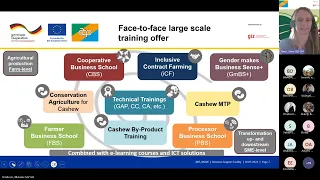
low emission and climate resilient practices in the ACP member states the project has three main components the first one is skills for Agri Business Development M we scale successful Agri bus training approaches and tools through face-to-face trainings um the second one is a competitive matching Grant fund we mobilize resources for implementation through introducing a financial instrument that facilitates private Investments and promotes the transformation Agri business and last but not least we have the sou sou exchange component we support knowledge sharing and Lear ing for for further scaling what we are doing now also with this
expert talks with this expert talks we want to bring a little bit of fresh air to the project we would like to address current issues relating to the promotion of Agriculture value chains and the same time also support the multi actors Partnerships that are supported by the matching Grant Fund in the implementation of their activities the motto for this expert talks is listen reflect and join in this discussion afterwards I would like to take the opportunity to refer to the third call of the matching Grant fund to support innovative ideas in the cashew Coco Maze
and livestock value chains the call will start next Monday 8 of July with a Readiness program to prepare applicants by means of webinars the deadline for for the submitting proposal is the 18th of August this year all information of the third call can be found on the following websites I have now or I will post now in the chat so you have the links where you can go and see uh if this is perhaps something where you would like to motivate your partners or you would also uh participate yourself so I wish the event good
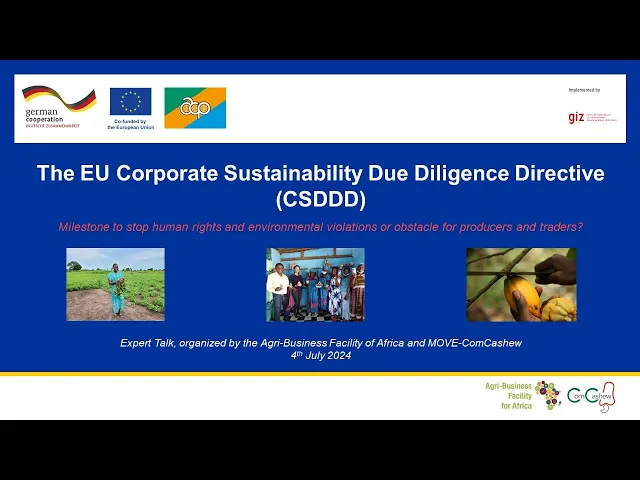
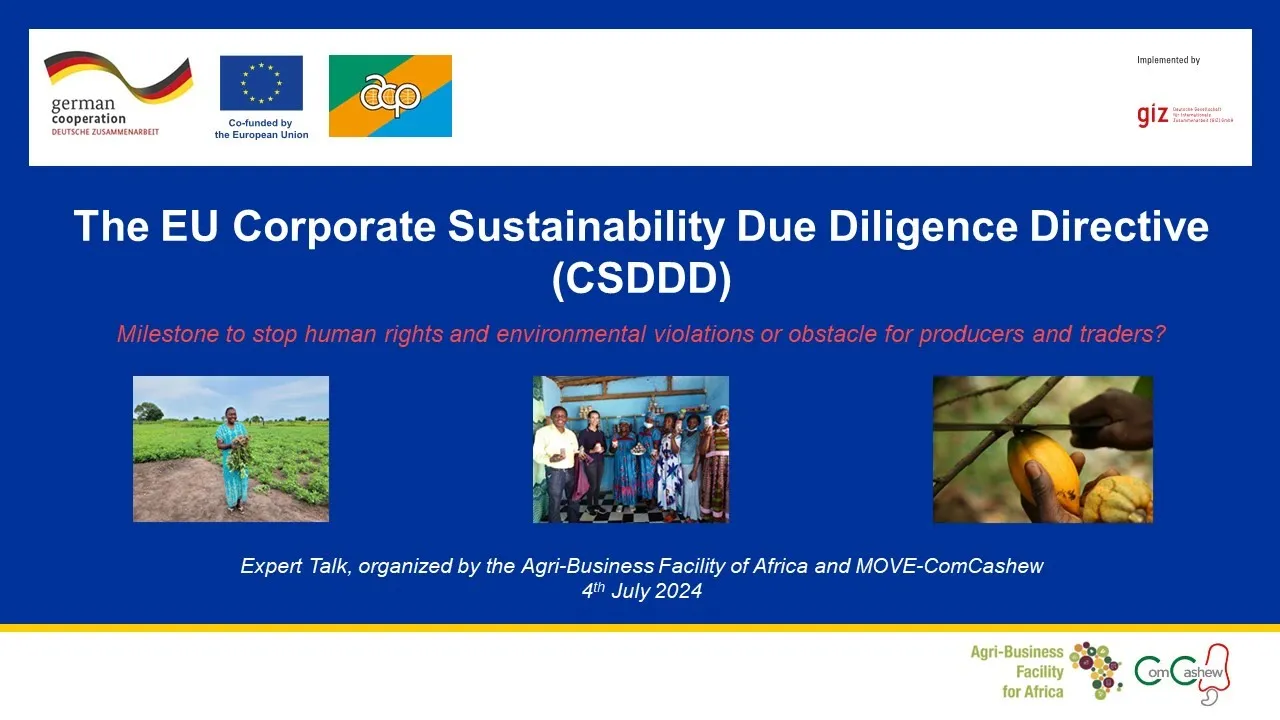
and fair discussions as well as a successful outcome thank you very much especially also thank you to our speakers today to you Stefan thank you very much Mark Gus for this words of introduction words of welcome and and also those very useful information so the European Union corporate sustainability due diligence directive quite difficult word CS Tri D what is it is it a milestone to stop human rights and environmental violations or is it an obstacle for producers and Traders this is a quite tricky question and um yeah we have invited Lena and Janice to shed
light on this topic and to to tell us what does it it mean for our partners in the global South what does it mean for our cooperation and we are very happy to listen now to your presentation I would like to give over to you the floor is yours welcome Lena indanes thank you so much Stefan and magnos for your introduction and thank you so much also for the invitation it's it's our pleasure to present on the um the law you've just mention I will call it csd4 short which isn't that short either but a
bit easier than the EU corporate sustainability uence director then I will share the slides uh in a moment then I can use the chance to introduce ourselves um we are both advisors in the uh sector program uh for sustainable Supply chains that means we both advis the ministry in Germany for uh development on sustainable Supply chains with a focus because we both have a law background Lena as a lawyer uh we advis mainly on legislation and in the last year uh most of our time has been taken up by advising on the csle D the
law we are talking about today thank you very much uh Lou for sharing the the presentation I think you can go to the second slide with the um overview of what we will talk about today so it's a bit tricky to to have this um to talk about the law because as we will see later in our presentation it doesn't directly uh apply to suppliers um in the supply chain it affects directly the large companies based in Germany in the EU but it will have a lot of uh indirect effects both on rights holders and
also on suppliers so this is what we want to talk about today first I will give an introduction talk a little bit about um the context and where the this legislation comes from then Lena will present the details of the csle D we will try to um make it as uh easy to understand as possible but I think it is important to understand the details to then understand what effect it will have on suppliers and then I finish with the last bit to explain uh the indirect effects um the challenges but also the chances that
this law um brings for suppliers and then um we will end with some accompanying measures measures that the German government is taking to support and we're also very happy to answer all your questions um that you can I think post after the presentation but also during the presentation in the chat St has already said so let me let me start to give you a little bit of the context um so we are seeing globally um a lot of risks and violations of human rights and also damage to the environment um give some examples here of
U forc labor of um workers miners exposed to dangerous chemicals uh of textile workers exposed to to dangerous chemicals working conditions um that are harmful to to humans and the environment and the EU or the EU companies have a big part in it um and with that we think have responsibility um how their corporate actions how their businesses their business activities um affect people in their supply chains and this is why this legal this this law has has come to um why the why the EU has passed it and next slide can't see the next
slide but I will just continue thank you so I've been I've mentioned human rights and and also the environment so there's Global consensus I would say on on certain on certain human rights on on labor rights um we we mention here in our Slide the international bill of human rights from 1966 um also the ILO declarations um on fundamental principles and rights at work the the the core ILO obligations um so we have all these International conventions on what is considered human rights and uh we have environmental treaties but these treaties or these these um
these conventions are mainly directed at at States so there's a state duty to to protect um and what we've seen in the last decades has been um an extension of this Duty and say well of course states have a responsibility to protect human rights and the environment but we also have to consider the actions of companies because we all know that business uh has a big impact both for for good I mean it creates work it can uh create Prosperity um but it can also have a negative impact business activities can be harmful for workers
can be harmful for Farmers uh it can affect the and damage the environment so this is why the un uh in 2011 published the UN guiding principles um saying next to the states also companies have responsibility and what they did is they took the concept of due diligence something that is well known in the in the corporate world and said well you companies you can use this com this concept of due diligence to also look at your supply chains and see where in the supply chain do we have risk for human rights violations or for
environmental damage what is our part in it like how does our activity affect human rights the environment and how do we have to change the way we do business to deal with these risks and to prevent violations um these were voluntary guidelines saying we expect companies to be active uh not yet lost but what we have seen in Germany that many companies most companies do not follow these voluntary guidelines and this is why first the German government and now also the EU have decided we need legisl we want our companies in Germany in the EU
to take up their responsibility we don't want them to harm human rights and the environment through their business practices and if they are not acting on it voluntarily then we need laws and this is why we have since 2021 the German supply chain Act and why now since um 2024 since this year we have the EU corporate sustainability due diligence directive or CS d in short and you can go to the next slide I don't want to go too much into the details of the legislative process in the EU that is extremely complex and complicated
um so you don't have to focus too much on the content on the slide you can also look at it later um when we share the the PowerPoint presentation but um what is important here to understand is that the EU law doesn't go into effect directly um it has to be it kind of like it forms the framework and the the Baseline like the minimum standards and now all the member states of the EU Germany France Spain many others they have to create their National laws based on the Cs D CS is giving the minimum
standards so what we will see now in the next two years that all member states in the EU will create their own National National laws based on the Cs D so we will now explain to you more detail what is in the Cs D what are the rules for German and EU companies but then it will take another two years until um the national laws will become active and then as I said in the beginning after this part of going a little bit more into the detail um we will also say what does it all
mean for suppliers what does it mean for rights holders um for all the companies that are not directly in the scope of the year over to you Lea all right thank you Janice and hello everyone also from my side um yes I would like to dive in a little bit deeper uh with you now into the csle D um and I would like to talk to you about the scope um the obligations and of course um access to Justice which is a very um very important uh aspect so first of of course the most important
question is who does this directive actually apply to um and first the statement that you can see on the slide is very important that only large companies are affected and then furthermore you can see that there is a differentiation between EU companies and non-eu companies um and there are certain criteria and requ PR requisites that are being developed in the directive for in order to determine when a company falls under the scope and when not so I think it's important to stress that most of the times um suppliers of EU companies will not fall under
the scope or will not be directly affected by the directive or by the transposed laws in the National member states as yanas just explained and of course they will not be subject to a fine or civil litigation or anything as long as they don't meet these thresholds that you can see here um so you can see that um if we want to um enter a bit more into this um into this graphic here you can see that EU companies um are affected um in a staggered or that the directive will be applied in a staggered
um in a staggered way so starting 20207 the only the biggest companies will have to apply the directive so that means all companies that have more than 5,000 employees and more than 1.5 billion net worldwide turnover then the next year um it the threshold is a little bit lower it will be 3,000 minimum employees and 900 million net worldwide turnover and then finally 2029 um the threshold will be even lower and it will be 1,000 employees and 450 million at worldwide turnover it's also important to note um what Yiannis just explained that of course the
member states they have a certain discretion when it comes to the transposition of the directive into their National laws so they may decide to already start in 2027 to apply the directive to all of the companies if they want to but the directives the directive gives the opportunity to kind of stagger um the application in order to give companies a little bit more time to adapt to um to the provisions of the directive so I just just want to mention there are also the non-eu companies that will be affected by the directive however as you
can see there is only one um prerequisite that will be um applied it's only about the net turnover and it's not about the worldwide turnover as for the EU companies it is only about the net turnover within the EU so it doesn't matter how many employees that company has it only matters how much money do they make in the EU okay next slide please thank you okay so now we saw who the um directive applies to and now um of course it's also important what does the um directive aim to protect um and the directive
it does not establish any new rules or any new rights it just kind of collects um the internet nationally recognized human rights and environmental rights um so the quote unquote most basic human rights like the right to life the prohibition of forced labor freedom of Association living wage and income that are enshrined in the um human rights instruments and conventions that are and have been agreed upon and ratified by the vast majority of the states in the world like like the ILO core conventions and the international Covenant on civil and political rights and of course
just just to mention it that also environmental impacts um are protected there is a list of prohibitions in the in the directive um enclosed and of course environmental um related human rights are also protected like let's say for example if there is a strong pollution in rivers or um on the land and this has an effect on the um um on the people that live there in that area that could also be protected under the directive next slide please okay that's the last part of the scope so we saw who the directive applies to we
now know what the directive aims to protect now it's um now the final part is what part of the company's activities are affected by the directive um so you can see here that both upstream and downstream activities of the company are affected so there was a bit of a discussion in the legisl legislative process how this um act these activities should be called so there was a discussion if it should be called a supply chain or value chain in the end the agreement was um chain of activities which is a very broad um term and
also with respect to the Upstream so the design development sourcing of the product that's all covered by the directive with respect to Downstream down stream it is a little bit more limited um so only the downstream activities that are um for the company or on behalf of the company are covered next slide yes thank you okay so this is I think in my opinion the most important slide and most important page that we will be looking at today or maybe the second most important um so what are the obligations that the companies have under the
directive you can see here they are um listed in the directive so it's eight obligations eight or nine um that the companies have to adhere to and the first one is um the most or that forms kind of the framework or the basis for the obligations which is that the company has to implement a so-called um risk management system and based on this risk management system all the other activities have to take place like the risk analyzes and also um what kind of preventive measures so they have to really structure their company according to these
due diligence obligations that's part of the risk management system and of course most companies they already have kind of a risk management system but now with the directive they will have to adapt that um according to the human rights and environmental aspects so that they also cover that um so far to the risk management system and then I already mentioned the companies will have to do um a risk analysis along their chain of activities and um all of the due diligence obligations are on a risk based basis um so this also refers to the risk
analysis so maybe to explain it a bit better um if a company has several chain of activities let's say one being Consulting and the other one being extractive Industries so it's expected from the company but it's also allowed for the company to start their risk analyzis with the extractive chain of activity because usually that's the chain of activities that's more prone to human rights violations um so this is like a underlying thought of the directive that everything that the companies do can be risk-based and should be risk-based that doesn't mean they don't have to look
at their other chain of activities but it means they can can prioritize and then if the companies found a risk um that has not realized itself yet they have to take preventive measures if there is a violation of human rights that or of the environmental rights that has already taken place the companies have to start and mitigate um these violations or these adverse impacts um and possible preven preventive measures could for example be um that the companies look at their um um at their procurement process for example and see okay um our supplier he really
pay he really pays low wages could we maybe um higher the prices that we have um like in the sorry the purchasing practices could we maybe change that in order to accommodate our supplier a bit more so it makes puts them in a better situation in order to better fulfill the viol the um human rights expectations that we have towards that supp fer and then um maybe just to pick one one or two other um obligations um one I think very important just to mention is that the directive clearly states that the companies have to
engage with stakeholders in a meaningful way throughout the implementation of their um due diligence process and all companies have to implement a notification mechanism and complaints procedure which should make it possible for um any and all people along their supply chain along their chain of activities or anyone else that has a complaint to file that complaint with the company also on an anonymous basis and the companies will then have to investigate that issue and if they find it to be founded or founded um complaint they will have to act upon it okay the other two
I think are kind of um uh self-explanatory um the companies also have to monitor the effectiveness of their um policy and measures and they have to communicate publicly um on their due diligence next slide please okay the final part I want to point out about the csed D um is the access to Justice which is also something that um that we focus on very much um there are three main components to the access to Justice complex one being the complaints mechanism of companies that I just mentioned and explained to you which is one of the
due diligence obligation um the other one you can see that there is a complaints um procedure to supervisory authorities so the directive says that when the member states implement the directive they also have to implement and establish so-called supervisory authorities that are charged with the control um of the the compliance with the with the directive and the national laws so they are the ones who will be able to impose fines Etc and will be able to ask the companies for more information so it's it kind of um gives like um two ways of complaints so
one being directly with the company but also one being with the authorities so that means you give your complaint directly um to to the authorities and the authorities will then have to investigate the issues and um and act accordingly and finally um one important issue that's also a novelty um Janis mentioned that we also have a German law in place um that is pretty similar to what is coming now with the European directive um however what was not included in the German law was civil liability there was um there was some there were some intents
to include it but it did not end up in the law however now in the with respect to the European law um there was an agreement so now um people from people that are affected whose rights are violated by a European company or even a non-european company as as as long as they fulfill the thresholds that I just pointed out they will be able to go in front of a European Court of one of the member states and then sue the company because of um because of um the violation of this of the rules of
these of this directive of course it's also important to mention this will not always be easy because usually at least um at least in Germany and I think most European um systems the um the claimant will Al always have to prove that there has been a violation and the violation has to be has to have taken place with respect to the um uh to the due diligence obligation which then leads to a human rights violation so this will be probably very difficult because for people living somewhere on the other end of the world to prove
that a European company did not for example conduct their risk analysis in the proper manner or they did not take preventive measures in a correct manner it will be difficult but I think the legislature they saw this imbalance and they also included some so-called safeguards I would say um so the member states when they transpose this directive they will have to make sure that there will be representative ction representative action possible um and no prohibitive costs will be imposed on the claimants and also another example is that um the courts will be um able to
require the disclosure of um of evidence from the companies if they have a certain certain basis for that yes and with that I will um conclude my very fast overview of the most important provisions of the Cs d and hand back over to yanis thank you very much Lena yeah you can go over to next slides um so Lena explained now the the obligations for the EU and the the the very large companies outside of the EU so the the law doesn't have any direct effect on but of course it will have an indirect effect
and and it can have a very big one so the idea of the law is that the E the the very large EU companies look at their supply chain see what risks they have and then try to um find Solutions together with the suppliers in a in a sense of partnership um trying to improve the situation slowly trying to see how in the next years or even decades they can come to to a solution that is good both for the buying companies for the suppliers but of course in the end it should all be good
for the workers for the farmers for the right holders kind like this this relationship of of partnership um that that leads to to good business relationships and um resilience then we also know that this is not how the business World works at least not all the time so you have the big companies that have a lot of power and that can dictate certain contracts or certain business relationships so what we sometimes see with the with a German law that we already have but that we also expect to see with the csle D is that some
of the big buying companies will just push down their obligations to their suppliers and say well you have to sign in the contract that you're human rights violation free you have to make sure that you don't have any human rights violations and of course there's always a threat of if there are human rights violations or environmental damage found that the contract is terminated so the legislator was aware of this danger and had put some safeguards in place in the law that I will show to you now um on the next slide um and I think
yeah I'm going to I'm going to point out a few a few like a few points from the from the law that um should help with that or should save guard um that the obligations are not just put down and then overwhelm the suppliers especially small and medium uh Enterprises or even microenterprises that disly the the big buyers so first L has already mention is the risk-based approach so it can be very hard for suppliers to deal with all their buying companies and like fill out questionnaires for all the different buyers um it can be
it can be too overwhelming so what the law wants is risk-based approach says well the buying companies the big companies should only target their very highrisk areas they shouldn't they don't have to Target U everyone so if there's a company in their supply chain and they know they have an excellent track worker we work together for years on like very good projects then this can be a lowrisk supplier and they don't have to put any burden um on the supplier and then in the same uh same way they should request information only where it's necessary
so if they know that a certain chemical uh is often used in a certain supply chain in a certain re region then they should ask the suppliers do you use this chemical how do you make sure that this chemical doesn't harm your workers and doesn't harm the environment but they don't necessarily have to ask about everything that is covered by the law that makes it very hard for the suppliers to answer question about something that maybe is not relevant for that and then Lena mentioned this already and I think this is a very crucial point
the idea of the law and I think this is something that we will have to also enforce is that the buying companies have to look at their purchasing practices they can't just say well our suppliers have to make sure that they don't have these violations no we as a company have to make sure that the business model Works in a way that the the delivery times um the pricing it works in the way that our suppliers can then also protect human rights so if we want for example a living income in our supply chain for
Farmers then the EU companies also have to make sure that they pay enough to their suppliers to make sure that there's enough money to then pay high enough income and wages and they also have to support their suppliers there's an investment Duty in the law there has to be targeted proportional support um it's for bidden to just pass on the costs of uh verification um for suppliers and also the opportunity for suppliers that if they have done one kind of verification certification that they can use it for all their buyers or not just for the
one they they've done it with so there there's all these points um that are in the law um aimed at protecting suppliers another one that is very important for us is to make sure um that the contract terms between the buying company and the suppliers a fair and non-discriminatory discri non-discriminatory and based on the the idea of partnership so not just pushing it down um and then last um termination of a contract um this is not if you find a human right risk or a risk for for environmental damage the the EU companies are not
allowed to just terminate the contract no they have to work together with the supplier to come up with a solution and I'm not I don't know that much about the the specific sector of and the agricultural supply chain but maybe give you one example in the in the Coco sector that there's a Human Rights Convention um forbidding child labor but then we know that for many families this is the only way to to come to a living income that everyone in the family works and and creates the income so that they can survive and live
well so how do we deal with that we have co-o buying companies like chling producers uh in the EU that that know that in their supply chain they have children working so if they if they know that they shouldn't just say okay we we we we're not allowed to do that we have to leave now no they have to work together with the rights holders with the families with the parents with the children and their suppliers to see how can we come up with the solution that works for everyone um maybe they have to pay
more so that the workers and the farmers can earn more and then this allows the children not to be on the field but go to school so they should come up with a with a in the relation of partnership and also what is very important that also Lena has mentioned they can't just decide oh we know we think this is good for the right soldiers for the workers for the farmers they have to talk to them and they have to get their opinion and then come up with a way that works for everyone and actually
improves the lives of uh of farmers of workers uh and not just decide on their own so this is kind of what is in the law but it will be a long process and we will see problems and challenges and it's it's very important for us to also hear back from you what you see as challenges now or in the in the next years um so that we can use that to adapt to support um and also to enforce so if big EU companies are just pushing down their obligations then the authorities in the EU
should work against that and and sanction them so two more slides before we go into the the Q&A section the question section um I also want to point out because it's often seen as something that can be uh harmful or dangerous for um for suppliers but there's also a lot of uh a lot of chances for that um so if you already have sustainability Supply it can be a big competitive advantage in the uni selling point because EU companies now have to um aim for sustainability so they will look for suppliers that that can offer
that for them uh it gives a chance for suppliers to demand responsible purchasing practices and ideally counteracts price pressure at the expense of environmental and social standards and as I said if there's a problem EU authorities can support so but we know it's it it will be a long process and it will be it will be challenging uh at points so on the next slide I put together some of the support measures that the EU and the the German government are offering so I think the gz project that has invited us is one example how
how the German government wants to support um there's also some um guidelines that will come from the commission uh and support from the member states uh I want to point two two projects out before we end and go to the question section um so there will be an EU help Des uh aimed at at partner countries uh for governments for suppliers but also for civil society and rights holders and direct them to the information and training they need to understand um the laws and how they can use them and at the moment it's still very
much focused on um the textile supply chain but I know there um they they're also going to other countries uh there's a network of responsible business Health LS that is also specifically aimed at suppliers to make sure that they get the training and the information they need um to deal with new requirements and and to use this new law as an opportunity for improvement that's how we want to end it um our information I hope it was useful to you and we're very happy to uh answer any questions that you might have now or also
of course you can always contact us with our email addresses if you have any questions directly or through Stefan thank you very much thank you very much Lena and Janice for this very excellent and uh presentation the good o overview I think many of our more than 90 participants they really appreciated it so in this name of the participants first of all thank you very much dear colleagues um what we did not mention maybe that Lena and Janis are working for the giset sector program corporate and public responsibility for sustainable Supply chains so they are
really experts on this topics as you noticed of course dear ladies and gentlemen all right we have around 12 13 minutes to go um in the chat there was only I saw one question from Marcus and Marcus if you want you can um open your mic and your camera and then you can ask our colleagues directly please please Marcus um stepan thank you very much um Marcus D working with the alliance for product quality supporting companies on uh complying with international certificate certifications uh We've sort of looked at CS triple D as well as an
um probably anchor for our work uh but in discussions we found that um like certification doesn't play or does play only an indirect role in this risk based approach so in in your opinion um looking forward what role could certificates being it like ISO standards for example or private standards play for suppliers to actively signal uh yes we are compliant please choose us as you mentioned this competitive Advantage yeah thank you thank you very much for this question I think it's it's a very a very um very important one um so as you said there's
no CS D certification uh yet um but I mean it's all based on on the OC guidelines the year guiding principles and I think a lot of multi-stakeholder initiatives um already already use use this or or support this and we'll also see how they can um how they can like change the way they work to to um include this more so I would say that participation in in multi-stakeholder initiatives and and certification schemes that already exist I don't know the specific ones agricultural sector can show to buying companies here we have a company that here
we have a supplier that is already very strong on due diligence or on human rights Environmental Protection depends on the on the specific initiative um and this will cover probably most of what the CSD requires but I think that most initiatives will also see how do they have to change their requirements to cover all aspects that the CLE wants I think that's Happ in next few years thank thank you Janis and also thank you Marcus Marcus for the question is it okay like this marnos um Marcus um yeah so you do see some like progress
I mean we've seen standards like Global gap which started off as a agricultural standard now including social standards as well um so do you see private standards sets adapting to CS D and then in the end there will be certificates that say yes a company complying with this certificate will be csle e um compliant um so I can I can just I was at the iel conference this Association of of uh of sustainability initiatives a few weeks ago and for them CSD is is a big big topic uh what they say what we also support
is that you can't really certify CS D compliance because it's an individual process every company has to look at their supply chain at their individual risk and then find individual solutions for it and and and Remediation but all initiatives that I think want to be relevant they will have to see how they can tie in with these process and how they can support uh what the Cs D requires so I think yes in the next few years probably all or at least most initiatives will see how they can tie in and support the processes that
CSG requires even if they can't say we certifies this Tri compliance but they can support the process definitely thank you thanks very much to both of us I still the um see there's a t raised by Ricardo and so if you don't mind you just open your mic and your camera please and then feel free to ask your question please I hope you can hear me you hear me now thank you uh my name is Ricardo from mozambik I work for National Institute for promotion small and medium Enterprise under the region uh Center of mamb
uh but I think this might be proba the question for many of us uh is it the the LW that uh is being uh shared with us in this uh expect talk uh affect uh uh German companies or european companies which are operating in mozambik or only uh or also the the companies which have a possible benefit in some uh F or Grant from uh European Union uh uh entities or World Bank are also affected for the is low but also I would like to understand if within the process of this the Implement now the
connection has stuck would you repeat the last part of your question I think the first part we got with respect to the application to companies but the second part we did not understand I was asking if uh uh is there uh companies or government entities in mosm for example which are can be trained uh from this uh project to be able to support the SMS uh on the implementation of this various law and uh this various uh program thank you thank you please okay I'm not 100% sure I understood the um the second part but
I will start with the first part maybe if the um um who the law applies to if the law would also be applicable to German companies for example in mosambik that's what I understood um and the answer would be um yes it would be applicable um for example the law also applies to groups of companies um so if for example that's like a subsidiary of a German company um that would also apply to the law but then maybe the mother company in Germany could fulfill the obligations for um for the mozambik company um but it's
important to know that um for groups of companies it's also applicable so that the compan companies are not able to kind of circumvent the provisions of the directive by just um establishing new um new companies right but if it's just any company in mosm Beque it will the law will only apply to it um in case in case they reach these thresholds that we looked at that we looked at before and then for the um for the second one maybe Janis you want to come in I can do this second one I as I understood
it asking for support measures specifically fores in in moan and I can't say I can't speak specifically for smmes in mamb but I know that is a big um that's very important for the German government and also for the EU to offer these support measures uh fores so as I said there there's like kind like an our system project there's a lot happening in the Tex supply chain in South Asia and Southeast Asia but I know that that these projects present today have very like a lot of activity um in the agricultural Supply chains and
specifically in Africa uh magnos uh I can see your raised hand maybe you want to directly respond on that yeah buar mik yes um we uh as a program um we have also a market facilitation unit yeah and uh of course our uh resources are limited it but what we will do is in future in cooperation with other projects from giset to try also to prepare uh an e-learning program no we are already working and have a platform yeah so this could be also one possibility to get also new information yeah and also to get
uh some training over this e-learning system yeah and uh what Janis already has said this is uh very important also to our donor which is among others also the uh EU yeah um and I I'm sure that also the EU delegation probably in uh mosambik uh will also offer in future um yeah at least uh some uh uh possibilities where there's a POS where small uh and medium entrepreneurs have the possibility to get more information over workshops and conferences yeah uh and from our side we will push this also over e-learning and uh also over
this platform which we are in we have in preparation thank you thank you thank you very much to both of you and I see that we have not much time left there is one question from Simon the whim and also I would like to ask you just to open your mic welcome the floor is yours thank you thank you stepan thank you also um for your presentations market and jennis very interesting I've been working in Ivory Coast on cashew nuts for the last two years on CSR and now it say with the law CS D
my question is um yeah will there also be an overall let's say assessment on European level uh in terms of risk areas geographically or sectors that will be highlighted and that will be also let's say first um yeah critical areas as it is also for the eugr they have also prepared it uh sort of a risk areas risk scoring of countries uh is that also for the Cs Tri D prepared okay maybe I can uh start and also um yeah maybe I can start with that um yes so actually in the directive there are um
a lot of Provisions regarding the support of companies um so also the commission um in collaboration with the member states will pass um guidelines um also for example sector specific guidelines um but also model contract Clauses for the collaboration between um between companies and their suppliers and um yeah this is a process that is starting right now but I think we can expect a lot of um support and more information on the implementation of the directive in the coming months um from the commission and from the um and from the member states however I'm not
sure if there will be like a risk like a like a risk markup or something that you just mentioned I'm not sure if it's going to be that specific to be honest Janis maybe you want to add yeah I think the the the commission guidelines will be important but then also the Cs D is taking established Concepts and and putting them into law so I think like all all the kind like sector specific Publications are are still are still important um I don't know how active the ooc is in the agricultural sector but I know
that they cover many many specific rectors sectors with their business and human rights guidances um there will be work of multistakeholder initiatives of course and uh also we see uh that there's a lot of activity both but good and bad in the in the kind of like consultancy sphere and uh with like software Solutions um so I think there will be a lot coming out and it will be important to see which are the credible ones which are the ones that uh really used this this approach of uh um supporting the companies with their efforts
and not just uh like offering Simple Solutions of saying well this is a risk-free area uh or this like highrisk area but like giving data and giving giving resources I think this is something that will need to come more and more in the coming years and it will be important to watch this space and see what is credible what is what is fair and responsible uh but um yes there will be a lot of support needed yeah thanks for your answers so it's could be also good if he can stay in informed also about it
thank you thank you so much thank you also for organizing also this uh this session also St over to you yes thanks thanks very much to all of you and I do see that we have already one minute um um 1 minute past 5 p.m. Central European Time so I would come to an end but nevertheless I have noticed that there are two um still two questions in the chat from El and Simon and maybe I can um ask yanis and Lena to answer to those questions in a written form when the chat is over
yeah so that also Simon and Ela um will get a response to their question I still have some final remarks to other questions of course all of you get an email with a presentation of course and as you have noticed we have recorded it you will get a link to the full recorded session which will be published on our web page most probably next week and then you can listen once again to the full presentation to all the question answers and of course you get the full presentation as I have mentioned I would also like
to ask you to have a look at the invitation because in the invitation there was the full expert talks which are coming this this year seven in a row and so you are mostly invited also to join those kind of expert talks last but not least let me thank Janis and Lena for this very excellent presentation and for the good um answering of all the the questions and um yeah if there are no further remarks for the moment I would say thanks very much to all of you and we stay in touch and in case
if there are any specific questions you have the email contact of yanis Lena and also my myself so do not hesitate to come back to us thank you very much colleagues people from all over the world and I wish you a nice afternoon and evening all the best take care bye bye bye