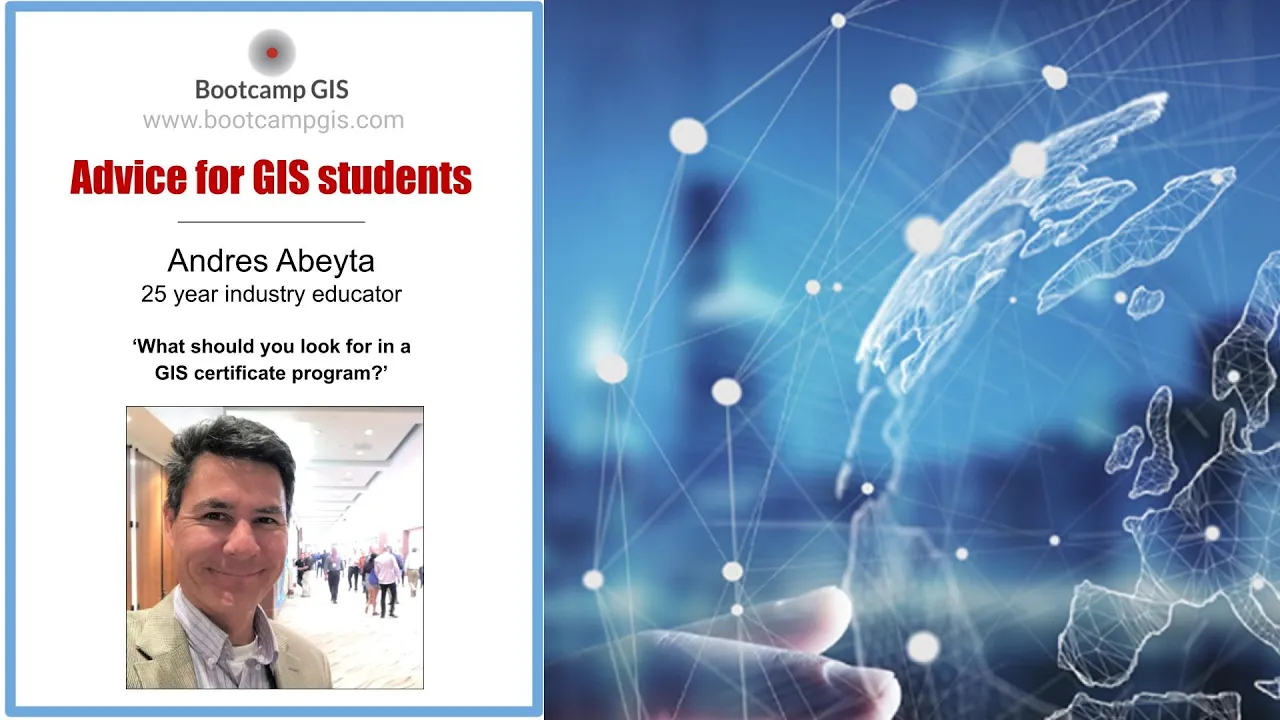
Hello. And welcome back to our podcast series with Andres beta. Today, we're going to talk about what should you look for in a GIS certificate program?
So welcome and Andres. How are you doing Good. Hey Rebecca, I'm good.
Thanks for having me. Okay. I'm going to get right into the video and ask you the first question.
And that is how can students learn GIS? So you can go the traditional route. Like I did get your degree.
I got a bachelor's degree and a master's degree in geography. So that was six years of going through and getting a lot of education with, with GIS. But GIS is a technical skillset and you may already have a degree in something like environmental studies or biology, and maybe you got exposed with a small class that said, oh, this is how you make a map and you want to go further so you can get a GIS certificate.
And that might be five or six classes that you could accomplish in six to nine months. So much shorter path to tech enable your career and lets you map out, manage, visualize, stand up applications with the type of data that you collect in biology or environmental. And in fact, I will say many of my best friends in GIS.
They have degrees in something that's entirely different than, than geography and they're excellent developers in GIS. So it's totally possible. And then the last way is just do it on your own in tech.
There's a lot of people that did DIY and find classes in different places and you can string together with enough ambition and diligence, a set of skills just by practicing. And then you'd have to demonstrate that that to somebody and say, this is better than maybe some general classes and education. Cause I know how to stand up applications or program, you know, that happens actually quite a bit nowadays in tech.
So those are the three ways. Yeah, that's awesome. And I also wanted to know a little about the analysis you did on certificate programs.
If you can tell us a little bit, a little bit more about that, that would be helpful. Yeah. So that's a growing audience, people that want to get a certificate.
So I just mentioned that you might have a degree in something, but you want to get a professional certificate in data science or cloud architecture or GIS. That's what we offer at bootcamp, gis. com.
And I wanted to examine all the GIS certificate programs out there in the country. And there's about a hundred of them. Only about 10% of them are online.
And most of them teach a pretty set, a common set of classes that are general in nature. They've taught those for decades and that's the exposure to the geography and GIS industry and thought processes. So classes like that might be intro to cartography intro to remote-sensing intro, to JS analysis, intro to JS databases.
That's the core set. So those are great classes to have, but you might find that you're you'll experience a skills gap, meaning you take those classes and you still don't have quite enough skills to get out-compete somebody else for a job in industry because in industry, the skills required get even more specific than those general classes. So like processing data imagery from UAV or learning to create 3d elevation models from LIDAR or creating application out on the web in AWS, those are things that you might go back and get your certificate and finding a program that actually teaches.
Those would be the best return on investment for you. That's where the jobs are. Make sure you get a GIA certificate program that offers that and also examine who's teaching those classes.
So not everybody has applied if you've gone through college, you've, you know, this, you can take a general class and you question whether is this something that somebody would really do an industry. So I, I hope you examine a class and say, is this something that is really reflective of what's being done in industry and applied classes, project based classes. Those are things that really were typically going to places like YouTube and Coursera to find really applied classes.
Cause they're a shortcut to having a skill that's employable quickly, Right? Yeah, absolutely. I think students need to market themselves better choosing the right courses and choosing the right courses.
Definitely helped. So yeah, another thing I need to ask is what are some other characteristics that are good for students besides, you know, getting the skills in GIS When you shop for something Rebecca, what's like one of the most critical things besides price that you want to know is available for you before you buy it, The quality of the material, or you know, just the person teaching it. If you're talking about courses, are you talking about courses or just in general, Anything, if you go online to Amazon before you click the button, what do you got to know?
That's absolutely important before you will buy it besides price, The quality I need to know if the product actually works, the reviews really matter to me. I always looked down to the reviews before buying something. And the other thing is speed.
You know, it's gotta be accessible if it's not on back order for three weeks, then you just go to some other link, right? So if all, if the class is available or the product there, whatever it is, isn't available quickly, you are a real time society. Everybody's carrying around these things.
And if you can't be served right now, you know, people, we don't even leave voicemails anymore because if I call you and you don't pick up, you know, that's, that's the generation that this, that you are. So I say that because that is one of the key things in a lot of these GIS certificate programs and degrees in general, you may apply in March and get notified in may if you've been accepted and then you start in September. So that's about six months of waiting before you can even start your education.
And then you, you know, maybe it's a certificate program for a year. So it's a year and a half later in which you may get a certificate. So real-time access.
And that's where these commercial platforms are much speedier than typically higher, higher ed is making those classes offered asynchronously. You can start right away. That's what we do because that's better for the students when they've got so much going on in their lives and their life is, is impacted by, you know, family obligations or other part-time jobs.
And they just need to be able to say, Hey, I'm interested in this. I want to start right now just like the rest of their shopping behaviors. So that's speed.
And then making sure that you got the types of instructors that you want, not all instructors are the same, really critique them and see if they have experienced in the areas that are applied. That's a good thing to shop for. Yeah, absolutely.
It seems like career advice is critical. How can a school demonstrate its prowess here? Her advice is really important.
I would say most students that come to us, I'll look at their LinkedIn profiles, which after four years or longer, their graduate student should be pretty well developed. If they were getting career advice from anybody, their parents, their colleagues, people at the university counselors. There's a lot of people around you in education.
That probably should be like me saying, this should start happening. The day you start your education as a freshmen, you start building your profile because you're building towards something. You're building to getting a job, having a really meaningful career, something that you love, you can't start that process and be where you want to be.
If you do it your senior year, I think it be happening right away. And that's why we put a lot of effort into helping our students make sure that when they're taking their first class, they know they've got to get a good graphic and to put on their, their LinkedIn profile. They need to be able to describe that class class very well as if they were an interview and need to work network with people in that particular segment of the industry.
Maybe it's GIS and conservation while taking that class and tell people, I love this. I love making maps. I love saving habitats.
And the more people you tell that to the more that are going to know, oh, this person is passionate and even paying to develop themselves in that area. That's somebody I want to hire. Yeah.
Yeah. If you, can you tell that story? Are you equipped to do that Rebecca for yourself On the path of doing that?
To be honest, like I have developed my LinkedIn profile. I've heard it's very important. You told you from our previous podcasts, you've given me a bit of insight on how I should, you know, improve my LinkedIn profile too.
So I've definitely been getting on that. So I've taken your advice and I can't say, yeah, I've linked with a lot of interesting people on LinkedIn and I think it's very useful too. So yeah.
Yeah. LinkedIn is awesome because it's usually the number one search result that comes up if somebody types in your name and if you don't have that as the best representation of you, the first impression, then you're missing out. So spending a lot of time on that and then also just maturing your, your vocabulary and your desire when you show up for an interview is, is really important.
So practicing that and knowing what you want, knowing why you want to work with a company, those are all important things. It's so competitive right now to compete for jobs. I tell my kids that, you know, when I, my father applied for a job, it was, he was competing with anybody that could drive to the building where the interview was when I competed for a job, it was for anybody that could fly to this interview.
And now your generation, when you can be for a job, you're competing with anybody in the world because so much work can be done remotely, that you have to have compete. Somebody else that could be cheaper just as available more technically qualified. You have to be very articulate and a good communicator to really impress somebody, to have them hire you.
Thank you on this. I thought this was a really helpful conversation. I really enjoyed this and I think many will be grateful for the advice provided.
And for anyone interested in Andres' company, it's called bootcamp GIS where it is a project-based learning company, check it out at www dot Gump, gis. com. And it will be linked in the description below.
Also subscribe to our channel if you're interested in our content and have a good one. Yeah. Thank you.
Feel free to reach out. We'd love to talk to you. Bye for now.
Bye. Hello. And welcome back to our podcast series with Andres beta.
Today, we're going to talk about what should you look for in a GIS certificate program? So welcome and Andres. How are you doing Good.
Hey Rebecca, I'm good. Thanks for having me. Okay.
I'm going to get right into the video and ask you the first question. And that is how can students learn GIS? So you can go the traditional route.
Like I did get your degree. I got a bachelor's degree and a master's degree in geography. So that was six years of going through and getting a lot of education with, with GIS.
But GIS is a technical skillset and you may already have a degree in something like environmental studies or biology, and maybe you got exposed with a small class that said, oh, this is how you make a map and you want to go further so you can get a GIS certificate. And that might be five or six classes that you could accomplish in six to nine months. So much shorter path to tech enable your career and lets you map out, manage, visualize, stand up applications with the type of data that you collect in biology or environmental.
And in fact, I will say many of my best friends in GIS. They have degrees in something that's entirely different than, than geography and they're excellent developers in GIS. So it's totally possible.
And then the last way is just do it on your own in tech. There's a lot of people that did DIY and find classes in different places and you can string together with enough ambition and diligence, a set of skills just by practicing. And then you'd have to demonstrate that that to somebody and say, this is better than maybe some general classes and education.
Cause I know how to stand up applications or program, you know, that happens actually quite a bit nowadays in tech. So those are the three ways. Yeah, that's awesome.
And I also wanted to know a little about the analysis you did on certificate programs. If you can tell us a little bit, a little bit more about that, that would be helpful. Yeah.
So that's a growing audience, people that want to get a certificate. So I just mentioned that you might have a degree in something, but you want to get a professional certificate in data science or cloud architecture or GIS. That's what we offer at bootcamp, gis.
com. And I wanted to examine all the GIS certificate programs out there in the country. And there's about a hundred of them.
Only about 10% of them are online. And most of them teach a pretty set, a common set of classes that are general in nature. They've taught those for decades and that's the exposure to the geography and GIS industry and thought processes.
So classes like that might be intro to cartography intro to remote-sensing intro, to JS analysis, intro to JS databases. That's the core set. So those are great classes to have, but you might find that you're you'll experience a skills gap, meaning you take those classes and you still don't have quite enough skills to get out-compete somebody else for a job in industry because in industry, the skills required get even more specific than those general classes.
So like processing data imagery from UAV or learning to create 3d elevation models from LIDAR or creating application out on the web in AWS, those are things that you might go back and get your certificate and finding a program that actually teaches. Those would be the best return on investment for you. That's where the jobs are.
Make sure you get a GIA certificate program that offers that and also examine who's teaching those classes. So not everybody has applied if you've gone through college, you've, you know, this, you can take a general class and you question whether is this something that somebody would really do an industry. So I, I hope you examine a class and say, is this something that is really reflective of what's being done in industry and applied classes, project based classes.
Those are things that really were typically going to places like YouTube and Coursera to find really applied classes. Cause they're a shortcut to having a skill that's employable quickly, Right? Yeah, absolutely.
I think students need to market themselves better choosing the right courses and choosing the right courses. Definitely helped. So yeah, another thing I need to ask is what are some other characteristics that are good for students besides, you know, getting the skills in GIS When you shop for something Rebecca, what's like one of the most critical things besides price that you want to know is available for you before you buy it, The quality of the material, or you know, just the person teaching it.
If you're talking about courses, are you talking about courses or just in general, Anything, if you go online to Amazon before you click the button, what do you got to know? That's absolutely important before you will buy it besides price, The quality I need to know if the product actually works, the reviews really matter to me. I always looked down to the reviews before buying something.
And the other thing is speed. You know, it's gotta be accessible if it's not on back order for three weeks, then you just go to some other link, right? So if all, if the class is available or the product there, whatever it is, isn't available quickly, you are a real time society.
Everybody's carrying around these things. And if you can't be served right now, you know, people, we don't even leave voicemails anymore because if I call you and you don't pick up, you know, that's, that's the generation that this, that you are. So I say that because that is one of the key things in a lot of these GIS certificate programs and degrees in general, you may apply in March and get notified in may if you've been accepted and then you start in September.
So that's about six months of waiting before you can even start your education. And then you, you know, maybe it's a certificate program for a year. So it's a year and a half later in which you may get a certificate.
So real-time access. And that's where these commercial platforms are much speedier than typically higher, higher ed is making those classes offered asynchronously. You can start right away.
That's what we do because that's better for the students when they've got so much going on in their lives and their life is, is impacted by, you know, family obligations or other part-time jobs. And they just need to be able to say, Hey, I'm interested in this. I want to start right now just like the rest of their shopping behaviors.
So that's speed. And then making sure that you got the types of instructors that you want, not all instructors are the same, really critique them and see if they have experienced in the areas that are applied. That's a good thing to shop for.
Yeah, absolutely. It seems like career advice is critical. How can a school demonstrate its prowess here?
Her advice is really important. I would say most students that come to us, I'll look at their LinkedIn profiles, which after four years or longer, their graduate student should be pretty well developed. If they were getting career advice from anybody, their parents, their colleagues, people at the university counselors.
There's a lot of people around you in education. That probably should be like me saying, this should start happening. The day you start your education as a freshmen, you start building your profile because you're building towards something.
You're building to getting a job, having a really meaningful career, something that you love, you can't start that process and be where you want to be. If you do it your senior year, I think it be happening right away. And that's why we put a lot of effort into helping our students make sure that when they're taking their first class, they know they've got to get a good graphic and to put on their, their LinkedIn profile.
They need to be able to describe that class class very well as if they were an interview and need to work network with people in that particular segment of the industry. Maybe it's GIS and conservation while taking that class and tell people, I love this. I love making maps.
I love saving habitats. And the more people you tell that to the more that are going to know, oh, this person is passionate and even paying to develop themselves in that area. That's somebody I want to hire.
Yeah. Yeah. If you, can you tell that story?
Are you equipped to do that Rebecca for yourself On the path of doing that? To be honest, like I have developed my LinkedIn profile. I've heard it's very important.
You told you from our previous podcasts, you've given me a bit of insight on how I should, you know, improve my LinkedIn profile too. So I've definitely been getting on that. So I've taken your advice and I can't say, yeah, I've linked with a lot of interesting people on LinkedIn and I think it's very useful too.
So yeah. Yeah. LinkedIn is awesome because it's usually the number one search result that comes up if somebody types in your name and if you don't have that as the best representation of you, the first impression, then you're missing out.
So spending a lot of time on that and then also just maturing your, your vocabulary and your desire when you show up for an interview is, is really important. So practicing that and knowing what you want, knowing why you want to work with a company, those are all important things. It's so competitive right now to compete for jobs.
I tell my kids that, you know, when I, my father applied for a job, it was, he was competing with anybody that could drive to the building where the interview was when I competed for a job, it was for anybody that could fly to this interview. And now your generation, when you can be for a job, you're competing with anybody in the world because so much work can be done remotely, that you have to have compete. Somebody else that could be cheaper just as available more technically qualified.
You have to be very articulate and a good communicator to really impress somebody, to have them hire you. Thank you on this. I thought this was a really helpful conversation.
I really enjoyed this and I think many will be grateful for the advice provided. And for anyone interested in Andres' company, it's called bootcamp GIS where it is a project-based learning company, check it out at www dot Gump, gis. com.
And it will be linked in the description below. Also subscribe to our channel if you're interested in our content and have a good one. Yeah.
Thank you. Feel free to reach out. We'd love to talk to you.
Bye for now. Bye.


![Entrevista com Pastor Presley sobre História do Cristianismo [PLANCAST] PODCAST](https://i.ytimg.com/vi/gvs_KooZXz0/mqdefault.jpg)