Hello everyone! This is number four in my ongoing series on YouTube that I've called, for short, "Jesus Archaeology. " What I mean by that designation, the title of the series, is that I want to take the textual evidence that we have, primarily the New Testament but also other texts as well in some cases, and take a look at it in the light of the material evidence, the archaeology of Jesus.
I think you can call that Jesus archaeology for short. Now, that would include sites, artifacts, and things that have been found. I've begun to talk about some of that, but also the lay of the land—what we call landscape archaeology.
If you read in the Gospels that Jesus travels from point A to point B, you need to be on the ground to really understand that. One of the things that I've done in my, what, 74 trips to the Holy Land—research, filming, leading tours, just studying on my own; many, many trips, many, many travels in Jordan, in the land of Israel today, the Holy Land—Egypt, east side, west side of the Jordan River, is to try to do what I call "tracking Jesus. " By that, you literally walk the paths, and you go on the ground, and in the case of archaeology, under the ground, to see what you can say about the material record that we have today after almost 2,000 years.
So today I want to talk about Nazareth: the city, or the town, or really I'm going to call it the hamlet, the little hamlet of Nazareth. Today, when you go to the Holy Land, Nazareth is the largest Arab city in what's called today the West Bank. But in the time of Jesus, it was a tiny little suburb of a much larger city that most have never heard of called Yafia, and that in turn was on the outskirts of the major urban center of all the Galilee called Sepphoris or Seori.
So if you didn't watch the previous lecture on Sepphoris, you can go back and hear that, and this one will have even a broader context. So I'm going to share my screen right away and get started. We've got a lot to cover here.
Okay, I'm going to begin with the map that I used before. Here's Sepphoris; you see my cursor right there moving. That's the urban capital.
This is just four miles to the southeast. I've walked it many times; it takes just over an hour to walk, and you go down the hills and into a valley, and this is Yafa or Yafia, which actually is the major city south. Nazareth is just a hamlet or suburb of Yafia, which I almost never hear anybody talking about.
So we're trying to get the lay of the land, and if you get the lay of the land here, as you can see, you're going to have to talk about Sepphoris and then Yafia outside of Sepphoris, and then Nazareth as the little hamlet. Now when you travel to the Holy Land today, Nazareth is the largest Arab city in the Galilee, but it wasn't that way in the time of Jesus. So let's start with some texts.
I realize many of you may not read Greek, but you can probably make some of these letters out, certainly the noon. So we have three terms here that are used in the New Testament: Nazareth, Nazarene—which would be somebody from Nazareth—and sometimes that's spelled Nazara, so it would almost be like saying New York, a New Yorker, and a New Yorkian, or something along those lines. Here are the terms used in the Greek New Testament.
They're all very similar, translated in these various ways, and they all have a context. Now, Mark 1:9 is our first and earliest mention of Nazareth in terms of a first-century mention in the New Testament: "In those days Jesus came from Nazareth of Galilee. " It's a place, clearly, and was baptized by John in the Jordan River.
So we can track Jesus. If I go back on the map here, he went down into the Jezreel Valley, and then it's literally just a slot on down, and John is baptizing just at the end of this Jezreel Valley where it empties out into the Jordan Valley and up and down along the Jordan River. So Matthew 2:23: "And he," talking about Joseph, "went and lived or dwelt in a city called Nazareth, that what was spoken by the prophets might be fulfilled: 'He shall be called a Nazarene.
'" In other words, there's somebody from Nazareth. Now, we don't know exactly what prophet he has in mind, because there's no Messianic prophecy saying he will be called a Nazarene, but I'm going to show you one that I think he must be referring to, that is, the author of Matthew. Now, according to Matthew, Joseph and Mary leave Egypt after the birth of Jesus when they've had to flee from the persecution of Herod the Great, and they waited in Egypt until he died.
Now Mark and Luke don't know anything about this; of course, Mark doesn't even have the birth of Jesus, but he has Jesus in Nazareth when you begin the story. But the way Matthew has it is he becomes a Nazarene because Joseph picked this city out. I think that's probably unlikely, because in Luke we have a different account, and I think Luke is more reliable here for various reasons.
So, an angel is sent from God unto a city of Galilee named Nazareth, to a virgin betrothed to a man whose name was Joseph, of the House of David, and the virgin's name was Mary. And then, when they returned from Jerusalem after the birth of Jesus, they performed everything according to the law and they returned to Galilee. Own City, Nazareth.
I think that makes more sense, given all of our records, that Mary is from Sephus—that's what I presented last time—and she marries a man, Joseph, who is from Nazareth. When she's told that she's going to have this child, according to Luke, uh, she's in Nazareth, and they go back to Nazareth. Luke chapter 4: "He came to Nazareth where he'd been brought up.
" So, throughout the Gospels, you get Jesus from Nazareth, Jesus of Nazareth, and Jesus the Nazarene. So again, the New Yorker, the guy from New York. Now here's where people get confused: in Hebrew, there's a word neter.
So here's the n sound, noon, and here's the tz sound—that's called aadi—and then here's the n sound with Nazir. Instead, you've got a Zion. They might sound somewhat the same, but you can see they don't look the same.
No one writing "NZ" would accidentally write "neter"; they also have different vowels. So what is a Nazir? These are verbs.
Aeter has to do with a branch coming forth, and a Nazir has to do with the verb "to separate," as we'll explain. So the word Nazar is tz; it's this word netzer in Hebrew, at least. So Isaiah 11:1 states, "There will come forth the shoot from the stump of Jesse.
" Now, Jesse is David's father, so this is the Davidic Messianic line. It's cut off after the Babylonian exile. There are no more kings of the Davidic line allowed by the Babylonians, the Persians, the Greeks, or the Romans.
But then, from that stump comes a neter—that's the word: a branch that will grow out of the roots of that stump of Jesse. What it's saying is that although the line of David is going to be cut off, someday a branch will sprout forth. There's another word for "branch" that's used in Zechariah and Jeremiah; it is seak—very similar meaning.
But here it is neter, very clearly in Hebrew. That, I think, is what Matthew is referring to—that he's going to be called a branch or a nerite. So we’re talking here about a branch Davidian, a Messianic title that was picked up in 1993 and earlier by David Koresh, who became leader of a group that sometimes called itself the Branch Davidians.
I was involved in that Waco crisis; you can look on my YouTube channel as well as my blog, and I have a lot of material on that. But you see where the name comes from in terms of David Koresh picking that up. Now, Nazir is something entirely different that has to do with separating.
It's a different idea. This is a branch springing forth; this is separating. They’re not connected in any way, even though in English people get mixed up.
Numbers 6:2 says to the people of Israel, "Whether a man or a woman wants to make a special vow, the vow of a separated one—to separate himself to the Lord. " And if you remember, you can look it up: Numbers chapter 6. The person who does this, male or female, declares a time for how long they’re going to do it, and then they abstain from certain kinds of ritual defilement: touching dead bodies, going to funerals, having any kind of grapes or alcohol—not even touching unfermented grapes—also growing their hair on their body—all of their body hair—without cutting it.
So it's a vow of austerity and dedication for a certain reason that you would make in Israel. Today I've met a couple of nazirs who have taken the Nazarite vow; it's still done, rarely, but still done in Judaism today. John the Baptizer is said to be great before the Lord, and he will drink no wine or strong drink and be filled with the Holy Spirit.
Now, everybody assumes that he is a Nazir from his mother's womb, and that's possible, but notice it doesn’t say that he's a Nazir. The other Nazir that everybody knows is Samson in the Hebrew Bible, in the Book of Judges. It very clearly says in that text that he is to be a Nazir, which means he's to follow this entire ritual of separating himself from all kinds of defilements and growing his hair, and so forth.
So, whether John the Baptist did that or not, it's become part of the movies; he's always shown as this wild and crazy guy with long hair, kind of screaming at the top of his lungs. He might not have been that way at all, if you think about it. But he's not drinking alcohol.
Well, James, the brother of Jesus, didn't drink alcohol, according to our early text, and Jesus apparently did drink alcohol, or this is usually wine. In Luke 7:33, Jesus comments on that, and this is from the Q Source—one of our earliest traditions of Jesus material. "John the Baptist has come eating no bread and drinking no wine.
" Now, notice it doesn't say meat; he's not even eating bread. What we learn from other texts, particularly from Josephus—and here you have to go to a Slavonic version of Josephus—is that he won't eat anything that doesn't grow naturally. He's eating what is usually translated from the Greek text: locust and wild honey.
But "locust" could well mean a plant—a honey cake that grows in the desert—it has to do with the translation from Hebrew to Greek. According to the Ebionites, he's not even eating locusts, these insects; he's just eating a kind of honey wafer that grows on plants in the desert. And of course, he's not drinking wine.
Now, Jesus, referred to here as the Son of Man, has come eating and drinking, meaning he drinks wine; of course, he eats to live. Say, "Meat, he eats bread, and he drinks wine, and he's accused of being a glutton and a drunkard, a friend of sinners. " Okay, so those are the two terms.
Now, one of the ways we now know—and this is the archaeology—was this little fragment. There are several fragments, but we want to talk about this one right here: three little fragments that were found at Caesarea in 1962. Here you have, you can tell that it is the noon, that's the r, and the Tav neter, and it's nerit.
It refers to the city of Nazareth. Here's a translation; it's talking about the Priestly courses. If you remember, in the book of Chronicles, different priests would serve different terms of time, and there were these 24 Priestly courses.
They would serve probably for two weeks of the year so that you didn’t have the priests scattered throughout the land of Israel. So, anciently, in the Hebrew Bible, these courses of the priests are preserved. The 18th course, which is called haes, is actually in Nazareth.
Now, this shows us how to spell the town. This is the town of Nazareth, and we have other references to that as well. So here’s the picture I used before.
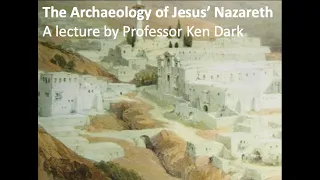
This is modern Nazareth, spilling over into the Baate Nofa Valley, and this is the hill upon which Sepphoris was built. Go back and watch that video. Now, even if you go to the 1830s, this is the famous artist Roberts.
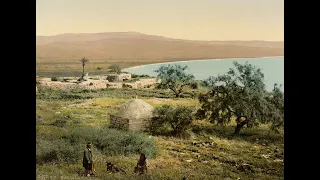
This is what Nazareth looked like. Notice it’s not the huge metropolis; it's actually set among the hills of what we now call modern Nazareth. If you’ve ever been to Nazareth, you know it's this gigantic metropolis with up-and-down valleys and hills snaking around—very congested, very populated.
But in the 1830s, just maybe 200 years ago, it was just a little village. This is REM; here’s a mosque, and then you have the Church of the Annunciation, remembering the Christian memory of Mary having the appearance of the angel Gabriel. I would love to go back in time and walk these streets of Nazareth.
Can you imagine doing some of the archaeology here? People say there’s no archaeological evidence for Nazareth. Well, because Nazareth is this huge megapolis today, there’s little chance of doing much digging anymore.
But can you imagine in the 19th century if you had excavated here? This is a bit later; this is in the 1860s, and you can see how it's beginning to grow, but it's still about the same. Here are the hills to the north and the west, and this would be the hill of Sepphoris—that would be in the 1860s, very rural again.
You could do all kinds of archaeology. I wish I lived back then in some ways. Now here we go to the 1920s; it's still a small little hamlet.
Any of this could have been excavated—this could be excavated, this could be excavated—and today that’s no longer very easy to do. But we're going to see some evidence for some archaeology. Now, Nazareth Village, that I'm going to show you in a minute, is right here on this hillside, just above the central city.
The central town really—let's call it a town, not a city—of ancient Nazareth, the little hamlet, was just right here. There’s a water source here; that’s why it's here in the little valley. You've got all of these hills around, but there’s a water source in the valley, and this becomes Branch Town Naret.
Okay, today look at that! Look at the difference. Okay, see this right here?
This is the modern Church of the Annunciation, one of the most beautiful churches in the Holy Land. In this photo from the 1920s, it’s not even built yet—but it’s going to be built. Here you can see some evidence of the church here, and if you go back to Roberts, you can see the front of it here.
So let’s go on and look at that. When people talk about the archaeology of Nazareth, I mean, you could go up and dig in this area, but this is the concentrated area of anything to do with Jesus growing up in Nazareth. Here’s a close-up of that Church of the Annunciation, and here are those buildings on the hill.
This is Nazareth Village. Nazareth Village is an attempt to reconstruct what this might have been up here where there’s more room to build, and it’s an amazing thing. I take groups there all the time to look at it, and they try to do everything—I'll explain when we get to it—based on how things have been built and done in the first century.
So it’s pretty fabulous to visit. Most pilgrims go to the church; it’s built over the traditional house of Mary and Joseph, and this would be the place, according to Luke, where the angel Gabriel appeared to Mary. Now, Ken Dark has really done some marvelous work on Nazareth, and he's particularly worked on an excavation under a church.
He has looked at Roman, Byzantine, and Crusader ruins, and down in this lower level here, this is the entrance and threshold going into first-century remains of a house. There are other first-century parts of the house right here, and I've been there. I've looked at it extensively.
You can see I've gone down through it and spent time with the sisters that have helped me greatly to understand it. I have both of Ken Dark’s books—highly recommend these; I have them on my bookshelf. If you go to james.
com, up at the top, you’ll see a bookshelf where you can get the links to these books. So I’m basing what I’m saying on a lot of the work that Ken Dark has done. Done.
Okay, here's the Church of the Annunciation right here, and we're going to look at a first-century house that has been excavated right here. And also, this is the Sisters of Nazareth, where we also have a first-century excavation. I remember in graduate school, I was reading about archaeology; I hadn't done any yet.
This was at the University of Chicago, and the basic idea back in those days that we were taught is there are no first-century synagogues that have ever been found, so anything about synagogues is completely fictitious and imposed later on the text by the gospel writers, making them very late and derivative. Also, there are no archaeological remains from the first century in what is historically called Nazareth, leading some people to say, "Well, there probably wasn't even a city or town called Nazareth. " Here's another map where you can kind of place yourself.
So, here's that Basilica with the great dome; right across the street is the Maran Center, where you have one excavation—that's the first one we'll look at briefly—and the other is under the Church of the Sisters of the Nazareth Covenant. Now, here's the one across the street from the church, as you can clearly see. So, if you go to Nazareth, you'll see all the magnificent sites inside the church, walk out, cross the street, and go to the Maran Center.
Here's when it was being excavated: these are the ruins of a first-century house. I'm not saying it's the house of Mary and Joseph; I don't know whose house it was, but it absolutely is a first-century house. It's been securely dated, and you can see that you're down to first-century Nazareth.
So, all those doubts about, "Well, there was no first-century Nazareth," are just not the case today. There's a visitor center; you can walk around and see some of the ruins. I've been allowed to go down into some of these ruins, and there’s a bell cistern and other amazing things that have been found.
Then, there are artifacts that they'll show you, so this first-century house is very important. Now, you say, "Well, why haven't more things been found? " Well, if you excavated here—which is now sacred territory, part of the grounds of the church—what do you think you're going to find?
You're going to find more of the village of first-century Nazareth. Here's a building, a modern building, right next door; there's a falafel shop right there. I remember because we ate lunch there.
What, are you going to go under their shop and dig? Well, if you did, you’d find more of first-century Nazareth. This is not the only structure, obviously, and if you go back to our map, notice how close this is to this.
So, this has been dug, and this has been dug, and what do you find? First-century remains. Now, the Sisters of Nazareth, this is the entrance to their church.
You see a traditional statue of Joseph, Mary, and little Jesus, but you've got to go down under the church to see the excavations. There is a picture that I took with my own camera, a fabulous picture, and you can see the meter mark, and this is a first-century level. You can go down into the chambers of the house, and then it's built up so that you have bedrock and you have Byzantine and Crusader ruins.
So, this was revered, and finally, a church on top in the Byzantine and Crusader period. If any place has a chance of being at least what they thought was the house of Mary because of the Byzantine church and the Crusader Church above it, this would probably be it. If you get those two books by Ken Dart, he talks about those.
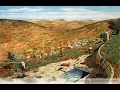
So, what did it look like? This is Bal's painting. Here's his website; be sure and give him credit: archaeologyillustrated.
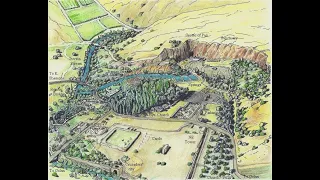
com. Look at all of his amazing color portraits. He's an archaeological artist, and the hillside he has—remember that hillside going up and then the little village?
—he's imagining it probably having what? 100, 200? It's a little hamlet, and you've got a road coming in.
These are more hills of Nazareth, all populated today with that congestion. And Sepphoris would be possibly this here. I'm not sure if he represented the hill exactly beyond, but it's to the north.
So, this gives you an idea of what it might have been like in the first century, just imagining with some fields; it's an agricultural rural village where Joseph applied his trade. In the previous video on Sepphoris, I presented the possibility that Joseph and the boys growing up were making their way to Sepphoris every morning, and it's an hour-and-a-half walk or so from the village, working in the stonemason industry as that amazing capital of Herod Antipas was being rebuilt. So, if you'll permit me a bit of speculative romanticism here, as Jesus is growing up in this tiny little village, remember what it says in the Gospels: "Can anything good come out of Nazareth?
" That's just a little hamlet. What is Nazareth? Well, it's a branch town, and probably called that because the families that populate this village are of the lineage of David.
I don't know that all were, but there are a lot of close relationships between families in these villages where people marry other people from the same clan. So, I like to imagine Jesus growing up here. Here's the road north to Sepphoris, but all of these hills I imagine him wandering and praying and thinking about his mission, and also working in the building trades.
So, when I look at that picture, that's what I think about. Now, here's Nazareth Village. Isn't this.
. . Fabulous!
There's the synagogue, there's one of the houses, here's inside one of the houses. You can actually see the thatch roof. Everything in Nazareth Village is built as it would have been in the first century, based upon archaeological findings.
In other words, they don't use fiberglass, modern nails, screws, braces, and so forth. The idea is to be as authentic as possible, and they've created a working village where they grow crops. There's a stone-cutting area where they cut stones out of the bedrock.
You've got the animals running around; it's a fabulous place to go! Here I am in the reconstructed synagogue, reading from the Gospel of Luke 4, which tells of Jesus going up into this synagogue, stepping up to the bench, and taking up the scroll of Isaiah. He finds the chapter we call 61 and reads it to the congregation, who sit on benches around the edges.
This is how all of our first-century synagogues looked. If you go with me on one of my tours, we'll visit several authentic synagogues from the first century that have these features, including one at Migdal, and now there's another one that's been found, and one at Mada. Those two, in particular, are very similar to this.
Now, I've heard people say for years that there's no precipice at Nazareth. So, if you go with me, I'll take you out on the precipice of Nazareth. If you remember the story in Luke 4, the crowd takes Jesus to the brow of the city, and they're going to cast Him off into the valley below.
This is called today the precipice. The tourists go there, and believe me, if you get close and look down, it's dizzying! Now, here I want to introduce something else.
Let's go back to Yafa or Yafia. Don't confuse it with the port city of Yafa today, or Jaffa, which is down by Tel Aviv, the city where Jonah sailed from. This is in.
. . So here you've got Sephus, the Banofer Valley that goes all the way to the Sea of Galilee.
By the way, when Jesus would travel to the Sea of Galilee, maybe to visit Mary Magdalene or to finally go to Capernaum, He would simply walk down this valley. It comes out right here, and I'm going to show you later a whole presentation on this area of the Arbel and the cliffs overlooking Migdal. There's Migdal, and then Capernaum and Guin.
These are all very important in the archaeology of Jesus. But back to Sephus. So, here’s Sephus.
Jesus is walking an hour and a half every morning, maybe 4:30 or 5 o'clock, if it's like our digs. You need to be at work by six, by sunrise, and he's working in the building trades with Joseph and his brothers and then back to Nazareth at night. But what about Yafa?
What is Yafa? Read Josephus; look up Yafa in Josephus or Yafia, as it's called today in Hebrew, and you're going to see that Josephus, who says he stayed there, describes it as a wall town. So, I’d like to call this a town or a village.
This is a city, and this is a little hamlet nestled in those hills that we saw because there's a water source. You see, the idea is all beginning to make sense now. Can you see off of today?
Well, you can see the hill where the center of the city was. Yes, there were some excavations there over the years, but it's so congested now with modern buildings that you can't get much of a sense of what it was. But if you read Josephus’s inscription, it's very clear.
Here’s a version of it that gets you a little closer: Here we have Sephoria, which is another name for Sephus, and here you have Nazareth. You see how it's nestled between those hills? It's easy to get to Sephus from there because it's on the north side, and there you have Yafa.
So, Yafa sprawls around this way, almost taking in the hamlet of Nazareth. Here is a close-up view of this; it would be the hamlet of Nazareth, and it's basically a 40-minute walk to Yafa, because it is kind of rugged terrain. All of this now is modern Nazareth.
So when you drive into modern Nazareth, it's very complex with all these side streets and so forth; you're completely lost. But if you back off and look more at the ancient site, you can begin to get a view, or even if you look at those 19th-century photographs. So let's talk a little bit about Branch Town, Isaiah 11, verse 1.
Most likely, if it is a little village with 100 to 200 people living there, as I said, these clans are intermingled and mixed, and Jesus then is called the guy from Nazareth, which becomes then for Him a very specific designation. There aren't going to be many people of prominence coming from Nazareth, but Jesus becomes very popular—a similar way John the Baptizer, I think, is from a little village called Einum, where I've spent years of my life excavating just outside of Anaram. I'll cover that probably next time because I want to keep this somewhat sequentially in terms of the chronology.
We need to do the birth of John the Baptist as well, and we'll get to that and a cave that's been discovered there that may very well be linked to the historical first-century John the Baptist. It's very exciting! Anyway, so we've got this little village or hamlet, but it's linked to the town of Yafa, and the town of Yafa, in turn, with the little hamlet or village of Nazareth, is linked to Sephus very closely geographically.
So this is going. . .
To transform our whole understanding of Jesus, I think—did he walk into Yafa? Did he know Yafa? If it's a walled town, if there are significant buildings there, he could have also worked there and had friends there.
So he didn't just grow up out in the middle of nowhere. It's also just adjacent to Mount Tabor, which is a major landmark in the Galilee, and you can see on that map, as I pointed out, how you can walk down to the Sea of G. So it's very strategically located.
I want you to think like that when you think of the historical Jesus. I'm going to argue that the headquarters Jesus sets up at Kafar Capernaum, as it's called today in English, is a strategic move as he begins to calculate and lay out his strategy for bringing about the Kingdom of God. I want to mention my book, "The Jesus Dynasty," again, particularly in connection with this series, because most of the sites and the points that I make in this series on archaeology have dozens of illustrations going through all of this material.
Now, this series is going to go much further than the book, but the book is a foundation. So, if you haven't gotten the book, I highly recommend that you get it, and you can use it as you read along and study the things that we're covering in this series. So take care, everybody.
Let's go next to the home of John the Baptist, and let's dig around and survey and walk around and see what we can figure out about the lovely village of Anaram, which is west of the city of Jerusalem. [Music] Today.