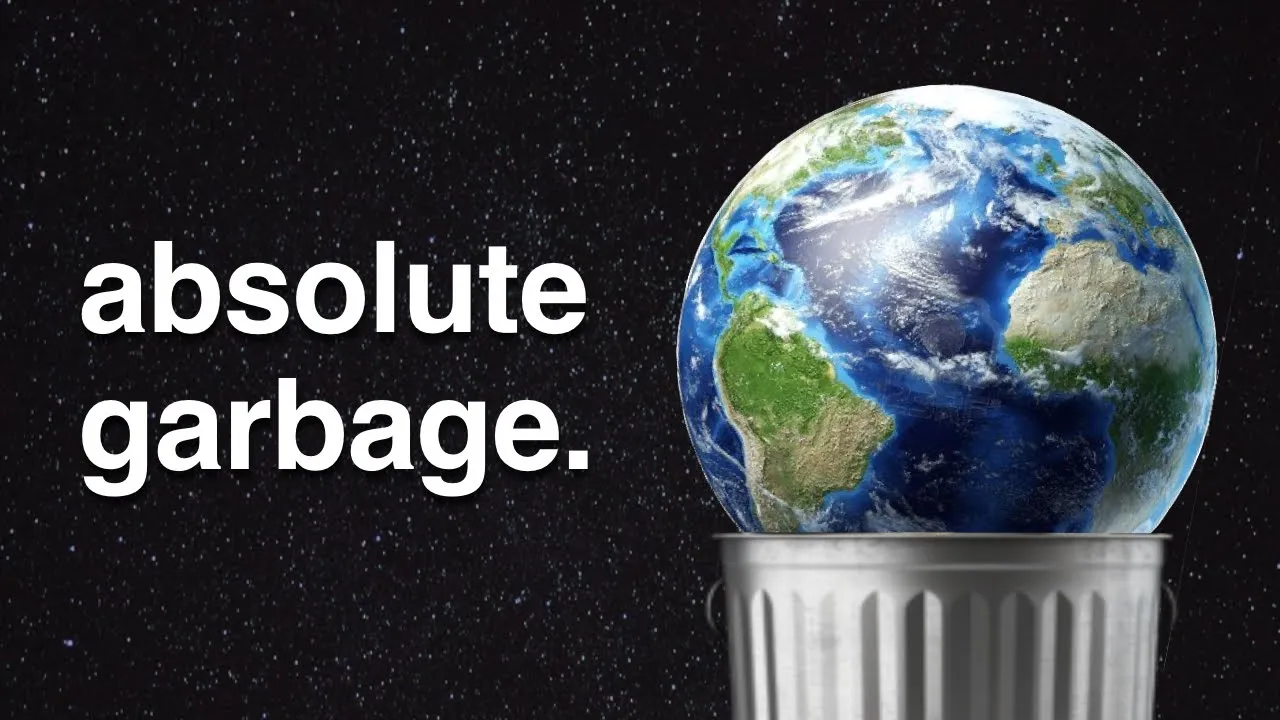
Because I’m a huge fan of worldbuilding, I wish I was as impressed with the ‘Earth Project’ as… everyone else (cheering). Like, sure, with its long evolutionary history, detailed storyline, and complex magic system, this setting is amazing… ly full of sloppy mistakes! That’s right, I’m stepping into the ring — today I’m doing a full takedown of Earth’s so-called ‘realism.
’ Okay, first problem: Physics. At a glance, Earth’s physics system seems pretty reliable — especially compared to other pieces of media, but look close enough, and you’ll definitely see the sloppy oversights. Like how a human can put their hand in molten metal and avoid getting burned if they remove it fast enough.
Supposedly, this is because of something called the Leidenfrost effect, wherein a layer of rapidly evaporating moisture shields the colder object, in this case the hand, but I don’t know, sounds like an excuse for shoddy craftsmanship. And there’s some huge incompatibility between relativistic and quantum physics? That’s embarrassing.
“I really hope somebody got fired for that blunder. ” A setting’s magic system would typically smooth over such inconsistencies, but supposedly, magic isn’t a thing on Earth, and any spells performed are just clever bits of trickery. Heh, okay then explain this?
But seriously, when your primary mode of transportation is the car — a metal creature with arcane innards that only a specialized form of wizard called a mechanic is able to tame — you still have a magic system, you’ve just called it something else. And light here is both a wave and a particle? Yeah, pretty sure that’s called witchcraft.
Earth’s habit of overcomplicating perfectly-good systems is apparent with how the project handled the elements. The ‘Classical Elements’ of yore kept things… ‘classy. ’ Only playing the hits of water, fire, air, and some variation on the earthy, rocky, mineral-y stuff that makes up the ground.
Basically, things you can see, and feel. These early systems usually had lovely symmetry, and some nice, rock-paper-scissors-style power-scaling — exactly as it should be. But, uh oh, the Medieval Alchemists have gotten ahold of these systems, and they want to add Mercury, Sulphur, and… Salt?
Okay, that’s fine, Mr Von Hohenheim, as long as no-one adds any more — oh boy. What have you done to us, Dimitri? What did you do Dimitri?
! Now, it’s a huge mess. Sure, some periodic elements like Helium grant the wielder obvious powers, like levitation… some have decent splash damage, and some even make for horrific destruction spells, but this many elements means the quality control — is pretty spotty.
We got Rutherfordium, Californium — is ‘that’ what it’s made of? And Un-, Un-un… Un-un-en-nium? .
And that one might not even exist? Get out of here. Just goes to show that when it comes to worldbuilding, complexity isn’t always more engaging.
I mean, no one is going to be taking a “which periodic element are you? quiz — oh, that’s spot on actually. So, Physics is a bust, how about Biology?
Well again, it’s certainly complicated, but there’s still no consistency between what gets included, and what gets left out for being ‘unrealistic. ’ Past critics have rightly pointed out the absurdity that unicorns are mythical within this setting, but Giraffes, ‘leopard-moose-camels with a 40-foot neck’ — give or take — are completely normal, nothing to see here, it’s fine that they eat bones. Also, some turkeys can spontaneously impregnate themselves, butterflies’ taste with their feet, and sea turtles can breathe out their… posterior.
So, all that, and no dragons? Feels pretty arbitrary, to be honest. But nothing’s quite as arbitrary as who gets to be the star of the show — Humans.
Lots of these silly things rushing about, around 8 billion which is… probably fine. They come in all different looks, but have the same, impractical drawbacks. Wisdom teeth they have to remove, appendixes they have to remove, goosebumps — because they still think they have fur, these little fleshy eye-corners — because they still think they have third eyelids, foreheads they can’t even directly see, oh, and most absurd of all, they can’t hold their nose and hum at the same time.
– Wait is that true? (tries) It is true that’s so weird. Do we buy that these things took over?
On a planet with lions, crocodiles, and this — thing? Oh, but humans are smart — are they? Greed, pollution, the shake weight, I could stop there, but let’s look at something really basic like currency.
In most fictional settings, objects have value if they’re made of a valuable material: something logical, like a rare mineral or unicorn snot. But in Earth’s latest chapters, most forms of value are instead tied up in hypothetical worth assigned to paper or just electronic digits. That means you have characters buying food, exchanging houses, working long hours, losing everything, going hungry, and committing atrocities, all over something whose meaning is 100% theoretical.
Feels a bit too pessimistic, to be honest. Oh, and speaking of food and pessimism, I-, oh no… oh that’s not right. But forget artificial nightmare-concoctions for a moment, and meet mentha spicata an all-natural plant that produces a noxious chemical compound to keep animals from chowing down.
But humans call it mint, and put it in their food, and calming tea, and toothpaste, because they love that refreshing, burning flavor. They’ve also bred peppers to be as hot as possible, because they apparently can’t get enough of that sweet capsaicin, an ingredient classified as a ‘chemical irritant and neurotoxin. ’ …Okay maybe it does make sense that these things took over.
So maybe some points for Earth there, but how about Geography? Because in worldbuilding, a consistent map usually means a consistent world — and Earth’s map is, as you can see, wildly inconsistent. In theory, this is really the fault of Earth’s shape, since flattening out a globe into a flat projection messes up the scale no matter what — as this country-size-comparison website demonstrates.
Here, you can see that Australia is actually… woah. Is that right? And Greenland is only… really?
Don’t even get me started on Liechtenstein. But seriously, is it so impossible to make an accurate map? Watch, you just take both sides of the globe, and then you just sort of — uh.
. . Okay you just gotta… huh.
Yeah, that looks right. But how about place names? Well, not to overstep, but some of these names strike me… as a bit silly — and the stories behind them are often even sillier.
For example, there are upwards of six rivers in the UK all called the ‘River Avon. ’ And though it’s hard to find an exact source, the general theory goes that this is because when the Romans invaded and they asked the Celts “what’s that river called? ” The Celts would say “Avon,” and the Romans were like “Cool” and wrote it down, not realizing Avon is just the Celtic word for “river.
” …Of course, another explanation is that whoever made this map is super lazy. Beyond place names, Earth linguistics are generally a bit catawampus. An effective fictional language, or ‘conlang,’ should have reasonably consistent rules for the audience’s benefit.
For research, I wrote the script for this video in English, an Earth conlang which is… complete nonsense. This, I think we can all agree, is not a sentence. The English wiki might claim it’s a sentence, but it is not correct.
English spelling has equal clownery afoot. Like, ‘Friends’ is spelled with the I before the E — fair enough, that’s apparently where it goes except after C, unless your foreign neighbor – Keith – receives – eight – counterfeit – beige – sleighs – from – feisty – caffeinated – weightlifters. Or with… all these.
Also, why is it, (as one scholar notes), that writers write and painters paint, but fingers don’t… fing? Why don’t hammers ham, or dumpsters… dumpst? Yeah, do yourself a favor, and just learn Klingon.
So more points off for linguistics and geography, how about music? Well Earth, admittedly, has a pretty great soundtrack. Difficult to choose a favorite… I mean — hard to beat a cuneiform classic like the Hurrian Hymn.
Tree frog sounds are pretty good, waterfalls, Hieronymus Bosch gave us a definite banger with his 15th Century butt music, and Purple Haze is also pretty good. No, my real complaint when it comes to Earth’s soundtrack… are these instruments. Because I’ve actually got a replica of an in-universe stringy-whatever, and it doesn’t sound nearly as good as Mr Hendricks’s.
I looked on the wiki, and apparently, learning to play an Earth instrument requires ‘time’ and ‘effort. ’ This is apparently true for any meaningful Earth artform… and you have to be emotionally vulnerable? Definitely don’t like that.
‘But hang on, what about the storyline? ’ Well, I skimmed through most of the plot at some place called a library and wow this project needs an editor. First of all, the timeline itself is way too long.
Having hundreds of millions of years be all dinosaurs is ridiculous, no matter how cool they were. As it stands, the T-rex lived further away from Stegosaurus than from modern humans — which, come on. And zero human/dinosaur overlap feels like a pretty obvious missed opportunity.
No, birds don’t count, they don’t hunt people — except for that one time. But the timeline gets far messier. Sharks — everyone’s favorite murder-fish — are supposed to have been swimming around for longer than the evolution of trees?
They’re also older than the formation of Saturn’s rings, and older than one of the points in the Polaris system, aka the North Star. Yes, more ancient than the birth of the actual star. I get that sharks are a cool bit of worldbuilding, but that’s overdoing it.
Also, Cleopatra lived closer to the Moon landing than the pyramid’s construction, and there are parts of the Appalachian Mountains older than the evolution of bones. A timeline this muddled and lengthy makes getting invested in any one character pretty difficult. Tycho Brahe seems promising — he became a renowned astronomer, lost his nose in a duel over a mathematical formula and got a bronze one, lived in a castle, once owned 1% of the wealth in Denmark, had a pet moose that died after getting wasted and falling down the stairs, until finally Mr Brahe himself passed away peacefully — just kidding he might have been murdered?
Sounds like a character worth following, but Tycho was tearing it up for an all-too-short 53 years — Earth’s plotline covers 4. 5 billion years. The fleeting nature of existence is actually an issue you’ll run into with every character, which makes caring about anyone, on some level, an inherently tragic experience — and that’s….
I don’t like it. Glass sponges have things figured out, though. The cosmic unfairness of the human condition aside, Earth’s storyline leaves a lot to be desired in terms of believability.
It rained frogs for a minute, a bear named Wojtek served in WWII and was promoted to the rank of a corporal, the US government once lost a nuclear bomb, whew can you imagine, a dog played in the NBA, it looks like, and oh yeah and this exists. And was sold. Humans bought this.
Hey, speaking of — Technology! Earth is full of tech, a lot of which seems to have no function but to breed nightmares. In keeping with this project’s penchant for hyper-complexity, even the most ordinary objects have ludicrous amounts of lore behind how they’re made, especially compared to other settings.
I’m not sure we need all this to explain where bubble gum comes from. It’s bubble gum. When it comes to inventions, humans get credit for most ideas — Dolphins came up with the printing press but no one tell them — and have worked their way reasonably far up the tech-tree, with such hits as masonry, pottery, the wheel — ah, what a classic — gunpowder, splitting the atom, the… internet… uh oh.
Yes, for every smashing success like refrigeration or washing their hands, humans have created a double-edged nightmare like leaded gasoline, microplastics, Yahoo answers — hmm yes, the work of an enlightened species. And this is just tech that caught on for a time; there’s all sorts of insane stuff either forgotten in the past, or yet to be added in future Earth updates. Looking down the technological-tree, it’s hard not to wonder exactly where the human plotline is headed.
Because there are lots of inventions that seem primed for absolute horrific consequences — too many, I’d argue. Like, it’s a bit much to keep foreshadowing a robot apocalypse, and a climate apocalypse, and a nuclear apocalypse, and a genetic-engineering apocalypse, you need to pick one! With all these looming potentialities, combined with the crushing weight of mortality inherent to the human condition, it seems unrealistic that this species would be able to emotionally function at all.
Well, supposedly, they’ve something to help them sort through all those fears and questions of existence. It’s called philosophy, and it comes in many flavors. Okay, we’ve got Anthropocentrism, which basically says humans rule, humans are number one, they’re separate from nature and definitely not still connected to a complex web of ecological interdependence beyond their control, and nothing is ever likely to take humanity down a peg.
We’ll see how that one works out. There are various forms of Essentialism, which is the idea that all things have some set of inherent traits that determine their identity, and therefore everything can be categorized. This links back to the older Theory of Forms, and that time Plato defined ‘Man’ as a ‘featherless biped’.
Behold! A man! Yeah, I’ll be honest, far from categorizable, every single facet of the Earth seems pretty darn wiggly and determined by subjective experience to me, but what do I know?
If you think Essentialism is lame but still wish things were less wiggly, there’s always Empiricism, the philosophy of using research and the five basic human senses to figure out what the universe’s deal is. Pretty solid idea, although human senses are absolutely bonkers. Most have veritable labyrinths of tissue that translate acoustic vibrations in the air into electrical impulses — that’s called hearing.
Biological lenses can turn reflected photons into portraits of their surroundings — or seeing. Smell a process in which humans inhale molecules from the surrounding air and their olfactory nerves tell them if it’s pleasant or yucky. Touch seems to work the same way except with nerves all over the body, and most humans need to touch other humans with some regularity or else they get quite sad.
Seems… pretty tough to be honest. And then there’s taste, where humans slather their gross fleshy mouth organs all over something to decide if they want to consume it. Add on all those senses no-one cares remembers, and you’ve got a pretty solid argument that Empiricism and direct observation can teach you everything.
Except for the problem that human senses lie to them all the time, as proven by the existence of optical illusions. Is this an old woman or a young woman? Neither, it’s some sort of acorn with a funny hat.
So, if humans can’t trust their own sensory reality, what can they trust? Well, how about the idea that every decision they’ve ever made was completely out of their control? This is called Determinism, a cheery bit of philosophy that argues that because every event is the product of past events, free will therefore doesn’t exist.
Any decision a human makes, no matter how impulsive it might feel in the moment, was predetermined by brain chemicals and their environment and the fact the earth formed at all and a billion other factors that would have always played out the same way, no matter what. This kind of thinking leads comfortably into nihilism, the idea that life has no intrinsic meaning or value, comforting stuff, which leaves humans with limited options. There’s the existentialist route, where since has life no inherent purpose, humans can instead craft their own.
Or the absurdist route, where since life has no inherent purpose, humans can… just do whatever. Relax, if they feel like it. Nothing really matters.
Or there’s the route where they just feel really bummed out for perpetuity. A trend you might have noticed is that the philosophies that acknowledge the state of the world aren’t very consoling. Even Stoicism, an ancient philosophy which is now hip again, is ultimately more about accepting the hardships of live than making those hardships go away.
At first, I thought this was another amateur mistake, where someone forgot to add the objectively correct philosophy that fixes everything, but upon reflection, I think this might be an inherent byproduct of the fact that it is difficult to be a human. To be a character in this setting is to experience pain, bright spots too, and seeking a greater understanding of the world can help, but human life has fundamental drawbacks no one can fully escape from. No matter one’s philosophical outlook, to live in this world is to experience sorrow.
Good thing Earth is entirely fictional, ha. . .
All right, let’s brighten things up with some fun ethical thought experiments — loads of philosophies come packaged with them. Like the classic Trolley Problem, where there’s five humans tied to a trolley track, one human tied to another, and you off to the side with a lever and the power to decide which track the trolley goes down. This dilemma, of course, ignores the real question, which is who is tying all these folks to the trolley track, and how do we get them to knock it off?
Plato’s cave is another famous dilemma, about — being stuck in a cave or something, it seems like. Cool shadows though. Anyway, solution here also seems pretty simple, just go and leave the cave, problem solved, wow ethics are easy!
Less easy are paradoxes, logical fallacies that prove how easy it is to break Earth’s rules. A paradox can be as simple as writing “This sentence is a lie,” or as circuitous as The Barber Paradox. So, imagine there’s a barber who claims he "shaves all those, and only those, who do not shave themselves.
" Does this barber shave himself? Well… he can’t shave himself, because he only shaves those who don’t shave themselves. Which means he would be shaving someone who shaves themselves.
But if he doesn’t shave himself then, he’d be someone who’d be shaved by the barber, except he’s the barber, so if he shaves himself then he’s someone who shaves —nope this reality is a scam, Earth sucks, we’re canceling it. I could rest my case, but… I’ve got some miscellaneous complaints. Okay, Socks.
One sock is always going missing in the wash, no explanation. There used to be creatures that explained this phenomenon, but it seems like they’ve been de-canonized, add them back. Holidays.
Celebrated once a year, even if that holiday is based on surprise. With April Fools’ Day, you’ve got humans messing with each other and making prank videos, but how surprising can it really be if it’s the same day every solar rotation? If you really wanted to get someone, you’d upload your prank video like two months later on a completely random day….
(coughs). Also why, in a world with this fellow, and this fellow, and this fellow are there still no dragons? And if the writers were to add dragons to Earth, they’d probably hide them in what I believe to be Earth’s out-of-bounds-zone: the deep ocean, because that place is full of creations that definitely weren’t there a second ago.
You’re telling me this thing has been floating about in the depths for eons, yet was only found and added to the wiki in the last decade? Yeah, not buying it. Someone's sticking designs rejected for being too out-there in a place they think no one will look.
I’ve solved it, I’ve got this project on the ropes, I’m declaring victory. …But I think my single biggest problem with Earth, to be completely candid, is the way I sometimes feel like I’ll never understand it. Which shouldn’t bother me, because it’s nonsensical, and overly-complicated and yet… I’ve been studying this project for… what sometimes feels like my entire life, but I still find myself occasionally baffled by basic things, like when one is supposed to have a sense of where their life is headed, or why on a planet with eight billion humans it’s so easy to feel alone, or how anyone finds the time to iron.
And though I’ve done my best to give Earth a fair review, I still sometimes wonder if there’s some obvious point that I’m missing, that everyone else is just aware of. I want to like this project, and I know it has potential, so… maybe I should keep looking for meaning, maybe what gives Earth value are the small things more than the broad strokes, maybe there is something among all this noise that makes the world worthwhile like… this, woah this is beautiful, what is - all right nevermind, we’re raising the score, ten out of ten — Oh hey, as always, thanks for watching. If you enjoyed this video, you can… like and subscribe?
I don’t really have a way to turn this part into a bit.