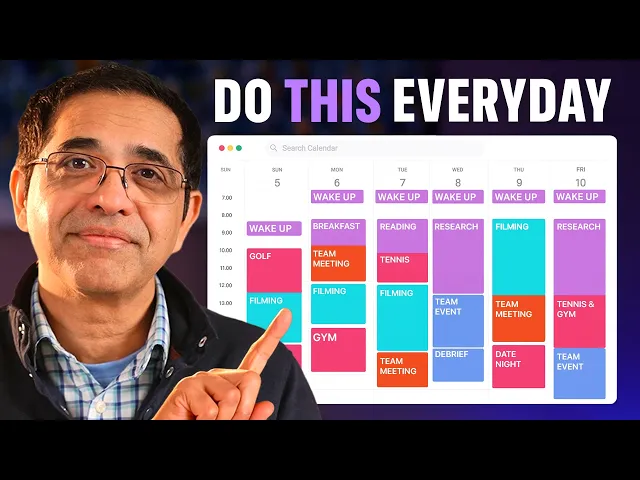
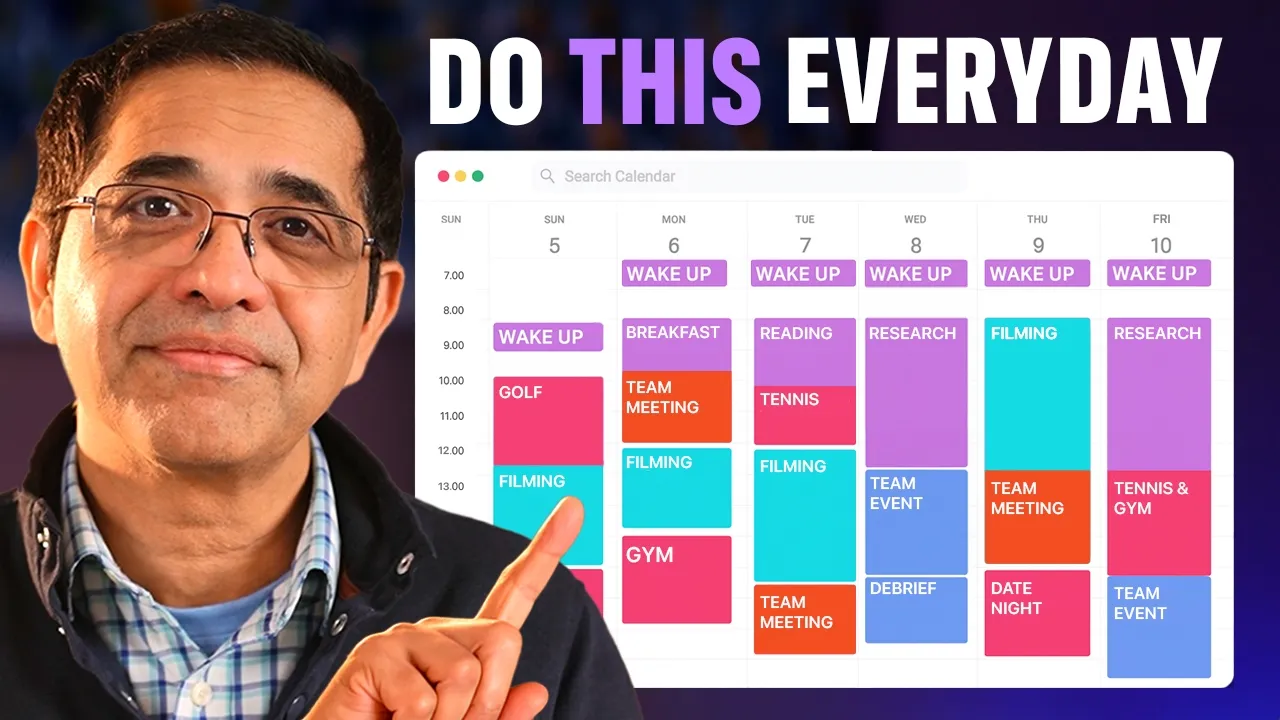
If you want to manage your time like the top 1%, you need to stop following the same old productivity advice and start using a system that rewires your brain. As a CEO, board member, and investor at some of the fastest growing companies, my life was a firefight. For years, every second mattered.
I had to make time for what drives results, cut distractions, and stay in control when things got chaotic. Today, I'll share a simple system I use. Borrow what works for you so you can make time for what matters [music] to you.
But before you apply this system, there is one question that can help you cut through the avalanche of online advice. Everyone has the same 160 hours per week, right? Why do the top performers get dramatically more done without burning out?
Jack Dorsey can run Twitter and Square simultaneously in the same week you and I have. Elon Musk runs more than two companies, same number of hours. These CEOs don't manage time.
They manage their attention. If you're just focused on the [music] tactics of managing time like batching and prioritizing and time blocking, that's great, but you will still miss the big picture. It's about applying what I call the 321 system.
Here's how to do it. The first part of the system is the three roles. Most people fail at productivity because they're playing the wrong game for their level.
Taylor Swift is a [music] perfect example. In the early days, she wrote songs and she recorded songs. Today she has to write, [music] produce, record, perform, make music videos, run business operations, do philanthropy, manage [music] brand partnerships.
All of it while managing a global tour schedule. The time management system that worked for her early on would kill her productivity completely today because her game has changed [music] and her role has changed. How she manages her time has to be completely reinvented.
Marshall Goldsmith says [music] the right thing. What got you here won't get you there. Habits that tend to work in simple phases of life actively harm you when you graduate to a role that demands [music] complex responsibilities.
That's what CEOs learn the hard way. If you want to manage your time like the 1% elites, you have to understand the role you're playing right now. And there [clears throat] are three roles.
Maker, marker, multiplier. First, maker. This is relevant when you're juggling handful of priorities or if you're an individual contributor.
Your role mostly requires that you do everything yourself. Stay in late, stay in your lane, heads down, deep work, details, diligence. You have clear deliverables, clear timelines.
Your time management has to build with that role in mind. Now there are tons of folks I know around the world who love staying in that role throughout their entire career in tech, in finance, in pharma, research, several other vertical. And it's a totally acceptable path for time management and career management if that's what lights you up.
But then some of you will want to graduate from maker to marker role. Now you have to manage 10 to 20 priorities in life all at once. You start managing a team.
Maybe you have a life partner or a family. [music] So in this phase, you can't touch every single thing on your own every single time. And you shouldn't.
Think of it this way. You are transitioning from the maker to the marker mode. Everybody else in your team will produce research, code, business plans, whatever they're working on, [music] but you are the marker.
You're the editor. You give feedback. You [music] give comments to refine their work.
You don't take their work and start rewriting. You build processes [music] that automate everything. You're doing and you're also delegating.
That's the mix. The challenge in this phase is to understand what you [music] can delegate and where you have to invest your own time. Anything that's missionritical to [music] your project or your company or your brand, that's where you need to be totally hands-on.
And from there you graduate to the third role, the multiplier role. That's when you have 30, 40, 50 responsibilities. You're managing a very large team.
In this phase, you have to become what Eric Schmidt calls the most expensive router [music] because your job is not to create. Your job is not to review what other people create. Your job is to recruit, [music] orchestrate, and align your team.
You focus on connecting people. You make strategic bets. You [music] route requests from one corner to the other corner of your team.
You have to stop obsessing over every little detail and focus on the big picture. Taylor Swift again is a great example. Her early career was about being a maker.
Today, she's a maker in music, but she's a multiplier across the rest of her life. The core insight here is that if you don't know what role you're playing, you'll manage your time the wrong way. Delegating when you're a maker and micromanaging when you're a multiplier are both recipes for failure.
You of course have to come up with tricks and techniques to manage your time better, but only after you know what role [music] you're in. Otherwise, your calendar will fill fast with the wrong things and you won't get anything done. Or more alarmingly, [music] no one around you will get anything done either.
But the way you manage your attention is not just about the role you play. It's also about which zone you're in. The second part of the system is about two zones.
Airbnb's founder almost killed the company by following textbook time management advice. So from 2016 to 2020, Airbnb's founder Brian Chesy did what every business school, every business book, and every VC will tell you to do. hire great people and get out of their way.
Let them do their magic. Nothing wrong with that advice [music] because when he was doing that, the business was growing. Brian was enjoying the multiplier role.
But around year 2020, Airbnb's [music] growth started slowing down. Cost started exploding. Co had changed the dynamics of every business including Airbnb.
Chesy had to make a difficult decision. step in, get his hands back on the wheel, and steer the ship through the icebergs. [music] He removed layers of leadership to make the company lean and flat.
He got deeply involved in product, in every critical decision, every [music] important detail, and the result, the company delivered over 500 product [music] improvements in just 3 years. Airbnb went back to being a profitable [music] company. That's how the zones affect your time management and your [music] priorities.
There are two zones, wartime and peace time. [music] When Airbnb was collapsing, that was wartime. That's when you have to roll up your sleeves and get in there.
Once the company stabilizes, step back again, become a multiplier. The key insight is that your zone dictates your role. [music] wartime zone can force you to move from a multiplier to a marker or from a marker to a maker.
Your system has to be this dynamic. You've got to know which zone you're in and act accordingly. When you're building a startup or when you're in a tough market or swimming in the red ocean with sharks, it's war time.
And when you're in wartime, all bets are off. But even if you master your role and [music] your zone, there is one final piece that separates the top [music] 1% from everyone else. The third and final piece of the system is the one non-negotiable.
I have seen many CEOs struggle with this until one brutal question changes everything. When I served as the CEO of our AI company few years ago, I had a great team. The timing was great and we [music] had a great product.
So we were one of the top 20 fastest growing tech companies in the US according to deoid fast 500 and we were absolutely in wartime zone. Every day was just plain chaos and every night I would stay up wondering if we can hire the right people fast enough whether [music] our customers were delighted to have us as their partners. And then I started realizing that I was becoming a bottleneck in every decision.
I had to ask myself that one question. What is the one thing that only I can do? That one thing I should focus on while I delegate everything else.
And I thought about it and I realized that we were growing because of our mission. If I could focus on building relationships with our people and with our [music] customers, then I could articulate our mission even more clearly. I focused on that one thing, relationships, on recruiting, on culture, on internal communication, on customer partnership, [music] every touch point that helped me build the relationships.
The rest of it I delegated. I still had daily standups with our sea level team. We had our weekly leadership meeting, product meetings, tech meetings, finance meetings.
That's the operating rhythm of the company. And you need that to build the execution muscle. But for me personally, my proactive focus was on that [music] one thing that I couldn't delegate, which was building missiondriven relationships.
Now, I'm not sharing this to show off or anything, but to showcase how you can put your CEO hat on. Your 321 system is about three roles, two zones, one non-negotiable. You have identified your one non-negotiable.
But how do you actually delegate everything else without it all falling apart? The best leaders don't manage time, they [music] manage trust. Steve Jobs and Johnny IV are the gold standard [music] when it comes to this.
Johnny IV was the chief design leader at Apple and he designed iPod and iPhone, iPad, Apple Watch. These were complex tasks, [music] right? The designs had to be tasteful but they had to keep in mind the cost.
Cost of manufacturing, cost of supply chain, [music] all of that. So Steve Jobs and Johnny would meet every day for lunch and then they could go for a walk and they would talk about business, design, [music] aesthetics, art. Steve would ask deep questions.
He would review [music] everything. Every detail mattered to him. But here's the thing, Johnny never felt micromanaged.
Why? [music] Because Steve Jobs was there as a partner, not as a boss. He was in the details [music] to learn everything, not to control everything.
And that's what most people [music] miss when they move from doing to delegating. Because leading is not about time management, it's about trust management. You review things but to [music] coach.
You connect but to provide context. You step in but to unblock others. So your time management outside of your own deep work [music] is spent on developing and managing trust.
And how do you find the right rhythm for delegation? It depends on three things. If your teammate is new [music] to the task, work alongside them.
Build trust by giving [music] comfort. If they have some experience, guide them closely. Review steps, but build trust by giving clarity.
[music] And if they're experts, step in to unblock. Build trust by giving context. That's what Steve Jobs [music] was doing with Johnny IV.
If new hires get too much freedom, they will fail. And if experienced people get micromanaged, they will quit. You lose both ways.
So that's trust management. [music] Trust speeds up everything. And remember, you don't need to be a CEO or a founder to apply any of these ideas, right?
You can still apply to your calendar with your teammate, to your roommate, your partner, your spouse, [music] your kids, whoever. So, here's what I would invite you to do this week. Pick any of the following.
Define your role, name your zone, write your one non-negotiable, or delegate one repeatable task. And remember the eternal principle. You cannot control [music] time.
You can only steward the time you have. In the end, good time management helps you make time for what [music] matters to you personally, things that bring you joy and happiness. [music] Because your time is finite.
If you like this video, I hope you find time for another one here that I think you will enjoy. See you next week. Thank you and I love you.