everybody I'm here to talk about the narrow view of CSR which was basically made Popular by Milton Friedman actually the article he wrote which went by the title of his main idea right the social responsibility of business is to increase profits It Was Written In 1970 and it came out uh in the New York Times it was really popular at that time because it challenged the whole idea of what CSR was right actually it was not the a whole new idea because it uh was somewhat emanating from from The Wider view of CSR so in
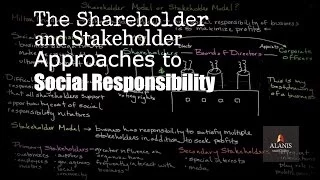
our first really understand what uh CSR narrow view of CSR is it might be useful to find out what it's not or the broader view of CLR so let's do that okay so the broad view uh basically s CSR as it says here it's called Corporate social responsibility the most well-known proponents of of this was that there was there's actually two people here are really famous for the debate it's Edward Freeman for Broadview and our Milton Friedman for narrow view so Edward Freeman was popular for the broad view which is Corporate CSR or basically corporate
social responsibility he made it popular right because his idea was that it was possible for all stakeholders to play a part in CSR right so he was saying that it could come to a point where it's not only uh the business that's profiting or benefiting but it's also the consumers themselves it was like there was like a common ground where everybody can actually uh be benefiting from from the business so it is popular and it had many other terms the most popular of which was big corporate certification movement which was a movement predicated on three
things right it was performance accountability and transparency so for Freeman right those three things matter those are the three more most important things right because because it assured that business was not really just taking care of itself right on the other hand there's the narrow view this time where uh the question of Ethics or ethics no longer matter because business is essentially a game where the business people or the business players have to be engaged in a kind of cutthroat set up where where the rule of the the premise of the game is to get
as much spot as much as possible revenues as they could right so the main proponents one of them is Adam Smith I think you've heard of them in college he had the idea of the Invisible Hand of the market in a free Society we'll get to that later and then there's Milton Friedman which we mentioned in Albert Carr who had the idea of business is a game okay so let's make this fast right about view right I think this was supported by our other classmates any group or individual who can affect her is affected by
the achievement of the organization's objectives and so uh stakeholder view everybody's support and so here as you can see here uh uh there's a pyramid I don't want to explain this because other people are explaining it right but but basically uh it's like actualization on top right so the business is able to actualize itself as an entity that can actually help others and but Friedman then a spouse that idea right uh he believed that although the business has to do is to make money right and according to him this is especially true with companies who
have shareholders or stockholders for that matter uh you can do that yourself right but another person who was famous for this was Albert Carr who compared business to a poker game car said that's it like in a poker game there are unethical things that could be done so just bluffing right the same thing is true for business it meant having to do things that might sometimes be unethical for the business so another person who espoused this view of narrow CSR was was Adam Smith right he argued that the nature of capitalist markets which by the
way is the kind of Market that we have it is all about acting in terms of own self-interest so yeah everybody has a self-interest but taken together it creates the greater good overall right so this one for him was the idea of free Society it would be to decide what you want and when we're deciding what we want and going for it we make a collective effort towards something good right so here are some of the assumptions and assertions from Milton Friedman right he said business should not clearly be concerned with profits no sorry he
was against this idea that business should not merely be concerned with profits they have social responsibilities and they should pursue the cerebral and social dance that's more due to CSR businesses should have a social conscience and take all seriousness in things such as saving the environment putting an end to discrimination so on and so forth right so this and Friedman said businessmen who talk this way are inviting puppets of the intellectual forces that have been undermining the basis of a free Society these past few decades and the main basis of a free Society of Friedman
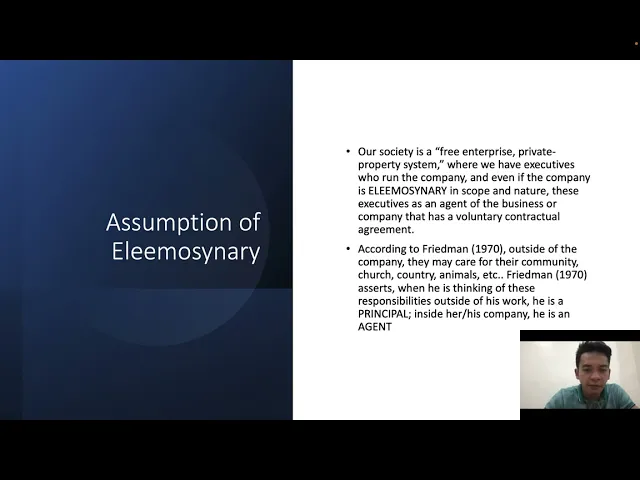
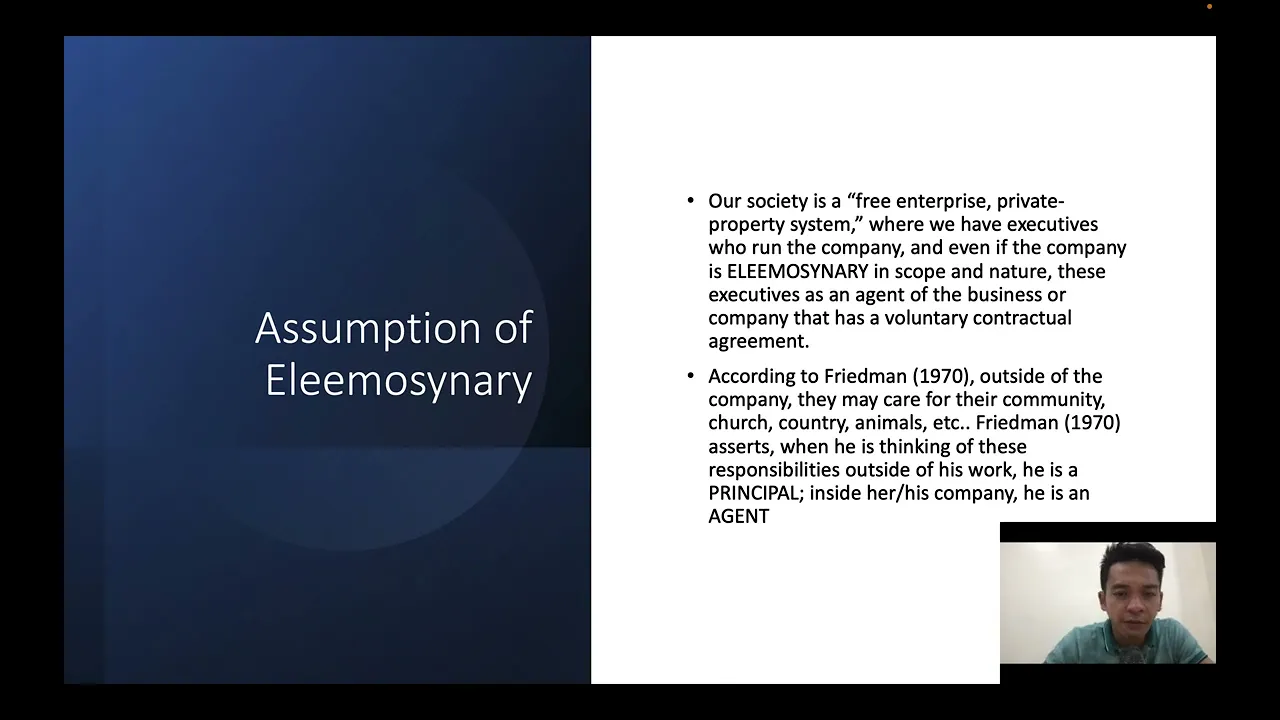
well for him right so long as everybody has a stake on the matter and they are not being taxed by any particular person right that could taken collectively be form a society where everybody can be successful episodes our society is a free enterprise private property system right we buy things we own things where there are Executives who run the company so he said even if the company is earlier schools churches whenever there's an executive there right that executive or that boss is acting as an agent for the business right this means that if he does
CSR it has to be in such a way that he takes it outside of the company because if he's the one who decides he or she the executive decides to do CSR is basically taxing all the shareholders and directly directing it to a horse that only him is the represent representative right uh Franklin was uh for this idea right because at that time 1960s 70s America was clamoring for Taxation and representation right so according to him people can only do CSR outside of the company right because there they become agents at there they become the
principals and they are the principal mover for the goodness of society inside the company an executive is always is always will always have to be an agent okay so what does it mean to say that corporate exec the corporate executive as a social responsibility in this capacity as a businessman according to him this statement is puritatoric it must mean he is that in some way that is not in the best and best of his employers so if you were to be really strict about it for example that he has to refrain from increasing the price
of the product in order to contribute to a social objective such as probably uh being able to help people prevent inflation about handling prices society and if you do things like that you're actually doing a function of the government right not the business so so as you can see here in relation to communication studies it's really so difficult to articulate CSR right according to Pride man right because if you do that you're not really communicating uh uh the tenants of free Society or free market Society at okay so we keep in mind that stockholders of
a business select the corporate executive and this suggests that the executives are serving the interest of the principal which is again uh the boss or or the people who own the company or the shareholders who own the company but when the executive allows taxation to happen through a direct direction of proceeds towards a social purpose it becomes in effect a Public Employee a civil servant even though he remains in the name a name and employee of the private Enterprise right in an ideal free market testing on private property no individual can coerce any other all
cooperation is voluntary all parties to such cooperation benefit or they did not participate these are not values social no social responsibilities in any sense other than the shared values and responsibilities of individuals Society is a collection of individuals you know various groups groups they voluntarily form that is free society and then that is for Friedman condition that is against uh abroad view of CSR 10 according to Friedman 1970 there's one and only one social responsibility of business and that is to use its resources and engaging activities designed to increase its profits so long as it
stays within the rules of the game which is to say engaged in open and free and free market right free competition so I end my apart with this right I hope you get the sense of uh of the model here right because this was really having their parties you'll also be able to understand the broad view of CSR that is that is all thank you for Lending me your ears