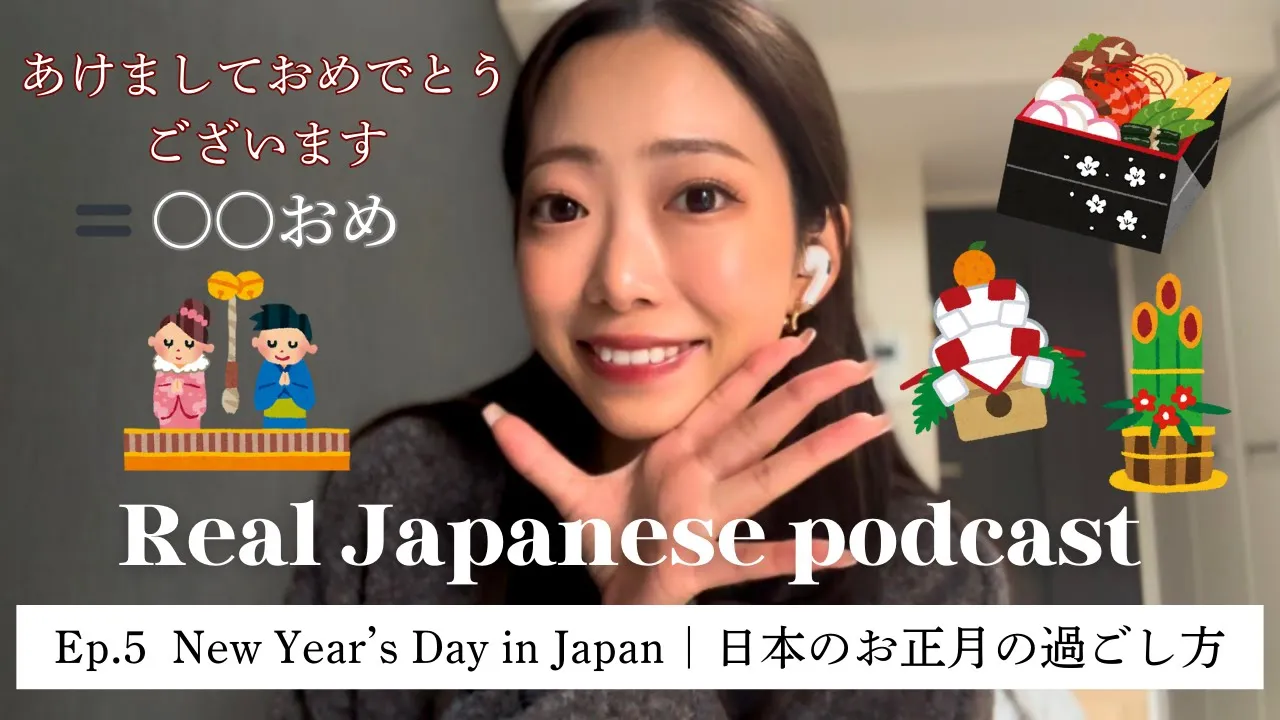
Yaho~ Hello everyone, I'm Kumi. Thank you for coming to watch this video. This time I would like to record episode 5 of my podcast.
Yes, today's date is the 15th of December. I'm filming this podcast on Sunday, December 15th. How has everyone been this week?
Yes, a week has passed so quickly, hasn't it? I took a video last Saturday and uploaded it on Sunday night, but I'm surprised that it's already another Sunday. I'm in a hurry and filming the video right now.
So, last night, I told everyone on instagram story that I wouldn't be able to upload videos this week, and a lot of people said, "It's okay to take your time ,'' and "I look forward to the new episode. '' I was really happy to hear comments like this. I think everyone always supports me like this that I'm able to continue doing YouTube happily.
Thank you so much everyone. Okay, so I don't have anything special to report today, so I'd like to get straight to the point. Yes, the topic I would like to talk about with everyone today is "Japanese New Year's.
" Yes , in my last video, I think I talked about how Japanese people spend their time from Christmas to the end of the year, as I said then, in Japan, Christmas is more of a holiday spent with your lover. I did, right? For Japanese people, New Year's Day is a very important traditional holiday to spend time with family.
Yes, there are really traditional foods and traditional events during the New Year period, so I would like to tell everyone about it because there are many things to do. I hope I can introduce it to everyone . I'm sure there will be a lot of difficult words that you don't know, so it might be a little difficult to listen to, but I'd be happy if you would listen to it till the end.
Yes, first of all, December 31st is called "Omisoka" , New Year's Eve, and it is said that the year changes from December 31st, New Year's Eve to January 1st, in English , there is a saying, "Happy new year," right? The moment the new year begins, everyone says "Happy new year", but do you know how to say it in Japanese? Yes, Japanese people say "Akemashite omedeto gozaimasu" (Happy New Year)at the moment of the new year.
And the next line to say is, "Kotoshimo yoroshiku onegaishimasu"( I look forward to having a good relationship with you this year too). These two are quite a set, so I think it would be good for everyone to memorize them. "Akemashite omedeto gozaimasu.
Kotoshimo yoroshiku onegaishimasu. " Yes, but it's the same as always, but this is a very polite way of saying it, so when I say it to my friends and family, it’s something like "Akeome~'' or "Kotoyoro~. '' Yes, I'm sure you understand, but the initials of Akemashite omedeto gozaimasu are omitted as "Akeome'', and "Kotoshimo yoroshiku onegeishimasu" is omitted as "Kotoyoro.
'' Yes, this is probably used by close people and friends, but I think the younger generation definitely uses it that way. I don't think people older than me would say "Akeome" or "Kotoyoro" but I think someone in their 20s or 30s would say that. Yes, so every please remember this casual version as well.
In Japan, a very famous thing to do at the beginning of the New year is "Hatsumode. '' Hatsumode is when you go to a shrine after the New Year and pray to the gods for a good year. Yes, this Hatsumode which means New Year's visit, some people go at midnight,12am, while others go in the morning, around January 1st, January 2nd, or 3rd.
It depends on the person, so it can be done at anytime, and it's like going to pray to God, for the greeting at the beginning of a new year. At quite famous shrines and really big shrines in the city, there are a lot of people lining up at midnight, and the moment 12 o'clock, people are rushing in and There are food stalls and amazake (sweet sake) is handed out at there. And when Japanese people go to Hatsumode, one thing we do is called "omikuji.
'' Not only do we pray to God, but after that we draw omikuji, but do you know what omikuji are? An omikuji is a small piece of paper with your fortune written on it. Various fortunes are written.
There are various levels of great fortune, medium luck, good luck, and very bad luck, but for example, if you have "daikichi", no matter what you do, everything will go well this year, There are some really good things written about it. If you draw something bad like "daikyou" it will tell you that you won't be able to study well, you'll run out of money, and even if you move, things won't go well. Yes, of course, if you ask me if everything will go well this year just because I draw a daikichi, I’m not sure.
If I draw a "kyou" something really bad will happen? It's really up to the person to believe it or not. For me, it's just fun to draw the omikujis and check my fortune, so I definitely draw the omikujis every year.
I don't really worry about the results of that. If it's a "daikichi", I'll say, "Yey! Awesome,'' but if it's a bad one like "kyou" , I'll think about it lightly, like "Well, my fortune was bad, but I'll do my best to make sure it doesn't happen.
'' Well, I think there are lots of people think like this. After the Hatsumode, another popular thing to do is to go and see "Hatsuhinode" (the first sunrise of the year. ) "Hinode" means the sun rising in the morning, but this is the first sunrise of the year on January 1st right?
So it's "Hatsu"(first) It is called " Hatsu Hinode ( the first sunrise of the year ). There are quite a lot of people who go to see Hatsuhinode. From on top of a mountain or somewhere like the sea?
we go to a place with a nice view and see it. I think there are some people who go to see the Hatsu Hinode. I have never been to see that, so I would definitely like to go and see that at least once in my life.
Well then, it’s January 1st, right? In Japan, it is called "Ganjitsu", and the morning of January 1st is called "Gantan". The period from January 1st to approximately January 7th is called "Oshogatsu".
It depends on the region. In some regions, Oshogatsu means the period up to January 7th, while in other regions, it is called the period up to the 15th. So , I can't say exactly how many days New Year's Day lasts, but my understanding is that it generally ends around January 7th.
In Japan, it has been said for a long time that this is the time when the gods come to your home and welcome the gods. That's why we decorate the entrances of our homes to welcome the gods, and we also make and eat traditional foods such as osechi ryori and ozoni as offerings to the gods. It seems that there are.
I didn't know this either. Yes, it seems like that's what it means. There are several traditional decorations that I would like to introduce to everyone today, but first there is something called "Kadomatsu.
" Kadomatsu is made of something like bamboo or pine, and it looks something like this. I think many families put this at the entrance. The next one is called "Shimenawa" Many people also display shimenawa at their entrances along with Kadomatsu, and they also hang shimenawa on the license plate of their car or on the door of their house.
There are families who wear shimenawa in many places, so when you see them, you can really feel that the Japanese New Year has arrived. Yes, and lastly, there is the"Kagami-mochi". Kagami-mochi has two rice cakes stacked on top of each other, giving it a snowman-like appearance, but it with something like a small mandarin orange on top.
This is called "Kagami-mochi". All of these items are said to be displayed in homes to welcome the gods. As I said earlier, the two traditional Japanese foods that are often eaten are "Osechi ryori" and "Ozoni.
" These two are commonly eaten. Osechi ryori looks gorgeous and uses a lot of Ingredients. However, each ingredient has an auspicious meaning.
For example, as wishing you a long life, good luck in your studies, and good luck with children are packed into boxes called "Jubako". It looks like a lunch box, but it’s a little bit different. they are packed inside a black or red square box.
The meaning behind putting food in a jubako is to wish for many good fortunes to come your way. Jubako boxes are stacked one on top of the other, which is a play on the idea that good luck will come one after the other. Speaking of "Ozoni", the main thing is Mochi.
It's a dish with mochi in the soup, but the taste is depending on the region. For example, if it’s Kanto region, you'll probably have vegetables and mochi in your dashi or sumashi soup, and if it’s Kansai region, it’ll probably in the white miso or miso-based soup. In Tottori Prefecture, where I lived, used only red beans and mochi.
Tottori's Ozoni is a dish made by boiling red beans and rice cakes with sugar. But in my family, my dad liked Kanto-style ozoni, so my mom always made ozoni in Kanto-style. She made it every year for us.
So, I think that Ozoni has a lot of regional differences and there are various flavors depending on the family, but in general, Ozoni is a dish that has mochi in the soup. Yes, we eat traditional foods like this in Japan. Now I'm going to talk about how Japanese people spend their time during the New Year period, but first of all, There is something traditional thing called "Nengajo".
It is something like a postcard. On this postcard, write a message like "Happy New Year. I look forward to having a good relationship with you this year too,'' write the address of the person you want to send it to on the back, and then submit it to the post office.
It will be delivered to the address. So, this Nengajo is actually written before the end of the year, and if you write it before the end of the year and post it , the person at the post office will deliver it on January 1st. Therefore, it is a Japanese custom to send Nengajo to each other as New Year's greetings.
It's a Japanese tradition. But sadly, in this day and age, smartphones are so popular that everyone can use their smartphones to send messages like "Happy New Year! '' on LINE, right?
Yes, that's why I think the number of people writing Nengajo this year has decreased. I think there are probably some older generations who still send it each other, but younger generations know the culture of that, but many of them no longer do so. I guess.
I don’t send it anymore, so I'm a bit sad about it, but I think this is a very good Japanese tradition, so even if I have a child, for example, I feel like I want to teach her that there is such a traditional thing called Nengajo. Second thing, you can get something called "Otoshidama. '' Otoshidama is like a pocket money given by adults to children.
You get money. I don't know the amount, as it varies from family to family, but I think that in my family, we received Otoshidama during elementary school, but since we were still in elementary school, we didn't receive a huge amount of money yet. I remember that the amount started to go up from about 1,000 yen to 5,000 yen or 6,000 yen as I got older.
I think around 1,000 yen to 10,000 yen is normal . Yeah, maybe rich families might get paid 10,000 yen or 20,000 yen, but that wasn't the case for my family. lol.
I don't know because it depends on person However, I am very grateful that I received Otoshidama. So, everyone uses the Otoshidama money to buy something they like, or to save money. In Japan, there are other things called "Hukubukuro.
'' Have you ever heard of it? They are bags that can be bought cheaply, for example, 7 items in one bag for 5,000 yen, but you don't know what's inside, because you can’t decide items for yourself. There are a lot of stores and brands selling Hukubukuro, for example if it is a Hukubukuro released by a clothing bland, you can be sure that it will contain clothes from that brand, but you don’t know what color sweater will it be in, what kind of shape the pants is?
You never know. that's what it is like. You don't really know what's inside, but it's definitely cheaper than buying each item one by one, so it's really fun to open it and wonder what's inside.
I think there are many people who buy Hukubukuro with their Otoshidama because they can have fun opening them. Yes, If you go to a shopping center in Japan, you will definitely find many differently brands selling Hukubukuro, so when you come to Japan, please try to get various things with that. Then, there is something called "Kakizome" Kakizome means writing "shuji" (Japanese calligraphy) in the New Year's Day, shuji means writing characters with ink and a brush.
It's a traditional Japanese thing, but I think there are many people in Japan who does Kakizome. It 's not everyone, but when I was little, I did it at home during the New Year's holidays. You write down your goals for this year in calligraphy .
I was in middle school at the time, and I remember writing the kanji for ”完全制覇 '' The reason why I chose them is because there was an entrance exam that year. It was the year of my high school entrance exams, so it was January of my third year of junior high school. I was about to take an entrance exam, At that time, I was really bad at science, so that I would like to take the exam after I had completely mastered science, and I chose "完全制覇” And I remember my mother always displaying it in our house.
It's already dirty so I took it off the other day, but yes. It's like that, "Kakizome'', means writing calligraphy and sometimes you write your goals for this year. This is how most Japanese people spend the New Year’s day, and I think there are many people who spend the New Year relaxing at home, holding various events with their families.
How do you spend the New Year? Do many people spend time with friends instead of with family ? What do you do when you spend time with your family?
Does it have a lot of traditional things like Japan? I would really appreciated it if you could let me know in the comments Yes, I think this video is probably quite long, but thank you again to everyone who listened to the end.
![[Japanese Podcast] AREKORE Radio #5: Listening to How Learning Japanese Has been Useful](https://img.youtube.com/vi/boLw4_Knjbo/maxresdefault.jpg)

![日本人は年末年始に何をするの?What do you do during the year-end and New Year's holidays in Japanese?[Subtitled CC]](https://img.youtube.com/vi/Jnea4HbYIso/maxresdefault.jpg)
![45 min [Intermediate] Japanese Immersion 🎧 | Natural Chat About Japan's Hidden Gems & Local Life](https://img.youtube.com/vi/QCZlyktsBpI/maxresdefault.jpg)