Today, in the UK, half a million people are suffering from work-related stress. Can you believe that? We need these breaks in order to really restore ourselves and to really step back for a moment and to get some peace in a way and to help us to de-stress.
In the US, 13% of injuries sustained at work can be attributed to fatigue. A doctor might say to you, or you need to get some rest while you recover from, say, your operation. But what does that actually mean?
And more than a quarter of people have fallen asleep at work. And even more alarmingly, 16% have fallen asleep recently while driving. On average, people got three hours rest to the previous day.
It's clear that we are facing a rest deficit. What can you do about it? We need to value this because it does make a difference to our health and our mental health.
So the rest test may be share some of your findings. We found that two-thirds of people said they wanted more rest. What about television?
People who are watching one hour a day of TV have higher wellbeing levels on average than people who aren't. Not watching, watching any. Welcome back.
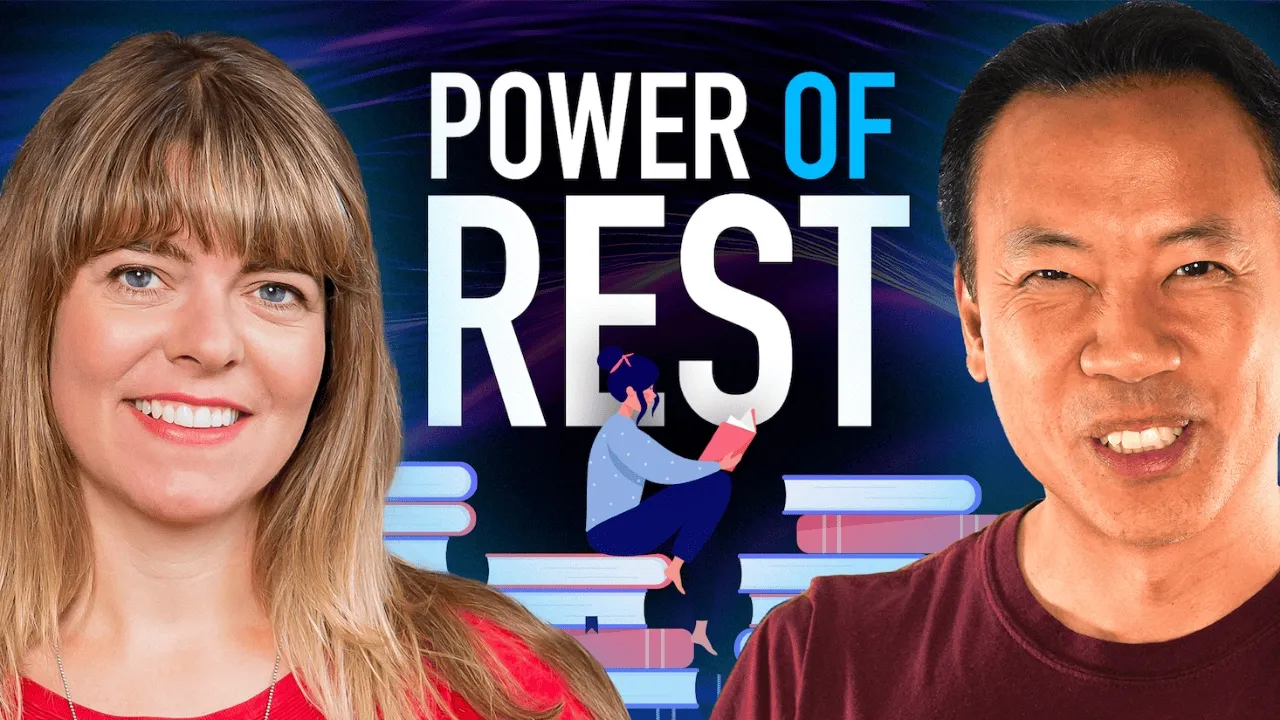
Quick brains. I am your host and your brain coach, Jim Quick. When we think about rest, we immediately think about sleep, which is a subject we've covered many times in this podcast.
But it's not necessarily the same. Our guest today, Claudia Hammond, is here to share a simple yet somewhat counterintuitive message. It's time to take rest, Mary, seriously.
Claudia is an award-winning broadcaster, multiple author, psychology lecturer. She is the host of all in the mind on BBC Radio 4, which covers psychology, neuroscience, and mental health, and also hosts the weekly global health show health check on BBC World Service. In her book that we're going to be talking about today, The Art of Rest.
And I'm holding this for those of you watching the extended version on YouTube. You can join us there with 1. 6 million subscribers.
She challenges our culture's obsession with being constantly productive. You know, busyness is a badge of honor nowadays. And drawing on the largest global study on rest ever conducted, she will reveal a startling truth our approach to relaxation might be all wrong.
Welcome to the show, Claudia. Thanks very much for having me. We're really looking forward to this.
And for those interested in this conversation, I encourage everyone to get the The Art of Rest. This was definitely one of my favorite reads this year. So much so we're adding Claudia's book The Art of Rest into our book club for the month of November, I believe.
And so make sure you get your copy and to join book club it's again quicksuccess. com. So probably the question Claudia, everyone is is asking is in their mind is what is the difference between rest and sleep?
And why is it important to focus on both? What is the difference in the benefits of receiving from each and what your approach there? Yeah, it's definitely the case that they both matter and obviously sleep is well, hopefully being asleep.
If you can get to sleep and stay asleep, then it's being asleep. And we know that that has matters of benefits for your mind and for your body. And we know how very difficult it is if you are tired and you were talking about accidents and all those sorts of things.
And we know why sleep is so important now. And I think sleep has begun to be taken much more seriously. But I really want the same to happen for rest.
So rest is what we do when we are awake. So it's something that's that's restful and it feels restorative. It feels as if it replenishes you, but it's something that you do when you're awake.
So it could be having a break. It could be going and getting a cup of tea. It could be exercising.
You know, some people find they can't really switch off that worrying that continually goes on in their mind until they have exhausted their bodies physically and that that's what really helps their minds. And for them, that will count as restful. So it's very, very individual and people will find that different activities are the thing that feels restful for them.
But you know you're resting if afterwards you feel a bit better than before. You feel that you are a bit restored and that you've been able to relax. I mean, it's very similar to relaxing and that maybe you've been able to stop worrying for a while that you've perhaps been distracted.
It could be something like listening to music or watching TV that distracts you, but it takes you out of yourself for a little while and away from those worries and works as some kind of some kind of break. And we need to take it more seriously because it's no good just being on the go all the time or asleep. We need these breaks in order to really restore ourselves and to really step back for a moment and to get some peace in a way and to help us to de-stress.
I like that where rest is you're still awake, but it's there's a restorative aspect and I'm going to go through some of these activities in a moment in terms of your kind of go to. I always tell people that sometimes we're burnt out not because we're doing too much, but sometimes I feel like we're burnt out because we're doing too little of the things that do restore us, the things that make us come alive. Now, your book is based around the rest test and a lot of our audience, they really like the science.
And we like to interpret the science as something that can inform some practical pragmatic things, little things that people could do when they're listening or afterwards to make a shift. So the rest test, this was carried out among I think it was 18,000 people living in 135 different countries. Maybe you could explain and tell us a little bit how this test was done and maybe share some of your findings.
Yeah, it was fascinating because I was working with a group of people from all sorts of disciplines with artists and musicians and psychologists and neuroscientists, historians, geographers. And we were all working together for a short while at Welcome Collection, it's a big biomedical funder in London. And we were working there together on the topic of rest and everyone was interpreting it in different ways.
You know, the composer composed the piece of music all around rests that you get in music, we looked at it in different ways. And what I wanted to know was what do lots of people, what are thousands of people think about rest? And it's a bit confusing if you look at the evidence so far, if you look in the literature, in the medical literature sets, not always that well defined.
So a doctor might say to you, oh, you need to get some rest while you recover from say your operation. But what does that actually mean? Some people will interpret that to mean, oh, I can just not go to work, but I can go out with my friends and go shopping, do anything I like.
Others might think, oh, this means I have to stay in bed. Others might think, well, this means I can be up and about, but I should alarm the sofa all day. So it's not very well defined.
And so we wanted to know what are lots of people think about rest and so a group of psychologists from the University of Durham, which is in the north of England. And I, we got together and we devised an online survey, if you like, and it was called the rest test. And we asked people all sorts of different things, we asked them about how much rest they get, whether they would like more rest, whether they think they get more rest or less than the average than other people.
And we used all sorts of very well used, well defined measures on to measures say they're well being. And also people's personalities to try to find out what are the differences that are going on here, who's getting more rest and who's getting less. And 18,000 people from around the world took part, as you said.
And we found that two thirds of people said they wanted more rest than they were getting, which is a large number. And you could say, well, people decided whether to take part or not. Maybe they took part because they're also interested in rest, but it did take a good 30 to 40 minutes to fill in.
And so if you were really lazy, I don't think you would take part in it in the first place. So people told us that they wanted more rest. And we found that on average, people got three hours rest the previous day.
But when we looked at well being, we found that those who got between five and six hours rest the previous day had the highest levels of well being. They went slightly down again when you got near, say, 11 hours. So it's not a question of, oh, if you just rest all the time, that's the best way.
This is all about the rhythms of rest and activity in our lives. And so for those people who's well being was a bit lower, who was say getting 11 or 12 hours of rest. Maybe they were unemployed and didn't want to be or maybe they were ill and so they were forced to rest.
And so their well being was not as high. But we were really struck by this five to six hours. And I know that that might sound like a really long time.
You're thinking, how on earth could I fit five or six hours resting in? But it all depends on what counts and feels restful for you. So for some people, that might be cooking the supper.
If you like cooking, then that might be a restful thing. Some people may find their train journey to work if they can stare out of the window is restful. Other people, if they're crammed in, standing in a train and not getting a seat, their commute might not be as restful.
And we found that people who feel that they get more rest than average and who don't feel in need of more rest had well being levels twice as high as the others who felt that they did need rest. So there does seem to be something going on there with rest and well being that it seems that it does really matter. And is something we should therefore take seriously.
But I think sometimes sometimes we don't want to sort of the last thing we do as rest if we've got new time left. Because we need to get done all the busy things that we've got to do first. And so that can that can make rest feel like a very low priority.
But perhaps we should be changing our views about that. So these restful activities are individual per person, like cooking could be restful for one individual, but not necessarily, you know, for the person, their neighbor. I'm curious.
Was there any kind of touch on this where there are things that you your team expected to be true. That you found not as much like, you know, where they're findings that that surprised you. Yeah, it was it was interesting.
Yeah, we were we were very interested in in the activities that people said they found restful. So we asked people to name the three activities that they found the most restful. And so we put those together.
We have a top 10 and a top 20, if you like. And where we were really surprised was that things that you might expect that people do in there in their leisure time, like socializing or seeing friends and family or going out eating. Those things didn't appear not only in the top 10, but barely appeared in the in the top 20.
So those things, those socializing things and we know how important connections are psychologically. But those may be very enjoyable, but they weren't restful. And so the top five activities, which people said that they found most restful, were things that people tend to do when they're on their own.
Leading us to think that maybe what we need in order to get some rest is is a rest from other people in a way. Like however much you love the people around you, if they're with you, you're always considering what are they thinking at any given moment. What are they thinking about the situation?
Are they happy? Is everything okay? What do they think about what you've just said?
What are you going to say next? All those things are going on in our minds all the time when we're with someone else. And so a chance to be on your own.
And in fact, being on your own came at number three. Seems to give us a chance to rest and recuperate a bit and be ready to go. And then you might think, oh well, surely the people who were really outgoing, the extroverts, surely they would find being with friends restful.
But even then, if we, because we used to look at a personality measure, so we knew who the extroverts were. If we took the people with the most extroverted, still these activities that people did on their own came up as the most restful, because it's different from what's enjoyable. It's what's restful.
And it seems that we do need a bit of that as well. And they're disconnecting to maybe reconnecting with themselves. So if being alone was number three, can I ask what two and one are?
Yeah, so number two was being in nature. And most people found that restful. So 53% of people had that as one of their top three.
And then number one was surprising, actually. Nice for people who write books like me, but number one actually was reading. 58% of people said that they found reading restful.
Now that is really interesting because reading involves, of course, some cognitive efforts. You've got to read the words, think about what you've read before and how that fits in and work out what it all means. And you have to concentrate.
And it was interesting that that came top. And I think all of these activities are telling us something about the essence of rest in a way. And I think one of the things about reading is that, again, it takes you away from your worries.
It takes you into this other world, whether it's fiction or nonfiction. It's often about either something else or someone else or somewhere else, but it takes you away from away from yourself. And also it's a really good jumping off point for daydreaming.
And so there's, you know, there's research showing that people aren't always concentrating when they're reading. And you must have had that where you, you read the whole page and you think you were concentrating. You realize you've got to the bottom of your eyes, move down, but you weren't actually concentrating at all.
You read it again. And you read it a third time and then you maybe give up because you think this is just not going in. I'm just not concentrating.
And studies have found that some of the time people are doing this and you can tell this by, you can actually track their eye movements. And so you can tell whether they're concentrating or not. Because if we're concentrating, your eyes slow down very slightly if there's a long word or a really unusual word.
But if you're doing what psychologists slightly judgmentally call mindless reading, then your eyes go along at a regular pace. So you can find some of the time people aren't concentrating. But I don't think we should beat ourselves up about that because it is what it means is that maybe you are daydreaming about something else.
And books are a good, a good jumping off point for that because they take your mind elsewhere. They make you think about all sorts of things and that makes you remember things and make other connections and think about other things. And that that's okay because we know that there are some real benefits from daydreaming.
If you're not ruminating about something negative, if you're ruminating about something negative again and again, then there's plenty of evidence that that's not good for your well-being. But if what you're thinking about is something nice, then and different possibilities, then we know that there are benefits from that, particularly for things like creativity. So it's okay to daydream.
And in fact, daydreaming came at number eight, which I thought was interesting that actually people were saying they found this restful letting their mind wander a bit was a thing they found restful. I love that. We have one of the largest communities of readers in the world.
For our speed reading program, we have students in 195 nations. We had a lot of feedback and I've had the opportunity over the years. I've been doing this for 32 years, sit in labs and where they do these eye tracking exercises and assessments.
And reading definitely takes a cognitive load. It takes a significant amount of cognitive power. I always tell people reading is to your mind what exercises is to your body.
And it could be in a way sometimes people would say it's depleting around their minds because it could take us again certain amount of focus and mental energy. It was interesting. What about television?
How did, you know, it could be, I don't know if this is controversial every and as a resting activity. What does, I know, I don't know what the stats are in terms of the average person, how much they consume in terms of television or Netflix or what have you. Did that make the top 10?
You have too much to read but too little time. Studies have shown that your ability to read is directly correlated to your level of success in life. But when was the last time you took a class on how to read?
I want to introduce you to the quick reading free master class. In this free training, I'll show you how to instantly increase your reading speed by 25 to 50% or more. Plus you'll boost your understanding, your comprehension, your focus and concentration along the way.
Don't miss out on this life-changing opportunity. Click the button or go to gymquick. com forward slash speed to access this free training now.
Yeah, it did. It was interesting. It was at number nine.
And we counted watching TV could be screaming or, you know, whatever they were doing, watching moving, watching moving pictures on your screen. And that did come at number nine and was something people said that they found restful. And it's interesting.
I think this feeds in again into the slightly the rest from other people in that a lot of the time people are watching TV in parallel with someone else. And that actually it's a really nice activity to do with someone else because you haven't got to talk, but you can if you want to. But you've got this shared focus on something else.
And what you're looking at is essentially stories again, whether it's, you know, documentaries that are or reality TV or dramas. What you're looking at is stories and in a way, you know, since the dawn of time people have sat around the fire and, you know, exchange stories. And now we're lucky enough to have them realized by, you know, the best directors and actors in the world can make something completely amazing and gripping and interesting to us.
And again, I think it takes us out of our world for a while. And if you look at all the evidence on watching TV, then yes, if people watch a lot of it, then, then there do seem to be poor associations with, with wellbeing. So your wellbeing might go is lower, say in people who are watching five or more hours a day.
But people who are watching one hour a day of TV have higher wellbeing levels and average than people who aren't watching, watching any. And I think it's, and sometimes people will say, oh, but it's empty time. You don't remember it afterwards.
Well, that all depends what you watch. So, you know, I can, I will remember some scenes from some amazing dramas for, forever, you know, I like things like Breaking Bad and The Wire and things like that. We're so amazing that I'll remember those things for a very long time.
And so I think it's a question of just, you know, deciding carefully what you watch so that you're not wasting your time so that it is something valuable. And that this is something that people can, where they can feel restored afterwards. And after it, and it is in a way, a very, very popular activity.
It is many people's go to, of an evening, if they've finished everything they've eaten, they've got the kids to bed. And there's a bit of time is to, is to sit and watch something. And I think, I think maybe people shouldn't feel too guilty about that.
One of the things that really struck us was that some people said that they felt guilty every time they rest due. And this is the biggest thing I've had people, I've spoken lots and lots of book festivals and science festivals and other events and public events about rest. And the main thing that people have come up to me and said is that from reading the book, they learned that you shouldn't, you don't have to feel guilty about resting.
And they some have said that, you know, they find that a kind of life changing inside that they don't need to feel guilty. That it is okay because there are benefits and there are real benefits for our mental health of resting. Just in the way that, you know, I don't feel guilty when I go running because I know that that is good for me physically and good for me mentally.
And one of the biggest changes I've made actually is not feeling guilty anymore about doing something that's restful or taking a break. I love gardening and I've got a small garden, a tiny greenhouse. And when I was working from home, I did use to sometimes go out into my garden for, say, 10 or 15 minutes and have a little potter and dead head things.
I always felt a bit guilty about it. And now I deliberately don't feel guilty because I think what I'm doing is I'm protecting my mental health for the future and for now just as I protect my physical health by going running that this is another thing I'm doing to protect myself. And if you can find the right activity for you, then you can feel the kind of worrying thoughts start to disappear.
And you know, the moment I go out into the garden and start engaging with with the plants and with what's going on, I completely forget for a moment what I was worrying about and what I was doing, say, work wise and concentrating on and thinking all this too much of this and this is all really stressful. So if you can find that activity that can make such a difference and then and not feel guilty about it, give yourself permission to rest. It's interesting that there's diminishing returns on something like binge watching television, you know, certain benefits, but also it could certainly not be as rewarding and maybe even detrimental by spending more time.
There's a minimum amount of minutes that qualifies as rest or do you have a recommendation? Let's say somebody's taking a little bit of a brain break from work and they only had 10 minutes. What can they do something that would count as a restful or energy restoring activity?
Yeah, definitely. And I mean, the research on micro breaks, I think is really interesting because sometimes people will say and it's an absolute fair point. They'll say, but you know, I've got a job or two jobs and kids to look after, parents to look after, you know, there is no time to rest and I absolutely get that.
But micro breaks can make a real difference and some of the research on that is really interesting. And often what we do is we make our breaks a reward for when we finish something, particularly if we're up against a deadline. So there's some really interesting German research that found that this is a thing we often do.
So you know, you've got, I don't know, an hour and a half left to get this project finished and get it in. And so you think, well, well, I'm going to do is I'm going to get absolutely head down. I'm going to get that done.
And then I'll go make a cup of tea afterwards. And actually, because we know that our attention and our focus can increase if you've had even a really short break, actually you should go and get that cup of tea now and come back with it because you'll be more focused and able to concentrate better. So if you possibly can, even taking a two minute break up to your deadline can help.
There was an interesting study done in South Korea where they got people to take micro breaks throughout the day. Every hour or so, just two minute micro breaks where people could say stay out of the window or doodle or lean their head back in their chair and just shut their eyes, but stay awake or go and get up, drink and bring it back to their desk. So tiny short breaks.
And they found that they an hour later, their attention levels were still higher. And at the end of the day, their well-being was higher. So even fitting in short breaks can make a difference.
And I'd say, you know, I say to people, you want to get a personal prescription for rest. So it's a good idea to think, to work out, well, what are the activities that I find restful to start noticing? What is it you find restful?
And then try and work out how you can fit short amounts of that into your day. Even if it is only two minute breaks, just getting up and walking around does make such a difference. Our company, we do a lot of corporate training in Facebook, Nike, SpaceX, Google, doing mental fitness training, brain optimization, accelerated learning around speed reading and memory.
I'm curious how knowing all that you know, all the research that you've compiled, when you're looking at a workplace or a school, and how would you go about encouraging or implementing these like rest activities as it's shown to increase productivity in a world where in the workplace where you always have to be working. What would you say to somebody, you know, like maybe somebody's listening, they want to bring this to their manager, the idea of creating a rest break or incorporating rest activities to be able to convince them that it's worthwhile and it's not just kind of not working. Yeah, so I've been taught to lots of companies and I think that it's a question of showing people the evidence, thankfully companies are taking organizations, many of them are taking mental health much more seriously now.
And they want their staff to be well and they want their staff to be productive, but they also don't want their staff to be feel miserable and stressed and to leave, particularly at the moment where recruitment is harder. And of course, you want to have happy staff and happy staff do well. And so I think it's a question of looking at their evidence to be able to say, well, look how beneficial breaks are, you know, they do make a difference, they do help you to concentrate better.
And that you will actually get more done, not less by having those breaks, but more importantly that you will feel happier and less stressed. And then I think it's a question of incorporating that into the culture, which we'll, we'll start with leaders showing leadership by doing this themselves and not, you know, if they're, if they're seen being there till 10 every night and not ever taking a break, then that's not a good example to set for people below. But also I think it has to be realistic or you can just annoy your staff.
So if you just say to your staff, oh, you've all got to take breaks, it's really important, but you're overloading them with so much work and with perhaps more work than they used to do because they might be doing other people's jobs as well. But if numbers have been cut, then it's got to be realistic in terms of their workload. Otherwise, it will just, you know, annoy people more.
But I think it's interesting that schools say in the UK, senior schools used to have breaks in the afternoon. When I was at school, there was a break in the afternoon, as well as morning and lunchtime. And now only 1% of schools have that afternoon break.
And so there is so much to fit in that the breaks, the breaks are what disappears. And we need to value those. You know, I say to people, put, put your breaks in your diary, rather than see, well, what space is left at the end when I've done everything else?
We need to value this because it does make a difference to our health and to our mental health. And so, so put those breaks in your diary so that you do have a break, you know, schedule breaks between many people, if they're working from home now, you know, help will have back to back Zoom meetings. And that's really, really tiring and hard to concentrate in is to try to don't always start them on the hour so that you can fit breaks in around those times as well so that you're not just stuck in front of your screen.
You know, I think this conversation is extremely valuable just to sign a spotlight on this, this very essential activity of rest because I imagine some of the listeners, they either feel like they don't have time to rest. Or they feel guilty if they did, you know, some of these restful activities because they're not doing something, you know, quote unquote, productive. And this is in a way giving people, making people feel seen and also encouraging people that this is, this is valuable.
Even we have some an acronym, we use a lot of acronyms with what we do and, you know, I did one recently called refuel where the R stands for rest and it's a starting place for all then you have exercise foods, us, meaning, you know, this positive peer group. The R &B's environment, L is always like the learning part. I'm curious, having wrote the art of rest has a change your own approach to rest in any way and maybe what is the key takeaway?
Do you hope readers will gain from the book? What I have done is to give myself permission to rest and to see that this is a good valuable positive thing, this is good for my mental health, this is protective and in a way of, you know, taking care of myself so that I can do all the all the work and all the fun things as well that I want that I want to be able to do. The other takeaway is that business can become a badge of honor, you know, it can become something where we may feel very busy, but also we'll say to people how busy we are because when they say, how are you?
We'll say, oh, I'm really busy, a bit too busy, but how much is that really acclaimed to status as well by saying, you look, look how busy I am, I must be really wanted, I must be really important. And that actually we shouldn't be valuing business for its own sake in that way, that it should be possible to say to people, well, you know what, I've been, I've been having a bit of a rest or I've, you know, I've been trying to fit in some other things and I'm trying to look for a different bounce in life between activities and restfulness, that that should be okay to say and should not be something to be embarrassed about and we should start taking it seriously because it really does matter to our mental health. I love it Claudia, we're excited to have you in our book club later this year, everyone get your copy of the art of rest, how can people get their book or stay in touch with you?
Yeah, so the book is, you know, in book shops and, you know, online at the big retailers and others and my website is Claudia Hammond. com and I'm on Instagram at Claudia Hammond and Twitter as well, so you will find me on all of those places. Outstanding, well, I really appreciate it, as always, we'll put all of the sites, the Claudia's book, social media, her own website at our show notes, gymquick.
com forward slash notes. So Claudia, thank you so much again for joining us and I really look forward to having you in our coming book club. Yeah, well thanks for having me in the book club, it's going to be great, really looking forward to it.
Everyone can go to quicksuccess. com to enroll in our book club and as we've learned today, rest isn't a luxury. It's not a sign of laziness, it's a non-negotiable, it's an essential component of a healthy, productive and more fulfilling life.
So I challenge everyone listening to take what you've learned in this conversation and share maybe on social media and you can tag Claudia, tag myself. Just one way you're going to incorporate more intentional rest into your day and I would love the feedback, how it impacts your energy, your focus, your overall sense of happiness or well-being. I want to remind everybody that we should recharge ourselves like we do, I don't know, our phones, right.
You have permission to rest, you are not responsible for fixing everything that is broken, you don't have to try to make everyone happy. Remember to take time to rest and recharge and replenish. And as always, you define more ways to fuel your brain's potential on our YouTube channel where we post the extended version of this conversation.
So make sure you do that also as well. And make sure you hit the subscribe button there, leave a comment on what you thought about this episode, any questions that you might have. We look forward to seeing you in book club, Claudia, thank you so much again.
Thank you. Yeah, this is your brain coach Jim Quick. Until next time, everyone, be limitless.