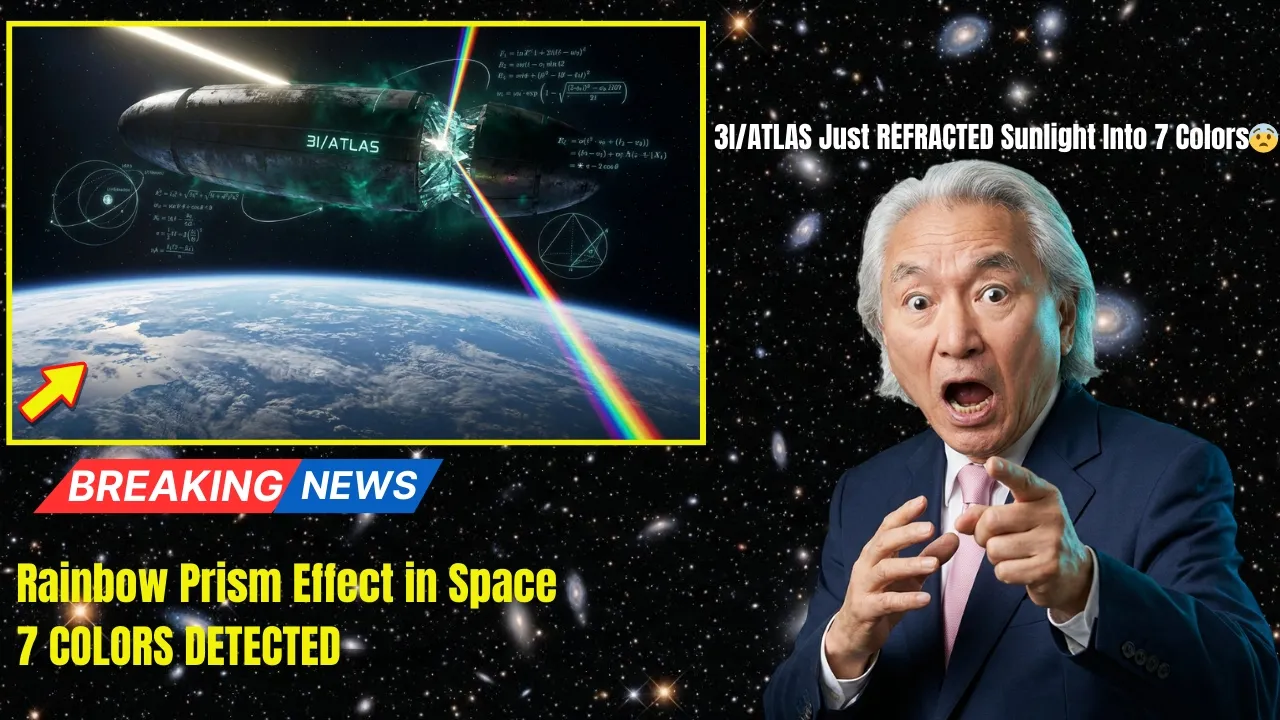
Hello and welcome. It is February 17, 2026, and what I am about to share with you challenges the fundamental laws of commentary physics. Six hours ago, NASA's James Web Space Telescope turned its NI Cam instrument toward threeey atlas.
We expected to see the usual coma, a dusty, chaotic cloud of ice and rock reflecting sunlight. We expected gray. We expected white, but we didn't see that.
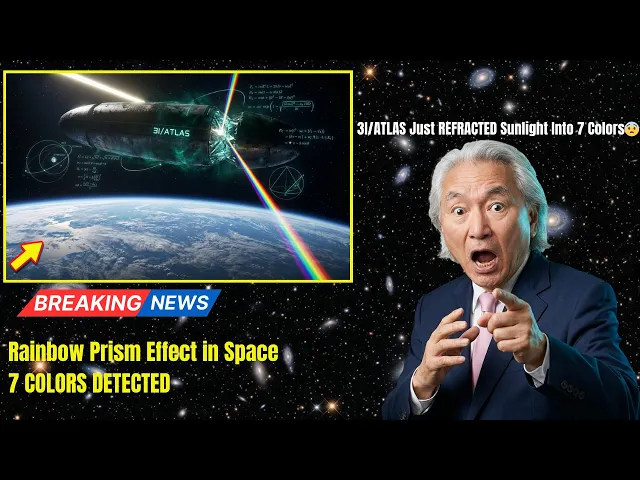
Instead, at 8:42 UTC, three IAS did something that a dirty snowball simply cannot do. It didn't just reflect the sunlight. It refracted it.
Picture this. The object of pure white solar light and split it into seven distinct coherent bands of color. Red, orange, yellow, green, blue, indigo, violet.
A perfect highdefinition spectrum projected against the blackness of deep space. Think about that for a moment. In nature, rainbows are created by spherical raindrops in an atmosphere.
But three eye atlas is in a vacuum. To split light this precisely without an atmosphere, you don't need a cloud of dust. You need a prism.
You need a solid transparent structure with geometrically flat surfaces angled at exactly 60°. Nature does not build precision optical prisms in the chaotic void of the outer solar system. The probability of a comet naturally forming into a perfect triangular prism capable of this refraction is effectively zero.
It is statistical noise. And yet three independent observatories have now confirmed the data. The light coming from three IATALS isn't random.
It's engineered. To understand why this data has silenced the control rooms at the Space Telescope Science Institute, you have to understand what a comet is supposed to look like. In my field, theoretical physics, we often describe comets as dirty snowballs.
They are messy aggregates of frozen water, carbon dioxide, methane, and dust. When sunlight hits them, the light scatters in every direction. It creates a diffuse white glow.
It's like shining a flashlight into a fog. The light gets lost. It gets fuzzy.
But the data from February 17, 2026 shows the exact opposite of chaos. At 9:15 UTC, just 30 minutes after the initial alert, the James Web Space Telescope's NIR spec instrument, which analyzes a spectrum of light, sent back a reading that looked like a laboratory calibration test. It was too clean.
The graph didn't show the jagged random spikes of a dusty coma. It showed distinct separated peaks of light intensity at specific wavelengths. 650 nanometers for red, 510 nanometers for green, 475 nanometers for blue.
The separation between these colors was mathematically perfect. Now, skepticism is the immune system of science. My first thought was glitch, a sensor error, a calibration drift in the telescope's mirrors.
NASA thought the same thing. So they called the European Space Agency. At 10:45 UTC, the Uklid Space Telescope was rotated to target the coordinates of three eye atlas.
Uklid is designed to map the geometry of the dark universe, but its visual sensitivity is legendary. Uklid didn't just see the object. It confirmed the refraction.
Then to rule out any space-based sensor anomalies, the call went down to the ground. The very large telescope VLT in the Atakama desert of Chile, arguably the most advanced optical instrument on Earth's surface opened its shutters. Three independent sources, three different technologies, one impossible reality.
NASA's NIspc detected the split. ESA's UKID visualized the bands. The VLT confirmed the angle of dispersion.
This is a smoking gun. If this were a sensor glitch, it would appear on one machine, not three. The fact that three distinct eyes separated by thousands of kilometers and different methodologies are seeing the exact same rainbow effect means the phenomenon is real.
It is physical. It is out there. Let that sink in.
We are looking at an object 240 million kilometers away that is manipulating sunlight with the precision of a high-end camera lens. And uh but the data gets even stranger. When you analyze the uh refractive index, a number that tells us how much a material bends light, you get a specific signature.
Water ice has a refractive index of 1. 31. That is the standard for every comet we have ever studied in the history of astronomy.
The refractive index calculated from three this morning is not 1. 31. It is 1.
52. Why does that number make astrophysicists sweat? Because 1.
52 is not the signature of ice. It is not the signature of frozen methane. It is not rock.
1. 52 is the specific refractive index of crown glass. High quality silica based optical glass.
Nature creates ice. Nature creates rock. Nature creates gas.
Nature does not create giant optically pure slabs of crown glass floating in the interstellar void. And there is one more detail in the telemetry that defies explanation. Comets tumble.
They spin chaotically as they heat up and release gas. If three eye atlas were a normal tumbling object, the rainbow effect would be flashing, flickering in and out as the object rotated. But the spectrum is stable.
For the last six hours, the color bands have remained steady. This implies that three atlas is not tumbling. It is locked.
It is stabilized. The face of the prism is held at a constant angle relative to the sun, correcting for its own orbit. A natural object does not stabilize itself against solar radiation pressure.
A natural object does not maintain a perfect 6deree angle of incidence to create a spectrum. We are no longer looking at a dirty snowball. The data suggests we're looking at something crystalline, something transparent, something manufactured.
The physics here is intriguing and not in the way a new supernova is intriguing. in the way that a flying saucer landing on the White House lawn is intriguing. Let me explain why what we are seeing is not just unlikely, it is according to our current understanding of cometary formation absolutely impossible.
When you look at a comet, you are essentially looking at a chaotic mess. Imagine taking a snowball, rolling it in charcoal dust, freezing it to absolute zero, and then throwing it into a blender. That is a comet.
The surface is rough. It is porous. It is dark.
Comets are typically darker than asphalt because of the carbon compounds on their surface. Dark rough surfaces absorb light. They do not refract it.
To refract light, to bend it and split it into a rainbow, you need three things. And you need them all at once. First, you need transparency.
Not just kind of clear like dirty ice. You need optical clarity. The material must allow light to pass through it without scattering.
If there are bubbles, cracks or dust particles inside. The light gets scrambled. It turns white.
It doesn't split. The fact that we are seeing distinct separated bands of red, green, and blue means the internal structure of three is flawless. It suggests a single massive crystal lattice with almost zero internal defects.
Second, you need geometry. This is the part that keeps me awake. A sphere like a raindrop can create a rainbow, but a sphere scatters light in a cone.
It sends the rainbow back toward the light source. What we are seeing from three Atlas is different. The light is passing through the object and fanning out on the other side.
That requires a specific shape, a prism, a triangular wedge with flat polished faces. Nature does not polish flat faces in the vacuum of space. Micrometeoroids constantly bombard every object in the solar system.
Over millions of years, any smooth surface gets pitted and scarred. It becomes frosted glass. Yet, the spectral data from JWST implies surfaces that are optically smooth to within a fraction of a wavelength of light.
Think about that. The mirror of the Hubble Space Telescope was ground to a precision of 150th of a human hair. That took years of effort by the finest engineers on Earth.
And now we are supposed to believe that random collisions in the or cloud accidentally created a surface with that same level of smoothness and the odds are astronomical. And the third requirement, stability. This is the nail in the coffin for the natural comet theory.
Comets are dynamic. As they get closer to the sun, they heat up. The ice turns to gas sublimation.
This gas shoots out in jets like little rocket thrusters. These jets make the comet spin, tumble, and wobble. It is a violent chaotic dance.
If three eyeatlas were tumbling, the rainbow would flash. It would disappear and reappear as the angle of the sun changed. It would be a strobe light.
But for the last six hours, the spectrum has been rock steady. That means threeey atlas is not tumbling. It is locked.
Imagine holding a prism in your hand and trying to reflect a rainbow onto a wall while you are spinning in an office chair. The rainbow would be a blur. To keep the rainbows steady on the wall, you have to hold the prism perfectly still relative to and the light source even while you are moving.
San Atlas is moving at 44 km/s. It is rotating around the sun and yet it is maintaining a precise orientation that keeps the angle of incidence exactly right to produce this spectrum. This implies active stabilization.
It implies gyroscopes. It implies reaction wheels. It implies intention.
When I run the numbers, I keep coming back to one conclusion. We are not looking at a natural formation of ice and rock. We are looking at a manufactured object.
The refractive index of 1. 5 to crown glass combined with a geometric stability and optical clarity points to something artificial. Is it a lens?
Is it a shield? Is it a communication device? Because here is where the physics gets truly terrifying.
We assume the rainbow is just a side effect. But what if the rainbow is the signal? In fiber optics, we use something called wavelength division multipplexing.
We send data down a glass fiber by splitting light into different colors. The red light carries one stream of data. The blue light carries another.
The green light carries a third. By splitting the light, we can send massive amounts of information simultaneously. If three is splitting sunlight into its component colors, is it possible that it is using the sun itself as a carrier wave?
Is it modulating the sunlight? This brings us to the most disturbing part of the new data. We have established that the rainbow shouldn't exist.
We have established that the stability shouldn't exist. We have established that the material crown glass refractive index 1. 52 is statistically impossible for a comet.
But that was just the appetizer. The main course arrived on my screen 45 minutes ago and it changes everything. When you look at a rainbow from a prism, you see a continuous gradient of color.
Red fades into orange, orange into yellow, and so on. It is smooth. It is analog.
It is beautiful. But when the data from the high accuracy radio velocity planet searcher HRPS in Las Chile was processed, they didn't just look at the colors. They looked inside the colors.
They found gaps, specific sharp vertical black lines in the spectrum. Now in astrophysics, we call these frownhoer lines. They are absorption lines.
They tell us what elements are present in a stars atmosphere. Hydrogen absorbs one frequency, helium another. It is a cosmic barcode.
But the lines in the threei atlas spectrum do not match hydrogen. They do not match helium. They do not match carbon, oxygen or any known element on the periodic table.
The lines are spaced uh artificially and uh let me be very precise about this. In a natural spectrum, the absorption lines are random. They are messy and they are determined by quantum mechanics and the electron shells of atoms.
In the spectrum of threei atlas, the dark bands appear at regular integer intervals. 500 nanometers, a gap 55 nanometers, a gap 600 nanometers, a gap. They are spaced exactly 50 nanometers apart across the entire visible spectrum.
Nature does not count by 50s. This is not chemistry. This is mathematics.
This is modulation. Think about a fiber optic cable again to send a digital signal. Ones and zeros, we turn the light on and off very quickly.
But over 240 million kilometers, that signal would degrade. It would get lost in the noise of the solar wind. But what if you didn't turn the light off?
What if you simply blocked specific frequencies? What if you used the prism itself as a filter? By carving microscopic grooves into the surface of the comet, like a defraction grading, you could create these specific dark bands, you could encode information into the rainbow itself.
The spacing of these bands 50 nanmters apart suggests a level of manufacturing precision that rivals our best semiconductor fabs. We are talking about structures etched into the surface that are smaller than a virus. And here is the kicker.
The gaps are not static. Every 23 seconds, the pattern shifts. The gap at 500 nmters disappears.
A new gap appears at 525. Then it shifts back. It is blinking.
The rainbow is not just a refraction. It is a display. It is a transmission.
We are looking at a dynamic modulating signal encoded into the very sunlight that three atlas is refracting. And we have been watching it for six hours. The amount of data contained in those shifting bands, it is staggering.
NASA's deep space network is currently recording every photon. They are treating it as a first contact scenario because there is no natural process, no outging, no rotation, no crystallization that creates a shifting integerbased mathematical pattern in the spectrum of light. None.
So let's be absolutely clear about what we are looking at. We are looking at an object made of a material with the refractive index of high-grade optical glass. We are looking at an object that has stabilized its rotation against the chaotic forces of the solar wind.
We are looking at an object with surface features etched so precisely that they create a defraction grading capable of modulating sunlight. And we are watching that modulation shift in a repeating mathematical pattern every 23 seconds. This is not a dirty snowball.
This is not a rocky asteroid. This is a lens, a massive engineered optical instrument sailing through our solar system. Is it a telescope?
Is it a solar sail? Or is it something far more advanced? A relay station designed to take the light of our own sun and code it with information and beam it somewhere else.
The implications are staggering. If this object is artificial, it means someone built it. Someone launched it and someone is operating it.
The prism effect we are seeing might just be the exhaust. It might be the side effect of a propulsion system we don't understand or it might be the main function, a lighthouse in the dark signaling its presence to anyone with the technology to see it. Uh for decades we have been listening for radio waves.
We have been looking for laser pulses. We have been waiting for a message in a bottle. But maybe we were looking for the wrong thing.
Maybe the message is in a radio beep. Maybe the message is written in the light itself. As I speak to you now, the Hubble Space Telescope is being retested.
The Keb Observatory in Hawaii is opening its dome. Every major telescope on earth is turning toward threei atlas because the pattern has changed again. The gaps in the spectrum are no longer shifting every 23 seconds.
They are shifting every 11. 5 seconds. The transmission rate just doubled.
Something is happening out there. We are not looking at a comet.