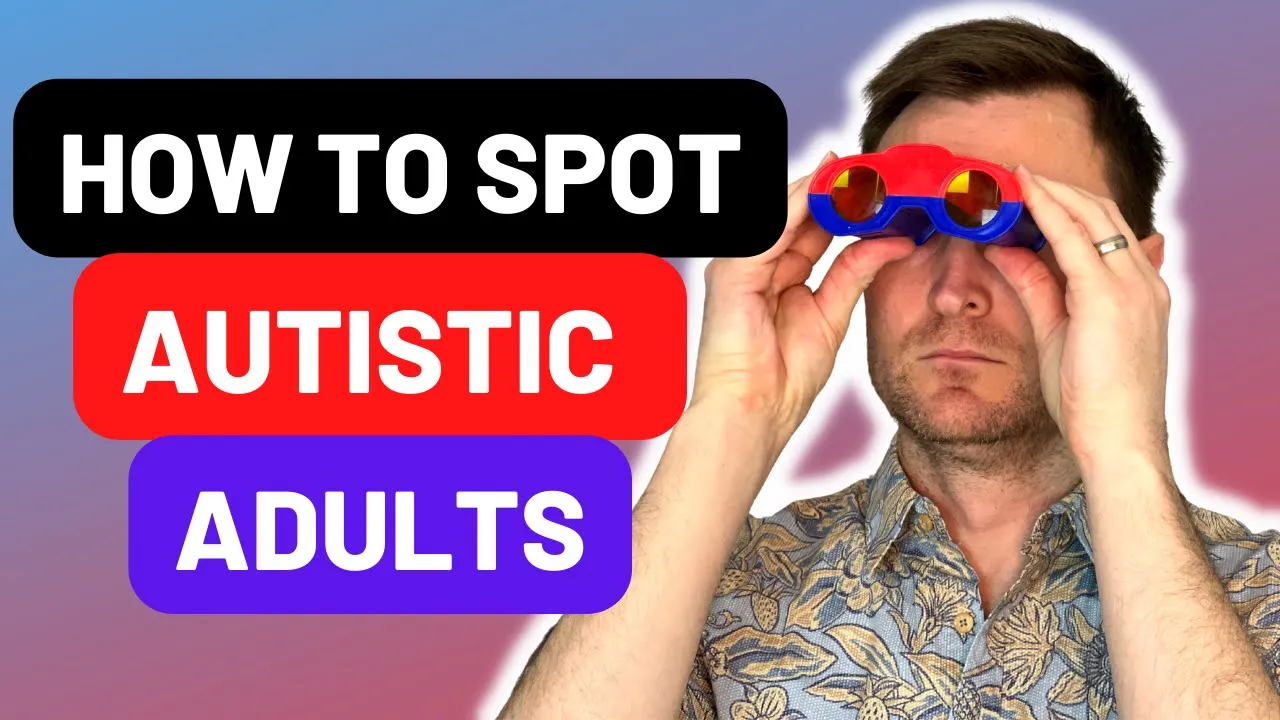
hang on a second I think that's an autistic person all righty then these are the top signs and traits to look out for if you think an adult in your life may be autistic the first sign to spot an autistic adult is that they prefer alone time rather than the company of others so while they may like spending time with you you might be their partner or their friend they prefer not to entertain others in their own home as an autistic adult our home really is our safe space and that's no different for kids but
as you get older and there's more stressors thrown upon you more demands placed upon you your home really becomes this Fortress of Solitude I'd also say autistic adults including me can be very protective in maintaining our safe place and I'd go as far as to say to the detriment of others now you might think what if this is our safe place place and other people want to come into that it doesn't really matter what effect we have on them to make that go away you know we're super protective of this safe Zone to the detriment
of others which really doesn't even appear on our radar and the last thing I'd say about safe zones or your home for an autistic adult or someone you think may be an autistic adult is this disproportionate response this overreaction in your mind to the simplest things like a door knock or an Uninvited Guest and for me you could throw in just too many people in my home these are the things that you might think who cares someone the door someone just rocked up to say hello or you know there's lots of people here we're all
having fun you might think that for me that's not the case this is a uh not not anything mere this is a major intrusion on my safe zone so yeah there's going to be different reactions and they're going to seem disproportionate another sign to spot an autistic adult in your life is do they have communication challenges or do they communicate in a very different way like I do do you find them constantly asking questions or interrupting you while you're trying to tell them something do you find yourself being peppered with follow-up questions that aren't always
even relevant to the topic of the conversation autistic adults often like to question every point of a conversation dissecting every last word I do this with my wife all the time I do it to process what I'm hearing so I can understand it and I can cont tribute of course that doesn't mean it's not incredibly frustrating for the people in the conversation with me I get that but critically without the endless questions for the most part autistic people will tend to Simply misinterpret what you're saying so but for all these endless questions we may never
interpret correctly what you're trying to convey to us so there's a point to them they're just frustrating so as an autistic adult let's say with my wife if I'm having a conversation or she she's trying to tell me something and let's say I decide I'm just going to listen from start to finish suppress all urges the chances are I will misinterpret what she says and I'll launch some sort of Counterattack so I'll take it the wrong way and attack anything that I don't understand is a personal attack on me and I must attack back or
I'll just go off on a tangent that's completely irrelevant autistic adults can also become disinterested in conversations really quickly we can lose focus and patience and honestly sometimes I'll just say to my wife can you just get to the point what are you trying to tell me can you just tell me what you're trying to tell me and often there is no point see as an autistic person it doesn't occur to me that people would talk when they have no point to make they would just talk my wife is entitled to just vent to just
debrief to just she's entitled to just tell me a story no point just a story she wants to share for an autistic person this can be very confusing so it works both ways to understand it where it's coming from from both sides the next sign to spot an autistic adult is that they seem to focus their time and energy inwardly as an inward Focus rather than say outwardly focusing like many neurotypical non-autistic people it's been said that women focus on people while men focus on things and that may be right or wrong but for autistic
people it's even more specific than that autistic adults tend to spend a lot of their time not all their time focusing on their passions their special interests in other words we adopt an inward focus by default it's not something we've chosen to do we just wake up and by default Focus inwardly so there's a clear favoring of our passions our interests over everything else and part of that inward focus is a tendency to mask or suppress our true selves and our true emotions and feelings to keep them inside while at the same time though struggling
to interpret to process and deal with these emotions and feelings that we're trying to hide this next sign to spot an autistic adult is do they seem to live in a world of their own autistic adults can sometimes just appear clueless to what's happening around them unaware of what's going on around them stuck in their own little world I absolutely can struggle with the awareness of others around me or the awareness of others in general and this would include a lack of awareness of presence of wants needs feelings and the intentions of people we're spending
our time with we can also lack an awareness of time and space our surroundings environment and our own personal needs we can also appear to be living in a world of our own because we can really struggle with identifying body language verbal and non-verbal cues voice tone and just generally language that can make us feel like we're an alien living on a foreign Planet the next sign spot an autistic adult is that they tend to struggle in multitasking so managing multiple tasks demands or even interactions for me as an autistic adult I have a strong
urge or need that I must complete a task before moving on to another task and there may not be any logical reason why one task is more important than other to other people but for me this must be done before I can do this and I would put this sign under the banner of executive function okay so we have executive function challenges like for example in my case not being able to appropriately prioritize tasks so an example for me is I can put certain tasks first I can make them a priority while to others they're
not actually important or the priority but in my mind they are I can also feel like a strong sense of resentment towards other people or other tasks things that are not remotely connected to my interest or passion getting in the way of me doing tasks that are connected to my interests passions that are a priority of mine people tasks come up and get in the way of doing what I want to do bad at Uni when I was studying law and this was obviously very bad I had to complete one assessment or essay or whatever
you want to call those kind of you know in semester assessments one at a time it didn't matter if multiple assessments were due at the same time I could only work on one at a time for moving on to the next assessment I guess I struggled to switch from thoughts and themes and I thought well if I'm doing an assessment on criminal law how could I possibly concurrently do an assessment on property law it's I can't whoa that's no that doesn't compute and even if they're do at the same time another sign to spot an
autistic adult in your life is they appear just generally super sensitive to things like smells and tastes and noises and light and I'm talking sensitive to a level that doesn't seem right to you or other people in other words they may be sensitive to Smells or tastes or noises or lights that don't bother anyone else so on the surface it can seem unbelievable disproportionate just plain made up but sensory processing challenges and hyp sensitivity to sensors like smell touch taste noise light these are very common challenges for autistic people a particular Paradox that can really
frustrate my family is I can be really hyp sensitive to noises so I can get really St I'm startled so quickly I get startled all the time and a lot of times I end up just putting my hands on my ears because I can't hear this noise anymore or I don't know how to get past this noise but the Paradox being hyp sensitive to noise but why are you so bloody loud o Ryan you're always you're always talking loud you're so loud you're banging and clanging it's funny it's a paradox I guess it's interesting and
I think it's pretty common as an autistic person I am really super sensitive to banging and clanging and noises but I am that person also and this is a sign you may have noticed certain voices or noises or actions can set off an autistic person straight away out of nowhere and it just makes no sense how that's possible for me a squeaky door loud eaters can't be in the room with loud eaters you know what what's worse slurpie drinkers do you know what's worse than that I'm a loud eater and I'm a slurpie drinker having
you a part of this community means so much to me so thank you for clicking subscribe joining the community and supporting me Orion Kelly that autistic guy until my next video we'll talk soon