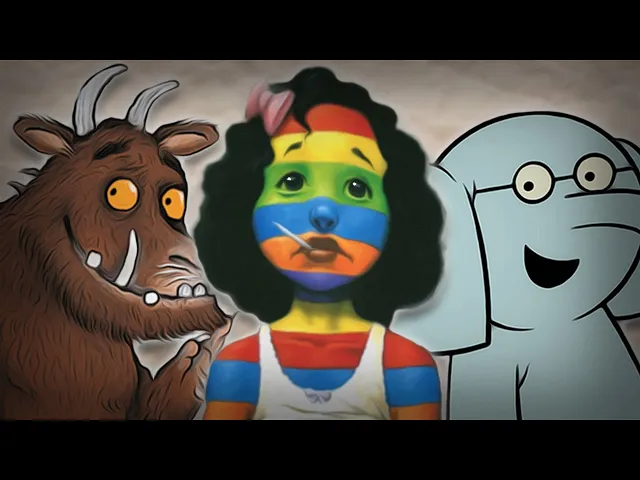
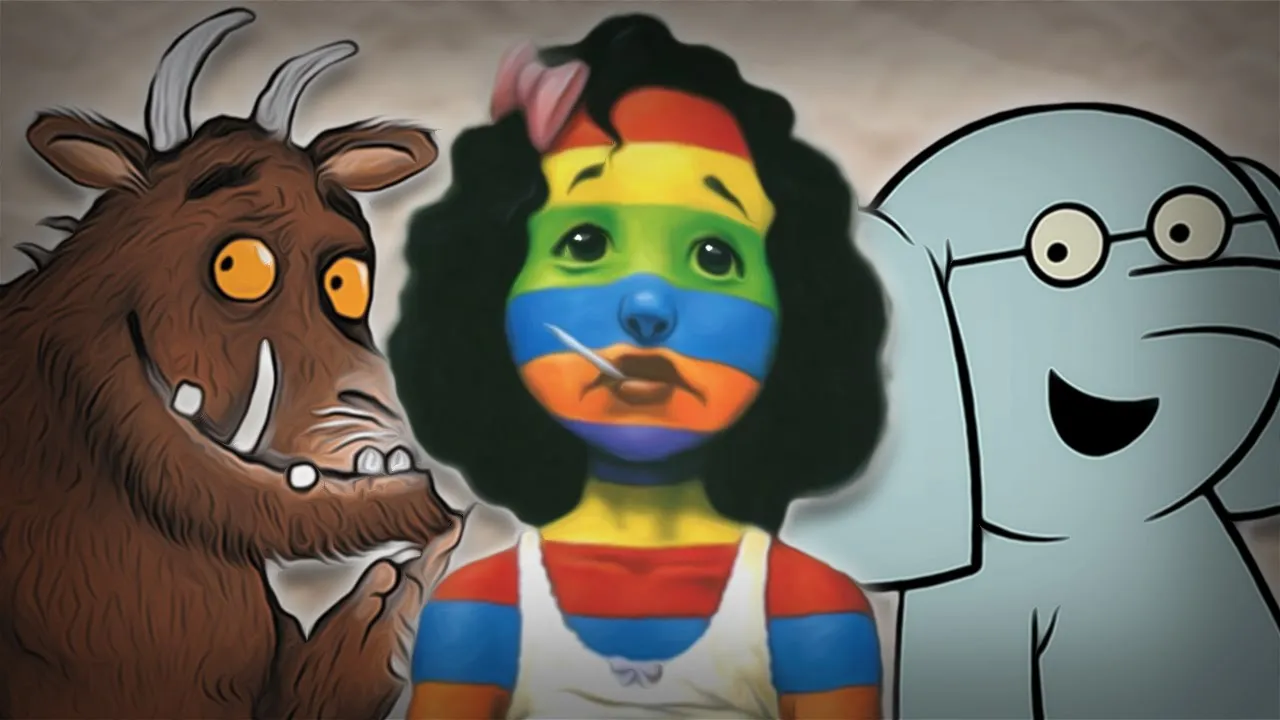
The Gruff by Julia Donaldson is one of the best-selling children's books of all time. Most people read it or consumed a version of it at some point in their childhood. It was first published in 1999, and while the main themes are simple enough to pick up on, a lot of young readers didn't recognize its darker hidden messages.
The story goes as follows. A mouse travels through a forest in search of some different food. On his journey, he's approached by various hungry predators, a fox, an owl, and a snake.
In an effort to save himself, he makes up an imposing monstrous creature called the Gruff. And his descriptions are enough to scare them off. While the mouse doesn't actually believe the beast exists, he ends up being approached by one at the end and tells it that he's actually the most fearsome creature in the forest.
He asks that the Gruff follow him back as proof, which it does, and the predators cower in fear at the sight of the monster, while the Gruff thinks they're hiding from the mouse. This is enough to scare off the gruff and the mouse enjoys his meal in peace. Now, the moral is clearly that brains and wit can be a stronger tool than violence and power.
While some have criticized the book for glorifying the act of lying at a young age, others speculate that the mouse in the story is actually a metaphor for smaller, less powerful nations using propaganda to intimidate larger forces and manipulate public perception. The mouse is motivated by a desire for more. He's in search of different food because what he has in his part of the forest isn't enough.
And such greed could be a gateway to authoritarianism. The mouse is painted as the good guy because he only lied to protect himself. Though it was greed that compelled him to begin with.
But if you really want to change the way you look back on your childhood, what if Piggy from Elephant and Piggy was never actually real? Mo Williams was an author that I'm sure most people read at some point, even if you didn't realize it. His iconic book, Don't Let the Pigeon Drve the Bus, is instantly recognizable, and his stories were very surface level, but he'd insert little details like a pigeon being hidden in almost all his books.
And while that was very on the nose, there were more subtle clues in the subtext of some of these narratives. The theory sounds pretty tinfoil hat at face value, but there's a good amount of evidence to support it. Elephant and Piggy first debuted in 2007, and it follows two central protagonists.
Gerald the elephant is characterized by being the rational, cautious one who constantly overthinks everything. This is represented even in his physical appearance. He's an elephant, large, heavy, and slow, which symbolizes the stressful weight of overthinking.
He wears glasses, which could represent his need for clarity and perceiving reality. Piggy, on the other hand, is spontaneous, optimistic, fearless. She's driven entirely by having fun and exercising emotional freedom.
Gerald's also a real name, while the pig is just named Piggy. Piggy is constantly trying to push the elephant into being more confident and doing things that he's not comfortable with, like going to parties. But Gerald remains skeptical.
The theory suggests that Piggy is the manifestation of what Gerald wants to be, but doesn't have the mental strength to do so. Maybe as a result of some past trauma. And yeah, if you haven't picked up on it already, like a kid's version of Fight Club.
Tyler Deran is everything that the narrator is not and drives him forward in a similar way. In one of the entries of the series, I'm a frog, Piggy acts like a frog and Gerald is immediately convinced that Piggy could have suddenly taken on a new form. He becomes genuinely distressed, stating that he was sure 5 minutes ago she was a pig, talking to himself as if Piggy wasn't even there and his mind was playing tricks on him.
Usually they just interact with each other and a few other characters, but occasionally there's a meta moment where they directly identify the reader. Specifically, we are in a book. Gerald randomly goes, "I think someone is looking at us.
" Piggy never realized this until Gerald pointed it out and then she noticed right away. Gerald finds out the book is going to end at some point, which leads to him freaking out and having an existential crisis. The final book released in 2016 and was titled The Thank You Book.
Piggy goes on a thanking spree, showing their appreciation for all the characters that have made appearances. Piggy is taking center stage, doing all the talking for Gerald up until the very end, where Gerald is the one that recognizes one last person. The only one that Gerald addresses is the reader.
Gerald tells Piggy that she did a great job thanking everyone, and Piggy says it was all thanks to Gerald. This is a weird line to end with because again, it was Piggy that did all the talking, unless she didn't. This whole finale could be seen as Piggy finally being let go because Gerald becomes self-aware and doesn't need her anymore, while the reader serves as a representation of the outside world or even God to him.
A lot of famous picture books about behavior center around a character who's such an exaggerated troublemaker that it forces the reader to take on the role of a parent or teacher and sympathize with the characters who had to discipline them. No, David would be an example or don't let the pigeon drive the bus. But some authors took it in a different direction with stories that challenged authority.
In particular, Click Clack Moo Cows That Type by Darin Cronin. The story is really simple. Some cows on a farm decide they're not satisfied with their working conditions and the barn is too cold at night.
So, they use an old typewriter to request electric blankets. And when the farmer refuses, they go on strike, denying him any more milk. This inspires the hens to also go on strike so he doesn't have milk or eggs.
Eventually, the farmer gets a message from the duck, a neutral party, requesting the blankets in exchange for the typewriter. He complies, but the next day he gets a note from the ducks asking for a diving board for their pond. It's a light-hearted story about negotiating and having a voice, but it's aimed at ages 3 through 8.
a pretty early stage to learn about Marxism and labor exploitation, which is why some have suggested it had other more extreme agendas. Perhaps the book is amusing and filled with laughter, but teaching our children how to strike and how to organize and create a union is wrong. We are a capitalist society.
Liberals and progressives are now aiming at your children, much the same that the German governments did in the 1930s. Wow, does history repeat itself or what? Do yourselves a favor and educate yourselves to what collective socialist progressives are trying to do to you and your children before it's too late.
The book is a lesson about socialism. It's about trade negotiation and has no lesson about how to be a respectful son or daughter, be a good friend, to get along peacefully with others, to share how to love the people around us, or how to love ourselves. Most of Cronin's other work is very inoffensive and kid-friendly, so it's unclear what the true intentions were with the book.
It was probably just another unserious story featuring farm animals. Though that didn't stop parents from being paranoid about it indoctrinating children with socialist ideals. The rainbow fish had a similar effect and is even more controversial.
In the story, a colorful fish gives away all his scales to the other fish who were jealous of him, and it makes him feel fulfilled. It was intended to promote generosity and selflessness. But the book's been criticized, especially in conservative circles, for pushing a communist agenda.
The idea that it is absolutely moral, that if somebody comes to you and asks for something that you are now supposed to give away everything that you have earned, and this is somehow good for society, pretty like I have serious moral objections with Rainbow Fish, which makes it a perfect SJW book, very popular with the commie crowd. A Bad Case of Stripes by David Shannon was one that didn't exactly have an underlying political message and actually had some really strong, clever themes. Yet, it still managed to traumatize countless young readers since it was published in 1998.
It has some of the most grotesque, unsettling imagery of any children's book. And if you didn't know what it was about, you wouldn't even think it was meant for kids. People who grew up reading it were so distracted by the jarring artwork that it was easy to miss the point of the story and overlook some of this symbolism.
It's a book about personal identity. A girl named Camila Cream loves LMA beans, but she's too scared to admit it because she thinks everyone will make fun of her. But suppressing these feelings leads to her waking up one morning with colored stripes all over her body.
When she goes to school, all her classmates ridicule her, yelling out various shapes and colors that get projected onto her skin. Throughout the book, doctors and therapists attempt to give her remedies and cure her, but everything they try only makes the condition worse, eventually taking on the shape of her room. It isn't until an older woman visits at the end and offers her LMA beans that Cama goes back to her normal self.
One detail that's easy to miss is the girl's name, Cama, as in Chameleon. The stripes themselves are a uniform pattern. They serve as a motif for conformity.
When Camila hides her personality to fit in with everyone else is when the stripes first appear. The doctors and the medicine they give her represent society trying to fix people's differences rather than accepting and celebrating them. All the other patterns and shapes she adopts are the visual representation of letting people code a false identity onto others until they become lost in the act.
All the characters wear plain formal clothing except for the woman at the end. She's wearing bright colors with polka dots and an unconventional hat. The woman is unapologetically herself and is the one that shows Camila how to do the same.
Anyway, a few of these were just theories and haven't been confirmed, but I wanted to look at these books in a different light. In most cases, people read these when they were like eight and haven't revisited them since. So, there was a lot to be overlooked.
Let me know your thoughts and if I missed something.