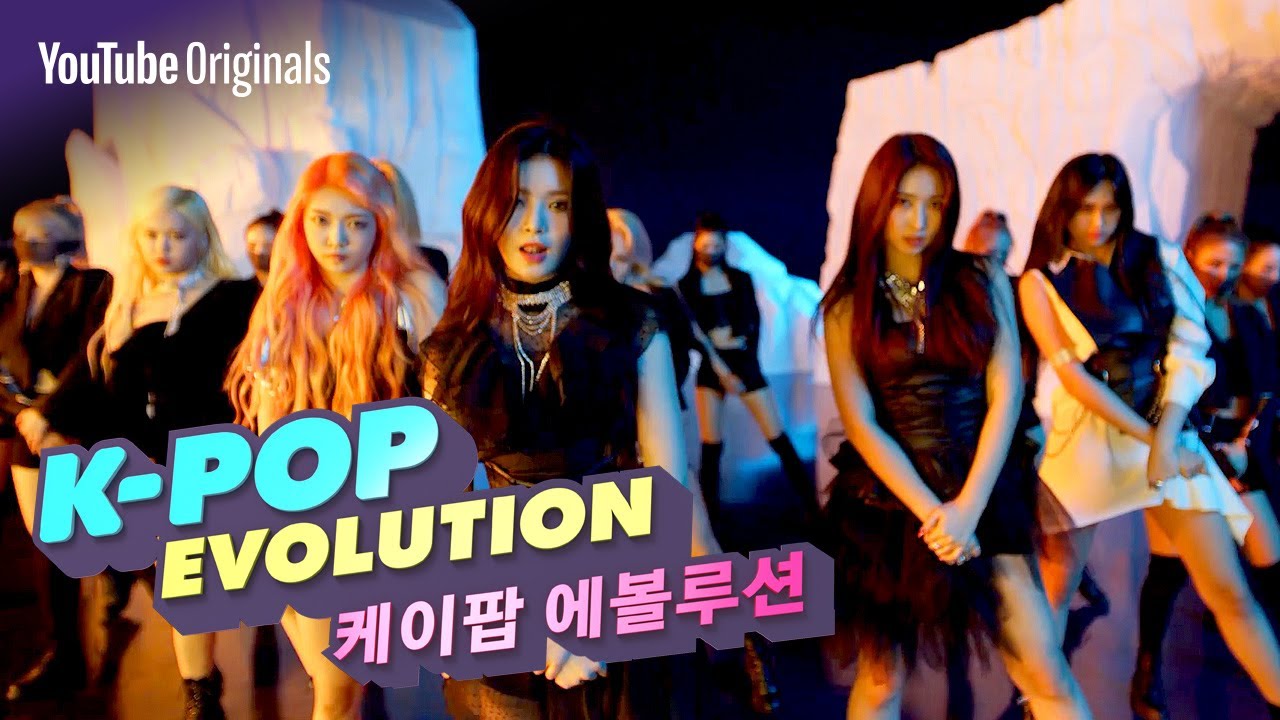
(dramatic music) Interviewer<i> So, and what is K-Pop? </i> (upbeat pop music) Amber Liu:<i> It's bright lights,</i> <i> vibrant colours,</i> <i> crazy concepts. </i> Everybody has to dance.
(upbeat pop music) Joon Park:<i> It's about the fans. </i> Fans are everything. (upbeat pop music) (upbeat pop music) (slate clacking) What is K-Pop?
K-Pop is huge. (crowd cheers) (upbeat pop music) (crowd cheers) (lively pop music) Korean pop culture is the third largest export industry for Korea. News Reporter:<i> K-Pop super group Super M</i> <i> gets Billboard's Grammy nod.
</i> (lively pop music) James Cordon:<i> I'm joined by K-Pop sensations Black Pink! </i> (crowd cheers) A global phenomenon, BTS is here! Bernie Cho:<i> It's become the new normal</i> <i> for Korean music acts to have a billion YouTube views,</i> <i> so the next question probably should be,</i> <i> how did we get from</i> <i> the traditional Korean popular music.
</i> (soft singing in Korean) To this phenomena? (upbeat pop music) Bernie Cho:<i> Itaewon is the Harlem of Seoul. </i> <i> The Haight-Ashbury,</i> <i> the Sunset Strip, all rolled into one.
</i> <i> In a sense,</i> <i>you can say that Itaewon is the birthplace of modern K-Pop. </i> (lively groovy music) ♪ (lively groovy music) (lively groovy music) (groovy guitar music) ♪ (sombre singing in Korean) ♪ (soft rock music) JinJoo Lee:<i> I'm JinJoo. </i> <i> I play guitar in a band called DNCE.
</i> <i> I'm in America. </i> <i> Originally from Korea. </i> That's me.
I grew up listening to all this amazing blues, <i> funk rock guitarist. </i> <i> I'm a big fan of Shin Joong Hyun</i> <i> and Kim Hong Tak from Key Boys. </i> He's one of the amazing guitarists that came out of that generation, <i> like 60s when it was like a lot of struggle</i> <i> because in that era,</i> <i> Korea went through so much.
</i> (frenzied rock music) (bullets booming) (frenzied yelling) (rock music) (bullets blasting) (rock music) (frenzied yelling) (rock music) (bullets blasting) (upbeat rock music) JinJoo Lee:<i> As a musician, it's really heartbreaking. </i> Like all these artists and players that I look up to, they went through that struggle. I look up to them even more.
They had to go through a lot of stuff and, you know, I'm thankful that they didn't give up and they just keep on going. (groovy rock music) (groovy rock music) (rock music) Bernie Cho:<i> This was a golden age,</i> <i> a golden era of Korean rock music. </i> <i>What might have been was crushed by the military dictatorship.
</i> <i> The government dictated what was going to be played on radio</i> <i> and more importantly, what couldn't be played. </i> <i> Musically, it was very much the dark ages. </i> <i> But then something happened.
</i> (uptempo music) Reporter:<i> Election fever</i> <i> has produced a remarkable demonstration of democracy</i> <i> for a nation with virtually no experience at the ballot box. </i> We must get, uh, real democracy. Bernie Cho:<i> And then in 1988,</i> <i> the Seoul Olympics came to Korea.
</i> <i> A spark was lit</i> <i> and the torch was passed to the younger generation. </i> Reporter:<i> The Olympic flame which burns in South Korea's capital city,</i> <i> signifies the emergence of a country</i> <i> which has become the new economic miracle</i> <i> of the 20th century. </i> <i> The opening of the 24th Olympic Games</i> <i>is expected to attract a quarter of a million visitors to Seoul.
</i> (gong) (upbeat dance music) And the movement was in Itaewon. <i> In Itaewon,</i> <i> a lot of clubs were like hotel clubs</i> <i> in the basement of the hotel. </i> <i> I would come to,</i> come to Korea during the summertime and, yeah, I was a minor, but like if you're from the States they kind of let you in to see what it's like <i> and that's how I was first introduced</i> <i> to like the Korean dance culture.
</i> <i>I was like, wow, the night life is really, really awesome. </i> <i> It was very European so it was like Euro disco. </i> Jae Chong:<i> Moon Night,</i> <i> that was like where all the hip-hop dancers, rappers,</i> <i> anybody who was aspiring to be into the hip-hop culture</i> <i> was hanging out.
</i> <i> There was a lot of hip-hop going on there</i> <i> because of the whole military base there. </i> <i> There was dance battles going on there. </i> <i> It's like one of those things where you take us to a club</i> in the middle of the night in Itaewon, <i> open the door and you were like sort of like</i> <i> kind of zapped into this new world.
</i> <i> There was like a whole new side of Korea</i> that I didn't know existed at the time. (frenetic rock music) <i> My name is Jae Chong</i> <i> and I'm a member of the group Solid. </i> <i> I was born in Seoul, Korea.
</i> <i>I moved here to L. A. when I was, uh, in third grade,</i> not knowing a word of English.
So, first time I went back to Korea was '92 <i> when we went to do the Solid thing. </i> <i> Initially, we went there as sort of like this, you know,</i> hip-hop, R&B kind of trio. <i> So, like we wanted to sort of bring that to Korea</i> <i> where we incorporate like some rap, R&B, pop,</i> all of it into one package.
<i> Our first album was like literally just nine demos</i> <i> that we had on my four track tape recorder. </i> So, here it goes. (hip-hop R&B music) Ah, this is so embarrassing.
(hip-hop R&B music) Jae Chong:<i> It's a very western type of melody,</i> <i> just kind of, you know,</i> <i> the chords are just kind of like very simple</i> <i> and there's a lot of ad-libbing on it. </i> (soft R&B singing in Korean) Just simple melodies, almost like too simple. So our first album like completely tanked.
<i> So, like the Korean public, they didn't really get it. </i> <i> It was unfamiliar to them. </i> <i> We were almost like,</i> <i> about to pull the plug on the whole thing.
</i> <i> My dad gave me like $4,000 at the time, you know,</i> and it was a big deal. We were just sitting in a hotel room like the three of us all together sort of like trying to figure out what next. (soft singing in Korean) Jae Chong:<i> You know, and we watched these Korean shows,</i> <i> like we had nothing else to do.
</i> (soft singing in Korean) And I used to watch it and go, wow. (soft singing in Korean) Jae Chong:<i> Sort of the common denominator in all the songs in Korea</i> <i> was what they call ppongjjak feel. </i> <i> Comes from like the old trot music.
</i> Bernie Cho:<i> But at the time what was really popular</i> <i> was music that your parents liked. </i> Trot, which is basically like Korean country music. Joon Park:<i> In Korea they would call it teuroteu.
</i> <i> Teuroteu means trot</i> or in another way it's called ppongjjak. <i> So, you have the ppongjjak melody going. </i> <i> That melodical aspect played a big, huge role in the song</i> to make it hit.
Joe Chong:<i> So emphasis of melody was very, very big. </i> <i> Like what I realized was like the melodies,</i> it was moving up and down a lot. (soft melodic singing) So, it's almost like you have to write the melody first before you lay down the beat so when we came back, <i> I just completely had a whole set of like new ideas.
</i> <i> And our second album sold two million records. </i> <i> First album sold like two. </i> (soft melodic singing) ♪ ♪ Jae Chong:<i> The biggest hit on our second album was (in Korean),</i> <i> was our ballad.
</i> <i> When we got introduced to the public,</i> <i> we got introduced singing a ballad,</i> <i> so initially we went there as sort of like hip-hop, R&B trio</i> and then when we-when we debuted we had suits on and we're singing ballads, you know, like-like R&B ballads on stage. (soft melodic singing in Korean) ♪ Interviewer:<i> Was Solid K-Pop? </i> Jae Chong:<i> Yeah, Solid is K-Pop.
</i> <i> That intricate Korean melody mixed with Western beat</i> <i> is sort of like the identity of what K-Pop is. </i> The rhythm is distinctively western and then the melody was very eastern <i> so that's sort of what we introduced in the early 90s. </i> <i> I think we had 10 songs on the album</i> and like eight songs were on the charts in the top 40.
(soft melodic singing in Korean) Jae Chong:<i> I think that was sort of the beginning</i> of what I call like sort of singer/songwriter self-produced bands. So Seo Tajii produced his own music, just like us, samplers and synthesizers and he banged it out in his bedroom <i> and that's his first album. </i> <i>You know, Lee Hyun Do from Deux, same thing.
</i> <i> Everybody was producing their own music. </i> <i> What people know as K-Pop now,</i> <i> what I consider sort of like the modern K-Pop is,</i> I think it started from Seo Tajii and that was sort of like the introduction of hip-hop, rap, rock, you know, all those fused, uh, with-with Korean music. (hip-hop Korean music) ♪ ♪ Korea at that time, '93, '94, <i> obviously it was Seo Tajii and Boys.
</i> <i> It was more than just hearing Seo Tajii and Boys</i> for the first time, it was seeing them for the first time. (hip-hop Korean music) (applause) (rapping in Korean) (hip-hop rock fusion music) (crowd cheers) (melodic pop music) (crowd chanting) (melodic pop music) Danny Im:<i> You know, it's what the youth needed. </i> It wasn't even just about their music, <i> it was their personality and how they dressed.
</i> <i> It was a merging of everything about them</i> <i> and the youth in Korea, most definitely,</i> <i> I think were yearning for that. </i> (rapping in Korean) Danny Im:<i> When you listen to the album,</i> <i> there's so many different styles of music in one album. </i> <i> You know, I mean, there's straight up rock song,</i> <i> hip-hop song,</i> <i> pop song,</i> <i> ballad song.
</i> I think that is what K-Pop is. (rapping in Korean) (rapping in Korean) ♪ Danny Im:<i> When we first saw them on the shows it was like yo,</i> that's what we want to do. Bernie Cho:<i> The first idols provided a preview</i> of what the future of K-Pop was going to look like.