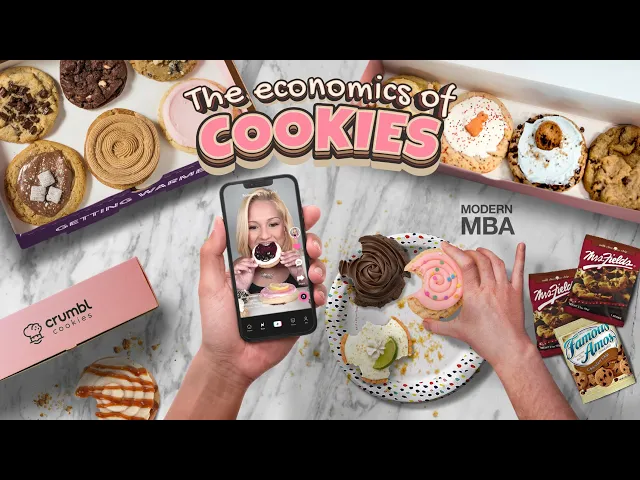
Every decade has its dessert trends. In the 2000s, it was cupcakes and frozen yogurt. Then in the 2010s, it was unicorn drinks, monster milkshakes, edible dough, and donuts.
Now in the 2020s, it's massive, thick topped 800 calorie cookies that come in extravagant flavors and have twice as much sugar as a can of Coke. It's impossible to not see the thousands gorging themselves on these cookies in their car every week for millions across social media. Cookies are the latest consumer obsession, and yet the trends setters are never the first movers.
For cupcakes, it was sprinkles. For frozen yogurt, it was Pink Berry. And now for cookies, it's crumble.
When the trend is set, all you need to do is follow it. You don't need to be the trends setter to make money, even if it only lasts for a few years. This is why when fro yo and cupcakes took off in the 2000s, opportunists quickly flooded the market, selling virtually the same product to capture whatever pink berry and sprinkles couldn't.
Supply rushed into fill demand and sellers exceeded buyers to the point of market saturation and consumer fatigue. Every dessert fad is a volatile, short-lived market with its own business cycle that seemed unstoppable at its peak and then crashes over time. This boom and bus cycle is the norm and it's happening right now with cookies.
Crumble is the market maker who has somehow maintained novelty and virality all while pushing price, product, and scale. Their growth is unprecedented in the history of food and beverage, going from a single store to an empire of over 1,000 locations in 4 years. And unsurprisingly, a whole landscape of copycat chains and independents have suddenly emerged, each hoping to cash in while the trend lasts.
But cookies have been around for centuries. Before Crumble, there were old school giants like Mr. Fields and new school entrance like Insomnia and Levane.
Yet, none of them ever came close to the success of Crumble. In this modern NBA original, we're diving into the business of cookies from the macro to micro, starting with these legacy brands and moving to Crumble, where we'll break down their never-before-seen financials to understand how they succeeded where others failed and what their endgame really is. And then experience what life is like under Crumble as a small independent from the standpoint of two beloved neighborhood mom and pops in LA who have each made two very different bets on the future of cookies.
Mr. fields in the 1970s paved the way forward for modern cookie shops. This was an era where Americans baked their own cookies at home, pick them up from fast food chains like McDonald's, or prepackaged off grocery shelves like Chips Aoy.
Mr. Fields upset the status quo by elevating the lowly cookie from a generic mass-produced cross-ell into a premium flagship branded product that was as good as homemade where every cookie was baked on site and served warm to customers. Cookies are made from everyday lowcost ingredients of flour, sugar, butter, and eggs.
And in comparison to cakes and pastries, which are also made from the same ingredients, cookies are much easier to produce with little technique, labor, and precision required. Dough could be produced in bulk and shipped to each location for consistency and simplicity. And a cookie shop at scale only really needs an oven, cash register, and display case, and can be manned by a single person.
With such low real estate and operational requirements, Mr. Fields grew without franchising from a single shop to 780 stores nationwide in 16 years. By the 80s, Mr.
Fields had become an institution at shopping malls and food courts around the country with strong margins given that cookies only cost cents to make, but sold for a dollar each. Yet, while the margins were high, the downside was low earnings. So, Mr.
Fields continually added candy, ice cream, brownies, and muffins over the decades in order to drive up sales. But when the 1990s recession hit, Mr. Fields found itself in a cash crunch.
She had borrowed money to scale, and the absence of franchising meant maximum risk exposure. Sales dropped, real estate value fell, and hundreds of stores shuttered overnight as they could no longer afford rent. Mr.
Field's initial prosperity had attracted rivals like Famous Amos and David's Cookies. And yet, their own brick-and-mortar ambitions were crushed under the same recession. Famous Amos pivoted to CPG, while David's Cookies shifted to wholesale, business models that both companies have kept to this day.
Saddled with debt, Mr. Fields gave up control of her company, and its new private equity owners demanded lower costs and greater profits. They envisioned a broader multicategory franchise empire and by 2001 bought pretzel time, Hot Sams and TCBY under the belief that pretzels and fro yo could hedge against cookies.
Yet all of these brands had the same problem as Mr. Fields. They were all walk-in businesses with no standalone appeal and could only survive in hightra areas.
Under franchising, earnings shrank, but profits quadrupled as Mr. Fields moved away from serving the public and more towards selling dough and collecting royalties from franchises. But as the shopping mall went belly up in the Great Recession, the business tanked once again.
By 2010, the company had sold off its pretzel chains to refocus on cookies. But the damage was done. The average Mr.
Fields grosses less today than it did 20 years ago. This is why if you come across a Mr. Fields store today, you'll usually find it manned by a single person who in most cases is the franchisee.
While an annual gross revenue of $360,000 per store sounds respectable, the reality is different. After deducting royalties and dough costs, the owner is grossing roughly $200,000 before labor and rent. And after paying rent, there's nothing left for payroll.
This means that the only way for the owner to take home a worthwhile salary is to work all the hours themselves. Mr. Field stores have been dropping like flies, and extinction seems inevitable.
The company today is a zombie milking its remaining franchises and its online gift business. Despite declining sales, the cash flow from the gift business is too sacred to give away, and Mr. Fields maintains a 12% profit margin selling cookies in metal tins and gift baskets.
These are the same margins that the company enjoyed decades ago, selling the same cookies one at a time at retail, which is a testament to how profitable selling cookies can be at their core. With such low barriers to entry, competition can come from anywhere. Insomnia was born out of a college dorm room in the 2000s.
While Mr. Fields made its name through product, Insomnia made its name through location. They've built their empire over the past few decades following the same fundamental playbook of serving opportunistic walk-ins in hightra areas.
But instead of serving shoppers at malls, they target students with the late night munchies. There's no family recipes, special ingredients, or even proprietary dough. As insomnia cookies are indistinguishable from those sold at any run-of-the-mill supermarket.
Their bet has been that convenience is the greatest premium, and quality is lost on the typical 20-year-old. The average store grosses about 700 to $800,000 a year, but this feels more like a ceiling rather than a floor. Expansion has been slow as Insomnia is more of a real estate play.
There are only so many colleges in the country and they've been careful not to open in places [music] where they would be forced to compete on product. In response to Crumble, Insomnia has broadened with limited time drops, brownies, ice cream, and now filled cookies to fortify its position as the fastest late night option for desserts on campus or in transit. The challenge Mr.
Fields and Insomnia both ran into is the fact that gross earnings in this business are just not that high. You can only charge so much for a single cookie. The only way to make up for the small order sizes is through cross-selling a wide product mix or by inserting yourself into hightra areas in the hopes of capturing as much volume as possible.
Out in New York City, it was Levane in the9s who solved this problem by transforming cookies from a cheap, traditional, thin, flat 2 oz serving into these decadent, premium, upscale 6 oz softball-sized indulgences. Lavane is the pioneer of the modern oversized cookie as their product challenged what cookies could be and how much you could sell them for. Fueled by critical acclaim, Lavane has achieved lasting pricing power as their cookies sell for nearly $6 each.
By estimates, Lavane grosses on average $1. 2 million per store. For decades, its owners were happy keeping Levane as a New York institution as tourists and locals came to them rather than vice versa.
It was only decades later in 2018 when they sold Levane to private equity and its new owners are now pushing for stronger growth. Yet to maintain Levane's position and reputation at the tip of the market, expansion has remained slow as franchising is not an option and brand dilution is the top concern. Crumble was founded in 2017 and their late start gave them time to absorb the lessons from all those that had come before.
They started with the intention to scale, knowing that the greatest profits could only come through franchising. Like Insomnia, they opened their first store on a college campus, using the low stakes and foot traffic to iterate on product and branding. But to avoid a territorial battle with the more mature Insomnia, they knew they had to grow beyond opportunistic sales.
Like Lavane, Crumble cookies from the start were designed as oversized photogenic 6o behemoths to drive differentiation, virality, and pricing. Crumble isn't at the tip of the market like Levane, but they're close. While every other cookie chain sticks to a set menu for consistency, Crumble deviates from this norm with weekly rotating flavors.
It's a page out of the fashion industry where the prevailing belief there is that scarcity, not consistency, is the strongest driver of retention. Limited time flavors create urgency, incentivize engagement, and encourage repeat visits. All of which outweigh the cost of rotation.
But most importantly, all these elements combined allow Crumble to position itself as a destination rather than a pit stop like conventional cookie shops. With top of the market pricing, high retention, and social media virality, the average Crumble went from grossing $700,000 in 2018, just a year after their launch, to roughly $1. 8 million in 4 years.
The average Crumble franchise netted nearly $300,000 a year in profit after rent, labor, and supplies. Store level operating margins reached as high as 30%, which was more than leading fast food franchises and even what Mr. Fields as a corporation was [music] making in its heyday.
The success of these franchises and the continual virality has inspired hundreds more to take the leap. Running a Crumble was cheaper, easier, and more profitable than running a McDonald's. Crumble exploded off this supply side demand to over 900 stores by 2023.
But when we dig into the numbers, we can see their real endgame. The non-refundable franchise fee that every operator must pay upfront was raised from $25,000 to $50,000 in just 2 years, which is a fee on par with the world's biggest fast food chains. Royalties were also increased from 10% to 12% in two years from 2019 to 2022.
Beyond royalties, Crumble Corporate makes money from kickbacks from its vendors. The cost savings from operating with economies of scale are not actually being passed on to the operators, but instead being pocketed as company profits. Crumble Corporate gets a 2% administrative fee, 10% on chocolate chips, $4 off every ingredient packet, and 50 cents off every case of cereal purchased by franchises.
The company grosses $32 million a year off all these rebates, kickbacks, and ingredient sales combined, which it pockets under an affiliate LLC. Franchises must also pay 3% on every transaction, even though the credit card processor only charges Crumble 2. 36%, meaning that Crumble corporate is once again pocketing [music] this difference for itself.
None of this is uncharted territory in the world of franchising. But to take such ruthless fees in 3 years suggests that even Crumble's leaders don't know how long this boom will last. They're determined to milk every dollar, even if that means squeezing its own franchises.
Sales at the Average Crumble have dropped to $1. 1 million in 2023. After paying for labor and supplies, the gross margin for the average crumble has plummeted from 60% in 2018 to 39% in 2023.
Even more damning is that the store level operating margins, which is the profit after rent, has fallen from 30% to 10%. [music] The average Crumble franchisee is taking home as much money as a present-day Mr. Fields.
Yet, while the franchises are regressing, the company is surging, having gone from $4 million to over $150 million in 5 years. The majority of revenue comes from royalties and ingredient sales to franchises. While store level operating margins have fallen to 10%, company level operating margins remain well over 30%.
Crumble is currently trying to reverse this slide by broadening their product mix with cakes and pies to drive up order sizes and to maintain novelty. But with numbers like these, it's difficult to imagine how effective these measures will be. how long this boom will last and how many franchises will still be around in the next year or two.
Crumble's rivals like Chip City, Crave, Dirty Dough, and Bang are all playing the same game. [music] They don't just want royalties. They want franchises buying their markedup dough and ingredients week after week.
They're not really in the business of selling cookies as all their franchise fees are priced in the same ballpark as Crumble. But despite demanding comparable fees, they all have significantly fewer locations and weaker branding. Their revenue per store is all over the place as every chain is based [music] in a different region.
They all do weekly rotations, cross- sell anything they can fit into their space like ice cream, use drops to get people in the door, and push their mobile apps. And it's only a matter of when, and not if, when these same companies will start turning the screws on their franchises, just like what Crumble is doing now at its peak. Out in Santa Monica is Cookie Good, LA's longest surviving neighborhood cookie shop.
Los Angeles is significant as the birthplace of dessert trends. Pink Berry and Sprinkles both started in LA, and it was their success here that sparked the global fro yo and cupcake boom. But the first movers typically aren't the trends setters.
And Cookie Good in some ways was crumble before crumble. Since 2008, they've been baking cookies in crazy flavors and rotating their menu. With over 300 flavors, from hot Cheetos to pancakes and bacon, there are few things left that Ross and his wife Melanie haven't tried to turn into a cookie.
Nowadays, there's cookies in all different kinds. You've got like the thin crispy ones like Tate. You've got the big mammoth like almost mini cakes like Crumble.
You've got the big scone-l like things like Leanne and all of the things that are now like Leanne. Like for me, I didn't want that much of an investment. I have the pallet of a six-year-old.
One of my favorite like things about being an adult is that I can go to the market and buy Captain Crunch and no one will yell at me or tell me I can't. And I think that kind of spirit goes into the cookie. So when I think about what's fun and what do I want to eat as a cookie, a lot of times it's that.
So it's like things that I loved as a kid. So whether it's cereal cookies or s'mores or ice creams when we were doing it 2008, that's when I would be starting to play with flavors. And around that time, like I said, there was Mr.
Fields. There were just combinations of things that that were a little bit more precious than what what we do. Like there's nothing precious about me.
There's nothing precious about our cookies. Like the founders of Mr. Fields, Insomnia, and Levane before him, Ross started in his home kitchen with no restaurant experience.
Cookies were a side hustle, and the economics were friendly enough for him to piece together the business as he went along. My uh grandfather was one of the original Caner brothers from Caner's Deli in LA. So, I grew up going to his deli in Boille Heights when I was a little kid, and I always just was fascinated by the bakery.
So, I became a writer, and I did that for a while. And so in 2007 going into 2008 was a writer strike. And so Melanie, my wife, said, "Well, why don't we think about starting a cookie business?
" So we did. I mean, the idea at that point, there really weren't a lot of cookie companies. There was Mr.
Fields, but Sprinkles was huge. So we sent an email out to about a 100 friends and family, and 3 minutes later, we got our first order. And um the orders just kept coming.
And we didn't know anything about business when we started from our house. We had no expectations. We had no business plan.
A friend of mine from the movie business called and said, "Can you send two uh 24 two dozen boxes to New York? " So, we were suddenly in the shipping business. And as people got the cookies, those people then turned to new customers.
And uh you know, at that point, we were just baking at home. And we knew that we had to get out of the house because we're baking for more than just family and friends. We realized that if we ever really wanted to do something, we kind of at this point had to go big or go home, right?
And um we thought let's get our own space. Everything we did like we figured out and we learned right from making small mistakes luckily to avoid bigger ones from happening. Having been in the neighborhood for so long, Cookie Good is a Santa Monica institution.
While they offer delivery both local and nationwide through all the usual apps, shipping makes up just 25% of revenue. A single cookie is $2. 75 and a dozen is 30.
A lot of people will go through some kind of logarithm to figure out costs and profit margins and all of those things. So they kind of build it backward. And I don't, you know, Melanie and I don't think like that, you know.
So we um had the cookie and wanted people to eat it. There are places now that charge a ton for cookies and um that's part of the cache. I we're not a cache.
We just want to make enough money to keep our business, keep growing. There are some people who start businesses to start a business. And we started cookie baking cookies because we like baking cookies.
And I think a lot of places today that are doing it from home or doing it from commissary kitchens and are starting niches because they're on Instagram or Tik Tok or whatever. It's so much easier to bake from your home, you know. And when we look at our numbers and you look at what percentage what was our profitability baking at home, it was huge cuz we didn't have to pay rent.
Ross enjoyed the highest profits when he baked out of his home from 2008 to 2010. Moving to a commercial kitchen was the only way to keep up with demand and the rent cut into his margins. By 2014, they had opened up in Santa Monica.
Revenue grew not just from the walk-in traffic, but also from the businesses in the area who began ordering cookies for clients, events, and employees. Store level margins have persisted in the mid- teens year after year, which is on par with Crumble and Mr. Fields.
Yet, Ross and Melanie have concerns that business is going backwards. The entertainment industry never fully recovered from the pandemic, and the continuous layoffs have pushed many away from the city. The couple are now focused on menu innovation with a new shelf stable, gift friendly product called cookie corn, where they make popcorn, cover it in caramel, and roll it in their flavored cookie crumbs.
For Ross, seeing the success of Crumble is tough. It's hard for him not to think about what could have been and what almost was. Every time you turn on Instagram, you see people tasting crumble cookies, right?
And it's like, "Oh, look, they just dropped this flavor. " I'm like, you know, we've been doing that flavor for 15 years, you know? And I I kind of wish that I had been more lizardy early on so that we could be the ones out there.
Um, we could never be crumble again. They were like warriors, conquerors. They had that mentality from the very beginning.
Since we started this business, we've always had this this wish, this dream that we find somebody who wants to, you know, be part of our team, who wants to partner, who wants to help us, who has the lizard brain that we don't have. Um, and can kind of zero in and focus on growth. And, um, you know, we we've met a lot of people over the years.
We have people come in, and one of the great things about having a storefront, by the way, is interacting with people who eat the cookies. It's like that's such a a great great thing that we didn't get when we were shipping or delivering or having people pick up made boxes. We've had people come into the shop who want to help us grow and they tell us, "I I want to help you expand.
" We over the years had talked to franchisers who had approached us. Their big thing was, "Yeah, we really think you could be a franchise. You just have to open up two more shops and then once you prove your concept, then we could franchise you.
" And we say the same thing. We're running this place. you know, the the last thing that we want to do is take on more.
Like we work obviously, we work really hard at what we do. Um, but what we don't want is somebody who can tell us who has ideas but can't implement them. Um, so that's been a frustration for a lot of time, but we were always really hopeful.
And then, uh, a couple years ago, we had somebody real. We had, I guess, what do they call the big tuna, the big fish, you know, kind of came to the shop and um, and he was awesome. Really great guy.
um he loved what we were doing. This guy had franchised. the franchise, you know, was early on with Wetzel's pretzels and, you know, Dave's Hot Chicken and um he was a real guy and he was smart and great and he brought in his teams like all of them like came in and to see what we did and to to meet and discuss things and you know what's our process and talk about everything and went over numbers and it was you know I don't let myself get excited.
So it started in January and then in March he called me and said that they were not going to be able to move forward. And by the way, this was like to the point where it was he was saying, you know, I hope you have a you have a lawyer, you know, we want to make a proposal. It wasn't like, you know, pie in the sky.
It was real. But ultimately what he said was they couldn't move forward because they felt like with us in the dessert space and the kind of thing that we were doing, you know, we might be able to open up 40 to 50 new units a year. And in that kind of that that level of franchise business, I think they're they're they're they're looking for hundreds.
And so um ultimately, unfortunately, we were too small. We're not those people. Um, and we've built a place where we have a great staff.
These are people we care desperately about and we're invested in and they're invested in us. We have to remind ourselves, I think, that we've come a long way since working out of our kitchen, but it is sometimes sad, you know, to think I think I think our stuff has our our people and our cookies have a lot of a lot more potential. On the other side of town are owners Ren and Caroline of Bake Some Noise, who refuse to follow trends.
In an era of crazy flavors, weekly rotations, and massive cookies, Bake Some Noise only serves the classics. They don't have a physical shop and serve their cookies warm out of an old school Volkswagen bus several nights a week on Sunset Boulevard. A single cookie is $4 and a dozen is 36.
Being in LA, I I felt like everyone was going in that route, right? Whatever is trending at the moment, that's what they were adjusting their menu to. They went left, we went right.
We wanted to stick with what we knew. We wanted to do only the classics. It was never a cash grab or or it was never trying to do something to do something right.
It was more like we knew what we like. We know what we enjoy. I think these people will enjoy it, too.
We're not bakers by trade. We enjoy eating cookies, but we know nothing about baking and we know that it's a science. So, in the beginning, like Ren said, we Googled a recipe, which we then modified uh with our own R&D over the next, I want to say maybe two years.
We were testing it. Yeah. On and off with friends and family.
I would bring some to work, to family parties. We would get feedback. Like Ross, it was a crisis that triggered their leap into the cookie business.
But unlike Cookie Good, who built their business through old school word of mouth in the era before social media, Ren and Caroline built Bake Some Noise through new school e-commerce, pop culture, and virality. It was the summer of 2019. She was in post-production and I was working in apparel.
Um, and we were working in New York. Um, and it was really there that we realized that they have cookie specific shops that they at the time LA didn't have. And so that's when we were like, okay, when we get back to LA, we're going to experiment a little bit.
We're going to figure this out. And then the pandemic hits and we were like, what do we do now? And that's when we're like, let's go back to this cookie thing.
Let's let's figure this part out. Coming from like an apparel background, I was very familiar with how drops the drop system works. um because we would do it with apparel.
We implemented the same game plan with our cookies. We created a website on Instagram. We sent out the password to get into the website and I I guess we did a great job at hyping it up.
Again, also it was, you know, the pandemic where a lot of people were just at home not knowing what they, you know, can do and have money just sitting around. We literally blew it out of the water. Like we sold so many cookies.
cuz I I want to say in like a minute or something, right? We sold out. Yeah.
I I It was a lot. It was a lot. It was over 600 something cookies that day in like 2 minutes.
Whether your product is or not, you're going to get the love and support from your family and friends. It's what happens after that that will really kind of define whether you have a business or not. Um and that's what we saw.
What really drove that home was when it's like someone in Florida or someone in Hawaii or someone in New Jersey where it's like we literally know no one there that is willing to spend their hard-earned money for like a product that they just saw on Instagram. So we're like, "Okay, I think we have something here. " Just like with Cookie Good, the business took a life of its own and the couple quickly outgrew their home kitchen.
Once again, the economics were so favorable that the couple could piece together the business and recipe along the way. We were getting orders for so much that we we could no longer do this at home offer. So we get to the commercial kitchen.
We don't know how to scale this thing up. And so each one can only make 12 cookies, which means this x amount of butter, x amount of sugar, x amount of eggs on each one. And what we learned really fast was like this this is not it.
We need to figure out how to use this giant mixer. While virality and drops were how they found their initial footing, Ren and Caroline were smart enough to adapt and to channel that lightning in a bottle into a lasting business. We implemented a drop model because coming from an apparel background, that's the way that everything went, right?
We went by seasons. It creates a demand for people. It it's it creates a scarcity, right?
It's like we only have x amount of time to be able to grab these cookies that these guys are making. Mind you, they don't even know that we're making this out of our our home. And people are always looking for like what's the next big thing, right?
If especially for a company like us, it was never going to last. The first time that we opened the website at 12 Pacific Standard Time and we got no orders, we were like we thought there was something wrong with the website, right? With the world opening up and people eager to be out and, you know, go to go to physical places.
I I think that had already took a turn for us. we've moved on and we we figured and our game plan was like what we need to do is we really the ultimate goal was to get this product warm to our customers. That's that's how we that's how we would taste test it and then it's like that's how we wanted to serve it when it's packaged in a box, you know, shipped to you in 2 days.
It it's not the same experience. The typical playbook for a cookie independent is to scale with demand. You start with your home oven.
Once you outgrow that, you rent a commercial kitchen and then you save up to open your own brick [music] and mortar. That was like the next move, right? It's textbook.
Um, we actually were looking in this area first. And what we were finding was the rent here was outrageous. For a tiny 300 square ft space, a window, a window, it was like 7 grand a month.
That's not including like the buildout and everything else that you have to do. So, you know, financially, we didn't think that it made sense for us. It doesn't take a rocket scientist to figure out that it's like in order for me to just clear my rent alone with insurance and utilities and and uh labor.
How many cookies do I really need to sell at I think we did the math and we were like we need to clear just to just so that we can break even. I think we need to do like 15,000 a month in cookie sales. If you look at everyone else it's like oh we we started from home and we moved to a commercial space.
The next thing to do the next step up is to open a space. At the end of the day, cookies is a lowcost product, which also means at retail, it's still going to be a lower priced item. By nature, we're very unconventional.
And so, we figured I I think if we put our two heads together, we can figure out another way that we can still captivate the market without having to really be locked down to like another 5-year lease. Instead of a generic food truck, they opted for a custom 1972 Volkswagen bus, which was cheaper than the retail buildouts that they were getting quoted for. Caroline and Ren are still figuring out how to optimize the van.
But the most important thing for them is that everything is branded and remains on brand. Yet, there's no such thing as originality in the cookie business where everyone's come-up is near identical. Both Insomnia and Crumble in their early days doubled in food trucks to get around the overhead of brickandmortar.
In their first year, Bake Some Noise grossed $240,000 a year as an online only business. As the virality faded after the pandemic, they transitioned away from drops and towards catering and pop-ups to replace that online drop off. Sales have dipped in the past 2 years, but with the van finally online this year, they're optimistic about the future.
By running lean, they've kept operating margins at 35% which is comparable to Crumbles as a franchiser and what Cookie Good was making at home before they had to pay rent. Ren and Caroline have made more money selling cookies than they ever imagined. And the couple is adamant that they'll only ever make the classics on their own terms.
We knew that from the very beginning that like we wanted to create a brand uh a brand ccentric cookie company because what we were trying to do is withstand the test of time. I think people see authenticity, right? They they see right through a cash grab.
We've seen other companies do it where they they make the pivot in their in their business and and and their branding to adjust to the market. From the very beginning, it was it was always authenticity for us. If it doesn't resonate with us as people, it's we're definitely not moving that onto our business.
Cookies are easy to make, cheap to produce, and simple to scale. But product alone does not make for a complete business. That's why there will never be any shortage of amateur bakers on Instagram selling cookies, as the profit margins there are really at their highest when it's made at home in small batches.
It's not the ingredients or the labor, but instead the rent that kills margins. The overhead of a brick-and-mortar, whether it's one shop or 10 shops, is what creates problems for a business that is fundamentally hindered by small order sizes and low earnings. This is why bootstrapped mom and pop cookie shops rarely, if ever, scale beyond one store.
For better or worse, expansion in this game is only possible with outside investment, and profits at scale can only be really achieved through franchising.