Even a century after its creation, Dada has been, to this day, a challenge to define and to explain. “Dada existed before dada” said Hans Arp. “Dada is the sun, Dada is the egg.
Dada is the Police of the Police. ” said Richard Huelsenbeck. However, my favorite quote explaining dada is by Francis Picabia: Dada alone does not smell: it is nothing, nothing, nothing.
It is like your hopes: nothing. like your paradise: nothing. like your idols: nothing.
like your politicians: nothing. like your heroes: nothing. like your artists: nothing.
like your religions: nothing. The reason why I find this definition, if it’s even a definition, so relevant is because it reveals two fundamental truths about dada: Rage and rejection. Many introductions on dadaism fall in the same trap: Trying to find the origin of the word dada.
The creation of the word dada has been claimed by more than one dada artist, from Richard Huelsenbeck to Tristan Tzara and, ultimately, it doesn’t matter who came up with the word dada and the dadaists knew that. If you’re trying to understand dada by tracing back the origin of the word, you’re not looking at the right place. You’re waaaay off track and if you’re puzzled by who actually made up the word dada, you’re being messed with by the different dadaists.
They’re making fun of you. "I hereby declare that on February 8th, 1916, Tristan Tzara discovered the word Dada. I was present with my twelve children, and I wore a brioche in my left nostril.
I am convinced that this word has no importance and that only imbeciles and Spanish professors can be interested in dates. What interests us is the Dada spirit and we were all Dada before the existence of Dada. .
" However, looking back at the context where dada emerged can be extremely important in order to understand the dada spirit. Dada came to be in 1916, 2 years into World War One. I’ve spoken many times about the great war on this channel and you must know by now how disastrous and murderous it was.
However, Dada was born in one of the neutral parties in the conflict: it was born in Zurich, Switzerland. Switzerland, being neutral during the war, hosted many political refugees. The anarchist and artist Hugo Ball, for example, escaped the war, its chaos and its barbarism.
Other anti-war refugees did the same and, among them, many were, like Hugo Ball, artists appalled by the absurdity of war. The Cabaret Voltaire, founded by Emma Hennings and Hugo Ball, was, more specifically, the birthplace of the dada movement, but it would later spread throughout Europe, America and Asia during the 1920s. Hans Arp would say: “Revolted by the butchery of the 1914 World War, we in Zurich devoted ourselves to the arts.
While the guns rumbled in the distance, we sang, painted, made collages and wrote poems with all our might. ” What jumpstarted Dada was the war and its atrocities, but the dada revolt didn’t end there. Their deep disgust for the war made them look for what caused it and their gaze was directed straight for the bourgeoisie, its culture and its politics.
The dadaists were anti-war, anti-bourgeoisie, anti-bourgeois culture and anti-bourgeois politics. They were, ironically enough for artists, anti-art. Art was under the dada critical eye because art, at the beginning of the 20th century, failed them.
Dadaists were angry. The world was barbaric and the ones holding power, the bourgeoisie, seemed to want it to stay that way. So what do you do when you feel completely powerless and you face a world that seems to want to end itself as quickly as possible?
What do you do with all that anger? The dadaists’ were far-left political advocates, but in their artistic expression, their solution was to reject anything and everything. Their art was sometimes overtly political while, some other times, they were political in their rejection of bourgeois conventions.
So how did Dada challenge and reject the bourgeoisie? Let’s look at Hans Arp. He was one of the co-founders of Dada in Zurich and he’s important for, among other things, introducing chance in his art-making process.
Here, you see Untitled (Collage with Squares Arranged according to the Laws of Chance) made in 1917. Though seemingly harmless, this artwork heavily challenged the conception of art at the time. There are three ways in which it does that and the first one is the use of chance.
Arp said he cutout different squares of paper to let them fall. Where they fall is random, thus the laws of chance arrange the squares. Using chance undermines the idea that the artist is a skilled craftsman whose worth is measured by their technique.
Anybody can use chance. You don’t need formal training; you don’t need to understand composition or colour theory. This brings us to the second way this challenges the art of the time: authorship.
The use of chance forces us to reexamine what it is to be an artist and how an artist can make art. This work has been made more-so by chance than by Arp. Arp is shying away from being the creator behind this artwork, and is becoming the creator of the idea behind the artwork.
We’ll come back to that later. And now we come to the final way this artwork challenged the art of the time, and this is probably the most dadaist of ways. Arp challenged traditional art by lying, at least I think so.
None of these squares touch or overlap, some even align perfectly. The idea that Arp would let paper squares fall and the laws of chance would have them align this way is highly improbable. The same goes for his other Untitled artwork using the same process.
This one, by the way the square’s corners perfectly touch the edges of neighbouring squares, clearly reveals the lie behind Arp’s title. Having the title of an artwork lie about the artwork confronts the viewer with deception in art, but also with the lies dadaists wanted to denounce. If the bourgeoisie, especially in the face of WWI, can lie about caring about liberty, equality and justice, then where’s the harm in lying about an artwork?
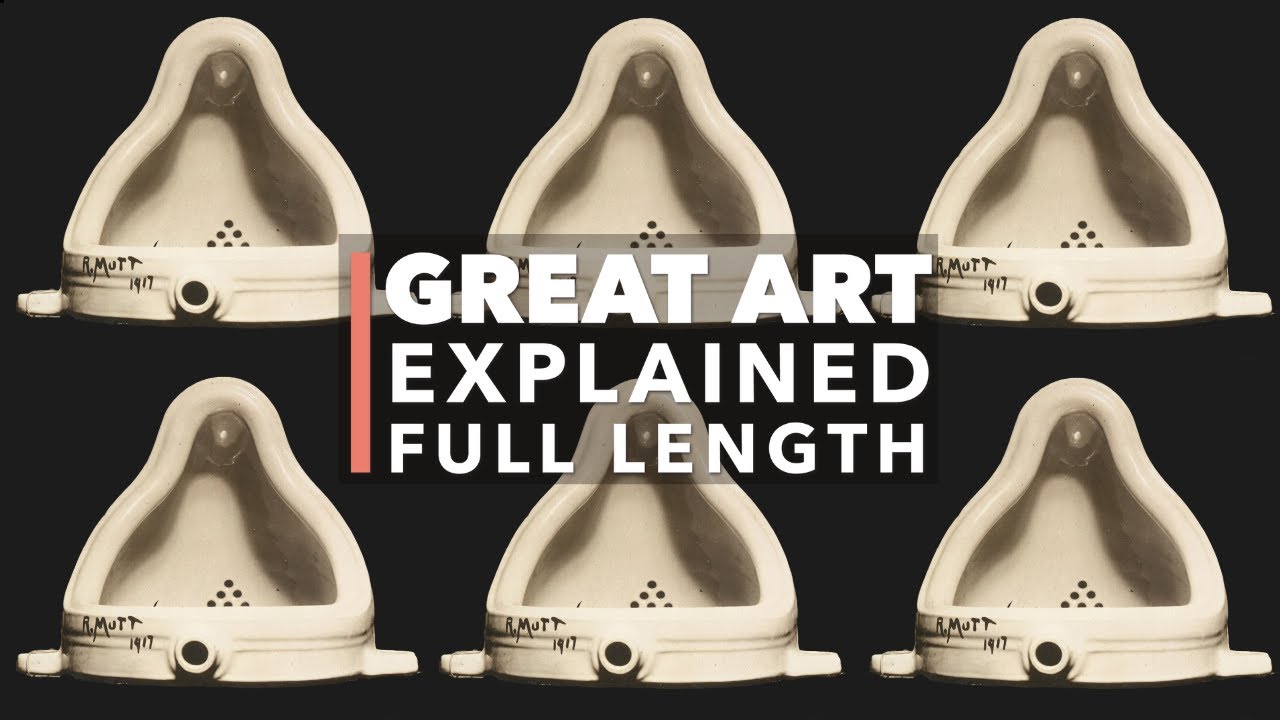
The second artist I want to talk about is Marcel Duchamp and I’ve already mentioned him a couple of times on this channel, from talking about his readymade fountain to talking about his female alter-ego in my latest video. But one cannot make a video on dadaism without mentioning Marcel Duchamp. Fountain, made in 1917, is an artwork that not only seemed to make fun of art, as dada artworks could often do, but that also changed the course of 20th century art in a radical way.
In a nutshell, Duchamp presented a urinal on a pedestal, signed it and submitted it to an art exhibition. Duchamp was asking a question: Is this work art even though the artist didn’t really do anything aside from conceptualizing the object as art? See the similarity with Arp’s collage?
Anyhow, this was the challenge that readymades presented to the art world. A readymade is an object which, through re-contextualization by an artist, becomes art. Another popular readymade by Duchamp is L.
H. O. O.
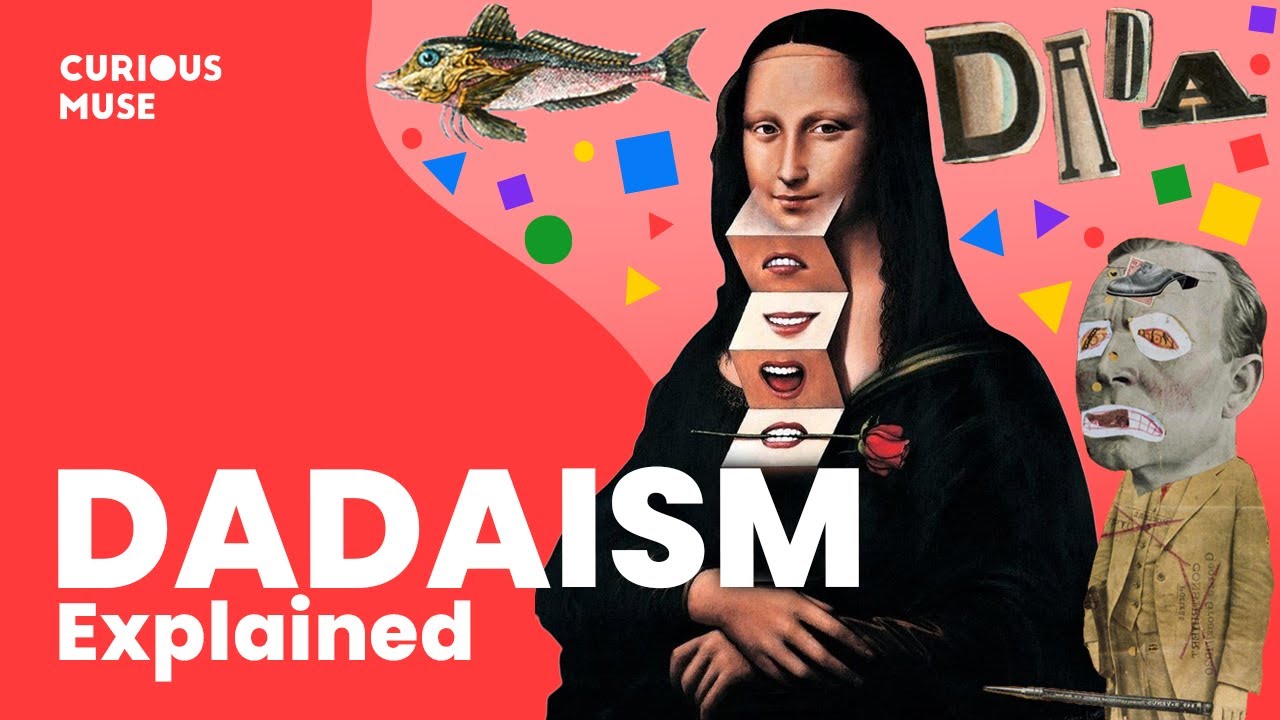
Q, made in 1919, and this one consists of taking a postcard of the legendary and untouchable Mona Lisa, and drawing a moustache on her. L. H.
O. O. Q.
is also a play on words in French for “there’s fire down below” as Duchamp would translate it. He’s basically saying that the Mona Lisa is promiscuous. It’s a typically dadaist work because it’s humorous, it’s vulgar and not only does it attack art, it attacks the symbol of traditional bourgeois art.
Hannah Hoch is another dada artist I really want to talk about. However, I’d like to dedicate a video entirely to her in the future, so I’ll simply focus, for now, on her photomontage Cut With the Kitchen Knife Through the Last Weimar Beer-Belly Cultural Epoch in Germany, made in 1920. Post-WWI Germany was chaotic and Hoch beautifully and quite accurately depicts this confusion.
The Weimar Republic had just been founded, the communist Spartacist uprising led to the political assassination of communists Karl Liebnecht and Rosa Luxemburg and, to the dadaists, the future didn’t seem to get any better. Where do we start? Well, we can look at the world of Dada on the bottom right of the composition.
You see prominent dadaists from John Heartfield, to George Grosz. You can also see Vladimir Lenin, Karl Marx and, in the corner, glued to the corner of a map, the tiniest of faces, the face of Hannah Hoch herself. The map represents the countries with women suffrage.
On the top right are the anti-dada, the bourgeoisie with, notably, the Kaiser Wilhelm II and the president of the Weimar Republic, Friedrich Ebert. At the top left you see the biggest face in the composition, Albert Einstein with a statement saying “dada is not an art form”, as if that was a scientific fact. And finally, at the bottom left, you see masses of people with the words “join dada”, a call to action, underlying the political aspect of dada.
It would be a lot easier to appreciate Hannah Hoch’s work if we were one of her contemporaries. But even though we hardly recognize any of the figures in the composition, it’s still a very telling depiction of what dada art was (especially the extremely political dada art of Berlin). I would have loved to go over more dada artists, from Francis Picabia, to George Grosz and John Hearfield.
I definitely will cover them in future videos, so if you want to see those, I guess you’ll have to subscribe. I see dada, and let me know if you disagree, as a state of mind which mixes anger and powerlessness, rejection and open-mindedness, a kind of cynicism, a lost of hope in the world, but a refusal to give up. And what do you do when you lose all hope in the world but refuse to give up?
Well you can’t cry about it, that would be giving up, so you laugh. You laugh at anything which makes you lose hope because, maybe by laughing at the absurd, by laughing at it loudly and proudly, you’ll make others realize that things need to change. When you loose all hope and your last resort is to laugh, I think you run the risk of becoming dada.