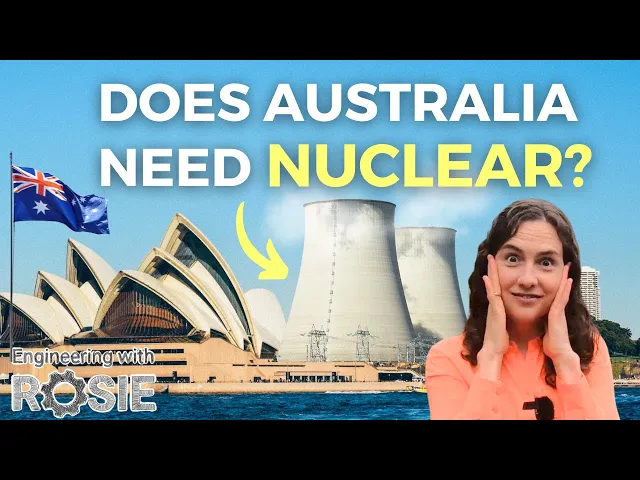
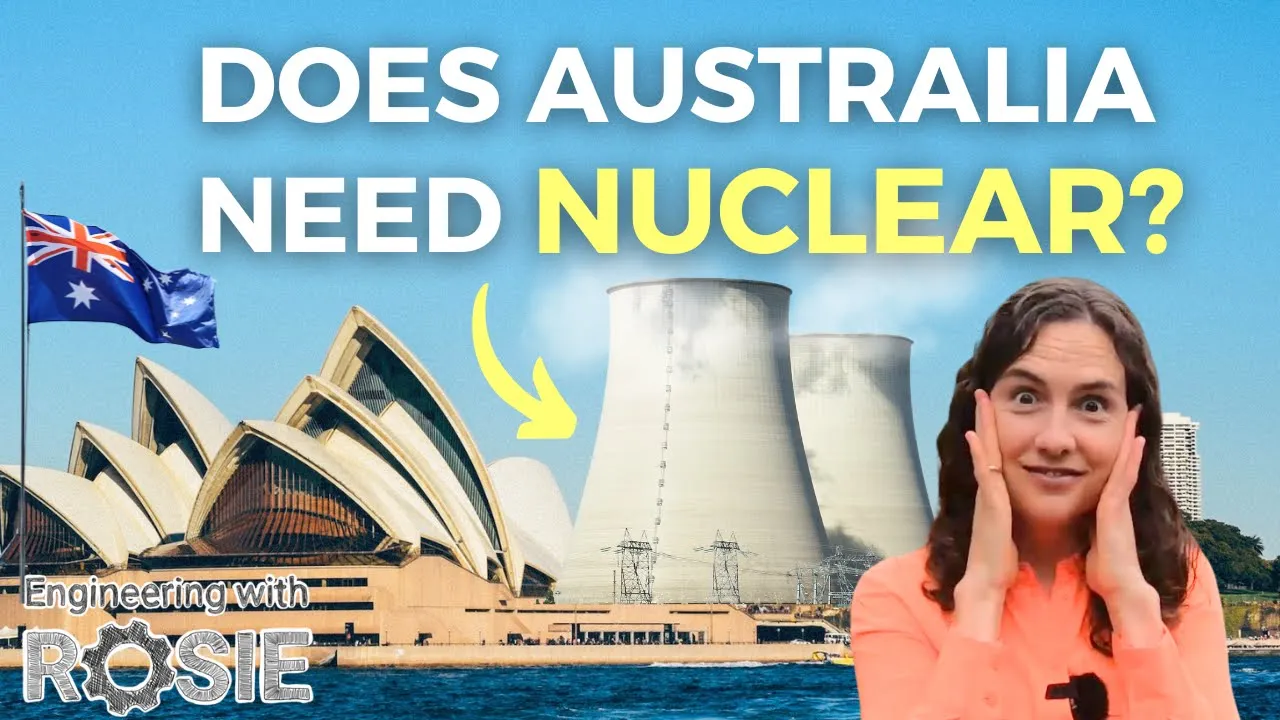
In the vibrant, renewable-rich landscape of Australia the symphony of wind and solar has long played the tune of progress, an unexpected blare cuts through the harmony. Like a foghorn in the calm of dawn, the sudden advocacy for nuclear power from a party that previously silenced such discussions is turning heads and raising eyebrows. It's an about-turn that could make solar panels tilt in Curiosity.
I'm Rosie Barnes, and with 20 years in the trenches of clean energy development, I've seen firsthand the evolution of Australia's energy landscape. Does Australia need nuclear power? The notion of nuclear energy was, until recently, firmly off the table for Australia.
But now it's found its way back into conversation championed by the Conservative opposition party Under the leadership of Peter Dutton, there's a push to integrate nuclear power as a backbone for Australia's clean energy future. His vision includes swift construction timelines for large reactors and small modular reactors once that technology matures. And they are specifically targeting the sites of our retiring coal plants to take advantage of existing infrastructure, The first obstacle that these nuclear plans face is that nuclear power is currently banned in Australia.
Back in 1998, the Conservative Howard government wanted to secure a nuclear research reactor at Lucas Heights near Sydney. To do so, they needed support from the Greens Party, who made a deal to support the research reactor if a nationwide ban on nuclear power plants was introduced at the same time. so it was banned and remains so today.
But what if this ban were lifted? Should we then embrace nuclear for our energy future? Nah, it's a dumb idea for Australia.
And I'm not just throwing around words here. There are some solid reasons behind this bold claim. four to be precise.
Let's start with the first one. The sluggish pace of bringing nuclear power online. In an era where rapid change is the norm.
this slow stride just doesn't cut it. Ready on to find out why. Let's dive in.
the first reason that nuclear power is a dumb idea for Australia is that it is too slow. Recently completed nuclear power plants have taken about nine years on average to construct. If we step into our time machine to 2033 Australia, 90% of our electricity will come from renewables by then.
Which doesn't leave a lot of space for nuclear. All of our brown coal power will be closed and a decade later there'll be no coal power at all. And that nine years I mentioned is only for construction.
It takes years of planning before any contracts are signed. Some countries are building nuclear reactors faster than that nine year average. some of China's recent plant constructions have taken more like five years.
But others, like the US and the UK, are taking much longer. The Vogtle plant in Georgia, USA, began construction in 2013 and it's still not complete. And Hinkley Point C in the UK announced in 2007 that the reactors would power British homes by Christmas 2017.
However, construction didn't even start until 2018, and the latest projections push completion to beyond 2030, with more slippage expected by most people. Those aren't isolated examples. Nuclear projects are very prone to large overruns and construction time.
Worse than any other kind of energy project. And the only other category of large projects that performs worse than nuclear power plants is Olympic Games and nuclear storage projects. according to Bent Flyvbjerg, who has spent his career studying cost and scheduling overruns in large projects out of the 191 nuclear power projects he studied, 93% of them took longer than expected to complete.
And the mean schedule overrun was 65%. so if the plan for Australia is ten years construction and remember, that needs to come after we change the law to allow it and develop a regulatory environment for nuclear power funding, etc. , then we could expect that on average instead of ten years, it'll actually take 16.
5 years. And this would be our very first reactor built presumably by foreign experts in a new market and or by inexperienced locals. I think it would be prudent to assume we're not going to beat that average.
All that is to say that by the time we managed to get a nuclear reactor operating in Australia, the energy transition would have mostly happened. That alone is reason enough to rule out nuclear power for Australia. I'm going to go through three more reasons.
The next one is that it doesn't play nicely with wind and solar power. Australia has a lot of wind and solar power and more and more every day. 15 years ago, less than 1% of our electricity came from wind and solar power.
And today it's over 30%, growing by about three or four percentage points every year. Of course, the thing about wind and solar is that they are variable, nuclear power plants on the other hand, like to be turned on and stay operating at a nice constant output. If you don't think very closely about it, perhaps you might think that sounds nice and complementary.
Actually, it's not. Electricity demand varies from hour to hour and season to season. Either nuclear or renewables need a dispatchable energy source like hydro, batteries or gas peakers to match generation with demand minute by minute.
Combining nuclear with variable renewables, turns out to not actually reduce that amount of dispatchable power that's needed by much, if anything. Now, there are lots of countries that combine nuclear with renewables, but none with both a lot of nuclear and a lot of variable renewables. France gets most of its electricity from nuclear and most of the rest from renewables, but that's nearly all hydro.
which can be turned on and off when you want. Same with Switzerland, Armenia and Slovenia. the only countries with both a lot of nuclear and a lot of variable renewables are Sweden, with 30% nuclear at 20% wind and Finland with 35% nuclear and 16% wind.
But crucially, both of these also have a lot of hydro. 40% and 20% respectively. Let's look a bit closer at what exactly this means for a country like Australia with currently 32% of our electricity from wind and solar power.
Today, the amount of other generation needed varies by a factor of two. From midday to evening, on average, modern nuclear reactors can vary that output a bit, but to cycle from 50% to 100% on a daily basis is really pushing it. Today, that's only done across fleets of nuclear by turning some off entirely and ramping the rest by a smaller amount, which means you need a large number of reactors like France has.
and using their reactors intermittently like that with a lower capacity factor would make nuclear power more expensive. This chart shows both high and low cost estimates for nuclear power, and you can say that in either case, the difference between operating at 60% capacity factor instead of 90% capacity factor is going to add something like 30% to the cost of energy. Ramping up and down is also hard on the equipment, which leads to higher maintenance costs.
There is at least one example of a reactor in Germany that broke down as a result of ramping and in that case it was only ramping up and down by about a third. Which leads me to the cost of nuclear power. It is expensive.
There is admittedly a lot of disagreement amongst published values for the cost of nuclear, but the ones that I've seen are at least double and probably more than triple the cost of wind and solar in Australia. And that's true even when you account for the extra integration costs that variable renewables need. That means extra transmission and more storage.
Furthermore, as well as being prone to schedule overruns, nuclear projects are even more prone to cost overruns. With the average nuclear project eventually costing over double its original estimate. in contrast, wind and solar projects have about 0 to 10% average cost overruns.
those are costs for new nuclear, but after it's paid for itself, it is very cheap and that's great for countries that already have nuclear who might rather extend the lifetimes of their reactors than build new alternative sources of low carbon generation when those reactors were supposed to retire. But that's not us in Australia. And that leads me to the last reason that nuclear is a dumb idea for Australia.
It solves problems we don't have. There are a bunch of great things that nuclear can do, that wind and solar can't. It can provide constant baseload power no matter the weather and no matter the season.
nuclear reactors also take up less space than renewables, and existing nuclear is cheap to run. Let's tackle those one by one in the Australian context. first, nuclear provides firm baseload power.
Well, there's no such thing as baseload in Australia anymore. At times, rooftop solar on its own covers 100% of the demand in the highest renewable energy grid. South Australia.
That means there is no space for anything else at that time. This is going to happen more and more across larger and larger parts of the country as solar installations continue over the coming decades. but that's usually only in spring and summer and probably a bit in autumn, too.
What about winter? One of the benefits of nuclear is that it is weather and season independent and that is great for countries whose energy demand peaks in winter when the solar power may be close to zero. But that's not Australia for most of Australia.
Energy demand is in summer and there is still good solar output in the winter. You can see on this chart that the balance between renewables and fossil fuels in our current grid doesn't change that much from month to month. But renewables are variable, intermittent, unreliable, right?
What about dunkelflaute? That's periods when there's no wind and no sun for days or weeks at a time. Potentially a huge problem in some places, but again, not in Australia.
42 years of weather data history show that widespread dunkelflaute across the whole Australian grid last hours and occasionally a day, never weeks. These charts show renewable resources for every one of the last 42 years. There are some winter days where renewables dip a little under 50% of the average output.
There are no weeks below 50% and the worst ever winter month was around 70% of the whole year average. There will be occasions every few decades where there will be a day or maybe two of very low wind and solar and on occasion, a few weeks in a row of something like 50% average output. And for those we will need to use something more expensive to cover those shortfalls after sitting around mostly idle for ten or 20 years at a stretch.
But you can't do that with a nuclear reactor. you can't just turn on a nuclear reactor that's been sitting idle for ten years. It's going to be gas or hydrogen or biodiesel or something like that.
The next advantage of nuclear. It doesn't take up much space. that is so important for countries like Japan, Korea, that have a lot of people packed in a small area.
Well, guess what we are not short of in Australia? space. Australia is so big and so sunny that we would only need 0.
1% of our land covered in solar panels to generate all our energy from solar. For wind, it's about double that. And that's just sticking to onshore wind.
if we consider offshore wind too, it's going to be even less. And our wind farms coexist with grazing. Our solar panels mostly go on roofs and could co-exist with agriculture if we so wished.
So even these tiny fractions are misleadingly large. in Australia, It does not matter that nuclear power might take up less space. I can understand why countries like Korea, Sweden or Canada feel like they would benefit from nuclear power.
They have long, hard winters that solar power can't help much with, and some of them have high population density. They can use nuclear to avoid seasonal storage and avoid needing energy imports But even in winter Australia, solar is pretty good. And our dunkelflaute are infrequent and short.
We have more than enough land to capture what we need. Do I think nuclear power should be banned in Australia? No.
I think it should be allowed a level playing field with other energy technologies to allow a fair fight. Like most people, I want the cheapest clean electricity possible and for any one of the reasons I've mentioned, nuclear would lose that fair fight. Add them all up and there is absolutely zero chance we'll ever have nuclear power in Australia.
I am not a nuclear hater. I think that nuclear makes a lot of sense in countries that have the kinds of problems that I mentioned in the last part of this video. I'm working on another nuclear video with a more global perspective currently, So please feel free to leave your angry comments about how I was unfair to nuclear in the comment section so I can make sure that the next one includes that rounded perspective.
Thanks for tuning in. A special shout out to the Engineering with Rosie Patreon team for your ongoing support and engagement. Your contributions make this content possible and better.
if you're not a member yet, but would like to join our community, then check out this link to see how you can get involved. I'll see you in the next video.