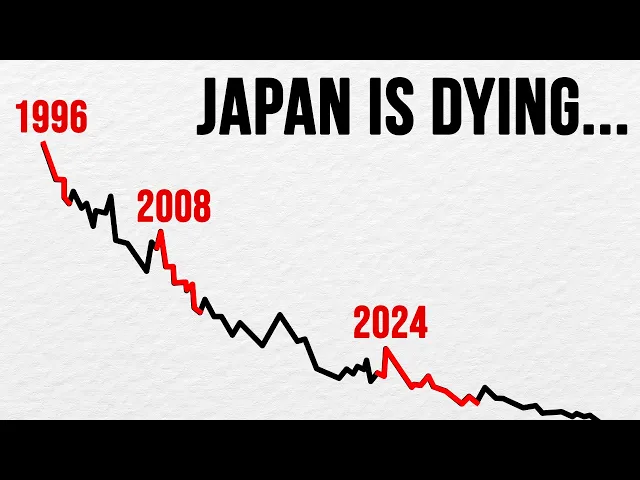
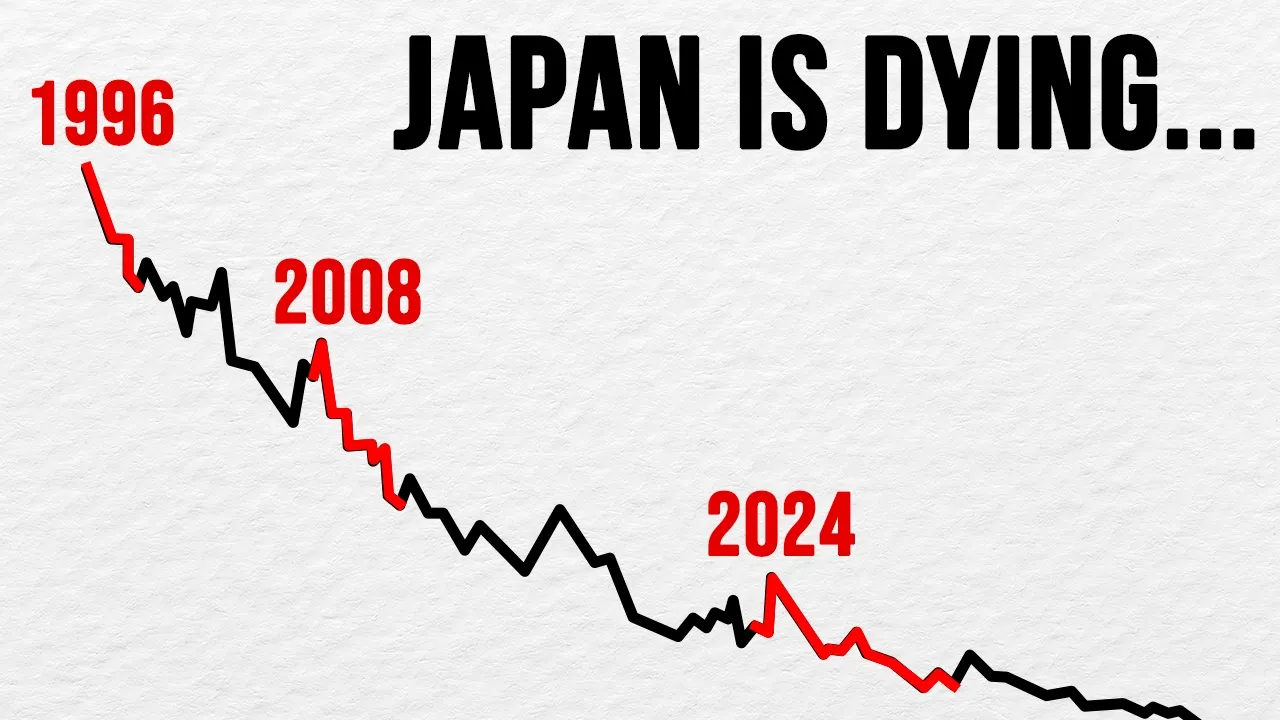
50 years from now people will look back and say that wait a second there was a country called Japan because it will no longer be around since Japan's economy is collapsing so fast that 50 years from now I don't think anybody will actually remember Japan and a 100 years from now a country like Japan probably won't exist because the situation with the Japanese economy is so bad that it's literally has been collapsing for the last 30 years so let's dig into the numbers and realize what exactly is happening because ja Japan is one of the largest economies out there and anything that will happen to the Japan's economy will have serious implications not just on the US economy but on the global economy as well so let's try to figure out what exactly is happening with Japanese economy now if you take a look at the Japan's GDP you will realize that there was a meteoric rise from this period up until 1960s or I would say 1990s at this point and Japan's economy Grew From less than $50 billion to six or no it's like 5. 7 trillion dollars and that growth is so much that the average Japanese that lived back in 1960s fell significantly wealthier and if you compare Japan's GDP per capita to the United States the average Japanese was actually significantly not significantly but it was much more wealthier than the average American but guess what happens next Japan's economy here it absolutely collapses and it leads to absolutely nowhere because today's Japan's GDP is a little over $4 trillion now let's take a look at the Historical numbers this is the GDP of the us over the exact same period and today the GDP of the US is $25 trillion now if you go back to 1990s you will realize that this was the point when Japan almost caught with the United States but guess what happened today the difference is absolutely massive yes Japan's $4. 2 trillion GDP is a lot and it makes it one of the largest economies out there but over the exact same period when us when the US GDP back in 1990s was around 7 or8 trillion dollar probably less than that it grew a few times to$ 25 trillion look at what happened to Japan's GDP now if you compare that to China you will see massive difference like in 1990s China was absolutely no one on the global stage today China's GDP is like five or six times much larger than the Japan's GDP and if you go to the GDP per capita things are so bad that you won't probably imagine I guess the only country that we can actually compare Japan is the United Kingdom but even if you actually put how bad the UK GDP is compared to the Japan GDP I think in this case even kind of the British economy is doing much better than the Japanese economy so let's take a look at the numbers in 1995 the US GDP per capita was around $41,000 which made it back then one of the wealthiest countries out there one of the wealthiest people in that country however compared to Japan back in 1995 during the exact same period the GDP per capita was $44,000 now the difference is not really a lot but the thing is that look at the difference that happened after that look at the growth of the United States and look at the GDP per capita today when it comes to Japan which is around $34,000 so Japan GDP today or the average Japanese today isn't even half as wealthy as the average American even though that 30 years ago the average Japanese was wealthier than the average American that's how bad the situation in Japan has got over the last 30 years and if you kind of scroll down you'll find out that the US GD the US national debt compared to its GDP is around 120% and that growth has been significant over the last 20 or 30 years as well because we know what happened in 20120 we know what happened in 20 in 2008 and we know what happened between those periods when the US actually started throwing trillions of dollars into the economy but the US national debts compared to Japan's national debt is absolutely nothing because Japan's debt to GDP ratio is significantly worse than the United States since the Crisis began in Japan the national debt grew to almost 260% of the GDP now that is nothing I mean that is significantly more than the United States 120% of course the US Deb is significantly worse because the United States owes a lot to the rest of the world why While most of the debt in Japan is actually owed to the central bank or the to Japanese people so let's now check a moment get deep into what happened historically in order to realize what exactly led to that bubble that happened in 1995 and what exactly caused it to burst that they can't actually fix the problem even 30 years later now back in 1945 Japan was one of the countries that suffered the most from that war two countries that suffered the most was Germany and Japan because these two countries lost the war but because these two countries had already a long history of being this discipline they had this culture of innovation and growth they quickly got themselves together and recovered and especially with the help of the United States because after World War II Japan and Germany became the closest allies of the United States technically the United States literally just took these countries and signed agreements that was F favorable to the United States so these countries got got themselves together now they had access to the US market and they started slowly growing and using us technology and you and taking advantage of the US market and that's why if you go back like to 1970s and 80s some of them was prominent names back in the day was companies such as Sony Honda Nissan Canan Toyota Mitsubishi and others these are the companies that started slowly taking off not just the Japan the Japanese Market but they also took over the United States you see the business was very simple that the Japanese companies actually built this is Japan and Japan is significantly back in 1960s is poorer than a country like the United States because United States at this point is the wealthiest country in the world what do you think Japan does Japan starts producing cause Machinery Tech at a significantly cheaper price than companies can do in the United States and then they start selling all of that all of those goods and commodities in the United States now think about that for a moment if you want to buy an American car that is made in the United States for example a GM or a Ford it is going to be much more expensive than a Japanese car because Japan at that point was significantly poorer and to produce that car in Japan you could actually pay lower wages the land in Japan during that days was much cheaper than the United States and that's how Japanese cars started taking over the United States and if you go back to 1980s there was a serious oil crisis where oil prices shot to the roof and if you know anything about American cars versus Japanese cars Japanese cars first of all are much cheaper secondly they're much more reliable and thirdly they're much more fuel efficient so from 1980s people realized that it's much better for them to actually start buying Japanese cars compared to American cars unless you have some extra money and you want to flex and you don't really care about those prices because you have enough money in the bank but that's not the case with the vast majority of Americans the second thing that Japan did during the days is that a lot of those companies were subsidized by the government because government realized that with its help they can actually take the entire the United States over the entire the market of the United States and that's something that reminds me of what's happening in China because if you take a look at the China the last 30 40 years and even today you will realize that a lot of those companies the reason they got out of China and became so successful because the government was there to back them up now there is absolutely nothing wrong with that this is a practice that has been happening all over the world for the last I don't know how many years companies so now because of government subsidies they can sell the exact same products at a cheaper price in the United States when in comparison in the United States days companies like Ford and GM weren't really as subsidized as Japanese companies another thing that actually led to that bubble is that low interest rate the Central Bank of Japan lowered interest rates in order to boost the economy so a lot of debt was actually thrown into the economy as well a combination of all of these factors led Japanese companies to take over the world not just the United States and the business model was simple there is a wealthy country the uni the Japan is going to produce that at a much better quality at a much better price and then we'll ship it to the United States or even to the Western of Europe because by that time the Western Europe has already recovered from World War II and was one of the wealthiest countries out there guess what this created this created a lot of tension between the United States and Japan because as I have told you earlier Japan started growing so fast that if you just go back to the headlines of 1980s they would say that Japan is about to take over the United States and the United States was afraid because wait a second we kind of gave you access to our Market we kind of gave you everything not everything but the reason you successful is because you have access to our market and now you're about to take over us that doesn't sounds like a fair deal so when Reagan became the president guess what exactly he did he started putting tariffs that is a very familiar word that we know today he started putting an extra tax on Japanese cause when you ship them to the United States he started limiting China I mean today we have we are trying to limit Chinese products into the United States but but back in the days we were trying to limit Japanese products to come to the United States in order to protect local manufacturers but that's not the only thing that the United States did back in the days they did something else besides the trade War because like China today that is a real rival of the United States Japan was an ally of the United States yes economically it was about to take over the United States but nonetheless Japan did not have a military and it relied on a military pack with the United States and the United States could not treat Japan as this enemy it could actually treat it as a competitor but not as an enemy especially when Japan no longer had any kind of military I would say it did not threaten everybody around that area so guess what the United States did in order to save itself they signed a deal that is known as the plaza Accord back in 1985 in order to devalue the dollar and guess what that means you see when you have a strong currency in your country it might seem great because you can go to other countries and they have weaker currencies and you come to that country with your US Dollars and you can Flex you can buy things you can rent houses at a much cheaper price you can literally enjoy everything but the downside of that strategy is that when you actually I mean imported goods in your country are cheaper but whatever is produced in your country is now more expensive so who do you think suffers in that in that case of course locer manufacturers starts to suffer and that's why when you have a strong dollar and you have a very weak Japanese Yen suddenly Japanese cars are much cheaper just because the yen is weaker compared to the and US companies us cost cannot be shipped to the to to Japan for example because nobody will buy them in Japan because they will be significantly more expensive just because the dollar is more expensive now to to solve that problem they got together in a room and they decided that let's do a deal we're going to devalue the dollar now the dollar is going to be less valuable which means that yen is going to be more powerful which means that Japanese Goods start starting from today that will float to the United States are going to be more expensive guess what that means that means that less Americans are going to buy those cars less Americans will buy those Electronics less Americans will buy those Machinery less Americans simply will buy Japanese Goods because suddenly their prices are rising in the market so what do you think Japan did at this point Japan wanted to keep growing its economy because it has been growing astronomically over that period now this business model that they have created over the last 30 or 40 years no longer works so Japan wanted to do something very different instead of actually trying to rely on exporting its products for example to a country like the United States it tried a completely different strategy it went inwards and it tried to actually invest everything inside Japan and grow the Japanese economy grow the Japanese stock market make people spend more in Japan make people invest more in Japan and that was the next strategy but in order to do that you need a lot of money so the Japanese government started bowing a lot of money and throwing them into the economy first they l a lot of monetary policy which means that debt became more accessible then they started borrowing and spending more money into the economy and that led to something that we call an economic bubble in fact during that period when Japan was at its peak Japan was literally buying everything in the United States because of how powerful Japan was and how powerful the Japanese end became after that and that's why if you just take a look at the national debt of Japan compare its GDP you will realize there's a clear point at this point where Japan's debt suddenly started growing dramatically because this was the period when theyve actually signed that deal at this point and then the debt suddenly started growing and it doubled by 1996 this is the point when the bubble actually burst and that was basically the end of the Japanese economy or the Japanese economic Miracle as they call it now just to tell you how bad the situation or the bubble was during that period do you see this picture this is the Imperial Palace of Japan and everything around it it's a pretty small area or a pretty small piece of land I would say of course it's a huge piece of land if you actually go there but in comparison to the entire city it's actually it's absolutely small now during the peak of the Japanese bubble this piece of land which is very very tiny was more valuable than the entire real state in the enti state of California that's how bad the situation was now this is the single most important thing that you have to know about how big the bubble was during that period so it was very clear that this is going to collapse this is not sustainable it is going to collapse whether you want that or not now just to give you another example of how bad this situation was during that period is that there was a company called NTT and at its peak its valuation was $2.
5 trillion now today $2. 5 trillion does not sound insane because we have companies such as Nvidia apple and Microsoft or probably even Amazon or that worth around $2. 5 to3 trillion I think Apple even worth like $3.
5 trillion I mean it fluctuates but it's around $3 trillion but we're not talking about today we are talking about 1990s when a trillion dollar valuation was insane I think the valuation of Apple during those periods was around like less than a hundred billion dollar so this company was worth $2. 5 trillion just to give you a perspective of how insane that is is that this single company was more valuable than the entire Stock Exchange of London can you comprehend that for a moment London is the second financial center of the world a lot of large companies are actually listed under the London Stock Exchange now we have a single company in the Japanese Market that is as valuable if not more valuable than the entire stock market of London that's how bad the situation got with Japan so at that point I guess everybody was like all right this is a bubble and it is going to burst but people weren't willing to actually stop because when you have something growing like when they have something growing people buying and selling people buying and selling people buying and selling and keeps growing but at some point it has to collapse the same thing remember it happened with Bitcoin it happened with housing market in 2008 it happened with internet companies back in 1990s and it happened with a lot of other markets as well so this is not unique to Japan but this was probably the most insane bubble that the world has ever seen in the entire history of humanity I mean maybe not the most insane but certainly one of the worst bubbles out there but the question that is very interesting is DoD if the bubble burst here back in 1996 why exactly the Japanese economy keeps suffering even though the the bubble has burst I mean I understand that it takes maybe like 10 years for the economy to recover maybe 15 years maybe I mean slightly longer than that but 30 years for the economy to recover and it hasn't yet recovered and it seems like it's going to get worse there is something unheard of so let's try to figure out what happened during this period is thought something that we call a deflationary period see when you have an economy and it's spinning it's like a wheel like think of an economy like a wheel and it spins if it stops spinning it's very difficult to actually spin it again and that's if you go back to 2020 the FED threw so much money into the economy because this is exactly what it was afraid of because if a a period of deflation starts in the economy it's very difficult to reverse it and that's something happened in Japan because a deflation is exactly opposite of inflation inflation means that prices are rising deflation means that prices are falling down so if you know that let's say you want to buy a car and you know that the price of that car next year is going to fall down what are you going to do you are going to wait another year and then you wait another year to buy that car and then you know that prices are going to fall further so what are you doing you wait more so you're not spending you're saving your money especially when I'm not I'm not I'm not talking here about like things you buy such as cars such as houses just for your own utility for your own use people didn't invest back in the days because people were afraid that if they start investing there is going to be another bubble what do you think the government did of course the government wanted to somehow get the economy out of this because the only way for the economy to grow is for you to spend and people are saving their money so you want to re reverse engineer this into the thing that people start spending more money so that the economy stops grow starts growing again so if you kind of take a look at the interest rates of Japan they kept lowering them down by the year 2000 interest rates in Japan were like 0% something like that happened in the United States in 2020 and we know what happened house prices shot to the roof stock market shot to the roof everybody was making a lot of money crypto was like all over the place it was like it was literally going to the moon and people made like astronomical amount of money but this is just the beginning because if you go back to the numbers by 2016 the Japanese economy lowered interest rate by 0 one% so Japan had like negative interest rates in order to save its economy but all of this did not help the economy economy all of this did not lead to the economy to grow so the Japanese government started taking a much more Extreme Measures they started pumping trillions of dollars into the economy so if you kind of go to 1991 you will realize that the dead to GDP ratio was 66. 5% what do you think happened next they started throwing trillions of dollars into the economy and by the year 2008 they have already spent like their GDP their Deb to GDP ratio was around 170% just for the context this is already more than the United States has today because the US debt to GDP ratio today is around 122% or something like that and the interesting thing about it is that if you just go back to the to the previous chart you will realize that by 2008 Japan finally solved its problem of deflationary period and the economy started growing again and you can see that they have already hit a new record of the economy crossing a $6 trillion Mark but guess what happens in 2008 the US economy collapses and it takes down with it the rest of the economy finally the Japanese people who after a decade of saving their money and being afraid to invest in anything they started buying something investing in something what do you think happens everything melts down what kind of a mess message does that sense to the average Japanese it threatens them they're like wait a second we started investing in the back in the days like back in 1980s and '90s everything collapsed and we lost everything now we started investing again now the exact same thing is repeating and everything is collapsing what are we supposed to do though the deflation period started again so all that spending trillions of dollars by the government didn't help 0% interest rate did not help at all and the economy started collapsing again and that is exactly and that has been continuing since those days and today the GDP of Japan is like 4.
1 trillion 4. 2 trillion which is to be honest is a lot from one perspective but overall when we when you know that the GDP back in 1996 was was much more than it's today and this is what they call the Lost decades I mean back in the days they they used to call it like the Lost decade but today I would add yesc I would add an S because it's lost decades for the last 30 years the Japanese economy did not grow on the other side it started growing down and you have to understand that when you're not growing and you're kind of staying in one place what do you think happens the rest of the world is growing you are staying in one place So eventually you are actually going back if you're not even growing by at least a single percentage every single year the US economy Grows by like two or 3% at best and that actually allows the US economy to grow to those numbers like $25 trillion and if the Japanese economy had the exact same growth rate at the United States things would be significantly different today now the main question is not why can't Japan solve this problem you got a crisis understandable you got a bubble I mean who doesn't have bubbles I mean just ask the United States they will tell you everything about bubbles bubbles are just part of the US economy 1999 2008 and I think more bubbles are waiting for us anyways the problem with the Japanese economy is that they don't have people the demographic problem in Japan is significantly worse than most of the other countries I mean technically it's not really significantly worse but because of the Japan's policy it makes it significantly worse than the rest of the world first of all Japan has 28% of its population over the age of 65 when you have so many retired people and you have less young people that creates a pension problem because today's young young people are working and paying taxes in order for the elderly people who are who have retired to be able to afford their lifestyle but when you have very few young people and a lot of elderly people you have a crisis because you can actually tax the young people but the problem is that there is a limit to how much you can actually tax them and if you actually take a look at the demo demographics of Japan you can clearly see that the number of people under 30 for example are very few while the vast majority of people are either over 65 or about to reach their 60s and that's the biggest problem that Japan has and the birth rate in Japan is like 1. 3 now 1.