Hello everyone. Uh this is a lecture four. Uh we're going to deal with uh the night book chapter 3 traditional educa uh traditional philosophies and education.
Uh we going to exam and we going to exam deeper into the classic or traditional philosophical systems that have significantly shaped educational thought. uh especially uh we're going to do we're going to do we're going to exam idealism realism and male scholasticism. Our goal today is to exam the core principles of each of these traditional philosophies.
Uh their views on reality, truth and value. Also uh we're going to explore how each trans uh translate translate also we're going to explore how each these philosophies uh translates into educational educ educational practice uh such as exam uh such as curriculum design uh the teacher's role u method of instruction uh today we're going to uh exam or study board uh and deeper about the the three traditional philosophies that uh impacted impacted the educational system. The first traditional philosophy is idealism.
Right now I wanted to talk about the uh philosophical foundations of idealism. What do you mean by idealism in philosophy of education? In simply terms, idealism is the world view world view that uh reality is fundamentally mental or spiritual.
The material world according to this philosophy is secondary. It's often seen as an imperfect reflection of a higher unchanging reality of mind and ideas. Knight defines idealism as a philosoph philosophic position concerned with the eternal truth of reality.
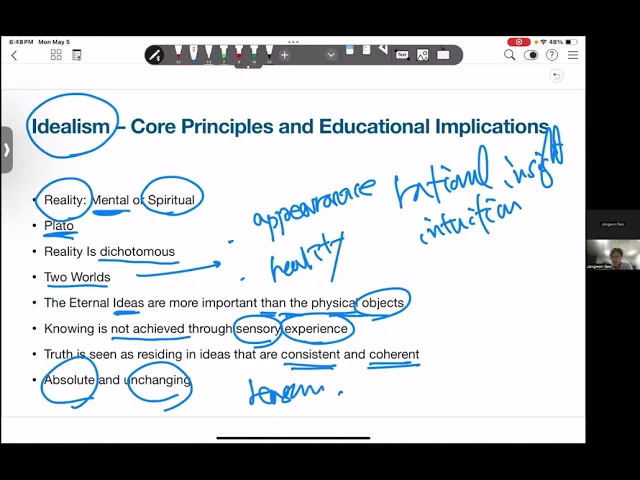
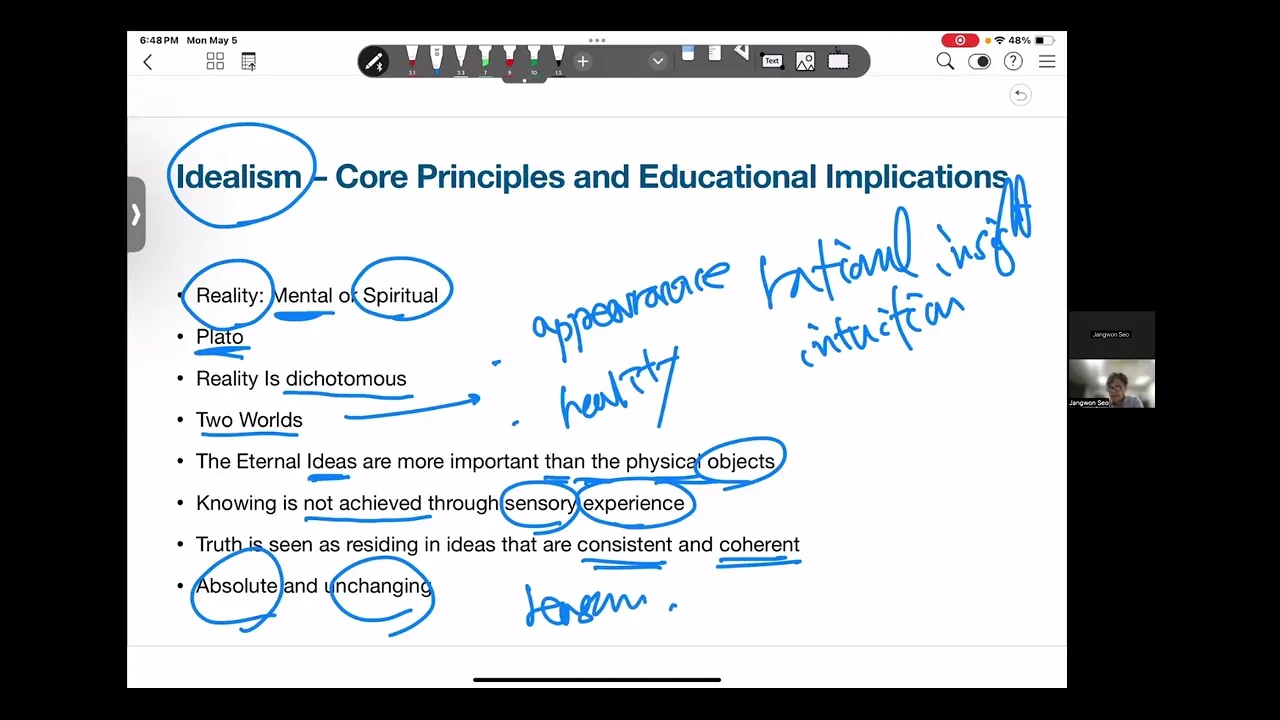
The classic root of idealism lie in Plato. Plato's philosophy. Plato taught that the things we perceive with our sensory sensories are not true reality.
They are like shadows of true forms or ideas. In other words, for the idealist reality is dichonomy. There is a two word.
The first one is appearance. Appearance. Uh in other words, the physical or sensory world around us.
The second the the other word is reality. An immaterial limb of ideas or forms accessible to the mind. Ideal ideal is to maintain that the eternal ideas are more important than the physical object that we can see and touch.
Uh according to this uh uh philosophy uh the physical world is not is a mere shadow of the real world of idea. Indeed knowing reality from an idealist perspective is not achieved through sensory or experience. In epistemology uh theory of knowledge idealist emphasize uh rational insight intuition and the mind's powers over empirical observation.
Truth is seen as residing in ideas that are consist consistence consistence and coherent. If our senses uh deceive or show change, the mind seeks the unchanging idea behind the change. In ancology, idealism roots values in this eternal spiritual limb.
If truth, beauty and goodness exist ideally and eternally then moral and uh aesthetic values are absolute and unchangeable based on the idealism. Our task is to discern them through reason through reason and perhaps spiritual insight rather than to create or choose them uh based on our experience. Okay.
Now let's go through the implications for education based on idealism. Uh first the first uh the aim the goal of education uh in idealism is often described as the most whole development of the mind and character. The other knight notes that in idealist to influence the education the learner uh is striving for perfection uh essentially to bring their finite mind close to the absolute or to discover the everlasting truth that governed both uh the universe and human ex existence.
The second the implication about teacher's law teacher should be a knowledgeable and also to guide uh students into the true knowledge and also exampler for students in perfect character or virtues. The third curriculum about the curriculum. The curriculum in on idealistic framework is centered on subject that convey timeless truth and develop reasoning.
The subject uh that convey truth and develop reasoning includes include literature, history, philosophy and art. How about instruct instructional method? uh usually uh discussion lecture to deliver the truth and knowledge.
Also storytelling uh having a true or absolute uh knowledge and absolute meaning. And last is reflection or thinking the critically uh to develop their students uh reasoning or their intellectual. The second of traditional philosophy is realism.
Let's go through the core principle of realism. In contrast to idealism, realism asserts that we reality exist independent of the human mind. That is difference from uh idealism.
The physical world is real in itself not just a shadow of a spirit or mind. Historically uh realism is from artist title uh and other MP deist thinker thinkers. Uh the author Knight describes realism as essentially a reaction against the abstract otherworldness of idealism.
The realist says let's start with the world of nature under our feet. The basic starting point for realistic is the is the claim that the object of our sense exist in our own right quite in indep uh independently of being known. In other words, ultimate reality is found in the physical universe.
In this world, uh the world of matter and energy. The universe is composed of matter in motion. The the author Knight explains, "So it is the physical world in which people live that makes up reality.
Epistemology in realism emphasizes sensory experience and objective observation as the primary means of obtaining the absolute truth. uh truth in a realistic views view tends to be conceived as a realistic champion. The inductive method uh we gather data uh through the observ observate observation and ex uh experiment then uh drive general principle that is uh inductive method that realist uh champion and use to get a truth and the absolute meaning in aniology.
Uh realist usually hold that values are objective and can be derived from the nature of uh the real reality. For example, they might argue that by studying human nature or the natural order, uh we can discern what is good or bad for humans. Now we are going to go through implications for education from realism.
The purpose of education is to prepare uh students to live effectively in the real world. The purpose of education is to prepare students to live effectively in the real world by understanding the world's objective reality and the natural law that govern the real world. Education should equip the learners equip learners with the knowledge of facts that effects and how to reason systematically through those facts.
Uh in in Knight's summary, the goal uh of education from realism is to help students understand the world by focusing on objective reality and empirical knowledge. Realist focuses on heavenly the stem in curriculum. uh science, technology, engineering and mathematics.
Uh the curriculum in realism is organized around the subject that it reflects the structure of the external world open emphasizing the natural sciences and social sciences. Courses in physics, biology, chemistry are given strong important also ma ma uh mathematics is valued for understanding patterns in nature. The teacher's law.
Teacher's law uh in realism is open likened to a subject matter expert or a guide to the objective knowledge. Knight described the realist teachers as a knowledgeable guide to natural laws of universal machine. The student law to the student law in realism is uh somewhat more uh passive than in idealism when it comes to generating knowledge but also active in the sense of engaging with handson observation.
The last thing that I want to go through the method. In terms of method, realist education favors uh demonstration, experiments, observation uh and clear expository teaching. The third traditional philosophy knight discusses no Scholasticism uh often used interchangeably with tomism.
Uh the philosophy uh stemming from Thomas Aquinas, a 13th century Catholic theologian and philosopher. The term uh neoccolasticism refers to the revival and development of medieval scholastic uh scholast scholastic philosophy in more modern times. Neoscolatism is rooted in synthesis of Aristotleian realism with Christian theology.
Uh in a sense it tried to take the best of both worlds of forming the reality of the physical world like realism and the reality of spiritual divine limb like dual uh idealism integrating integrating the physical world and the reality of the spiritual divine limbs uh in a Christian framework. work. In the other words, uh, neocaticism is a dualistic but integrated both realism and idealism.
It means neoscolar scholasticism acknowledges both uh both the physical and the spiritual limbs as distinguish aspects of reality. In the this understanding about neo scholasticism, former Aquinus taught that uh humans are a unity of body and soul. Uh in other word matter and spirit they are co exist.
In epistemology neocolaticism is distin distinctive for a forming two uh two sources of truth reason and divine revelation. Aquinus famously argued that human reason and God's truth are complement complementaryary in other words faith and reason are two path to acknowledge to know the true uh true knowledge in ancology neocolatism holds that moral values are grounded in the natural law, rational understanding of God's design and divine law uh commands of God. Let's go through the implications for education uh from neo scholasticism.
The purpose of education in this view is the development uh of the intellect and the moral character of students. Education is about disciplining the mind to grasp truth uh both natural or re revealed or it's a revelation and training the will to pursuit the good together virtues and character good character. The curriculum under neoscolaty scholatistic influence emphasizes a classical language, Latin or Greek or philosophy and theology as well as literature and history of western civilization.
The teacher's role in neocolaticism is that of an author authoritative mentor and a moral model. The teacher is expected to well learn in knowledge and to guide students through structured learning. There is often a socrat socratic or dialectical element to instruction.
For example, the disputation method used in medieval universities where teachers and students engage in formal uh debate on a question. The next uh content is about the student role. Uh student role is to exercise both obedience and inquiry.
The ideal leop scholastic students is one who can articulate reasonions for belief whether in uh geometric or doctrine. They learn to pursue knowledge through both reason and faith. The instructional methods in neoscalaticism often combine wrote running for foundation knowledge like vocabulary to train memory with a logical analysis for advanced understanding such as uh parsing a complex text or solving a philosophical problems.
The method of scholastic disputation is used to solve philosophical problems. This method is an audio form of debate club. Uh in this debate club, students might take turns defending or objecting toward thesis, sharpening their reasoning and understanding of multiple perspectives.
Okay. Thank you for engaging in this exploration of traditional uh phil philosophies and education. I encourage you to continue examine your own assumptions about what is your value of reality, truth and values.
Uh oh sorry what is your views of reality truth and values. In our next section, we will study pragmatism and extentialism to see how they uh enhance some of what we discussed today. Providing f further tools and caution for our journey toward a personal philosophy of education.