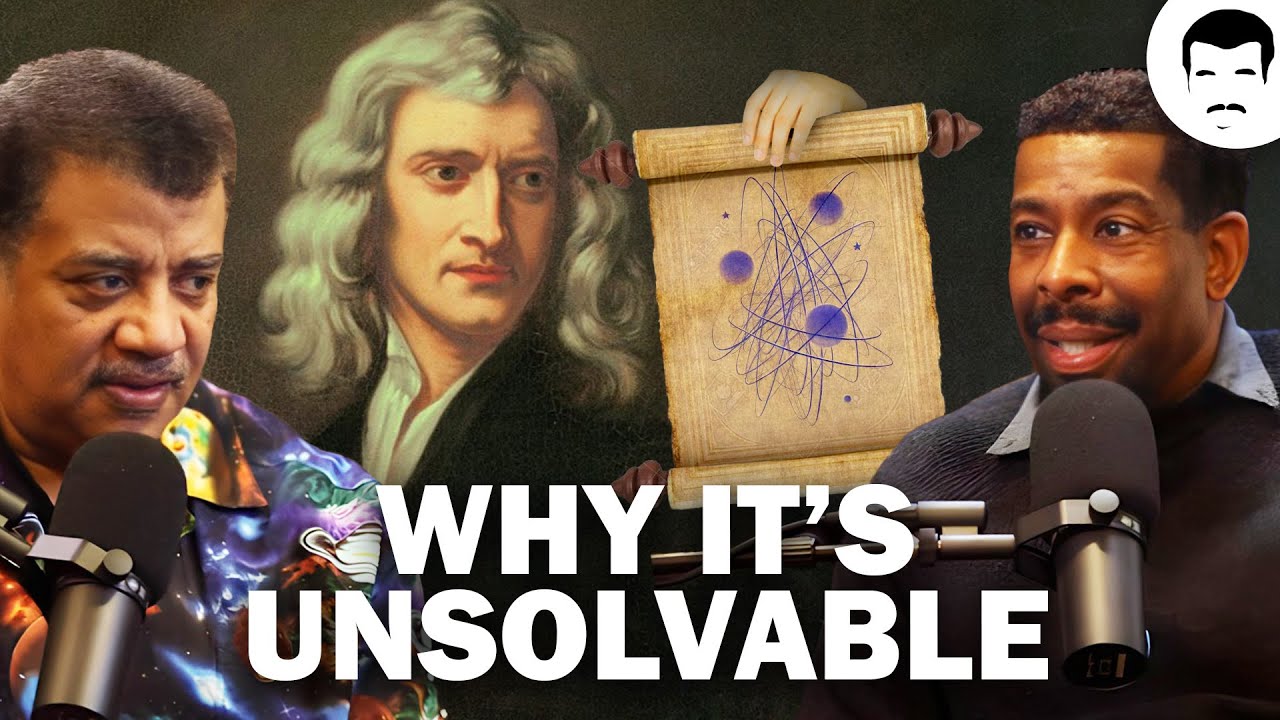
so I don't know if you're familiar with the three body problem the the not the Chinese science fiction novel made a big splash as a Netflix series recently but it's the novels that really grapple with what you are talking about and what's so remarkable about this series to me is that unlike a lot of American Science Fiction you've get Star Trek Star Wars which kind of give you this Misty secular pseudo science where it's the medoran that P things together or it's our humanist values in Star Trek in these this Trilogy of novels remembrance of
Earth's past the first book is named after famously an unresolvable problem in in astrophysics in Newtonian mechanics if you have three bodies mutually attracting each other it's impossible to lay out a logos exactly what you're describing that is a consistent system that can be reduced to abstract principles comprehended by the human mind and then used to fly outer space to navigate through whatever situation you find yourself in and the reason that shishino named began with this is because he is genuinely peering into the abyss of what science looks like once you pull the rug of
those five principles out from underneath us that there you might hit a point at which actually the whole structure of reality simply scrambled your monkey brain it just doesn't compute inside of us because we no longer have this conviction that the imprint on our brain is the is effectively the hand of God and so that's the same imprint that RIT large is is pressed across the whole universe when Newton came up with his laws there was a widespread belief derived from Aristotle that there were two sets of rules for the physical world it was called
the super lunary and the sublunary spheres and that there was Nam that because the barrier was supposed to be at the Moon where the moon's orbit is there starts to obtain a whole new set of of laws and the reason people thought this is quite reasonable is that you look at the stars and they're following these very regular patterns that we can chart and know more and more through observations you look at things around here they don't move like that kind of clockwork surely you get Stones falling to the Earth you get fire moving up
into the air and so people thought they're just a different Christians would say Fallen order down here and there is a pristine Reason Music of the Spheres yes operating even perhaps the angels are pushing them around whatever and what as opposed to forces as opposed to exactly yes this is a big in my in my book I call them ghosts in Exile the forces because right and and this idea is what when when Newton comes out with the prinkipia for the first time we now think oh he discovered gravity yes of course he outlines the
way of of calculating the force of gravity between two masses but at a much much deeper level what he does is he shatters the barrier between the sublunar and the super lunar spheres because now showing underlying Unity right here's the three rules that will govern not only the Arc of a comet across the sky but the Descent of an apple from a tree why did Newton have any right to expect that he could do that why were people working on that problem at that time it's because of the assumptions that your describing that the world
is not only organized according to AOS which is sort of the Pagan claim that we talked about in Greece but also that that logos is answerable to the patterns that are in our minds however they came about you talk about Evolution you talk about whatever but we now have and this is what we experience them as it's dishonest I think to describe our experience of these principles as anything else when when we see math we think we're looking at something universally valid and that something that not only hangs together in our brains but will also
send a rocket ship to Mars one day and that's because of this Faith the and that is something like that is something like a transposed monotheistic Faith it's the notion that at the foundation or at the Pinnacle there is an ultimate unity in which resides all things in the absence of contradiction yes right so now we're up against we wouldn't recognize it this way but we're up against another Super lunary sublunary barrier and that is the puzzle of how to reconcile relativity with with quantum mechanics and I know that you've talked to scientists about this
on on your podcast and I would I would say of course that like I am not going to be the person that resolves this puzzle but from the outside as a scholar of the history of Science and also a classicist I can see that this is the exact same issue this is two Realms that answer to two different and contradictory set of apparently contradictory set of laws and scientists are currently hammering away some of them working in string theory others in other versions of you know quantum gravity and so forth are hammering away at that
barrier right under the presumption that break through yes exactly that the fact that they can't detect the unity is actually a consequence of their ignorance not of the fact that reality itself is disjointed that there's a Fab there's a seam in the fabric that we will never bring back together or alternatively that there's a seam in our minds that we can never reconcile that there's something we need both both of these convictions and I think that anybody that does science is still operating on these convictions even if outwardly they would they would deny it well
if the hypothesis of Yung is true in the broad sense and that you see it implies something very interesting that I also saw as a practicing practicing scientist so I was involved and still am in a lot of research Enterprises right the production of approximately the equivalent of 30 phds it's something like that and I watched scientists who were genuine scientists and scientists who were careerists and huers and I watched how they operate and it's so interesting because the scientists that actually discover something of value and I would say the ones that have the deepest
careers and the best relations with their students the ones that are on the right path yeah they're suffused by uh religious ethos and and it it's very deep so I spent a lot of time I wouldn't say mastering statistics because I'm no statistical genius but understanding how to conduct a statistical analysis yeah well enough so that I could do it and actually do it and actually understand it yeah and one of the things that I realized was like if you have a spreadsheet that's full of data 100,000 data points let's say there is an indefinite
number of ways that you can apprehend that Matrix that you can see it right there's all the possible combinations of the numbers in the in the Matrix right okay so then out of that you can draw a discovery let's say that's revealed in the patterns but you cannot do that if your orientation to the spreadsheet is the progression of your career the pathways that make themselves manifest in the numbers will be those that further your career so this is part of the problem of replicability soing exactly you can do an infinite number of correlational analysis
and if you do a hundred of them five of them will be statistically significant well you can just ignore the fact that 95% of them weren't and report on those 5% and the thing is there's a profound pull to do that because in any given experiment you might have to Any Given experiment you might have devoted two years of your life for a graduate student the success of the analysis might determine whether or not they get their PHD like there's a lot at stake and so then you might say well why not just discover within
the Matrix of numbers the pathway that furthers your career yeah and the answer to that is well that's a complicated problem it's like is there anything other than self-promotion well you I told my students if you allow your careerist interests to determine the decisions you make when you're conducting your statistics which will be well hidden uhhuh from everyone else but also from yourself one of the negative consequences is that well you betray the spirit of science so you pull the rug out from underneath yourself but you also convince yourself of the existence of a delusion
that you might then cha Chase for the rest of your life right one so yeah yeah yeah so it's so interesting and this is something that scientists don't really concentrate on it's like how do you in in culcate in the scientific investigator the ethos that produces the desire to search for truth and not Career Success let's say at every micro level of the scientific Endeavor and I think that once the scientific Endeavor becomes sufficiently dissociated from its underlying Jud judeo-christian narrative yeah there is no protection against that and I also think that's why the scientific
Enterprise is corrupting so rapidly [Music]