Okay, so you should be coming from Part 12 of the series. These videos are part of a topical series and should be watched from the beginning, in order, if you're going to understand what is being presented. If you have not watched from Part One, please stop this video and start back from Video One.
So, in the last part, Part 12, we were introduced to the Greek philosophers, who were the actual prophets to the Greeks. The Hebrews had Jeremiah, Isaiah, and Ezekiel—men like that. The Greeks had Socrates, philosophies, and hypotheses.
That's from our New Yorkers. Anyways, the Greeks had these philosophers who were being used by Satan to create the mindset that would prepare the Roman world for the acceptance of the new religion Satan would create. From the beginning of this series, I've explained that Christianity is a religion of tares that Satan planted.
The Messiah Himself gave this prophecy: the tares were planted when Satan used these pagans and began to correlate the foundation that he laid with the prophets like Socrates and Plato. He began to correlate their philosophy with the faith that the Hebrews presented. We've gone over much of this history extensively.
Now, the thing is that there is a missing link to understanding this, and it comes from a lack of understanding how the culture of the Greeks was spread. Many people do not understand this, and in order to understand how these tares were spread, we must understand the history of how the culture of the Greeks made it into the Roman world. We also need to speak about the set-apart culture of Yasharel, specifically the Yahudim who were in Judea and who met the Messiah.
People assumed that because the culture of the Greeks was the accepted way of the majority, the Hebrews were just supposed to accept it as well. But this comes from a false way of understanding the Hebrews and the word itself because they were not a part of the world; they were the only ones taught to be set apart. This is something that someone said to me in correspondence about the Yahudim accepting Greek culture.
This is what he said: "The Greek language was the lingua franca of that day. The overwhelming majority of people under the Roman Empire, including Jews, spoke Greek. This is not even much of a dispute.
There is a reason there is no Hebrew or Aramaic Bible prior to the early 4th Century. You seem to equate speaking Greek with being Greek; your understanding is lacking and flawed. That is equivalent to believing that Spanish-speaking people are Spanish or English-speaking people are English.
" For the most part, what he's saying is correct, including with Jews speaking Greek, because they were. But while he says my understanding is flawed, there are obvious pieces to the puzzle that he does not see. I get it; this is how people feel, but when I show them quotes from historians like Josephus that totally prove that their way of thinking is incorrect, they ignore it and move on to something else.
There is a lack of understanding of history, and more importantly, a lack of understanding of the set-apart culture of Yasharel and why they were the only people in this world that were commanded by our Father to reject the culture of the Greeks that was being spread. They rejected the ones who did assimilate. Today, in our modern world, people just want to make assumptions that because Greek was overly accepted, it just makes sense that the Yahudim did this.
When you feel this way, it shows that you're missing an important understanding about our Father and the way that He led His people. In another correspondence, someone said to me, "God has gone by different names at different times. The supreme name we have been given for the time is Jesus, which is the English rendering of the original Aus from the Greek.
Why do you think Hebrew is some special language? " Again, this is how people feel, and it leaves out dealing with the other false notion about our Father having different names, which is another doctrine that leads to Satan because it's Satan that has many names. The reason why the Hebrew language is special is because this is the language of the people that He chose and is in covenant with.
It's the only people He dwelled amongst and that He led personally. It's the only language He wrote the Commandments in; it's the only language His people spoke. They were a set-apart people called to not assimilate and learn the ways of the other nations.
Hebrew is the language of creation, as the Book of Jubilees tells us. I'll read it to you: "And Yahweh Elohim said, 'Open his mouth and his ears, that he may hear and speak with his mouth with the language which has been revealed; for it had ceased from the mouths of all the children of men from the day of the overthrow of Babel. ' And I opened his mouth and his ears and his lips, and I began to speak with him in Hebrew, in the tongue of creation.
And he took the sepharim of his fathers, and these were written in Hebrew, and he transcribed them. And he began from henceforth to study them. And I made known to him that which he could not understand, and he studied them during the six rainy months.
And it came to pass in the seventh year of the sixth week that. . .
" He spoke to his father and informed him that he would leave Haran to go into the land of Canaan to see it and return to him. That's Jubilees 12:25-28, and this is talking about Abraham right here. You see, Hebrew is the language of creation, and scriptures like these are the reason why these books were decided to not be put into our Bibles because people would know this.
Anyway, the point is that the Yahudim did not assimilate with the Greeks; well, I'm speaking about the ones in Judea. But if you do not know this history, you would not understand this, so it must be brought out. Now that we know about the foundation of the Greeks from the Greek philosophers, we need to understand how this culture was spread later, and the understanding of this comes through understanding Hellenism.
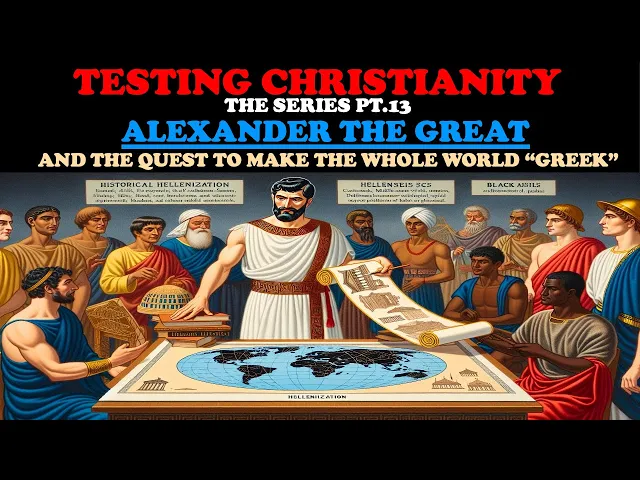
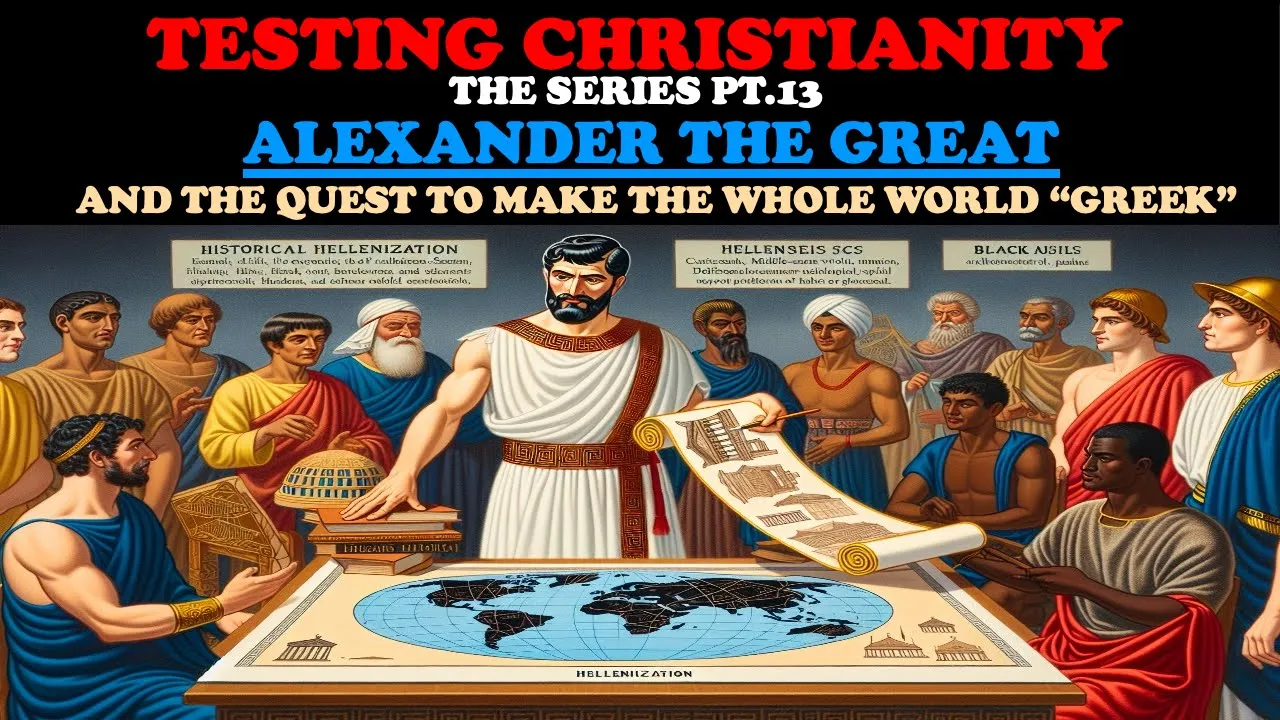
So, what is Hellenism? This is an important word and concept that must not be forgotten because it is the main strategy of the enemy. Hellenism is the adoption of Greek culture, religion, language, and identity by non-Greeks.
Again, this understanding should not be glossed over. Let me clarify Hellenism and its relevance to the Hellenistic age. I will read from the Encyclopedia Britannica: "The Hellenistic age in the Eastern Mediterranean and Middle East is the period between the death of Alexander the Great in 323 BC and the conquest of Egypt by Rome in 30 BC.
For some purposes, the period is extended for a further three and a half centuries to the move by Constantine the Great of his capital to Constantinople (Byzantium) in 330 CE. From the breakup of Alexander's Empire, there arose numerous realms, including the Macedonian, the Seleucid, and the Ptolemaic, that served as the framework for the spread of Greek Hellenic culture: the mixture of Greek with other populations and the fusion of Greek and Eastern elements. " Okay, that's a lot of words, but in summary, this explains that the time period of the promotion of Greek culture, language, and lifestyle, which is called the Hellenistic Age, was from 323 BC all the way to 330 AD, basically spanning almost 600 years.
This was merging Greek culture with the other populations of the world. So, this brings us back to Greece in the second half of the 4th century. The Macedonians—these were Greeks—were a diverse group of people living in northern Greece.
Their ruler, King Philip II, marched through the Greek Peninsula. If you remember from part 12, Athens and Sparta were divided because of the Peloponnesian War, but they were now united, even if it was against their will. In 336 BC, when Greek unity was completed, King Philip was murdered.
Then his 20-year-old son, Alexander, even though it was him who was under suspicion of being the engineer of his father's death, replaced him. This son is who we know as Alexander the Great. Now, many of the Greek city-states showed little enthusiasm for Alexander's rule.
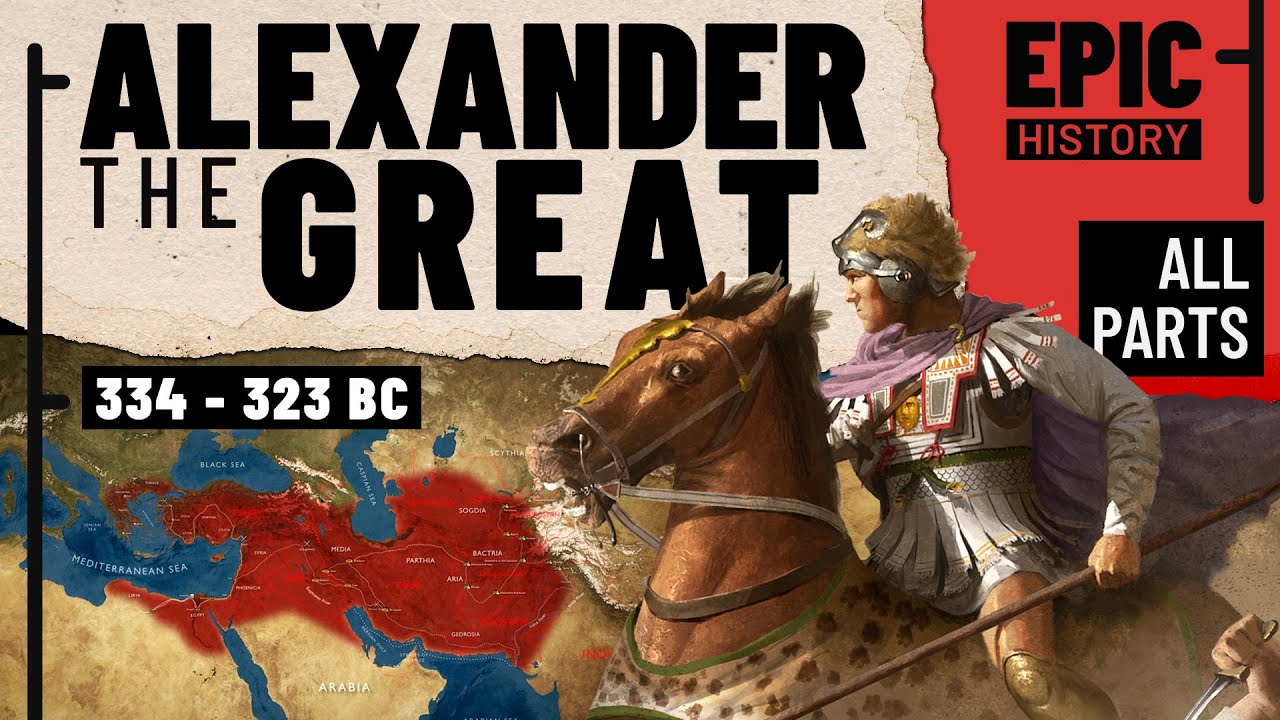
The animosity between the Macedonians and the Greeks was so intense that some Greeks refused to participate in Alexander's army of conquest. Let's talk about Alexander. He was a student of Aristotle and was said to display remarkable military skills.
His Macedonian Greek army conquered Asia Minor, Egypt, Syria, Babylon, and Persia. Alexander began to adopt Persian ways, including a demand that he was to be worshiped as divine—something many of his soldiers found repulsive. In 323 BC, Alexander came down with a fever, and within a short time, he died.
He was 33 years old. His death threw the conquered territories into confusion. You see, Alexander had plundered the Persian Empire, Asia Minor, and Egypt, but other than placing Macedonians in charge of existing governments, he did little to bring any central organization to the conquered territories.
He just left them. Alexander left his mark on every area he conquered, though. Throughout his empire, he and his successors constructed new cities or modified existing ones to conform to a Greek model.
In these cities, Greek architecture, religion, athletics, and culture were introduced to the population. A number of Greek cities sprang up along the Mediterranean coast of Judea and in Samaria. Alexandria on the Egyptian coast would eventually become the home of the ancient world's greatest library until it was burned down by the Romans.
Okay, understand this about Alexander: he was a great conqueror, not just because he took control of vast amounts of land, but it was his method of control of these lands that was special. For instance, Egypt welcomed him as a liberator because they hated Persian rule. They placed Alexander on the throne of the Pharaohs, giving him the crown of Upper and Lower Egypt, and named him the incarnation of Ra and Osiris.
This is when he set in motion the plans for the second largest city in Egypt, named after him, Alexandria. Alexander's conquest introduced Greek culture into the Eastern Mediterranean world. His rule introduced Hellenism, and this is why Alexander's rule was so unparalleled.
Although he conquered these civilizations, he left the country to the people. What he did mostly was import his Greek culture. Cities such as Alexandria in Egypt became influential centers of Greek learning.
This could be compared to, let's say, America taking over a country, let's say Iraq, and leaving the government to themselves while letting the Iraqis control the government, but starting to bring in their shopping malls, their movies, their churches, their way of life—everything about the American way of life they brought to Iraq. Now Iraq is still running the same, but all of a sudden, they start living like Americans. This is how Hellenism died.
In 323 BC, his empire was divided among several of his generals. One of these, named Seleucus, took control of much of the old Persian Empire, a territory. We know Asia Minor as modern Turkey and Syria.
Another name is Tmy; he governed Egypt. It's said that he hijacked Alexander's corpse and used it as proof of his succession, seizing Egypt. These two generals established the Seleucid and Ptolemaic dynasties.
This was not a peaceful period for them, but the spread of Greek culture persisted in society since this period and never stopped. The Macedonian rulers promoted Greek language and customs in the areas under their control, exposing literate people from diverse cultures to the philosophies of Socrates, Plato, and Aristotle. One ideal that they did not spread, since it would undermine their power, was Athenian democracy.
That did not come through in those lands for nearly 300 years. The lands conquered by Alexander would be embroiled in warfare between the competing Macedonian Greek dynasties of the Seleucid and Ptolemaic dynasties, from which later came the takeover by the Romans. Okay, you should know that Roman culture is not solely Roman culture; it is a continuance of Greek culture, just with the Romans in control of it.
As history continued to unfold throughout the world, our culture today is still built upon the same Greek influence that the Romans took over. But let's keep going, talking about the Greeks. Because the Grecian Empire was split, a new power was rising over the Mediterranean.
Eventually, the Romans came sweeping over the Greeks in a series of 2nd-century BC wars. The Romans plundered every piece of Greek art and sculpture that they could find. Rome basically conquered the Greeks but took their culture as their own, and they continued with the process of Hellenization.
Even though it was not their culture, they continued to spread Greek culture. Roman architecture, art, literature, and religion— all of it—was influenced by the Greeks. It was all from the Greeks but under the banner of the Romans.
The Roman upper-class families imported Greek tutors to teach their children. Some Romans sent their young men to Athens to further their education in philosophy, arts, and science. The Romans took over the culture of the Greeks; you must understand that.
Now, I really want you to understand this, and to do this, we need to go back—back to the Book of Genesis. In the beginning, what did Satan try to do to rebel against our Father? Let's read: “And they said, ‘Come, let us build ourselves a city and a tower whose top is in the heavens; let us make a name for ourselves, lest we be scattered abroad over the face of the whole earth.
’ But Yahweh came down to see the city and the tower which the sons of men had built. And Yahweh said, ‘Indeed, the people are one and they all have one language, and this is what they begin to do. Now nothing that they propose to do will be withheld from them.
Come, let us go down and there confuse their language, that they may not understand one another's speech. ’ So Yahweh scattered them abroad from there over the face of all the earth, and they ceased building the city. ” This is found in Genesis 11:4-8.
You see, it was the goal of Satan to rebel against Yahweh through the people coming together under one tongue to collectively work in rebellion. That was Satan's goal. Now, after Yah confounded their language and dealt with them, do you believe that Satan just abandoned that goal and said, “I'm never going to do that again”?
Absolutely not. We see it today with English; it's the culture being used in the same way it was used in Babylon. English today could be considered the language of the world; it's the most well-known language among the world population.
Anyways, the point I'm making is that it’s Satan's goal to spread his ways and unite men under it to rebel against our Father. So after he established himself centuries earlier with his prophets, the Greek philosophers, and after the religion was set, he then set in motion the events that would spread his culture, which is why a wicked empire like the Romans didn't feel the need to change the culture of the Greeks. They just said that they would do a better job of spreading it, so they took control of it and spread it further.
The major understanding that is not known is that this process of Hellenization has never stopped, and one main way of spreading it is through the religion of Christianity. You see, understand this: Christians are Hellenized disciples spreading the culture of the Greeks in the guise of their religion. They argue all day about the culture of the Greeks; they say Jesus is our Messiah's name, even though they know that that's not true.
They protect the language and the culture of the Greeks at all costs, and they don't want to hear about the Set-Apart Holy Way our Father led His chosen people. It's all because of Hellenization, and if you're looking at the world through the eyes of the Greeks, it's because you have been Hellenized and indoctrinated on the side of the enemy. The basis for the Greek association with the people of Yasharel is the claim that the New Testament was written in Greek, which we know is not true because the early church fathers themselves tell us that the first book of the Gospel, the Book of Matthew, was written in Hebrew.
The actual truth is that it's not that the New Testament was written in Greek, but that there are no more original manuscripts, and the only manuscripts we have are written in Greek. That's a very different thing, but because of this claim, people have chosen to accept Hellenization instead of rejecting it. What you have seen in my videos is the use of our Father and Messiah's true name and rejecting.
. . Many traditions of the Greek culture is me rejecting Hellenization, and so that is the main difference that you will find with this ministry.
And why do you say, "Why do you use these names, and why do you always speak about the Hebrews? " It is because I reject Hellenization. The major difference that you see with everyone else is that they accept Hellenization, and they spread Hellenization because Christianity is a religion of the Hellenized Greeks, and Christians are just disciples of Hellenization.
You see, Hellenization has never stopped; as I said earlier, to this day in America, it is a major part of American society. Look at the architecture of the United States. Why do you think it's built like that?
Many public buildings in the United States, including the United States Capitol, incorporate elements of classical Greek architecture, such as columns and pediments. People like to say, "Oh, it's built like the Romans. " No, it's actually built like the Greeks.
Why do you think that they use that architecture? It is all in embrace of the mystery religions and satanic goals that are hidden within their secret societies. Satan is all in the midst of this.
Satan is in the midst of this world, and it should be understood that Greek culture is the culture of Satan. As the world embraces it and tries to attach to our Father through the Greeks, they are not recognizing that they are embracing satanic culture. I just said a lot, so I'm going to repeat it slowly: Satan is in the midst of this world, and it should be understood that Greek culture is the culture of Satan.
As the world embraces it and tries to attach to our Father through the way of the Greeks, they are not embracing our Father, but they are embracing satanic culture that leads to Satan. Many people will say, "Well, God created all languages when he confused them at Babel. " Yes, he did this, but that does not mean that they were created in a way to serve him.
That's why it's important to read your whole Bible, because if you read your whole Bible from the beginning, you will know that he dealt with no other nation. These people never desired to serve Yah; he just made it more difficult for them to rebel against him, that's all. Satan has worked continuously through the centuries slowly to bring the world back to the goal of Babel, and he's used these empires, like the Greeks, the Romans, and the English, all to do so.
Look at the influence of Hellenism in our world today. Our sporting contests are all from Greek culture. Sports like basketball and football, though they may not be Greek games, the sports competitions are all a part of Greek culture.
The origin of soccer itself—what they call football around the world—its origins can be traced to ancient Greece. The Greeks believed that competition, or agón, was a fundamental part of life and was expressed in many aspects of Greek culture, including sports, music, drama, politics, and law. And I'm not saying that you're evil for playing sports or that you're a Greek for playing sports; I just want you to know where these cultures come from.
If you understand how these cultures have been passed down, you can understand more about the world that you live in. The Greek theater was a major part of Greek life. Our practice of medicine is influenced by the Greeks.
I mean, just look at our education system: the concept of a formal graduation ceremony with its emphasis on academic achievement, a symbolic rite of passage, and the presentation of a diploma draw significant influence from ancient Greece, where education was highly valued and marked by public recognition of a student's completion of studies. The word diploma comes from the Greek; it means double-folded paper. Our culture comes from the Greeks.
My point is that there is a great deal of culture that comes from the Greeks that is still in our modern world today; we are Hellenized. The whole government system of democracy comes from the Greeks, and this government is spread all over the world. Elections, plus a focused foreign policy effort that helps build the institutions of democracy, are what is going to be necessary to ultimately defeat the hateful ideology of those who would do our country harm.
So let us remember that this is a season of progress. For the first time in decades, Tunisians, Egyptians, and Libyans voted for new leaders in elections that were credible, competitive, and fair. This democratic spirit has not been restricted to the Arab world.
Over the past year, we've seen peaceful transitions of power in Malawi and Sagal, and a new president in Somalia. In Burma, a president has freed political prisoners and opened a closed society. A courageous dissident has been elected to Parliament, and people look forward to further reform around the globe.
People are making their voices heard, insisting on their innate dignity and the right to determine their future. Yet, the turmoil of recent weeks reminds us that the path to democracy does not end with the casting of a ballot. What I'm trying to say is that the Greeks did not mean to run the world by governing over it; they meant to run the world by spreading its culture and making the nations live through Greek culture.
And by making it live through Greek culture, being that the foundation of Greek culture was led through the mystery religions, it all leads back to Satan. As you can see, this influence has never gone away. I'm just listing out things that are very easy to see.
And so, if you're able to understand how deep this goal of Hellenization is. . .
Is and then understand that Christianity is also a part of that influence; you can understand the problem, and this is why Christianity is the major religion of the world. See, it spreads. I really want you to think about it: it's why we want to adapt to a Greek savior instead of a Hebrew one.
Our Messiah was never named "Aus"; he was Hebrew. He was Hebrew—there was nothing Greek about him. It's all a part of the same influence.
And listen, though all of this is important, the major influence that's overlooked, and that should not be, is the influence on our minds and the influence of how we think. We can't understand that until we understand the spread of Greek philosophy. If you understand this influence from the beginning, it will help you understand the mindset of the Roman pagan converts when they took control over the faith that came from the Hebrews.
The Hebrews were to apply what was told to them. The Greeks used reason and logic, saying, "Well, if it says this, then it means this. And if that means that, then this must mean this.
" This is Greek reasoning—it's logic; it is the culture of the Greeks. This is what goes on with most major false doctrines in Christianity. It's because of reasoning.
It's not because the doctrine says this; it's because people hear this, and then they make another reasoning and logic, which leads to a whole big logic puzzle that results in a false doctrine. If you don't understand that this comes from the Greek mindset of logic and reasoning, and not from the Hebrew mindset that you read about in the Scriptures, from the beginning, this is where confusion comes from. But this may be hard to understand if you don't understand the actual culture of the Hebrews.
So understand this: there was only one nation of people that truly resisted Hellenism, and that was the Yahudim in Judea. As I said, Ptolemy took over Egypt, and shortly after that, in 320 BC, he went to Judea to claim it as well. It's said that he anticipated some difficulty, but to his surprise, the Yahudim did not make the slightest effort to defend themselves.
Why? Because they went on the Sabbath. You see, to the Greeks, the idea of the Sabbath was unknown, and they didn't understand it.
To them, it seemed ridiculous for people to not defend themselves at all times. They looked at the Yahudim as foolish people. According to Josephus, Ptolemy showed kindness to the Yahudim, and because of Ptolemy’s kindness, many Yahudim felt impelled to move to Egypt.
It's said that in 311 BC, the high priest Hezekiah went with Ptolemy to Egypt. You see, there were many Yahudim who were in search of new opportunities to make a living, and they chose to leave their homeland. Slowly, Yahudim settlements grew up along the coast of the Mediterranean, on the islands of Greece, and even along the shores of the Black Sea.
This is when you begin to see the diaspora of the Yahudim being spread. These Yahudim left their homeland, and they were being separated from their people in a new land. These Yahudim began to adapt to Hellenism; they learned the Greek language and adopted some Greek customs and ideas.
One great example of this is what happened in Alexandria, Egypt, dealing with Alexander. He planned, and his successor Ptolemy continued to build Alexandria as a commercial port. In a very short time, this port of Alexandria became one of the most active commercial centers of the world.
You do not need to force anyone to settle there; people came on their own. This is where all the business was. The Yahudim spread there and became an important part of the community of Alexandria.
Okay, got that? Now listen: to be a citizen in a Greek city involved, to some extent, the matter of religion. You see, each city had its protecting patron god or goddess.
The yearly festivals, and even games of sport, which the Greeks were very fond of, were bound up with sacrifices to those pagan gods. So obviously, the Yahudim knew they could not take part in any of these activities, and they excluded themselves from full citizenship. But they could not be called foreigners because they were a great help and great influence in making Alexandria what it was.
Under Ptolemy, they had great influence there. The first Ptolemies understood all of that and permitted these Yahudim to organize a separate community within Alexandria. This is what the Yahudim did all over the world.
As you see them spread out, they had Yahud quarters, they had their own courts of law, and conducted themselves under their Torah. They built their own communities among their people because of the need to comply with their dietary laws and the desire to be near their synagogues. This is how the synagogues began to be spread around Asia Minor and Greece, which is where Paul and Peter, the apostles, began to spread the good news.
It's all part of the same history. Now get this: this was all in the beginning of the spread of Hellenism, but as the role of Greece spread in the world and people became more accepting of Greek culture in Alexandria, the time came where there was more Greek learning and philosophical thinking than in Greece itself. The Yahudim began to adapt and become influenced by the Greeks; they began to learn the Greek language and admired the Greek culture, but they insisted on remaining Yahudim, meaning living by their Torah.
You see, the first generation did not understand much. Greek, perhaps the Next Generation understood both Hebrew and Greek. The third generation understood very little Hebrew; their native tongue was now Greek.
They read Greek books and accepted Greek ideas. They could not read Hebrew, and this was a problem for many who still did not want to completely walk away from their faith. So, they encouraged their children to study the Hebrew language so that they might become acquainted with the ideas of the Yahudim in their original way.
So, what they did was translate the Torah, the five books of Moses, into Greek, and it's called the Pentateuch, simply meaning five books, so that they did not truly forget where they came from. Now, the history is much deeper than that; I'm just giving a brief overview of it. Because seventy learned scribes were a part of this translation, the Pentateuch was called the Septuagint.
The Yahudim began to merge with the Greeks, and this is where the confusion and the trouble began. There's a lot more to this history, but it does not matter, honestly. Now, what happened in Alexandria can provide understanding about what happened all over this new Greek world in the area they call Palestine.
Greek influence was spreading as well, on every side of Judea. Old cities that used to call themselves Ammonite, Syrian, or Philistine assumed new Greek names and practiced the Greek way of life. Everything began to adopt the way of the Greeks.
Hellenism was ruling; even their old gods were given Greek names. The Yahudim were surrounded by a changing world that was all becoming Greek. Those who took part in this new Greek wave were taking part in a great movement of prosperity as trade began to open markets.
So, if you took part in this Greek culture and this Greek way of life, you began to prosper because you were trading with everybody else. It was the way of life. The Yahudim in Judea did trade, but they could not keep up with that of their neighbors who actually adjusted and assimilated.
This is how they got left behind, and for this reason, many Yahud began to scatter around Greece and Asia Minor. Now, as we move into the times towards Messiah, there is a period that's not spoken about in great detail, and you see the lack of people's understanding of the history surrounding this. This is the reason why there is so much confusion today about things spoken about in the New Testament.
For instance, the many times Paul speaks about the Greeks. Because this history is not known, people believe that Paul is speaking about these same Greeks who were inspired by these Greek philosophers. Many people don't understand the history and the rejection that the Yahudim had for the Greeks, and so being thorough, it's important that I cover this topic next so that there can be no confusion.
As I continue to present my case about Christianity, I will continue to provide more understanding. We have to understand the history that they have kept from us, and it's not like this history is hidden; it's just not taught. After you understand the history, then you can understand why they keep this history from us.
So, what we're going to do next is understand the Maccabean revolt and what took place a century and a half before Yahusha the Messiah came. So, that's what we're going to cover next as we move through understanding Christianity. In the meantime, please remember: Christianity is a religion that on the surface seems biblical, but when you dig deep into the doctrines, it is not a doctrine of service to our Father but a doctrine of abusing grace, editing covenants, rejecting the way our Father actually chose to reach humanity, and making it only about the way Christians want to receive Him.
It lacks the love, obedience, and reverence for our Father that He deserves, and in the end, it does not prepare those who follow it to be ready for what our Father plans to do in the last days. If you desire to be ready for our Father and His plan for us, you must come out of this religion of tears and come to our Father in truth. Please move to Part 14 in this playlist, and we will discuss the Maccabean Revolt.
Click the link to the next video, and let's talk some more. Be blessed! Hallelujah!
Praise Yah! Okay, thanks again for watching. If this has blessed you, please like this and share this with your family and friends.
This video series is highly important for those trying to be ready for our Father. This is Part 13 of the series. Click this link or just move on to the next video in the playlist.
As always, I want to thank all who donate and contribute to this ministry. All this is made possible because of you. Thank you!
This series would not be possible without you. Be blessed! Okay, thanks again, everyone, for watching.
See you in Part 14! I love you all.