good so uh good time everybody good day everybody so I'm I'm not sure which part of the world that you're coming through and what's the time currently there in Queensland actually is uh afternoon um so and thank you very much for joining uh this webinar which organized by JK Tech and so in the seminar today I'm going to speak about uh soft sensors and yeah with the substances around trusted uh automation piece um so let me just set it up yes so my name is mohsen yahiri I'm the director of Julius cross Niche Mirage Research
Center jkmrc and also I'm a program leader for a program called future autonomous Systems and Technology or fast so my main line of research actually is in process Automation and process autonomy and that's my passion and the talk today it's going to talk primarily about that aspect as well so as I mentioned I'm the director of jkmrc so I thought that I would give you a quick snapshot of uh jkmoc and what it is about so it's a word leading Research Center in Mineral processing and the focus of the group is around transformational process technology
so we got five domain expect areas that actually we got researchers and would be the research groups that work in that space the novel separation Technologies which focused on separation technologies that they are transformative and we have a group that actually dedicated to mineral surface chemistry pyrite and and delicious element separation uh parliamentology and high temperature processing group and also process Automation and control group that they are working as part of jkmrc and in recent years we have a group that actually focus on energy transition and integration which works very closely with other research groups
that we have in jkmrc and also across University so our aim is to essentially identify or develop transformational processing technologies that can support basically mining companies with their Endeavor toward basically processing that okay so I have one person that says audio is not working do we have more people actually if is anybody that actually has problem with audio can you raise your hand um okay okay hence is one is there anybody that actually has problem with the audio as well other than hands okay I'm I'm thinking actually probably it's something an issue on your side
because I don't see anybody else actually raising that problem uh so uh I don't think would be a problem maybe uh try to disconnect your audio and connect again probably that would be the reason hence because I don't see anybody else has having the problem okay sorry for that Interruption yep so we are going to focus on uh basically those Technologies and whether we identify them uh through some of the windows that they have those Technologies or we develop them as well so currently we have course particle technology that we essentially uh partner with areas
and any Consortium of Industry groups and also a high voltage pause pre-concentration technology that we have developed in-house and we have a Consortium around that and we're working through de-risking that supporting the scale up as well as uptake and operation of those Technologies so let's go to the the main topic today which is about substances for trustable and and reliable automation um so we know that actually there is a increased pressure on operations and mining companies around delivering value while they are essentially observing the the Frameworks and regulations that are associated with environmental social and
governance aspects and that essentially means that we have to optimize our processes and reduce the Productions cost uh real in a real-time fashion and have a Target control over our product quality so that means actually there is a increased need for robust and reliable process control to reducing their cost of operation and production while we are operating within the ESG framework already mining actually benefit it from automation to a great extent so these are some of the examples that are basically we collected from some of the applications of Eternal Automation in processing and to be
honest when I see to this watch this slide I become very proud to be in the mining industry because like when people they say oh mining is lagging or it's not basically following the technology I would just show this slot and say actually we are cruising along very well in terms of uptaking Novel technology so from drones remote operations even robots that they're working in lab they exist and people are using them so and automation actually has lots of advantages so the safety is one of the uh the prime advantages that you're going to have
by introducing Opera automation into the process but also the productivity and also reducing the maintenance and also emission or some of the other additional advantages and like some of the uh initial thought that people they had in terms of automation is going to reduce the label cost um in reality actually it's not the case this is primarily around the additional benefit that you get in productivity and reduction of utilities as well as the safety which is the main advantage of the automation so one thing that actually have to bear in mind is when we are
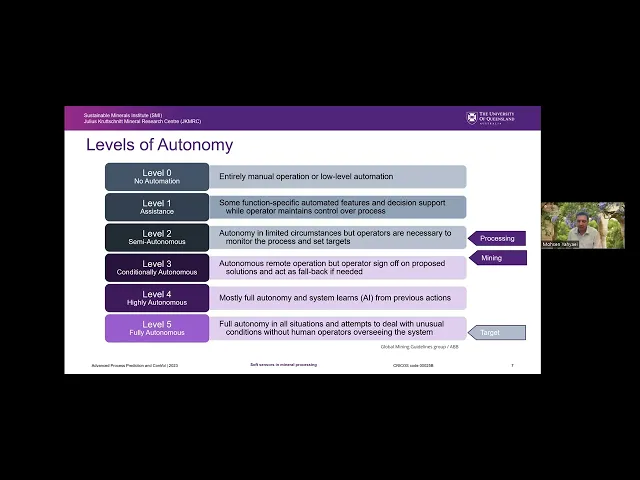
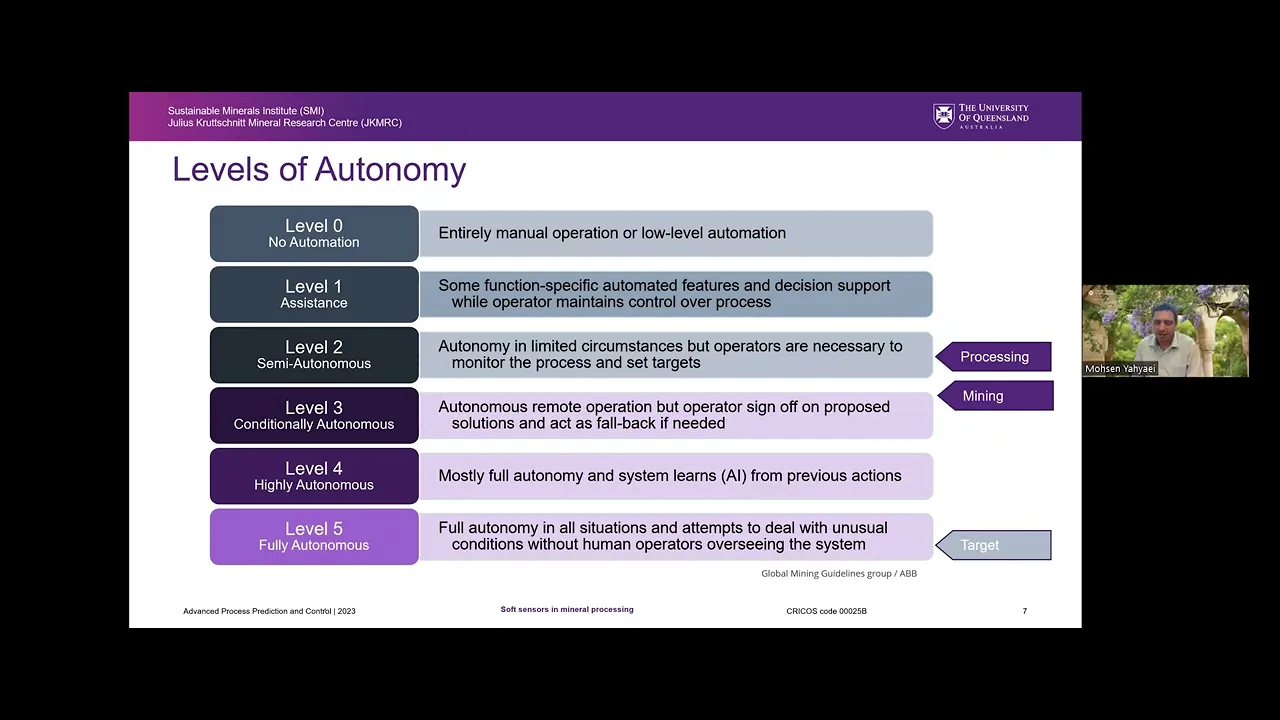
talking about automation people have different perspective about Automation and what it is and to be honest when I'm talking with operations when they say we are fully autonomous or we are working in automa system and when you evaluate them actually they might be anywhere in these different five levels of automation that are put in place in this slide so I just uh borrowed the standard that actually in autonomous vehicles people they use on level of automation which is adapted by global mining guidelines group and Abe ABB as well and that starts from no automation at
level zero to fully autonomous which is level five which means that actually the autonomy can run the process and make attempt to deal with unusual situation without human operator overseeing the system or intervening the system so that's essentially the fully autonomous system when people are talking about in reality where we are essentially I would say probably we are in level two or the verge of level two and level three and generally processing plants are lagging behind mining side uh in extraction part and obviously when people talking about fully autonomous systems the target actually is if
you can get to level five which is uh what we need as I said some of the parts of the process are in that level but when you look at the overall operation uh you generally are level two to level three so when we're talking about automation we have to have that in mind in terms of which level of autonomy we are talking so obviously our Target is to that level five so in Mineral processing plants most of the automation is around optimization and stabilizing the process so I here I just draw a standard sabc
circuit which is essentially a sag Mill which is a semi-autogens grinding uh tumbling cylinder which has mix of course Rock particles with grinding media and as they tumble inside the meal you growing material then that product if it's fine enough is going to be fair to a to a sizing device which is called hydrocyclone you classify fine or finished product which goes to the next step and if your course is still they're going to go to another round of grinding with bonus which is again is a cylindrical meal that actually is full of Steel media
and you tumble material inside and you get them grinded and you can do that in circulation and if there are coarse material they might feel you might feed them to directly back to the sag meal or you might actually saw sometimes crush them and then send them back and that's why they call circuit sabc sag meal bone meal and Crusher and it's pretty much covers many operations around the world that people they use it as a kind of a standard stage for grinding and size reduction which then prepares the feed for Next Step so if
you look at a process like like this so generally we get a data from the process in form of signals that you receive and I listed some of them like for instance you get the size distribution of the material that going to the grinding or you might look at the throughput of different equipment uh or using the bearing pressure for your meals as an indication of the load or like the cut size of the Cyclone which indicates what's the what's the size of the material going to the next step and these are not the only
parameters that they're going to look at there are huge amount of parameters so I listed some of them in here and in general what happens is you use all of this information and in a control room operators essentially use that information to make decision in terms of what's the current state of the operation and what do they need to make and what the type of decision do they need to make to operate that process As you move toward automation what you try to do is you use these signals and feed them to your automated system
to make that decision as autonomously as possible and obviously operators they generally make decisions around setting the boundaries setting the set points for the process or even identify the bottlenecks and trying to adjusting or adapting a operational strategy or control a strategy to release those bottlenecks so that's how generally the system works in in Mineral processing plants so nowadays if you go to control room pretty much you can see kind of the standard one that actually I I shown in this picture you got a bunch of monitors that actually shows you different signals or different
parts of the process even cameras around the process that actually gives you some visual observation and The Operators they normally make decision in how they want to operate their process so when you look at essentially processing plants as I mentioned generally they are lagging behind mining in terms of the level of automation so in the mining essentially there's lots of advancement in terms of uptake of autonomous systems and and embedding them into the system and in meal processing although we have very instrumented uh plan and generally you have lots of signals as I indicated in
the previous slide so there is a strong push toward using advanced process control or model predictive control but still it needs significant amount amount of supervision by operators and in many cases my observation actually I had a recent site visit a few weeks back and it still kind of confirms what I can see that actually in many cases people they tend to run processing plants in manual mode and and other part actually we have problem is actually the access to the skin and train people that they can essentially run these autonomous systems or automated systems
more comfortably with basically uh with a reasonable level of knowledge as you know the turnaround of uh turnover of people you know in in processing plants actually is very high and then by the time that you get new operators it takes time for people to develop that skill set so often we have that problem as well and which means actually much harder in terms of running the plant in automated more so if we want to go to that photo systems actually we are dealing with multi-dimensional problems essentially we have instrumentation issues we have uh basically
lack of tools and techniques that help us to move toward Advanced control and also people that actually are highly skilled or trained to deal with these type of processes and the processes that they designed to interact with people so there is a multi-dimensional problem my focus today is not going to go through all of the of those because there are lots of complex in that space I'm going to touch into one of the aspect which is primarily around the trust and reliability so one of the key points that you'll notice when you talk with operators
that they have to deal with autonomous systems or automated system is the lack of trust or lack of reliability that actually they don't they can't rely on automated systems because they have been burned few times what why those systems and we know that actually automated systems can be trusted if they work reliably with minimum requirement for human intervention and also if they make logical and safe decision especially not in a usual situation in unusual situations so when something goes wrong you you want to make sure that actually that system makes a rational and logical decision
and one of the people that I found always interesting is people they want to understand the rash so probably the black demonstrate why that decision is made or people cannot understand the rational behind that decision generally they wouldn't trust on that system and and the other thing is that also has to be accepted by human supervisors as well so they can they can they should accept that system they should accept that actually they can trust it the book that I I basically presented in here and you can actually access that book because it's available online
uh free it's called you how human judge machines actually is a very interesting book that actually demonstrates that people uh essentially require a high level of higher level of reliability in the decision that there is made by machines or automated system compared to the decision that is made by human the same situation uh in general uh what I got from the book essentially the level of mistakes that human can make in a similar situation if this is when machine can can make essentially people they they are more forgiving toward human when they make a wrong
decision as opposed to machine and generally they expect that actually Sheen has to have at least 20 to 40 percent higher accuracy in the way that they make decision comparing to the human being when they make the decision so essentially in general human judges machine much harsher than and then human uh in terms of the decision making and that actually emphasis importance of the reliability of the process and the importance of a trust so essentially we have to when we develop a system we have to look at the trust more carefully in that process and
that becomes very important to make sure that you have a process that is reliable and it's trusted so and that's another aspect so in in in in summary essentially you need to engineer trust into your process when you develop it and you design it and to me one of the key points actually is the trust starts with the data that you generate or with the instrument instrumentation that you have because we got significant amount of data that we collect from the processing plants and those data are the basis for the decision making for automated systems
so therefore you need to make sure to make sure you are reliable and that's something that actually we are missing in processing plans so generally when you look at processing plants the data that you collect usually they are not very reliable and because because we have lots of issues with sensors and and in and instrumentations so we need to address that yeah the issue of the reliability so this is actually one of those multi-dimensions that I mentioned into element basically automated systems if you want to have a successful automated processing control system so you've got
multiple dimensions and I think the trust is one of them and that distance down into the quality and reliability of the data so you up by now you might want that actually you're in the wrong webinar because the webinar was actually about safe substances but exactly that's the point that actually I'm gonna enter into the soft sensor and discussion about the sensors because that's the part that actually the substances can play a significant role in ensuring the reliability of the data that we collect and also ensuring the quality data so we want to look in
into that aspect so sensors and the measurements play a vital role in the trustable Automation and that's primarily comes from essentially having Pathways that it help us to improve the reliability of the reliability of the data that we collected from the sensors so when you're talking about the sensors essentially we are dealing with two types of sensors one is a hard sensors so obviously on the device that is designed to detect or basically detect or measure a physical property in the process and essentially provide a response to that so this is a one example that
I provide is a pressure gauge which is very uh kind of a sensor that is very common in in processing plants but they use them for multiple purposes so essentially what you have you have a diaphragm that essential instrument Ed with strain gauges and then as the pressure on the processing side actually changes then it will deform the diaphragm and that deformation of the diaphragm actually changes the shape of the strain gauge and that essentially generates electrical signal so the soft hot sensor is essentially what they have they have a way to translate changes in
the property that they are measuring into electrical signal and then we correlate that practical signal into actual pressure or any other properties that we have and then we use that electrical signal for the measurement so that's how a hard sensor works a substance on either side actually is not really a physical sensor is a virtual sensor which normally people commonly name them as software or which basically uses several measurements that done by physical sensors and then put them together with some mathematical models or if it's a data driven with the model that is developed Based
on data to calculate some parameters that usually are not practical to measure or easy to measure or at the same time they can be used to actually measure the same data that has been measured by other sensors as well so we can use it in same way as well so if you want to give you example in that sense like if you have a a leather sensor attached to a tank and you have a pressure sensor attached to the tank as well so the pressure sensor can give you directly the level of the liquid inside
your tank by using the measuring the pressure but at the same time you can use a soft sensor which feeds off that level sensor and combine that height with the density of the liquid and then calculate the essentially the pressure that you should read as well which then you can actually use it as cross-calibration substances normally are named as state observers as well so in a control uh essentially context people often they call them State observers and they have a range of them so the most common that actually control Engineers they know a lot about
that is common field tests that they use for estimation of the location and the Velocity estimators in electronic Motors that people they use them as well estimation of the process data using the self-organizing neural network fuzzy Computing in process control people they used it as well and then there are lots of estimators that people they use in chemical engineering and food industry that is basically combine some measurements and they feed into models and that provides them with some estimators so why do we need soft sensors there are many cases that we can use them uh
and generally there are areas that we are dealing with parameters that they are not uh possible to measure in practice uh like in many cases and nowadays like in in grinding means uh measuring directly what's the steel content in your segment or ball meal still although you have some heart sensors that they measure the charging side still you have no sensor to give you that value in terms of what system charge in your grinding media and or many other parameters actually you cannot directly measure them in practice because of the harsh environment or not being
able to access that the awesome mission and you take samples for lab and do the measurements in your routine and then you get the data that it comes with DeLay So and you need some sometimes those measurements in real time so in many operations if they don't have online size analysis in your Cyclone overflow normally they take a competition sample that they take you to the lab and they get the soil distribution or in some processing plants they take the product from the filter press and then they put it in the lab for moisture measurements
so those measurements comes with a delay whereas having this real-time size distribution or real time most content of your concentrate it becomes important uh there are some measurements that done offline as well uh some plants that actually they do assays or these composite samples that they take which they do it offline and then you have the data that is offline but this is not uh in real time and and there are cases actually because of the harsh environment that you have the cost of Maintenance and calibration of the sensor becomes high and people they essentially
just forget about them so that's another aspect that actually you might think about using uh soft sensors and as I mentioned earlier because now we have explosion of kind of sensors and data so we have many instrumentation that available you measure lots of data so essentially we have abundance of the data that we can use and and that's the part that actually we can try to in develop and Implement substances as much as we can to essentially use the operational data in more effective way and inform our operation decisions and also our control strategies so
uh the substances actually as I said they can and they can be made used as a measuring for backup like for instance as I mentioned like if you have 100 sensor you can actually use soft sensors as a backup as well uh you can actually use them for reducing the amount of Hardware that you require it can be used for real-time prediction uh and the part that actually are more focused today is about using it for sensor validation so you can actually use them in parallel with sensors and then use them for validation of the
sensors that they are measuring and also the people that use them for fault detection or diagnosis as well and somewhat if scenarios but my focus today is this aspect in terms of the validation of the sensors which then can help you to to have more reliability on the data so uh substances actually there are many techniques for development of them and so obviously the one that actually is my most favorite and not a list practice actually is mechanistic models so if you have from the first principles you can have relationship and that you can develop
then you can actually put some of your measurements from the sensors feed it into these mechanistic models and then you got the measurements the people they use maybe the statistical model like a data driven is one of the other techniques that people they use so essentially you get the data you train a and n and then you can use it as a soft sensor as well there are attempts that actually people have done in some other techniques like using fuzzy logic or even hybrid of these models as well so the data driven models are most
common approach because of the abundance of the data and auto development of those models are much easier but they have their own limitations so if you go down the path of the mathematical method so essentially you can have multiple approach so it could be simple mathematical conversion that you to use for your board or it could be mathematical model which actually combine multiple measurements so you might have multiple of them that have worked together and then it could be a combination of multiple mathematical models that actually which combined together and they predict a parameter as
well so there are several approaches you can have you can go as simple as only one model that actually you feed into that and potential Prime parameter or it could be actually combination of multiple models that actually that uses multiple measurements and then provides you with that information so if you want to go the data driven soft sensors you have to make sure that you collect all the data that you require and that's uh in terms of collecting those that the first part actually is identifying what valuables you need and which instrumentation actually provides that
data then obviously you once you collected them there is a human huge amount of work around cleaning up the data making sure that they select the data for the period that actually is useful uh and can be used uh basically reliably and then you have to use it for essentially screening the model and essentially using it for uh prediction once that done then you can use it for a finer calibration and then those are some of them are could be essentially kind of a iterative process and actually you keep updating the model by doing some
of the validation as well as because as you get more data and more use cases you might find that actually there are requirements for retraining of the model and you might do that and repeat that process so then you have a data driven model that can give you that prediction so as if you go with the down the path of then you need to collect some data for uh tuning and calibration of the model you need to identify the models that you require whether it's essentially a simple model or a kind of first principle based
model or it could be regression models that you select then once you have done that you have to develop those models and calibrate them and then the last part obviously is validation of the model to make sure that the model Works within the range that it's supposed to work and then you can actually roll out that model as well so that's essentially a simple how you would use those models so as I said substance tools have been used extensively and and in chemical engineering in food in pharmaceutical space people have been using them in many
cases and and also uh we we do that in Mineral processing as well so there has been many attempts I mean this is not really A New Concept that we are talking about it uh I mean you can see uh the data goes even up as far as 1997 that people they have developed some data driven models uh people in decent days they have been using uh machine learning techniques as well some attempts around the fuzzy logic and so the bulk of the sub sensors have been around rotation for predicting recovery or also Mass pool
and and performance prediction but there has been attempts around communication as well in terms of understanding the grind ability and state prediction as well so there have been people have been using them uh in in that sense as well so to me you know that actually the substances actually it's it's a approach for us that we can leverage the data that is generated by plan so it can help with us with the process Automation and also getting insight into the process but the aspect that actually I think is going to be more valuable for us
especially if we move down the path of automation is we can use them for validating our sensors so uh so one of the examples that I want to show today is about a substance source that we have developed in JK mercy and has been very successful and we have been using it actually for for guiding operation and and now actually we are thinking about actually using it to uh to for essentially around the trust aspects and that's what I want to discuss today about that but let's first look into the meal feed so what is
it for people that they haven't heard about it or they don't know about that one so we know that actually measuring the mean load is it's a complicated process so understanding what's the content inside the meal as well as the steel content inside them is important and that's why the recent years there have been many attempts and companies that actually they are offering hot sensors that you attach to your meat shell and using different techniques whether it's conductivity or vibration they can actually give you indication of the charge inside the meal and it's a common
practice for operations to do a regular crashes stop to get the feeling of the feeling is measured feeling inside the mirror and also do a grind out to measure the ball chart inside the meal whereas we have actually bearing pressure or the load cell data as well as the power drill that we can actually use it to the benefit to estimate the charge inside the meal on a regular basis so and if we can get and leverage that data actually we can provide that real-time information and that's where actually [Music] develop this substance absent for
prediction so the substances that we have been thinking to develop it actually or we have developed actually is giving you a direct estimation of the ball charge inside the mean rather than letting the operator to develop an idea in terms of uh what would be the current ball charge inside of me it allows for automatically adjustable line of air into that uh process and I think this is one of the important part in terms of pro basically provide confidence to a creature around the data that we have around the charge of the mean and that
actually is really important to make sure that the operator trust the data and then therefore they can trust the automated system that makes decision based on those information and that then results in more stable process and then you can push toward optimization so that substances that we have developed actually is a mathematical model which actually combines multiple of the models that we developed they got the ball there model you got the power drill model which is based on Steve Morrell a model that we have improved the line of a model and also we got the
load Mass model and the trajectories that you combine them together but what they use is data from multiple sources and this is a typical interface of that meal feed and now we are moving actually too much much simpler so what we do essentially we get the liner replacement data we get the power draw which is one of the parameters that actually it's very reliable the load cell value or the bearing pressure well but the steel is a parameter that three people and they use them very frequently and then by understanding the amount of material that
has been treated then we can work out what's your line of air condition over the time then work out the charge trajectory which then is indicated by the impact Point inside that graphic and then we can estimate the charge Mass inside the mean and then work out the shape of the charge and the ball and and total charge uh total feeling inside in it so essentially the substance or uses the existing data that you have but gives you the estimation of the total charge and the grinding charge inside the meal which is very useful information
for operator to use it and and also what it does it provides you with essentially reliability around the current state of the process which again you can use it for essentially for advanced automation so the substance uses the data from multiple points line aware and The Great Wave data the power draw and then uses those information and the load and then you feed them to those models that we have as uh the power drill model load Mass model and power model and then it provides you with the indication so the model had improved feature comparing
to the conventional uh steep Morel model that we had especially around the slotty pulling which has a better prediction around when the power draw actually reaches the peak based on the slotty pulling situation and that's where actually we had a bit more confidence around the results that we get from the from the model and obviously the Press uh resp question that you get from people is have you tested it and how reliable is this model and these are some of the measurements that is done by operations and so we put the measured data versus what
has been predicted by by the model it's a really reasonably good results even having one of these points that actually has a significant change when the ball measurement was 14 and we predicted it was 16 which we still we are waiting for receiving the evidence of that data but we included that including those points still we have 0.8 difference between what has been measured and what has been predicted and knowing that actually there is an inherent error in the measurements as well so this is a reasonable change difference between what we have measured and what
uh the uh the tool actually was predicted as I said a soft sensor that means actually there is no interruption into the process you can easily calibrate the model offline and then reconnect it to your DCS on the side then you get the data in a real time for every 30 seconds so now we have been actually implementing the number of operations is more than 17 operations that they are using it and now actually most of the operations they've gone to the path of converting these tool into a dll and then embed it into the
DCS which essentially receives the dots a lot and then provides a lot of information and then they can actually in two cases now they are feeding into the advanced control system as one of the inputs so and that can can be done easily but normally what we do is we have a trial period that people they just run it offline then we have a period that actually they run it as a real time to get give us a bit of a feedback if there is any change required and then once they build the trust around
that sensor then we can easily embedded into their DCs so there are some extended features in to that system we can actually switch between bearing pressure and low self require we use microphone if they have microphone as kind of a guideline as well and that's where again that trust aspect comes into play because we can actually use the data from our meal feed in Milford versus the microphone to cross check the data and make sure that actually we have reliable information in that space and also we can actually calculate uh slide pooling if the load
cell is available we have more trust into that so then people can see if the story pooling happens in the operation we can provide the specific energy and the size specific energy as some of the other inputs that people they can use as a guideline and also as I said this can be a very good source for diagnosis of the load cell or bearing pressure data when they are available so and and you can actually link it to your heart sensor as a sense of engine which is which is that now we are more focused
because what happens now then you can actually then use this sub sensor as a way to pick up if things go wrong immediately because in many of the sensors we have the issue in terms of it takes a while for us to figure out that that sensor is off calibration or is not reading the right information but then you fuse the hot sensor with your essentially with your substance so then then you can actually pick up when things go wrong immediately and that actually increases the reliability of the measured data and improves the trust of
the operators so in the the last few minutes that actually I have before we go into the questions uh so what's next so we are actually working toward development of Suite of sensors sub sensors and that's primarily because we want to increase or improve the reliability of the measurement that exists in operation and then provide that data which then help us to to increase the reliability and the Trust on operations on automation so at the moment we have JK meal feed and also our stockpile monitor actually already well established and we have been using them
in in millfield actually is quite Advanced we have been using them in many operations stockpile has been in use in couple of operations we are developing a new one which is Cyclops corn cyclo performance sensor and that's around an indication of how this cycle is performing especially around the cut size and the massive speed and then we are moving toward a substances that we are developing around the grinding as well as rotation and the watering as well so already we have one PhD student one sub sensor around Jameson cell that actually working in a coil
operation uh but we are moving towards that direction to develop it for base metal around the prediction of recovery and mass pool and as well as a devotee so this is an interface of the Cyclops at the moment we are looking for people that they are Keen to essentially through essential providers and help us to validate this model and essentially use it in the operation and if you're a group that actually you're Keen to do as a do it as a first adopter we got a couple of Partners now that we are working with them
but we're always looking for more use cases because it's going to help us to further development and make it uh complete and refined the stockpile model actually is very very establish established now and it's essential sense of time it provides you with the real-time estimation of the live capacity it can provide you with a lot capacity above each of the feeder average size of the material above each of the feeder and recently actually we added edge of the material as well so you can actually give it a residence time stamp or the age to the
particles so you can know how how long have been there been in the stockpile as well so this is an example that actually we have been developed for one of the operations in in Indonesia but to hit you we got the permission to name them before so essentially we can quite do bins Stockport with any level of complexity this one actually they have three pairs that actually discharges the material in two locations and we pretty much can simulate that at that process and also those models are fully valued that's I think one of the key
part we validated those with the industrial data to make sure that the model prediction versus the sensors that exist on site they actually uh fit very well and I think if we go down that path uh essentially what we are hoping to achieve is uh by getting uh linking to the technologies that already exist around trans uh transferring the data from bench to the plant uh which like jkvock value base or control is one of those solutions that already JK Tech has which then converts a spatial data to temporal data then with the help of
the dynamic models that we have in our uh as you know toolkit we can actually convey those information to the processing plans then the soft sensors that we have developed actually can help us to work out the current state of the process understand where is the bottlenecks into your process and where do you need to focus your work and also those substances can help you to have more reliability on the data that are the input to your Advanced control and then with the help of the knowledge that you got from the domain expertise especially like
how the performance of different equipment changes over the life and then what are the sweetest spot in terms of operation of those equipments then you can feed them toward your Advanced control system which then can help you to make sure that you operate your process in the you know Optimum situation and also with the help of the substances that you have you can actually make sure that if any of the measurements are wrong or they have a low quality you have a pathway to immediately know that which means that actually then you you don't have
to uh to wait for something to go wrong to notice those changes so you can use these substances uh fuse with other hot sensors to work out when those quality of the data is poor and then either you take an action to improve the quality of the data or you might have a decision-making Pathways that actually incorporates the quality of the data in your decision-making process so then when you make the decision it's a concept decision based on the quality of the data that you have so I think that was in general uh my talk
I hope that uh I managed to show you some detailed background as well as some of the ideas in terms of how you can leverage substances for uh trusted autonomy and so we have time still for questions uh in the Q a or in the chat box you can ask questions and I'll be happy to answer those there's one question actually asking about the recording and I think the recording is going to be available by JK Tech uh once it's finalized and I think the quality of the audio already we answered that as well so
um I would be happy to hear comments or questions okay it's a good question does this change fundamentally they control the strategies of a meal uh I would say yes if you if you're looking into this process essentially if you know what is happening in your stockpile with the substances that we have and you know your current condition of the mean the way that I would try to start controlling the mean is like as I presented in this graph probably it's very hard to read it but like if you look at the meal you know
that the performance of the meal changes over the time as the liner wears out so you have essentially Optimum feeling that you can operate your mean for a certain Target grind size so by knowing what's happening in your your meal and having access to the data from your stock part as well as your Downstream you can literally actually guide the target for your sag meal operation and then that segment operation can actually guide how you would run your stockpot so in my uh thinking actually you can actually fundamentally change the way that you operate your
whole grinding not only even meals and that essentially makes it enabled to actually go toward the pool strategy which means that Downstream process defines what they need and then each you each steps Upstream has to do their best to to deliver what is required for Downstream and also dictate what do they need from the upstream and you can go gradually Upstream to our stock part and Define what the mean has to do what the bombing has to do what the Cyclone has to do to deliver the fee to the stock part so that's essentially what's
uh what we can do with that how do you estimate the shoulder angle that was a question it's a great question we used essentially the Steve Morrell model in that space around once we work out the charge we got equations for the shoulder and the toe angle that we can actually estimate that so there is a model as part of the power drill model actually that exists so we can calculate the shoulder angle so the end the harsh environment of the mining how do you deal with missing data so that's very interesting because so and
definitely there are lots of missing data and I think again the substance actually plays a big role in here because we can actually use substances to generate the data that is not very easy to collect uh given that harsh environment so and to me actually using the substance to actually help us to reduce the amount of Hardware that we require as well and and avoid the cost of installation of the sensors that they have to work in harsh environment and that could be one of the area that we can use these substances to to cover
some of those missing data if there's a it's essential I think that that link about that more more seriously how much work is involved in the data processing and cleaning uh huge it's a very good question I think one of the key part that I often deal with and and my colleagues Gordon is dealing with is the quality of the data so uh you are they have lots of mistake missing data bad data and a stable data and normally we would spend at least 20 to 30 percent of the time that we have in general
for development of the model around the data cleaning and that's essentially using many any of the techniques that already we have developed but it's a very significant amount actually is required Hans mentioned that a great developments and and precision thank you very much where does the current Midfield and stockpile mean for in terms of commercialization to other customers or is it only available to customers that have opted to no no actually both are available for customers we are offering it to many operations it's not only for operations that initially they adapted it both are available
already we are delivering them to number of operations so if you got a use you can pretty much reach out to JK Tech and they can help you with with the costing and how you would access it's a one-off costs unlike many other cases so you pay one for the license of the software and you get the lifetime access to that license as I mentioned if there's no interruption to the process and you can pretty much use it without interruption into the process uh Danny thank you very much uh for your compliment how is the
mean fit uh output currently used in practice yet so there are a few things and that's a very good question so uh the meal fit because it gives you the total charge and the ball charge uh so the the basic very basic use case is operators they use it as a guideline because when you have an actual feeling and the ball feeling operator has enough confidence in terms of uh whether I'm running essentially to the right condition or not so the it removes the need for interpreting pretty and then they have more confidence so they
can make decision in terms in terms of the middle or not what the speed should I run do I need more feed or not in fact in most of the cases that we have been using it so predators they avoided uh frequent grind out and crashes stops that was one advantage they had a fast ramp up talk after relying operators because they knew exact feeling they could run it less conservatively but now actually the number of operations when they had more trust now they started feeding those numbers their actual feeling and the ball feeling as
one of the inputs to their control logic so in one of the operations because they have been using fuzzy logic control so they fed those two information as key important information to their physiologic systems and we know uh Paw Patrol and the bearing pressure are a good driver for the control but it's not really an indication of what's Happening inside the mean whereas the total charge and the the ball charge inside the meal actually they're a good indication in terms of what's Happening inside the mean so people they're using them in that sense as well
and my vision actually is those can be used to as an input to NPC to guide do you need more feeling or less feeling and then you can actually link it to your stock part to decide which feeder do I need to run in terms of filling up the meal or letting the meal through discharge so you can actually use it in that sense as well but people in a very basic they use it as a guideline for a patient and then some of the sites that now they have the trust they're feeding into their
Advanced control as an input and then there's another question in terms of uh how does Milford create trust between the technology and the operator very good question I think as I mentioned earlier one of the key point is because these are based on semi pay call understanding of the process so when one of the inputs actually doesn't make sense or is off calibration the model actually can pick that up and then we can actually raise alarm in terms of one of the input to the model actually doesn't make sense because now the combination of the
power drill and the load doesn't converge to a reasonable value so like for instance if you're getting pressure now it's reading off or which is very common or low cell is of calibration then the substances can pick it up and then when the operator understands that actually sub sensor can immediately pick up those issues and it's not actually solely realized on the data and it's not those issues is not raised when things go wrong then they'll play to start building that trust obviously it needs to work with operators to create that trust but I think
the advantage of the model is it picks those changes immediately in real time fashion so it doesn't have to wait for something to go wrong so then operator realizes that the input is wrong because the model can pick that up and I think when the operator sees that actually the substances can show when when sensor go wrong immediately that's where they build the trust because what they want to make sure is if something is wrong they want to know it immediately not after the fact and I think that's the part that actually can help with
improving the cost and in general the soft sensor which is so the last question was does it need a series of data to analyze and make decision about the process or instrumentation or can it customize the data itself if I got your question correctly I'm not quite sure if I catch it but if you're thinking about essentially validation versus the data that you have and the soft sensor you can pretty much if the model is based on uh essentially mathematical model you have more trust because you can actually cross validate the sensor measurement and what
model predicts but if it's a data driven I think you need to have a bit more analysis with your data driven model to make sure that actually what you're reading actually is wrong so then you can actually cross validate it I hope I understood your your question properly by thank you [Music] so I think we managed to answer all of the questions on time as well and and thanks for everybody for participating it was very good