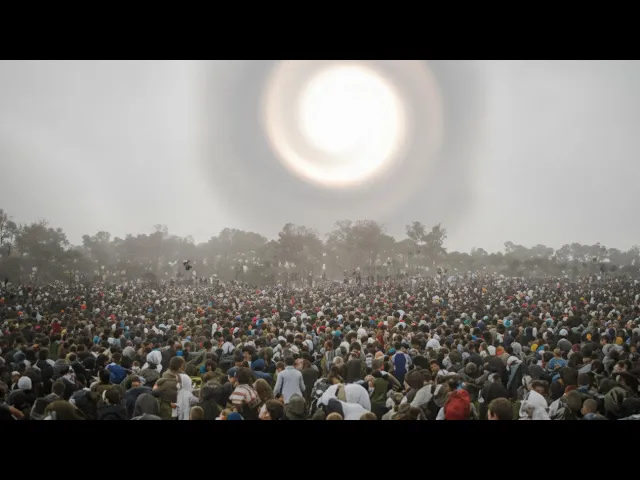
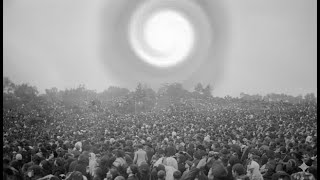
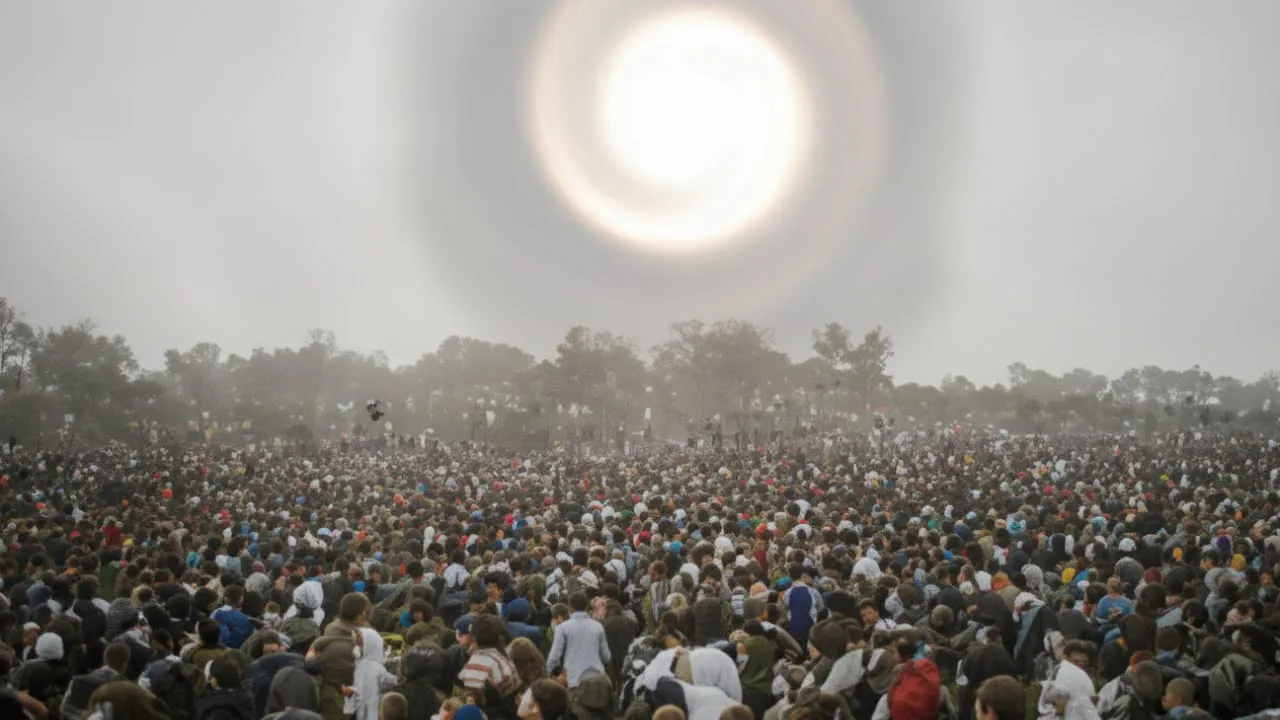
The sun began to spin. 70,000 people saw it. It wasn't suggestion.
It wasn't collective delusion. There were 70,000 [music] witnesses, illiterate peasants, university professors, skeptical journalists sent to unmask the fraud. Merchants, mothers with children in their arms, [music] men of science.
Everyone saw the same thing at the same time in the same place. The star that sustains life on Earth, which is [music] 93 million miles away, seemed to detach itself from the sky and dance [music] like a wheel of living fire. Impossible colors burst from the solar disc liquid, silver, blood red, emerald green, deep violet.
The light poured over the crowd in colored waves, tinting their faces, their rain soaked clothes, the muddy ground. People screamed, some wept, others fell to their knees, paralyzed by terror. And then the sun plunged from the sky.
Thousands of people saw the star dive toward Earth, zigzagging as if it would crush them all. Men who had mocked hours before now cried for mercy. Women confessed sins aloud, certain these were their final moments.
An atheist journalist sent by Portugal's largest anti-clerical newspaper to ridicule the event fell prostrate in the mud and wept like a child. After three long minutes, the sun returned to its position. And when people stood up, dazed, they discovered something even more disturbing.
The clothes that had been soaked by the morning storm were completely dry. The mud had disappeared from the ground. It was the 13th of October 1917.
Kova, Fatima, Portugal. And more than a century later, with all the advances in astronomy, physics, and meteorology, no scientist has been able to explain what happened that afternoon. First miracle, Fatima, the son that danced.
3 months earlier, three poor children had announced the impossible. Lucia Dos Santos, age 10, and her cousins Francisco and Justinta MTO, ages 9 and seven, said that a lady clothed in light appeared to them every 13th day near a small home oak. She asked for conversion, prayer for the end of the war, bleeding Europe, penance for sins that offend God, and she promised a sign on the last day in October so that everyone would believe.
The children were ridiculed. The Masonic mayor of Yurum kidnapped them and threatened to throw them in boiling oil if they didn't recant. Their families were publicly [music] humiliated.
Anti-clerical newspapers called them deluded fanatics, instruments of clerical manipulation. But they didn't back down. They always repeated [music] the same words, the same details, the same promise.
On October 13, an immense crowd converged on that forgotten place in the Portuguese countryside. Many had walked for days through torrential rain. Others came to mock, to prove the fraud, to write about the ignorant superstition of the people.
The newspaper O seculo sent its editor, Avalino de Almeida, known for his militant atheism and his sharp pen against the church. The phenomenon began exactly at noon when the children said the apparition was present. The rain stopped abruptly.
The clouds opened like torn curtains, revealing a strange different sun, a silver disc that didn't burn the eyes, that could be stared at directly without pain, without blindness, and then it began to spin. Dr Almeida Garrett, professor at the faculty of sciences of the University of Coimra, was present. He wasn't devout.
He was a scientist, and he [music] described with clinical precision what he witnessed. The sun transformed into a disc of matte silver, possible to look at fixitly without the slightest discomfort. It didn't burn.
It didn't blind. One would think an eclipse was occurring. But then a colossal uproar arose, and from the spectators [music] closest, one heard shouting, "Miracle, miracle, wonder, wonder!
" To the dazzled eyes of those people, the sun trembled, made abrupt and unusual movements. Outside all cosmic law the sun danced. Avalino de Almeida the skeptical journalist published on the front page of Oculo the next day.
The entire immense crowd turned to the sun which showed itself unveiled at the zenith. The star appeared like a [music] disc of matte silver and it was possible to stare at the disc without the slightest effort. It began to spin on itself in a vertigenous [music] whirl.
Suddenly a clamor was heard. a cry of anguish. The sun, still spinning, had broken free from the firmament and advanced red as blood over the earth, threatening to crush us with its enormous and fiery weight.
More disconcerting, the phenomenon was observed dozens of miles away by people who didn't know about the event. The poet Alphonso Lopez [music] Vieiraa who was in Sa Pedro De Moel 25 miles from Kova Daeria saw the sun dance and wrote about it in his personal diary without knowing that thousands were witnessing the same prodigy at the same instant. Physicist Stanley Jockey, a Catholic priest and historian of science analyzed the event for decades.
His conclusion was honest and disturbing. If the sun really moved, the entire solar system would have been disturbed. Astronomical [music] observatories around the world registered nothing.
Therefore, what happened at Fatima was not a natural astronomical [music] phenomenon. It was something that affected the perception of tens of thousands of people identically at the exact moment predicted by three children months before. Science has no category to explain [music] this.
And there's another detail that destroys all attempts at natural explanation. The three visionary children [music] didn't see the miracle of the sun. While 70,000 people screamed in terror looking at the sky, Lucia, Francisco, and Justinta [music] contemplated the Lady of Light who revealed her identity to them.
I am the Lady of the Rosary. Our Lady revealed three secrets to the children during those months. She showed them a vision of hell.
She prophesied that World War I would end, but if men didn't convert, a worse war would come. She spoke of Russia, which would spread its errors throughout the world, causing wars and persecutions of the church. The prophecies were fulfilled with frightening precision.
Francisco died at age 11, Jacenta at age 10. Both victims of [music] the Spanish flu, offering their sufferings for the conversion of sinners. Second miracle, Lanciano, the heart that crossed 12 centuries.
From the sky of Fatima, we now descend to a stone altar in the [music] city of Lanciano, Italy in the year 750a. D. Europe was living through turbulent times.
Heresies were spreading, denying the real presence of Christ in the Eucharist. and a Brazilian monk whose identity history hasn't preserved celebrated holy mass tormented by terrible doubts. He couldn't believe that piece of bread in his hands.
Those words he pronounced, "This is my body," seemed impossible, metaphorical, symbolic to him. How could bread become flesh? How could wine become blood?
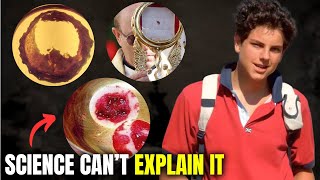
His reason [music] refused. His faith wavered. At the exact moment of consecration, when he pronounced the sacred words over the host, it transformed into living flesh, red, pulsating, bloody flesh.
The wine and the chalice coagulated into blood. The monk fell to his knees, trembling. The small congregation witnessed.
Some wept, others fled in terror, but the miracle remained. That flesh and that blood were preserved as sacred relics. They crossed wars, invasions, lootings, changes of government, revolutions.
They remained in Lanchiano through 12 centuries, exposed to air, humidity, temperature fluctuations, without chemical preservation, without mummification, simply there, intact, defying all laws of organic decomposition. In 1970, the Archbishop of Lanciano authorized a rigorous scientific investigation. Professor Oduardo Lenoli, a medical specialist in anatomy and pathological hisystologology, chief of Aretso Hospital, took on the investigation.
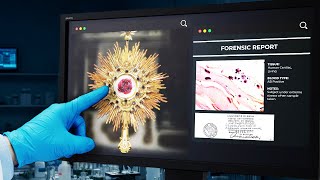
He worked for months assisted by other specialists. They performed hisytological, immunological, chromatographic analyses. They examined the tissue under electron microscopes.
They tested the chemical composition of the blood. The results were absolutely disconcerting. The flesh was human cardiac tissue.
Not just any tissue. It was myocardium, heart muscle, specifically from the left ventricular wall. The muscle fibers were perfectly preserved, interlaced, visible under the microscope as if they had been extracted just hours ago.
Blood vessels, nerves, branches of the vagus nerve, all there, intact, identifiable. The blood was real human blood, type AB. It contained proteins in the normal proportion of fresh blood.
Albumin, globulins, proportion identical to blood circulating in a living human being. Minerals, [music] calcium, phosphorus, magnesium, chlorides, all present in exact quantities. But the most disturbing, most impossible thing is that this tissue hadn't undergone any preservation process.
Professor Lenoli was categorical. The preservation of the flesh and blood which were left in their natural [music] state for 12 centuries exposed to physical, atmospheric, and parasitic agents remains an extraordinary phenomenon. In 1981, the World Health Organization [music] appointed a commission to verify.
For 15 months, 500 tests were performed. The conclusion was identical. Human cardiac tissue, human blood type AB without explainable preservation.
How is it possible that organic tissue exposed to oxygen for 12 centuries doesn't decompose? The laws of biology say this cannot happen. And yet it's there.
Measurable. Testable. Impossible.
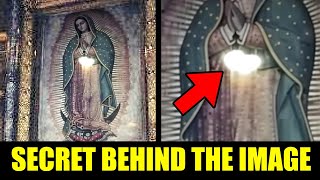
Third miracle. Guadalupe. The impossible image.
December 1 531. Mexico. Juan Diego was a converted indigenous man, poor, widowed, who walked barefoot 10 miles every day to attend mass.
On the morning of December 9, passing by Tepac Hill, he heard a voice calling his name. He climbed the hill and saw a radiant young woman who spoke in NahuL, the Aztec language. Wanito, my youngest son, I am the ever virgin Mary, mother of the true God.
Bishop Don Juan de Zumaraga didn't believe. He asked for proof. On December 12, the lady sent Juan Diego to the top of the barren hill where he found Castellian roses, Spanish flowers impossible to exist in Mexico, impossible to bloom in December.
He gathered them in his tilma, a rough cloak of cactus fiber. When he opened the tilma before the bishop to show the roses, they fell to the ground, and everyone present [music] fell to their knees. Because there imprinted on Juan Diego's tilma was the image of the Virgin Mary.
Not painted, not embroidered, simply imprinted as if it had appeared instantaneously. Over the following centuries, that image was examined [music] by hundreds of scientists. In 1751, painter Miguel Cabrera examined the image [music] with other renowned painters.
His conclusion, it's impossible that any human artist could have painted something so perfect on such a rough surface. The technique doesn't exist. The pigments cannot be identified.
The tilma was made of magui fiber, a type of cactus. This material naturally decomposes in 20 years. But Juan Diego's tilma was intact after 400 years.
In 1979, NASA scientists Philip Callahan and Jod Smith examined [music] the Tilma with infrared equipment. They discovered the image has no brush strokes. It wasn't painted.
The pigments cannot be identified. The image changes color depending on the viewing [music] angle, a phenomenon of iridesence that was only developed centuries later. The temperature of the tilma is constant at 98.
6° 6° F human body temperature. But the most disturbing discovery, there are reflections in the virgin's eyes. In 1956, opthalmologist doctor Javier Toroella confirmed reflections that follow the perkingi Samson law, an optical law discovered only in the 19th century.
Subsequent magnifications showed human figures reflected in the eyes. The Bishop Juan Diego opening his tilma witnesses. How can an image from 1,531 have three-dimensional [music] reflections following optical laws discovered 300 years later?
In 1921, an anarchist placed dynamite under the image. The explosion [music] destroyed the marble altar, bent a metal crucifix, but the tilma remained intact. After the apparition, 9 million Aztecs converted to Catholicism in 7 years.
Fourth miracle, Lords, the water that cures the incurable. February 1,858, Lords, France. Bernardet Subarus was a 14-year-old girl, poor, sick with asthma and bone tuberculosis, illiterate.
On February 11, she saw a brilliant light in the grotto of Masabiel. Within the light, a young lady dressed in white smiled at her. The apparition repeated 18 times.
On the ninth apparition, the lady ordered, "Go drink and wash at the spring. There was no spring. " Bernardet dug the ground with her hands, and suddenly water began to flow.
On the 16th apparition, Bernardet asked the lady [music] who she was. The answer, "I am the immaculate conception. " Bernardet was illiterate, had no theological education.
But just four years earlier, the Pope had proclaimed this dogma. People who drank the water began to be healed. The church established a medical committee to investigate each case.
The criteria are extremely rigorous. The disease must be serious and incurable. The cure must [music] be instantaneous, complete, permanent, proven by examinations over years.
To date, more than 7,000 cures have been reported in Lords. The church recognizes only 70 as authentic miracles. 1,858.
Louisie Buret, blind for 20 years. He washed his eye with lured as water. Instantly he recovered his vision.
1,937 Gabrielle Clausel advanced bone tuberculosis paralyzed near death. 3 days in Lurs instantaneous cure. The abscesses disappeared.
The bones reconstituted. 1,952. Brother Leo Schwagger.
Progressive multiple [music] sclerosis, irreversible paralysis. During the blessing in Lurards, he rose from his wheelchair. Later exams, multiple sclerosis disappeared.
1,976. Delitia Ceoli, 12 years old, terminal bone cancer. She went to Lords.
The tumor disappeared. Today she's [music] 60 years old without squelli. chemical analyses of the water.
Nothing special. It's ordinary water. It has no therapeutic properties.
And yet, it cures the incurable. Fifth miracle shroud of Turin, the impossible burial cloth. Turin, Italy.
A linen cloth with the image of a man who was scourged, crowned with thorns, crucified. Tradition says it wrapped Jesus after the crucifixion. In 1898, photographer Sakando Pia took the first photographs.
When he developed the plates, he almost fainted. The image on the shroud was already a [music] perfect photographic negative. How could someone in the 13th century create a negative knowing it would only be visible when photographed 600 years later?
In 1976, NASA scientists analyzed it with space equipment. The computer generated a perfect [music] three-dimensional image of the body. This is only possible when the image contains encoded three-dimensional information.
Common photographs don't produce this effect. Only the shroud does. In 1978, 40 scientists [music] examined the shroud for 5 days.
They discovered the image isn't a painting. There are no pigments. The image is only on the superficial fibbrals 1/5 of a thousandth of a millimeter thick.
It's impossible to paint only on the surface of microscopic fibers. The image was formed by oxidation of the fibers as if burned by intense heat, but there are no signs of combustion. There is real human blood, type AB, the same as Lanciano.
The stains [music] show precise forensic details. Arterial blood separated from Venus blood, a difference only discovered in the 17th century. The wound in the side shows blood mixed with serum happens when someone dies by asphixxiation on the cross.
Exactly as John describes. Blood and water came out. There is pollen from plants that only exist in Jerusalem.
There is oraggonite mineral from Jerusalem caves where tombs were carved. The body was scourged with a Roman flagrum, 120 blows from two executioners. In 2011, scientists tried to replicate with lasers.
To create the full body image would require a laser of 34 trillion watts. This technology doesn't exist today, much less in the 13th century. The only explanation, an explosion of radiant energy from the body, burning the fibers proportionally to the distance.
Physicist Paulo de Lazaro, science is still [music] not able to explain how this image was formed. Five miracles, five different eras. 70,000 people saw the sun dance on the predicted day and hour.
Cardiac tissue 1,273 [music] years old remains intact without preservation. An image on cactus fiber lasts 500 years with impossible reflections. 70 incurable cures documented by international medical committees.
A burial cloth with a photographic negative [music] and three-dimensional information impossible to replicate. science examined, tested, measured, and concluded. There is no natural explanation.
These phenomena shouldn't exist. And yet, they exist. They're real.
They're measurable. They're impossible. If stories like these touch your faith [music] and make you reflect on eternity, subscribe to the channel.
This way, you help us continue spreading the truths of our faith and the signs that testify to God's real presence. These miracles confront us with a choice. We can close our eyes and insist there must [music] be some natural explanation not yet discovered.
Or we can have the humility to recognize that we're before the mystery, before God, who reveals himself not to satisfy our curiosity, but to call us to conversion, to holiness. St. Thomas doubted the resurrection until he placed his fingers [music] in Christ's wounds.
Christ didn't condemn him. He allowed him to touch and then said, "Because you have seen me, Thomas, you have believed. Blessed are those who have not seen and yet have believed.
" These miracles are Christ's wounds extended to our disbelief. May these signs renew our faith. May they remind us that God is alive, present, active in history, that the Virgin Mary continues watching over her children, that the Eucharist is truly the body of Christ, that miracles happen, that heaven is not distant, that eternity has already begun.
Before these miracles, we can only fall to our knees and say, "Truly, this is the son of God. Oh claw pod comeer arrows confirre as respostus.