welcome back after the break article 42 of the ilc articles on state responsibility stipulates that a state is entitled as an injured state to invoke the responsibility of another state if the obligation breached is owed to that state individually or to a group of States including that state or the International Community as a whole and the breach of the obligation spec specially affects that state or is of such a character as radically to change the position of all the other states to which the obligation is owed with respect to the further performance of that obligation
in the Barcelona traction case in 1970 the English Court referred to the obligations of a state towards the International Community as a whole as distinct from those owed to another state article 48 builds upon this principle and provides that a state other than an injured state may invoke the responsibility of another state if either the obligation is owed to a group of States including that state and is established for the protection of a collective interest of the group or the obligation breached is owed to the International Community as a whole in such cases cessation of
the wrongful act and assurances and guarantees of non-repetition may be claimed as well as reparation the state responsible for the internationally wrongful Act is under an obligation to cease that act if it is continuing and to offer appropriate assurances and guarantees of non-repetition if the circumstances so require the tribunal in the Rainbow Warrior case held that in order for cessation to arise the wrongful act had to have a continuing character and the violated rule must still be in Force at the date the order is given with regard to reparation or the remedying of a breach
of an international obligation for which the state concerned is responsible the basic principle was laid down in the Cho Factory case where the permanent Court of international Justice emphasized that reparation must as far as possible wipe out all the consequences of the legal act and reestablish the situation which would in all probability have existed if that act had not been committed this principle has been reaffirmed in a number of cases including for example by the international Court in the Gap chova najim marus project case and in the genocide convention Bosnia against Serbia case and also
by the international Tribunal for the law of the sea in the MV Sega number two case in the choth advisory opinion of 2019 the international Court having noted that the decolonization of maius was not conducted in a manner consistent with the right of people's to self-determination held that the UK's continued administration of the chos archipelago con constituted a wrongful act entailing the international responsibility of the UK and the obligation to bring it to an end as rapidly as possible all member states of the UN were under an obligation to cooperate with the UN to complete
the decolonization of Marius article 31 of the ilc Articles provides that the responsible state is under an obligation to make full reparation for the injury caused by the internationally wrongful act and that injury includes any damage where the material material or moral caused by the internationally wrongful Act of a state the obligation to make reparation is governed in all its aspects by international law irrespective of domestic law Provisions article 34 provides that full reparation for the injury caused by the internationally wrongful act shall take the form of restitution compensation and satisfaction either singly or in
combination restitution in kind is the obvious method of Performing the reparation since it aims to reestablish the situation which existed before the wrongful Act was committed while restitution has occurred in the past it is more rare today if only because the nature of such disputes has changed a large number of cases now involve expropriation disputes where it is politically difficult for the state concerned to return expropriated property to the multinational companies in question recognizing some of these problems article 35 provides for restitution as long as and to the extent that it is not materially impossible
and does not involve a burden out of all proportion to the benefit deriving from restitution instead of compensation where restitution is not possible then compensation becomes payable this would cover any financially accessible damage including loss of profits in so far as this is established the aim being to deal with economic losses actually caused the concept of punitive or exemplary damages is not known to international law at this time compensation is usually assessed on the basis of the fair market value of the property lost although the method used to calculate this may depend upon the type
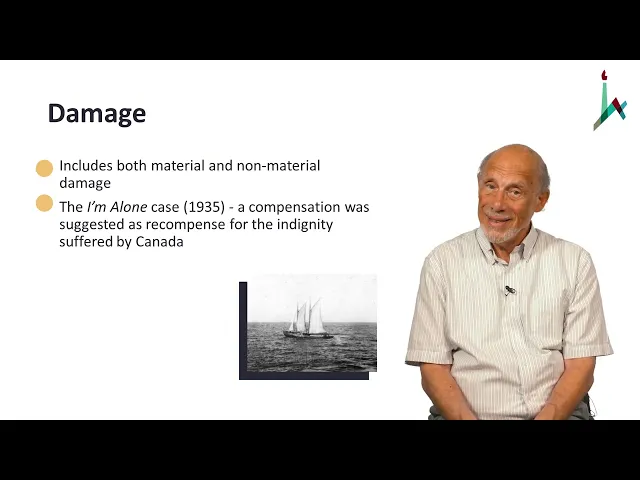
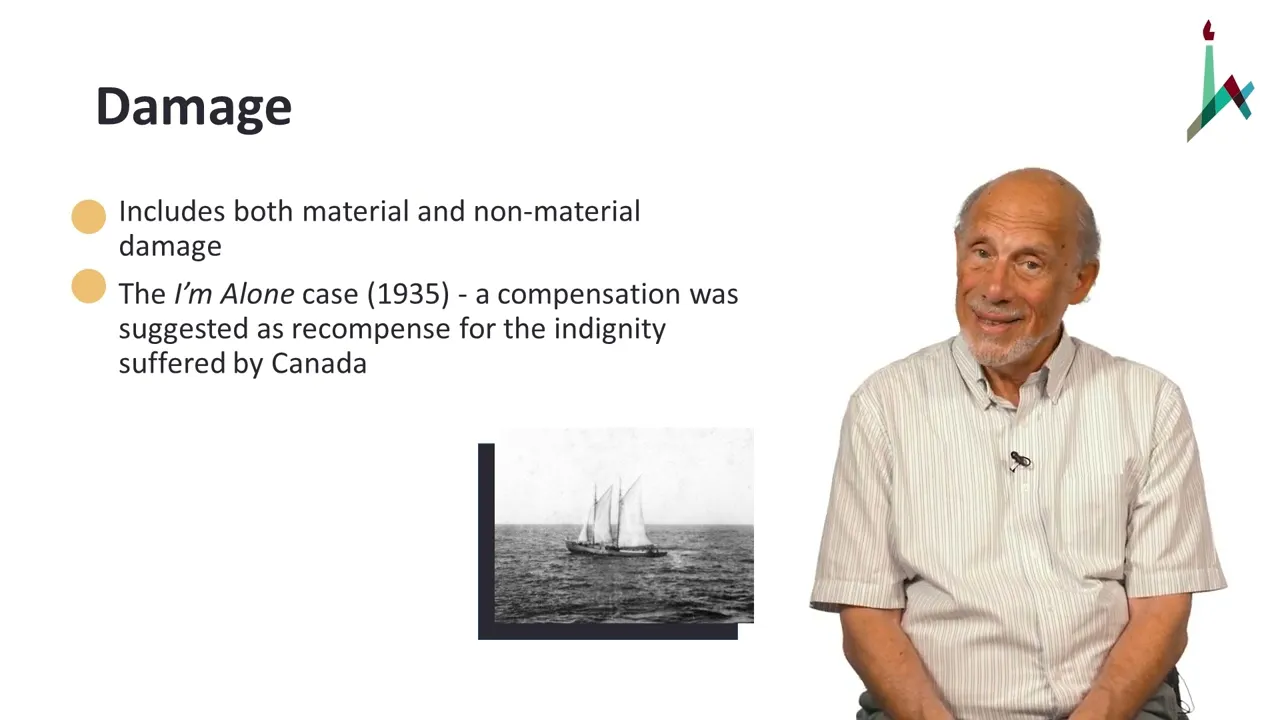
of property involved loss of profits may also be claimed where for example there has been interference with use and enjoyment or unlawful taking of income producing property or in some cases with regard to the loss of future income damage includes both material and non-material or moral damage monetary compensation May thus be paid for individual pain and suffering and insults in the I'm alone case for example a sum of $25,000 was suggested as recompense for the indignity suffered by Canada in having a ship registered in Montreal unlawfully sunk further the international court has held in Costa
Rica against Nicaragua in 2018 that compensation may be due for damage caused to the environment and the consequent imper or loss of the ability of the environment to provide goods and services satisfaction constitutes a third form of reparation this relates to non-monetary compensation and would include for example official apologies the punishment of guilty minor officials or the formal acknowledgment of the unlawful character of the act in question the tribunal in the Rainbow Warrior arbitration pointed to the long established practice of states and international courts of using satisfaction as a remedy for the breach of an
international obligation particularly where moral or legal damage had been done directly to the state in the circumstances of that case it concluded that the public condemnation of France for its breaches of treaty obligations to New Zealand made by the tribunal constituted appropriate satisfaction in some cases a party to a dispute will simply seek a declaration that the activity complained of is illegal in Terr torial dispute for example such declarations may be of particular significance article 37 of the ilc Articles provides that the state responsible for a wrongful Act is obliged to give satisfaction for the
injury verbi caused in so far as it cannot be made good by restitution or compensation satisfaction May consist of an acknowledgment of the breach an expression of regret a formal apology or another appropriate modality an example of such other modality might be an assurance or guarantee of non-repetition the doctrine of State responsibility with regard to injuries to Nationals rests upon twin pillars the attribution to one state of the unlawful acts and omissions of its officials and its organs legislative judicial and executive and the capacity of the other state to adopt the claim of the injured
party indeed article 44 of the ilc Articles provides that the responsibility of a state may not be invoked if the claim is not brought in accordance with any applicable rule relating to nationality of claims nationality is the link between the individual and his or her State as regards particular benefits and obligations it is also the vital link between the individual and the benefits of international law although international law is now moving to a stage whereby individuals may acquire rights free from the interposition of the state the basic proposition remains that in a state oriented World
System it is only or primarily through the medium of the state that the individual May obtain the full range of benefits available under international law and nationality is the key the principle of diplomatic protection originally developed in the context of the treatment by state of foreign Nationals however the international court has pointed out in the the Alo case 2007 that owing to the substantive development of international law over recent decades in respect of the right it Accords to individuals the scope Rion materi of diplomatic protection originally limited to alleged violations of the minimum standard of
treatment of aliens has subsequently widened to include inter Alia internationally guaranteed human rights right the international law commission adopted draft articles on diplomatic protection in 2006 diplomatic protection is defined as the invocation by a state through diplomatic action or other means of peaceful settlement of the responsibility of another state for an injury caused by an internationally wrongful Act of the that state to a natural or legal person that is a national of the former state with a view to the implementation of such responsibility a state is under a duty to protect its Nationals and it
may take up their claims against other states diplomatic protection includes in a broad sense Consular action negotiation mediation judicial and arital proceedings counter measures Severance of diplomatic relations and economic pressures there is however under international law no obligation for states to provide diplomatic protection for their Nationals abroad although it can be said that Nationals have a right to request their government to consider diplomatic protection and that government is under a duty to consider that that request rationally in addition once a state does this the claim then becomes that of the state as held in the
mavro Martis Palestine concessions case of 1924 and the state may or may not choose to exercise its right it is not a duty the scope of a state to extend its nationality to whomsoever it wishes is unlimited except perhaps in so far as it affects other states article one of the ha convention on certain questions relating to the conflict of nationality laws of 1930 for example provides that it is for each state to determine under its own laws who are its Nationals this law shall be recognized by other states in so far as it is
consistent with International conventions International custom and the principles of international law generally recognized with regard to nationality in the notam case 1955 the international court of justice decided that only where there existed a genuine link between the claimant state and its n National could the right of diplomatic protection arise however the facts of that case are critical to understanding the pertinent legal proposition I and these were rather unusual the government of lonstein instituted proceedings claiming restitution and compensation for notam against Guatemala for acts of the latter which were alleged to be contrary to international law
watala replied that notab Bam's right to lonstein nationality and thus its diplomatic protection was questionable notan was born in Germany in 1881 and and still a German National applied for naturalization in lonstein in 1939 the point was however that since 1905 and until 1943 when he was deported as a result of War measures lobam had been permanently resident in Guatemala and had carried on his business from there the court noted that lonstein was entirely free as was every state to establish the rules necessary for the acquisition of its nationality but the Crux of the matter
was whether Guatemala was obliged to recognize the ra the grant of lonstein naal nationality the exercise of diplomatic protection by a state regarding one of its Nationals brought the whole issue of nationality out of the sphere of domestic jurisdiction and onto the plane of international law the court emphasized that according to State practice nationality was a legal manifestation of the link between the person and the state granting nationality and the recognition that the person was more closely connected with that state than with any other the ISC in its draft articles on diplomatic protection of 2006
did not require the establishment of a genuine link as a requirement of nationality and the commentary to the Articles argues that the notab BAM case should be limited to its facts alone where an individual possessor dual or or even multiple nationality any state of which he or she is a national May adopt a claim of his or hers against a third state and there appears to be no need to establish a genuine link between the state of nationality and the Dual or multiple National in the case of more than one state of nationality the rule
appears to be that the state with which he or she has the more effective connection may be able to espouse the claim as against the other state the test proposed in the draft articles is that of predominant nationality at the time of the injury and official presentation of the claim as far as a corporation is concerned the international Court in the Barcelona traction case of 1970 held that the traditional rule gave the right of diplomatic protection of a corporation to the state under the laws of which it is incorporated and in whose territory it has
its registered office article 9 of the ilc articles on diplomatic protection provid that the nationality of a corporation is the state where it was incorporated although when the corporation is controlled by Nationals of another state or states and has no substantial business activities in the state of incorporation and the seat of management and the financial control of the corporation are both located in another state that state shall be regarded as the state of nationality article 11 provides that the state of nationality of shareholders shall not be entitled to provide diplomatic protection to shareholders where the
injuries to the corporation unless the corporation has ceased to exist according to the law of the state of incorporation for a reason unrelated to the injury all the corporation had at the date of injury the nationality of the state alleged to be responsible for causing the injury and incorporation in that state was required by it as a precondition for doing business there the international Court returned to the question of corporations in the dealo case 2007 noting that only the state of nationality May exercise diplomatic protection on behalf half of the company when its rights are
injured by a wrongful Act of another state in determining whether a company possesses independent and distinct legal personality international law looks to the rules of the relevant domestic law in so far as the shareholders of such corporations in the context of diplomatic protection were concerned the court emphasized that the state of their nationality could offer diplomatic protection for the violation of their direct rights such direct rights being defined by the relevant domestic law the position with regard to ships is rather different the international Tribunal for the law of the sea in the MV Sega number
two case emphasized that under the law of the sea convention 1982 it is the flag state that bears the rights and obligations with regard to the ship itself self so that the ship everything on it and every person involved or interested in its obligations are treated as an entity linked to the flag State the nationalities of these persons are not relevant customary international law provides that before International proceedings are instituted or claims or claims or representations made the remedies provided by the local state should have been exhausted the purpose of the rule is both to
enable the state to have an opportunity to redress the wrong that has occurred within its lone legal order and to reduce the number of international claims that might be brought another factor of course is the respect to be accorded to the sovereignty and jurisdiction of foreign states by not preempting the operation of their legal systems article 44 of the ilc articles on state responsibility provides that the responsibility of a state may not be invoked if the claim is one to which the rule of exhaustion of local remedies applies and any available and effective local remedy
has not been exhausted article 14 of the ilc draft articles on diplomatic protection reiterates the customary rule R noting that no International claim in respect of an injury to a national may be presented before that National has exhausted local remedies these are defined as legal remedies which are open to an injured person before the judicial or administrative courts or bodies whether ordinary or special of the state alleged to be responsible for causing the injury local remedies do not need to be exhausted where there are no effective remedies all the local remedies provide no reasonable possibility
of such redress there is undue delay in the remedial process which is attributable to the state alleged to be responsible there was no relevant connection between the injured person and the state alleged to be responsible of the date of injury the injured person is manifestly precluded from pursuing local remedies or the state alleged be responsible has waved the requirement that local remedies be exhausted the local remedies rule does not apply where one state has been guilty of a direct breach of international law causing immediate injury to another state as for example where its diplomatic agents
are assaulted but it does apply where the state is complaining of injury to its Nationals the local remedies rule may be be waved by treaty stipulation as for example in Article 5 of the US Mexico general claims Convention of 1923 and article 11 of the convention on International liability for damage caused by space objects 1972 the issue of local remedies was clarified in the Electronica secular case 1989 which referred to the concept as an important principle of customary international law the Court held that while the parties to an agreement could if they so choose dispense
with the local remedies requirement in Express terms it finds itself unable to accept that an important principle of customer international law should be held to have been tacitly dispensed with in other words the presumption that local remedies need to be exhausted can only be rebutted by express provision to the country the court also dealt with a claim by the US that the Doctrine did not apply to a request for a finding that the treaty in question have been violated this claim in effect was based on The View that the do Doctrine would not apply in
cases of direct injury to a state the court however did not find in the case a dispute over alleged violation of the the treaty resulting in direct injury to the US that was both distinct from and and independent of the dispute with regard to the two US corporations in question it was stressed that the matter which colors and pervades the US claim as a whole was the alleged damage to the two US corporations in the light of this stringent test it therefore seems that in such mixed claims involving the interests of both Nationals and of
the state itself one must assume that the local remedies rule applies thank you